Real Estate

TEAM EMPOWERMENT MORTGAGE CHATTER: Nov 28; Rent or Buy? The Research Is In!!; Understanding The Impact of Shadow Inventory; 4 Tips to More Successful Negotiations; Freddie Expands REO Winter Sale to More States; ‘Green’ Holiday Gift Ideas for Your Clients

“A resourceful person can see opportunity when others only see obstacles.” – Garrett Gunderson: is an entrepreneur and author


RENT OR BUY? THE RESEARCH IS IN!!

Should individuals buy or rent? What is the evidence on this question? What is the present condition of the U.S. housing market? Relatively speaking, how affordable is housing today? Is the market turning around or are we headed for another dip? These and other questions are answered in the attached PowerPoint presentation.

This is recently shared information at the National Association of REALTORS® annual conference in Anaheim, CA. If you are a practitioner, the presentation should assist in your daily practice. If you are a consumer (buyer, seller, renter or landlord), the information contained within should prove to be very informative. If you are a policy maker, the presentation presents several findings that should influence current housing policy.

The goal is to create an aware and thinking market place. To download the presentation, go to http://realestate.fiu.edu/buyer-or-renter-nation.html.


UNDERSTANDING THE IMPACT OF SHADOW INVENTORY

What is shadow inventory?

It is an inventory of houses that will come to market as a distressed properties at a discounted price. Each of the data companies define shadow inventory in slightly different ways. Standard & Poors defines it this way:

“We include in the shadow inventory all outstanding properties for which borrowers are 90 days or more delinquent on their mortgage payments, properties in foreclosure, and properties that are real estate owned (REO).

We also include 70% of the loans that “cured” from being 90 days delinquent (loans that once again became current) within the past 12 months because cured loans are more likely to re-default. Our calculation of the months to clear the shadow inventory is the ratio of the total volume of distressed loans to the six-month moving average of liquidations.

Is this inventory increasing?

The report shows that shadow inventory is decreasing in many parts of the country as banks are starting to release distressed properties to the market. From the report:

“We estimate that it will take 45 months to clear the national shadow inventory. This is seven months below our peak estimate but three months longer than our estimate a year ago. Twelve of the top 20 MSAs recorded declines in months-to-clear during the quarter, while eight reported increases.

What impact will shadow inventory have on real estate?

One of two things will happen:

  1. The inventory will continue to mount and be a hindrance to a housing recovery
  2. The inventory will be placed on the market and impact prices

As the report states:

“Despite the recent stability of our months-to-clear estimates and liquidation rates, these distressed loans continue to loom over the housing market and threaten to further depress home prices. Though fewer additional loans are currently defaulting, the overall volume of distressed loans remains huge. Low liquidation rates over the past two years allowed the shadow inventory to grow as distressed homes have remained tied up in foreclosure proceedings.

The shadow inventory will continue to jeopardize the housing market’s recovery until servicers are able to improve liquidation times. However, if and when that happens, an influx of homes will likely enter the market, increasing supply and driving prices down further.”

Bottom Line

We believe the inventory will come to market impacting prices now but bringing about a housing recovery in a much shorter period of time.


 4 TIPS TO MORE SUCCESSFUL NEGOTIATIONS

Negotiations are increasingly becoming a big part of a real estate agent’s job. Arthur Wylie, author of “Only the Crazy and Fearless Win BIG!: The Surprising Secrets to Success in Business and in Life,” offered some of the following basics to becoming a better dealmaker at Realty Times:

Know your value. Understand what your offer can do for the other party. You want them to understand the benefits of your offer, such as whether it may solve a problem, increase earning potential or make their life more convenient. “You want the other party to feel like you understand their needs and that you structure the agreement in their best interest too,” Wylie notes.

Articulate your ideas clearly. Once you’ve identified the value for both parties, be able to convey your vision of the offer in a way that the other party will want the same outcome. Rely on the “what’s in it for me” factor to present your position clearly.

Be humble, but firm. Respect the positions of the other party, regardless how bad of deal it is. “It’s important to be fair and honest about the negotiation and to keep your intentions pure,” Wylie notes. “At the same time, you must express genuine respect and appreciation for what the other parties, what they have done and who they are–even if they’re, well, jerks.”

Have some swagger. Wylie describes swagger as having “commanding and authoritative disposition and demeanor but without being pretentious or arrogant.” You want to be able to hint at what you’re capable of without coming across as bragging, he notes.


FREDDIE EXPANDS REO WINTER SALE TO MORE STATES

Six more states — now bringing the total to 33 — will participate in a winter sales promotion as Freddie Mac’s HomeSteps looks to unload its high REO inventory.

The six states added are Alaska, Kansas, Kentucky, Missouri, Oregon, and Washington. To view a complete list of all states participating in the winter promo as well as eligibility requirements, visit http://www.HomeSteps.com/smartbuy.

“We’re expanding our winter promotion to focus additional incentives to encourage strong sales activity in our ‘cold weather’ states over the next several months.” HomeSteps executive Chris Bowden said in a statement.

HomeSteps’ Winter Sales Promotion for buyers includes paying up to 3 percent of the final sales price toward a buyer’s closing costs for offers received between Nov. 15 and Jan. 31, 2012. (To qualify, escrow must be closed on or before March 15, 2012.) Selling agents may also be eligible for a $1,000 selling bonus through the program.

‘GREEN’ HOLIDAY GIFT IDEAS FOR YOUR CLIENTS

Save your clients money on their utility bills by giving an energy-saving gift this holiday season. The South Florida Sun-Sentinel recently highlighted several Earth-friendly holiday gift ideas, including:


  • Faucet aerators and low-flow shower heads: Help your clients reduce how much water they use and the amount of energy required to heat it. You can find these for under $10 and $25.
  • Pressure cookers: Pressure cookers can use up to 70 percent less energy than a conventional pot and you can cook your food faster, according to Energy Smart.
  • Artistic energy-efficient light bulbs: Give those CFLs an upgraded look. Hugler, a London-based company, makes a CFL called Plumen that can be used without a lamp shade. CFLs can last up to 25 times longer than incandescent bulbs.
  • Ecobuttons: You can attach these to your computer so you can instantly put your computer on energy-saving mode with one press of a button. The ecobutton also displays how much energy and money was saved.
  • Solar lawn gadgets and art: Help your home owners decorate their lawns by using energy-efficient products, such as solar-powered water fountains, bird feeders, mosquito zappers, and lanterns.
  • Energy tester: Give your clients an energy tester, like the hand-held Kill A Watt energy meter for about $20, which will reveal what home and office appliances are the biggest energy wasters.


TEAM EMPOWERMENT MORTGAGE CHATTER: Nov 21; The Price is the Same, but The Cost is Less; Freddie Issues Rule Changes on Short Sales; You Need an Industry Expert in this Market; Foreclosures Are Selling Quicker, BofA Says; Housing Affordability Hovers Record Levels

“All of us need to grow continuously in our lives.” – Les Brown: is an author and motivational speaker


 Join us for our monthly Lunch & Learn, every 1st Wednesday of the month. Bring your lunch & come learn with us! We’ll provide details once we have more for you. It will always be held here in our office conference room (2175 N. California Blvd., Ste. 1000, Walnut Creek) from Noon – 1:00 pm (come 15-30 minutes early and you MUST RSVP due to limited seating)

Do you have an open house this upcoming weekend? If so, we’d love to create an open house flyer for you. Simply email my assistant, Sherrell Ayers by Thursday at 3:00 pm to have this created for you! Provide her with the property address, sales price & any other additional information/pictures for your listing. You can reach her at sayers@rpm-mtg.com.

First Time Homebuyers Seminar – get your buyers ready for our upcoming event in January (1/18/12). More Details Soon!

THE PRICE IS THE SAME, BUT THE COST IS LESS

There is more and more research coming out showing that it makes great financial sense to purchase a home today . Whether it be rent vs. buy ratios, income-to-price ratios or income-to-mortgage payment ratios, purchasing a home right now is a bargain compared to historic norms. Now we want to look at the COST of a home today compared to pre-peak prices.

According to the most recent S&P Case Shiller price index, residential real estate values have returned to 2003 1Q PRICEs. That, in itself, says something. However, when you factor in mortgage rates, the case for buying a home today becomes even more compelling.

In 2003, 30 year mortgage rates stood at 5.88%. Today, they are 4%. How does that impact the actual COST of a home? On a home purchased for $250,000, here is the difference in monthly cost:

That means you save $285.30 a month, $3,423.60 a year and $102,708 over the life of a 30 year mortgage! You buy the home for the same PRICE but the COST is over $100,000 less.

Bottom Line

This is why so many financial advisors are saying that this may be one of the greatest times in history to purchase a home.


FREDDIE ISSUES RULE CHANGES ON SHORT SALES

As of Jan. 1, Freddie Mac will require parties involved in a short sale to sign affidavits that will make them liable for any negligent or intentional misrepresentations in the transaction, HousingWire reports. Mortgage servicers are being urged to implement the change immediately before the Jan. 1 mandate, however.

The move is part of Freddie Mac’s effort to crack down on the rising incidences of short-sale fraud.

“With this change, you will have more information to identify potential mortgage fraud and a clearer understanding of the intent of all parties involved in the real estate transaction,” Freddie said in a statement announcing the rule changes to mortgage servicers last Friday.

In its guidance, Freddie also eliminated a requirement that borrowers who are more than 120 days delinquent are required to list their home for sale before becoming eligible for a deed-in-lieu. The rule changes also included efforts to help mortgage servicers speed up the loss-mitigation process.


YOU NEED AN INDUSTRY EXPERT IN THIS MARKET

In today’s real estate market, it is easy to get confused. There seems to be an overabundance of information and much of it seems to be conflicting. As an example, we offer you two headlines that appeared within 24 hours of each other last week.

National Delinquency Rate Falls to Lowest Level in Three Years

– Mortgage Bankers Assoc. 11/17/2011

Second Consecutive Increase in First Mortgage Default Rates

– Standard & Poors 11/18/2011

(Remember, foreclosures impact home values and the cost of mortgage money. This makes current delinquency rates an extremely important data point.)

Though these headlines seem to be saying opposite things, both are actually correct. Each report was looking at different data points over different periods of time.

In their article regarding the MBA report, DSNews explains:

“Industry data released Thursday indicates the number of borrowers in the United States behind on their mortgage payments is showing signs of improving. The Mortgage Bankers Association (MBA) reported that the national delinquency rate for residential home loans fell to 7.99 percent in the third quarter.”

In their post, S&P claims:

“First mortgage default rates rose from 1.99% in September to 2.08% in October.”

Bottom Line

Make sure you are dealing with local real estate and mortgage professionals. They will help you and your family decipher the hordes of information available so you can truly understand your best options.

FORECLOSURES ARE SELLING QUICKER, BOFA SAYS

In several markets, Bank of America is reporting that it has picked up its pace in moving through its inventory of foreclosed homes faster than it has in the past, The Wall Street Journal reports.

Brian Moynihan, Bank of America Corp.’s chief executive, said at a press conference that in cases where banks can take ownership of the properties quickly and get them cleaned up, they are able to get them back on the market and selling the fastest.

“It moves as fast now as it’s ever moved,” Moynihan said at a press conference.

However, some areas–such as Florida, which is a judicial state for foreclosures–continue to see delays, as foreclosures inch along at a slower pace, Moynihan says.

But, overall, Moynihan says mortgage delinquencies are dropping in its portfolios and that home prices seem to be hovering at “a bottom” as the backlog of unsold homes reaches the market.

HOUSING AFFORDABILITY HOVERS NEAR RECORD LEVELS

Ultra-low interest rates mixed with stabilizing home prices continued to push housing affordability in the third quarter near its highest levels in more than two decades, according to the latest National Association of Home Builders/Wells Fargo Housing Opportunity Index.


For the third quarter, 72.9 percent of all homes sold were affordable to families earning the national median income of $64,200, according to the index. This marks the 11th consecutive quarter that the affordability measure was above 70 percent; prior to this it rarely was above 60 percent.


“With interest rates at historically low levels and markets across the country beginning to improve, home ownership is within reach of more households than it has been for nearly two decades,” Bob Nielsen, chairman of the National Association of Home Builders, said in a statement. “However, tough economic conditions – particularly in markets that experienced major changes in house prices and production – as well as extremely tight credit conditions confronting home buyers and builders continue to remain significant obstacles to many potential home sales.”

The most affordable major housing market nationwide? Lakeland-Winter Haven, Fla., in which 92.5 percent of all homes sold were found to be affordable to households earning the median family income of $53,800 for the area. Other affordable major markets included Toledo, Ohio; Youngstown-Warren-Boardman, Ohio-Pa.; Indianapolis-Carmel, Ind.; and Ogden-Clearfield, Utah. For smaller housing markets, Fairbanks, Alaska, ranked the highest, in which 97.8 percent of homes sold during the third quarter were found to be affordable to families earning the median income of $91,700.

Meanwhile, the least affordable major housing market continues to be New York-White Plains-Wayne, N.Y.-N.J., in which 23.3 percent of all homes sold were affordable to those earning the area’s median income of $67,400.


TEAM EMPOWERMENT MORTGAGE CHATTER: Nov 15; Know Yourself, Know Your Clients; Freddie Mac Hits REO Selling Record; One Thing That Still Concerns Us; 6 Low-Cost Marketing Ideas to Get Noticed; Tips for Selling a Home in the Winter

“The aim of marketing is to know and understand the customer so well the

product or service fits him and sells itself.”

— Peter F. Drucker: was an influential writer and management consultant

KNOW YOURSELF, KNOW YOUR CLIENTS

People like to interact with others who are like them. This basic premise is a key to successful interactions with buyers and sellers. At the REALTORS® Conference & Expo in Anaheim on Sunday, real estate trainer Jackie Leavenworth walked a crowd of about 80 REALTORS® through the DISC system – a method of understanding behavior and personality – and how to use it to meet clients’ needs.

DISC identifies four major elements of personality: dominance, influence, steadiness, and compliance. Dominance is the need for control and challenge; influence, the need to interact and persuade; steadiness, the need for security and stability; and compliance, the need to follow standards and be accurate and cautious.

To start, know yourself (Leavenworth recommended taking a DISC test online), then marry your natural behavior and style to match those of your client.

Buyers and sellers give clear indications of their personality type in the way they answer open-ended questions (influencers will talk about how party-friendly their home is, while those high in the compliance aspect will list the facts about the house, for example), their voicemail message, their home decoration choices, and even level of clutter.

Shape your tactics and approaches to match those of the clients you are working with, Leavenworth advised. She suggested tactics that are effective for each personality type:

  • For sellers high in dominance, lay out the process and ask how they’d like to be involved.
  • For influencers, make the process fast and easy.
  • For steadies, provide frequent updates about how the process is going.
  • For compliers, be fact-based.

Do you need to change who you are to work with clients whose personality is very different than yours? Not necessarily, Leavenworth explained. You can learn how to adapt to provide what they need. If that won’t work for a particular client, the smartest approach might be to partner on the listing with another agent and share the commission, she said.


FREDDIE MAC HITS REO SELLING RECORD

Freddie Mac has sold a record number of single-family REO homes in the first nine months of 2011, and the homes are selling for an average of 94 percent of market value, Tracey Mooney, Freddie Mac’s vice president of single-family servicing and real estate owned properties, said in a blog post.

“Because our homes are well maintained and priced right for the local market and home buyers, most of our homes sell close to full estimated market value,” Mooney says.

Freddie Mac sold more than 80,000 REOs in the first nine months of 2011.

“We are selling more homes than we are taking in through foreclosure,” Mooney wrote in the blog post. Mooney says Freddie’s REOs are selling in about 4 months or about 120 days, on average.

Most of the REO sales are to owner-occupants. “While we have always been open to selling to investors, our strategy is to limit the concentration of investor sales in any given area,” Mooney wrote. “In addition, we do not typically consider any offers that require significant discount pricing.”

ONE THING THAT STILL CONCERNS US

There is no doubt that the housing market is stumbling to a recovery. This past week Lawrence Yun, NAR’s chief economist, predicted a 4% increase in sales next year. Last month, Celia Chen of Moody’s Analytics projected sales to increase over 20% in 2012. Any increase in transactions will be welcomed.

However, we believe there is one headwind that could jeopardize a recovery: fragile consumer confidence. Consumer sentiment, as measured by the University of Michigan, has seen modest improvement in the last few months after nose diving over the previous several months. Moving forward, any hit to consumer confidence will impact a real estate rebound.

Prices are predicted to soften through the first two quarters of 2012 before reaching modest levels of appreciation by year’s end. Falling prices will force more homeowners into a position of negative equity. Being underwater is one of the triggers that cause people to strategically default on their mortgage obligations. If this happens, there will be an increase in the number of foreclosures. This, in turn, could cause a relapse in consumer sentiment.

Bottom Line

We believe that there will be a dramatic increase in residential real estate transactions (both existing sales and new construction sales). The only thing that may stand in the way is a loss of confidence in a housing recovery. The next six months will tell us a lot regarding this possibility.

6 LOW-COST MARKETING IDEAS TO GET NOTICED

You don’t need to break the bank to expand your marketing efforts and build connections, marketing expert Julie Ryan, e-PRO, with Strategic Thinking in Australia, told a crowd at the Marketing Without Money session during the 2011 REALTORS® Conference & Expo in Anaheim. “If you have a tight budget, you tend to be more focused on making sure every single dollar works harder,” Ryan said.

Regardless of how large or small your budget is, make your marketing message stick by focusing on three core areas: Impact (offering up a message of value to clients), frequency (making contact a minimum of at least three times in three weeks to get people to remember you), and building relationships to form lasting connections, Ryan said.

She offered up some of the following low-cost marketing ideas at the session:

1. Offer congratulations: Scan the local newspaper in search of good-news stories, such as people in the community earning an award or a job promotion, and then send a note congratulating them on the feat. That pat-on-the-back recognition makes you memorable and helps you build connections with people in your market, Ryan said.

2. Provide a special touch: To give your message more impact, print out an invitation to an open house for your listing and roll it up and tie it with a ribbon. Then, place it in door hangers on neighbors’ doors, mail the rolled-up invitation in a cylinder, or even hand-deliver it.

3. Show time: Create videos showing off your listings and post them on sites like YouTube to expand your reach. Also, consider creating videos of your community that explain what it’s like to live and work there, or that answer common real estate questions, Ryan suggested.

4. Try location-based social media: Sites like Foursquare aren’t just for checking-in to local areas, but you can use them to leave tips and relevant, helpful information at every single location your customers are likely to frequent (such as local restaurants or where to find the best views in the city).

5. Be a valuable resource: Once you’ve identified something your customers are interested in, set up a Google Alert to monitor that topic so you’ll get a notification when something matching those keyword terms surfaces on the Internet. You can then pass the message along through an e-mail or quick phone call to let your client know about something they may not know about yet. It’ll help you build stronger connections with consumers, Ryan said.

6. Reach out to the community: Instead of just writing a donation check to schools or charitable groups, try offering up an award that you can present or hosting a special event with community involvement. For example, present a book award at a middle or elementary school to a student for a job well done, or hire the local elementary school band to play at your upcoming auction or as part of a special event at your office.

——————————————————————————–

TIPS FOR SELLING A HOME IN THE WINTER

Traditionally, the time from Thanksgiving to New Year’s Day can be some of the slowest time of the year for home buying due to the holidays and the often less-than-perfect weather. But that doesn’t mean sellers can’t sell during the winter months. In fact, with decreased inventories, sellers may have a better chance to standout and face a buyer pool with more urgency to settle down.

Experts offer some of the following tips for selling a home in the winter:

Stage it: Stagers can arrange furniture so that selling-points in a home don’t get overlooked, paint rooms inviting colors, and have the know-how to give a home a cozy winter feel. Display photos of the home that also show it in warmer summer months. And don’t forget to turn up the thermostat in the home so buyers are comfortable from the moment they step through the door.”If you have a vacant house in winter with the heat turned down to 50, chances are someone will make a very low offer,” Loren Keim, a real estate broker, told the Associated Press.

Price it right: “If it’s priced properly, it will sell any day of the year,” Katie Severance, a broker for RE/MAX in Upper Montclair, N.J., told the Associated Press.

Show the way: Keep sidewalks and driveways clear of snow, ice, and leaves–giving potential buyers a clear path to your listing’s front door.

Light it up: There’s less daylight in the winter months so it’s even more important to keep all the lights on as well as open blinds and drapes for natural light. Keep the home well-lit even when you’re not there so the home still looks inviting to passersby who drive by in the evenings after work.

TEAM EMPOWERMENT MORTGAGE CHATTER: Nov 10; Americans Still Believe in Value of Homeownership; Housing is Key in 2012 Elections; Real Estate Prices Continue Slide; Federal Gov’t Properties Hit Auction Block

“Advertising is the ability to sense, interpret..to put the very heart throbs of a business into type, paper and ink.” – Leo Burnett: was a renowned 20th century advertising executive


AMERICANS STILL BELIEVE IN THE VALUE OF HOMEOWNERSHIP

Last week, Fannie Mae released their National Housing Survey for the third quarter of 2011. They survey the American public on a multitude of questions concerning today’s housing market. Each quarter, we like to pull out some of the findings we deem most interesting. Here they are for the most recent report:

Most Important Reasons to Buy a Home

The study shows that the four major reasons a person buys a home have nothing to do with money. The top four reasons, in order, are:

  • It means having a good place to raise children and provide them with a good education
  • You have a physical structure where you and your family feel safe
  • It allows you to have more space for your family
  • It gives you control of what you do with your living space (renovations and updates)

When we talk about homeownership today, it seems that the financial aspects always jump to the front of the discussion. There is no doubt that families must justify a home purchase from a financial point of view today. However, the reasons they actually buy are the same reasons our parents and grandparents purchased their home – to create a better lifestyle for their families.

The Home as an Investment

Though most people purchase a home for non-financial reasons, everyone realizes there is a money component to homeownership. Here is what they said on this issue:

  • 64% of the general population (and 69% of homeowners) believe that homeownership is a “safe” investment.
  • 55% believe that homeownership has more potential as an investment than any other traditional asset class.
  • 68% think that now is a good time to buy a home

Rent vs. Buy

We are always interested in the difference people see in renting vs. owning.

  • 63% of renters have aspirations to someday own their own home
  • 70% of renters think that owning is superior to renting
  • 96% of homeowners see homeownership as a positive experience (4% see it as a negative experience) while 83% of renters see renting as a positive experience (15% see it as a negative experience)
  • 97% of homeowners live in a single family residence while 53% of renters live in a multi-unit building

Bottom Line

Even in these difficult times, Americans still realize the value of homeownership both from a financial and social standpoint.

HOUSING IS KEY IN 2012 ELECTIONS, VOTERS SAY

Nearly seven out of 10 Americans — even more so for the millennial younger generation–say that candidates’ positions on housings will be very important to them in the 2012 presidential and congressional elections, according to a new survey by Move Inc. of 1,000 adults.

Survey respondents identified the following top housing priorities for the next president’s first 100 days in office:

  • Helping home owners avoid foreclosure;
  • Keeping interest rates low; and
  • Making more affordable mortgage credit available.

The survey also found that four out of five Americans say a strong real estate market is key to an economic recovery.

“After four years of living in a housing downturn, American voters clearly want answers and are looking to our elected leaders for solutions,” Errol Samuelson, chief revenue officer of Move, Inc., said in a statement. “Our survey found that while some people may be frustrated or pessimistic, 27.3 percent of Americans still plan on buying a home. The survey illustrates candidates who share the concerns of the American people and make housing a top priority will win their confidence.”


REAL ESTATE PRICES CONTINUE SLIDE IN SEPTEMBER

U.S. single-family home prices declined on both a monthly and annual basis in September — the second straight month that property data firm CoreLogic reported a decline in both measures.

CoreLogic’s price index fell 4.1 percent year over year and dropped 1.1 percent on a month-to-month basis in September, according to a company report released today. That follows a 4.4 percent annual decline and a revised 0.3 percent monthly decline in August.

Excluding distressed sales, defined as short sales and real estate owned (REO) sales, the national index fell 1.1 percent year over year in September and fell a revised 2.2 percent year over year in August.

In a statement, Mark Fleming, CoreLogic’s chief economist, said the company expects “declines to continue through the winter.”

“Distressed sales remain a significant share of homes that do sell and are driving home prices overall,” he added.

Among the 10 most populous metropolitan areas in the country, all but two saw index declines in September: Washington, D.C.; and New York-White Plains-Wayne, N.Y.-N.J. When distressed sales were excluded, half experienced index declines.

As in August, 38 states experienced year over year index drops in September. Eight states and Washington, D.C., saw index rises of more than 1 percent. West Virginia led the way with a 7 percent annual rise.

At the other end of the spectrum, Nevada was the only state to see a double-digit index drop in September, down 12.4 percent. When distressed sales were excluded, 33 states and Washington, D.C., saw flat or rising home prices.

The index incorporates 30 years of data for repeat sales transactions, and “price, time between sales, property type, loan type and distressed sales.”


 FEDERAL GOV’T PROPERTIES HIT THE AUCTION BLOCK

The federal government is trying to unload some real estate, and your buyers can now start the bidding in online auctions on various government properties, including residential homes in sought-after areas.

GSA (the U.S. General Services Administration), which assists federal agencies with unloading properties that they no longer need, is selling government properties through its online auction site, realestatesales.gov.

The auction site includes all types of property for-sale, ranging from residential homes and vacant land to commercial buildings, warehouses, and even historic lighthouses. You can use the site to search by property type and state.

“In addition to giving the public an opportunity to bid on government assets, the disposing of unneeded properties is helping to create a more sustainable government by reducing the federal real estate footprint,” writes Ralph Conner, director of GSA’s Office of Property Disposal Utilization, in a recent blog post announcing the auction site.

Recently, the site auctioned off a former U.S. Coast Guard Admiral’s 3,000-square-foot home in the Seattle area suburbs for $635,000. The home featured views of Lake Washington, Mount Rainer, and the Seattle skyline.

Last year, President Obama directed federal agencies to get rid of unneeded government properties in an effort to curb costs. The goal is a $3 billion in savings from government properties by Sept. 30, 2012.


TEAM EMPOWERMENT MORTGAGE CHATTER: Nov 9; HOMEOWNERSHIP: REPORTS OF ITS DEATH ARE EXAGGERATED; THE SHIP APPEARS TO BE TURNING; MANY CITIES FACE BIG BACKLOGS OF FORECLOSURES; HELP BUYERS ADD UP EXTRA COSTS; STOP MAKING ME FILL OUT A FORM!

“There are no extra pieces in the universe. Everyone is here because he or she has a place to fill, and every piece must fit itself into the big jigsaw puzzle.” – Deepak Chopra: is an authority in the field of mind-body healing

HOMEOWNERSHIP: REPORTS OF ITS DEATH ARE EXAGGERATED

There have been a growing number of reports announcing the death of American homeownership over the last two years. Some have said we are evolving into a rental society and even challenge the long standing belief that homeownership should be a part of the American Dream. They look at the falling rate of homeownership as proof of their point. Others say that the younger generations no longer see the value in owning over renting.

However, this past week, two news items might refute these points. First, DSNews reported the homeownership rate actually increased in the last quarter; the first quarterly increase in two years.

“After falling to a 13-year low during the second quarter, the homeownership rate posted a highly unexpected rise in the third quarter, according to a Census Bureau report.”

Then, Fannie Mae released their 2011 3rd Quarter National Housing Survey. We will cover this report in more detail on Wednesday. But we do want to mention a few findings the report highlighted. Both Generation Y (birth date mid-1970s to mid 1990s) and Generation X (birth date mid 1960s to mid 1970s) have stronger beliefs in the importance of homeownership than those of the general population.

Here are the numbers for the three major reasons to buy (as per the survey) with the percentage who believe in each reason:

1. It is a good place to raise children and provide them with a good education:

  • Generation Y: 84%
  • Generation X: 81%
  • General Population: 80%

2. You have a physical structure where you and your family feel safe:

  • Generation Y: 77%
  • Generation X: 79%
  • General Population: 76%

It allows you to have more space for your family:

  • Generation Y: 76%
  • Generation X: 77%
  • General Population: 73%

Both generations also believe in homeownership as an investment. 70% of Generation Y and 66% of Generation X see homeownership as a safe investment while 64% of the general population believes so.

Bottom Line

This country’s belief in homeownership is anything but dead. The younger generations have the same if not a higher level of belief than earlier generations. As the economy improves, more people will make the move into a home of their own.

THE SHIP APPEARS TO BE TURNING

Brought to you by: Ken H. Johnson, Ph.D. – Florida International University (FIU) and Editor of the Journal of Housing Research. To view other research from FIU, visit http://realestate.fiu.edu/.

On October 31, CNN Money reported: “Home prices headed for triple dip”. Reporting on information provided by Fiserv (a financial analytics company), a 3.6% fall in prices on a national basis is expected by next summer. This will result in the Case-Shiller Home Price Index falling to 35% below its peak in 2006 and marking a triple dip in U.S. housing markets.[1]

Say it ain’t so! Is housing set for a third dip in five years? This depends on factors being in place to lessen the impact from market anxiety brought on by worries over a pending wave of foreclosures and the U.S. debt crisis, which we will start to hear more about shortly.

So, what are these factors and what do they tell us? These factors are really fundamental drivers that encourage individuals to buy versus rent their personal residences. They are sometimes referred to as housing affordability measures. The price to income, mortgage payment to income, and a buy versus rent analysis for various markets provide strong evidence that factors are in place to encourage home ownership or favor renting depending on the resulting measurements. In ongoing research being performed by Beracha and Johnson, these measures are at record levels in favor of buying.[2] In fact, the price to income ratios in 23 of the 50 states are at 30-year record lows. The payment to income ratios are at 30-year record low in all 50 states. A buy versus rent analysis performed in 23 of the nation’s largest metropolitan areas also indicates that hurdle rates (the rates at which potential buyers are indifferent between buying and renting) in all 23 cities are below 25-year average appreciation rates. All of these results strongly favor purchasing.

What about per capita income and present day prices (relative to past prices)? Presently, U.S. per capita income is on the rise again and has regained to the level of 2007 (roughly $40,000 per person), while prices of homes on the other hand rest at 2002 levels according to the Case-Shiller Home Price Index. What about mortgages rates? Presently, 30-year fixed rates are at near record low levels.

So, let’s put this all together. Housing is presently more affordable than at any time in the last 30 years. While income is only at 2007 levels, home prices are even lower coming in at 2002 levels. All of these factors set the stage for many individuals to favor purchasing over renting. Thus, while there are grave concerns over the overall health of the economy, fundamental drivers now appear in place to staunch any further significant plunges in home prices.

The ship appears to be turning.[3]

Endnote

——————————————————————————–

[1] See http://money.cnn.com/2011/10/31/real_estate/home_prices/

[2] Beracha and Johnson (2011) on going research.

[3] This conclusion obviously assumes nothing unprecedented and catastrophic occurs such as the removal of the home interest deduction to combat the national debt or the often predicted foreclosure tsunami actually finally occurs.

MANY CITIES FACE BIG BACKLOGS OF FORECLOSURES

In half of the states in the country, it’ll take more than eight years to clear out huge backlogs of foreclosures at the current pace, new research from LPS Applied Analytics shows. Where foreclosures must go through the courts, it likely will take even take longer too.

In New York and New Jersey alone, it may take more than 50 years at the states’ current sales pace to clear the pipeline of seriously delinquent or homes already in the foreclosure process, according to LPS Applied Analytics’ research.

“This is like having water backed up behind a dam. We hope it’ll be let out easy and not all at once,” Allan Dechert, president of the New Jersey Association of REALTORS®, told USA Today.

After questions to lenders’ foreclosure procedures last fall, lenders are doing more checks when processing foreclosures, which have slowed the process of repossessing homes and created larger backlogs in many cities, experts say.

States where courts aren’t usually involved in the foreclosure process are clearing out foreclosures at a much quicker pace–just under three years, according to LPS.

But some cities continue to face possibly decades of large foreclosure backlogs. The following are the states with the largest backlog of foreclosures, including the state’s “pipeline ratio,” which is the time it would take to clear the supply of seriously delinquent mortgages or homes in foreclosure at the current pace of sales.

  • New York: 57
  • Washington, D.C.: 57
  • New Jersey: 52
  • Maryland: 21
  • Connecticut: 20

HELP BUYERS ADD UP EXTRA COSTS OF HOME OWNERSHIP

Home owners who plan to stay in their home long enough should be prepared for other costs of home ownership, besides mortgage payments and property taxes. For example, the hot water heater and furnace may eventually need to be replaced, and by budgeting for it from the beginning, they’ll be able to pay for it when it does need replaced.

A recent article at The New York Times provided estimated costs of some of these extras that can come with home ownership (average costs listed are based on service providers in Chicago and Los Angeles areas; prices can fluctuate greatly from city to city).

Central air: Home owners should expect the main central air unit will need to be replaced every 12 years, but possibly even sooner for warmer climates. A replacement will cost around $3,000, but a lot more for a higher efficiency model. Home owners can start saving $21 per month over 12 years to afford it, The New York Times article notes. Tip: Have a yearly maintenance check of the system to extend the unit’s lifespan (expect to pay about $163 year for a maintenance check).

Furnace: A furnace will last, on average, about 18 years before it will need to be replaced. Replacements will cost around $3,800, so home owners should start saving $18 per month for the future expense.

Hot water heater: These can last about 12 years before needing replaced, which starting costs for a replacement will run around $1,200 (or $8 per month to your budget). Tankless water heaters can last a lot longer, possibly even up to 20 years as well as help lower energy costs, but they cost about $4,000 each, according to The New York Times article.

Driveway:  Some experts recommend sealing an asphalt driveway every three years, which will cost about $550 or about $15 per month. Plan on replacing an asphalt driveway every 15 years, which will cost about $6,000 or $33 per month.

Trees: You likely will need a few trees trimmed every five years or so on your property, costing about $300 per tree. Home owners may want to budget $20 per month for this future expense.

Roof: Roofs, on average, need replaced every 25 years or so, but it’ll greatly depend on weather elements. New roofs may cost about $7,500 for an average-size home so home owners might want to start saving $25 per month to their budget.

STOP MAKING ME FILL OUT A FORM – I JUST WANT TO EMAIL YOU

If people want to get a hold of you and they don’t know you – they’re not going to call.

Again – they are NOT going to call you.

Blame it on the fact that maybe they’re a Gen X-er. But they hate calling people out of the blue. They’d rather poke myself in the eye!

They may tweet you, unless the last time your tweeted was in 2009.

They may or may not leave a message on your Facebook page.

If they want to reach you, and they’ve never met you – they want to send you a quick email.

They don’t want to fill out a form.

Why?

Sending someone a contact request on a form is like sending something into a black hole.

Who knows where the form goes to and who knows how long it could take before someone gets back to me.

Also, it is a bit off-putting that you wouldn’t put your email address out there – yet you are asking me for my name, phone number, email, etc.

I am willing to bet that if real estate agents stopped hiding their email address that they would start getting more leads off of their site.

In this age of transparency where people can find you just about anywhere at anytime, why in the world would you hide your email?

Two Big Takeaways

  1. Your email should be on every page of your website.
  2. You are losing business by not displaying your email.

Does most of your business come from people you know?

95% of agents I talk to say “yes.”

Even MORE reason to not hide your email. If your past clients want to reach you quickly or refer a friend, then there is even more reason to prominently display your email on your site.

Can You Have Both?

Can you have a lead generation form and display your email address? Yes, absolutely. In fact, you can have a number of them throughout your site.

Now is the time to be creative.

Promote a drawing for a gift card or a dinner out.

Give away a free market report.

Enter to win a drawing for a free home inspection.

Get creative, but also stop hiding your email.

One More Secret

Keep it simple. If you are going to have a form keep it to five fields or less. Don’t make it complicated and don’t ask for more than people are willing to give. Give them a reason to give you their info on a contact form.

So please, if you have a site you can edit yourself like a WordPress site – add in your email – make it blatantly obvious. If you don’T have a site you can edit, call (or email) your Webmaster and ask him/her to add your email to the upper right hand corner of your site!

TEAM EMPOWERMENT MORTGAGE CHATTER: Nov 7; Daylight Savings Ends; Is It Really Time to Buy?; Fed Focuses on Lifting Ailing Housing Market; How Longs are Loans Delinquent in Foreclosure?; First-Time Home Buyers Haven’t Vanished; Sellers Opt for Auction

“It has been my observation that most people get ahead during the time that others waste.”

– Henry Ford: Founder, Ford Motor Company


IS IT REALLY TIME TO BUY?

Earlier this week, we gave you the links to four different articles that came to the same conclusion: it’s time to buy a home. Today, we want to take a closer look at one of the sources, the JP Morgan’s Market Insights report. Right from the beginning, the paper identifies the greatest challenge in today’s housing market: consumer emotion. They attempt to overcome that emotion with logical reasons why now is the time to buy a home. They break it down to the following.

Price-to-Income Ratio

One measure of housing values is the ratio of personal income to home prices. The report explains where we are today:

“Since 1966, the median price of an existing single family home in the U.S. has varied between 150% and 251% of personal income per household. However, roughly three-quarters of the time it has been in a relatively narrow band between 185% and 230%. In September 2011, the ratio was just 153%, implying that to get back to an average price to income ratio, home prices would have to rise by about 27%.”

Current Mortgage Interest Rates

With current 30 year mortgage rates, housing payments are at historic lows as compared to personal income.

“During the week of October 7, Freddie Mac reported that mortgage rates had fallen to an average annual level of 3.94%. Assuming the use of a fixed rate mortgage with 20% down, this would make the median mortgage payment on a single family existing home just 6.9% of per household personal income, compared with an average of 14.4% since 1966.”

Monthly Rent vs. Monthly Mortgage Payment

Is it less expensive to own a home or rent a home? The answer to this question helps families make the decision whether or not to buy a home. The report explains:

“By the third quarter of this year, we estimate that the implied median mortgage payment had fallen to just 78% of the median asking rent…”

Bottom Line

The paper comes to the conclusion that now is the time to buy.

“The numbers on housing have an important message for American families today, and particularly younger families setting out on life’s great adventure: Five years ago, at the peak of the home-buying euphoria, it was emphatically a time to rent. Today, when home ownership is depreciated more than ever before, the numbers tell us it is a time to buy.”

We agree.


FED FOCUSES ON LIFTING AILING HOUSING MARKET

The Federal Reserve on Wednesday issued a new call about the importance of fixing the housing market, which could then have a trickle effect in strengthening the rest of the economy.

The Fed will consider buying more mortgage-backed securities to help, said Ben Bernanke, the Fed chairman. Such a move could send borrowing costs even lower.

“The housing sector is a very important sector,” Bernanke said at a news conference. “Problems in that sector are a big reason why our economy’s not recovering more quickly.” The Fed is holding a two-day policy meeting – which ends Thursday – to weigh options.

Economists believe that if more people were buying homes then it could lead to a boost in consumer purchases for other sectors, from furniture to appliances. They note that the housing market has led the economy out of recessions in the past, since it creates jobs and more spending on goods and services.

The housing market continues to be bogged down by a high rate of foreclosures, which is dropping other home values. About 7.5 million homes are either in foreclosure or delinquent on their mortgage.


HOW LONG ARE LOANS DELINQUENT IN FORECLOSURE?

Loans in foreclosure have been delinquent an average of 624 days — a record high, according to Lender Processing Services’ September report.

The time loans spend in foreclosure continues to increase. For example, 40 percent of home owners with loans in foreclosure have failed to make a payment within two years, and 72 percent of home owners have failed to make a payment in a year or more.

The time from the last payment to foreclosure sale has been found to be even longer in judicial states, in which foreclosures must be approved by the courts. The time span in judicial states is averaging 761 days, six months longer than non-judicial states, LPS reports.

While loans are spending longer in foreclosure, the number of foreclosure starts is decreasing. Foreclosure starts decreased 11.2 percent in September compared to August, and foreclosure starts are 15 percent below a year earlier, LPS notes in its recent report.

The states with the highest percentage of loans in delinquency or foreclosure are:

  • Florida
  • Mississippi
  • Nevada
  • New Jersey
  • Illinois

The states with the lowest: North Dakota, South Dakota, Wyoming, Alaska, and Montana.


FIRST-TIME HOME BUYERS HAVEN’T VANISHED

First-time home buyers are snagging up homes at much the same pace they were before the first-time home buyers tax credit created a buying frenzy two years ago. Indeed, for the first seven months of this year first-time home buyers have made up 32 to 36 percent of the market, according to NATIONAL ASSOCIATION OF REALTORS® statistics.

Low interest rates and fallen home values are drawing more first-time home buyers to the market, at a time when rental prices are rising. However, today’s first-time home buyers certainly are being greeted with more market challenges, everything from higher down payment standards, tougher credit requirements, and delays in securing a mortgage.

But first-time home buyers seem to be finding options to curtail some of the challenges. For example, the FHA’s 3.5 percent down payment market share has seen a large increase in the last few years, rising from 3 to 30 percent since 2006, even though tighter credit standards and higher fees took effect a year ago. Also, the USDA guaranteed loan program offers a no-down payment program that more first-time buyers are taking advantage of.

Given fallen home prices and record-reaching interest rates, why aren’t even more first-time buyers taking advantage of home ownership? They lack urgency, particularly since many first-time buyers say they expect home prices to drop further and mortgage rates to stay low. What’s more, they remain concerned about the economy and their personal finances, finds a national housing survey by Fannie Mae.


MORE SELLERS OPT FOR AUCTIONS

Home auctions are on the rise: According to PropertyAuction.com, a real estate auction Web site, from January to September of 2011 there have been 96,388 residential auctions posted on its site. Compared to last year’s 50,412home auctionsduring the same time frame, that’s a 48 percent increase.

“s housing prices continue to drop and mortgage foreclosures reach staggering levels, public auctions around the country are luring investors and first-time home buyers looking for bargains, according to auctioneers, real estate brokers, and home buyers,” RealtyTrac.com reports.

Moreover, the belief that only distressed properties top the auction block no longer seems to be the case. Many sellers looking for a quick and possibly profitable sale of their homes are seeing the upside of going the auction route rather than competing with the overloaded inventory of homes on the traditional market. Sellers are aware that first-time home buyers and property investors are currently hunting in droves for a good deal.

Some advantages of property auctions include:

A property is put in the spotlight on a specific date and time rather than being “just another listing” among thousands.

An accelerated marketing campaign, creating a unique curiosity and sense of urgency in buyers and investors due to the very small window of time the home will be on the auction block.

Competitive bidding, which can drive up the price of the sale.

A quick close, particularly for distressed properties.

And real estate companies are getting into the game. “Not only are auction transactions trending upward, but new players are entering the auction business,” RealtyTrac says. “Real estate companies are now getting into the auction business, competing with traditional auction firms … Sotheby’s, Prudential, Coldwell Banker, and other real estate brokerages are launching real estate auction divisions to tap into this ever-growing sector.”


TEAM EMPOWERMENT MORTGAGE CHATTER: Oct 31; Happy Halloween; It’s Simple: Now Is The Time to Buy A Home; Senators Want to See Fannie, Freddie REO Plan; 11 Ways to Ghost-Proof Your House; 5 Signs of Hope for Housing

“Your time is limited, so don’t waste it living someone else’s life. Don’t be trapped by dogma – which is living with the results of other people’s thinking. Don’t let the noise of other’s opinions drown out your own inner voice. And most important, have the courage to follow your heart and intuition. They somehow already know what you truly want to become. Everything else is secondary.”

— Steve Jobs: was an American inventor and businessman


IT’S SIMPLE: NOW IS THE TIME TO BUY A HOME

“The millionaire says to a thousand people, ‘ I read this book and it started me on the road to wealth. ‘ Guess how many go out and get the book? Very few. Isn ‘ t that incredible?  Why wouldn ‘ t everyone get the book? A mystery of life. ” – Jim Rohn

Mr. Rohn explains that if we want to make the right financial decisions in our lives, we should depend on the same sources the wealthy read. This past month four different iconic financial resources said the same thing:

IT ‘S TIME TO BUY A HOME!

Here are all four resources.

Forbes Magazine: The Next Mortgage Crisis

Wall Street Journal: It ‘ s Time to Buy That House

MarketWatch.com: Now Might Be the Best Time Ever to Buy a Home

JP Morgan Market Insights: Housing: A Time To Buy

Enjoy reading them!!


SENATORS WANT TO SEE FANNIE, FREDDIE REO PLAN

As Fannie Mae and Freddie Mac continue to take possession of foreclosed homes at a rapid pace, Senate Democrats are voicing their impatience with their management of real estate owned (REO) properties.

On Aug. 10, Fannie and Freddie’s regulator, the Federal Housing Finance Agency (FHFA), along with the Department of Housing and Urban Development (HUD) and the Treasury Department announced that they were exploring options for allowing bulk sales of homes to investors and converting Fannie, Freddie and Federal Housing Administration (FHA) REOs in some markets into rental properties.

The RFI’s (Request for Information) objective is to help address current and future REO inventory. It will explore alternatives for maximizing value to taxpayers and increasing private investment in the housing market, including approaches that support rental and affordable housing needs.

“While the Enterprises will continue to market individual REO properties for sale, FHFA and the Enterprises seek input on possible pooling of REO properties in situations where such pooling, combined with private management, may reduce Enterprise credit losses and help stabilize neighborhoods and home values,” said FHFA Acting Director Edward J. DeMarco. “Partnerships involving Enterprise properties may reduce taxpayer losses and meet the Enterprises ‘ responsibility to bring stability and liquidity to housing markets. We seek input on these important questions.”

“As we continue moving forward on housing finance reform, it’s critical that we support the process of repair and recovery in the housing market,” said Treasury Secretary Tim Geithner. “Exploring new options for selling these foreclosed properties will help expand access to affordable rental housing, promote private investment in local housing markets, and support neighborhood and home price stability.”

“Millions of families nationwide have seen their home values impacted as their neighbors’ homes fall into foreclosure or become abandoned,” said HUD Secretary Shaun Donovan. “At the same time, with half of all renters spending more than a third of their income on housing and a quarter spending more than half, we have to find and promote new ways to alleviate the strain on the affordable rental market. Taking steps to encourage private investment in REO properties and transition them into productive use will help stabilize neighborhoods and home values at a critical time for our economy.”

The RFI calls for approaches that achieve the following objectives:

  • reduce the REO portfolios of the Enterprises and FHA in a cost-effective manner;
  • reduce average loan loss severities to the Enterprises and FHA relative to individual distressed property sales;
  • address property repair and rehabilitation needs;
  • respond to economic and real estate conditions in specific geographies;
  • assist in neighborhood and home price stabilization efforts; and
  • suggest analytic approaches to determine the appropriate disposition strategy for individual properties, whether sale, rental, or, in certain instances, demolition. FHFA, Treasury and HUD anticipate respondents may best address these objectives through REO to rental structures, but respondents are encouraged to propose strategies they believe best accomplish the RFI ‘ s objectives. Proposed strategies, transactions, and venture structures may also include:
  • programs for previous homeowners to rent properties or for current renters to become owners (“lease-to-own”);
  • strategies through which REO assets could be used to support markets with a strong demand for rental units and a substantial volume of REO;
  • a mechanism for private owners of REO inventory to eventually participate in the transactions; and support for affordable housing.


MULTIFAMILY MARKET EXPECTED TO SEE BIG GROWTH

The multifamily housing market is expected to see a multi-billion dollar boost as millions of home owners who were foreclosed upon are now forced to rent, according to a new report by Morgan Stanley.

Many of these former home owners will now have to likely pay rent over the next five years as their credit repairs, which would equal $72.7 billion in incremental rental payments instead of mortgage payments, according to Morgan Stanley.

Since 2007, RealtyTrac has reported 8.9 million homes have been lost to foreclosure, with more expected. What’s more, about 7.5 million households are delinquent on their mortgage or in foreclosure, according to Oliver Chang, analyst with Morgan Stanley and lead author of the report.

Foreclosures are expected to chip away at the home ownership rate. Chang expects the home ownership rate to fall in the coming years to 60 percent. Recently, the Census Bureau reported the home ownership rate at 65 percent in the last Census, which is down from its 69 percent peak.


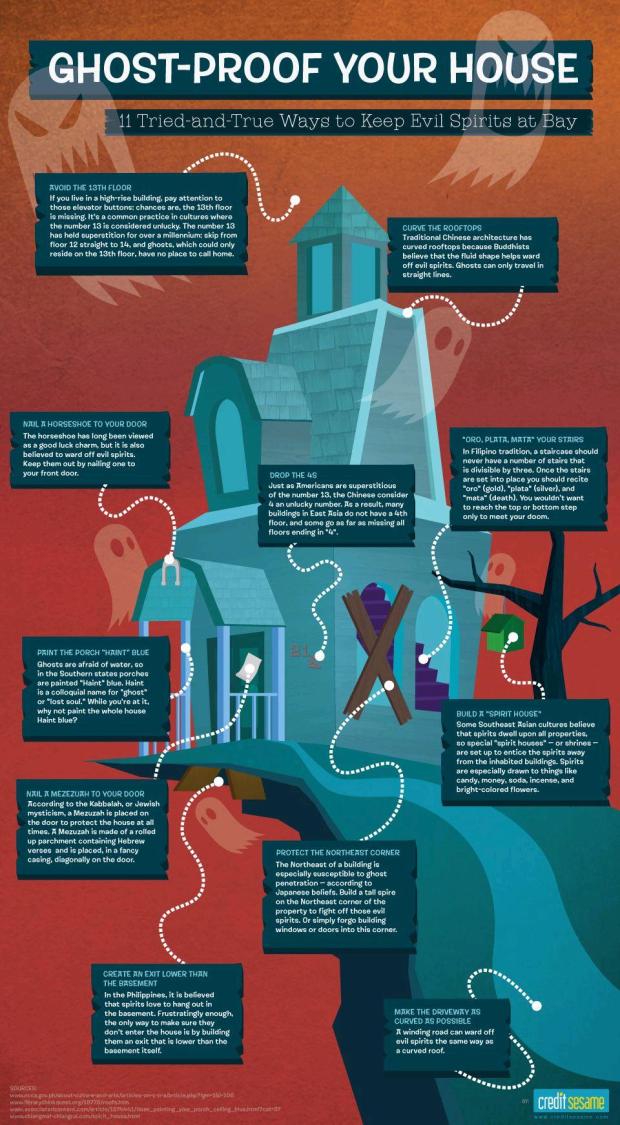
11 WAYS TO GHOST-PROOF YOUR HOUSE (FUN TIPS FOR HALLOWEEN)

Just in time for Halloween, personal finance website Credit Sesame has compiled 11 ways different cultures around the world design their homes to keep evil spirits away.

Some ghost-proofing methods may sound familiar (avoiding the 13th floor, nailing a horseshoe to a door), but others are not as well-known.

For example, curving roofs or curving driveways are believed to ward off malevolent beings in some cultures.

In the South, porches are sometimes painted “haint” (another word for ghost) blue because it is believed ghosts are afraid of water.

In some Southeast Asian cultures, people build “spirit houses” (shrines) filled with goodies to lure spirits away from the main building meant for the living.

5 SIGNS OF HOPE FOR HOUSING

 A Realtor of mine shared some great tips in regards to housing. This is a great tool for your buyers.

The following five factors may indicate that the market may be approaching its final descent. For sellers, that could mean that your patience may soon pay off. For buyers – this may be your best time to buy.

Fewer new homes are being built– In a September 15, 2011 white paper for the global investment management firm, GMO, titled “Between Errors of Optimism and Pessimism – Observations on the Real Estate Cycle in the United States and China,” financial commentator and consultant Edward Chancellor said that “at the bottom of the cycle, new construction comes to a virtual standstill”, which, according to federal statistics is now happening.

When fewer existing homes are selling, most home developers slow down or cease building new homes. To achieve a balance between supply and demand takes time before the market can turn around – which seems to be happening. In its September 20th report on new residential construction, the U.S. Census Bureau and Department of Housing and Urban Development reported privately-owned housing starts hit a three month low in August and were down 5% from the month before, down 5.8% from August 2010, and more than 25% from September 2006 when new housing construction may have hit its peak. At the same time,The National Association of REALTORS reported existing home sales hit a five-month high in August and rose 7.7% from July 2011 and 18.6% from August 2010. That may be a sign of demand catching up with supply.

A growing demand for housing– It’s a simple fact of life – people need somewhere to live. Buyers may be wary of the process right now, but there is an entire section of the population who will undoubtedly consider buying in the near future. In anInman Newsarticle released October 4, 2011 entitled “5 Signs a Real Estate Recovery is Near,” David Stevens, President and CEO of the Mortgage Bankers Association, reminds us that Generation Y (people born between 1977 and 1994) is estimated to include approximately 80 million people, or 25 percent of the U.S. population and those consumers “are now entering their prime time for starting their careers, their families, and for buying a home.”

Keep in mind that the U.S. Census Bureau predicts the country’s population to reach 423 million by 2050. That’s an increase of 112 million people in just 40 years. Those people will need housing and there will be an inevitable demand for homes to purchase. It stands to reason that this population growth will lead to fewer homes available for sale and prices will rise.

Rents are rising– Because more people are choosing to rent instead of buy in the present market, the cost of renting is rising. An article inUSA Todaytitled “Rising rents make housing less affordable,” Zillow economist Stan Humphries noted that rents are expected to rise about 4% this year and that increase will continue in 2012. He attributes the price increases to the strong demand created by homeowners who have lost their homes to foreclosure.

High rental prices can be a good thing for the health of the over-all real estate market. The closer the average cost of renting comes to the average cost of owning, the more attractive it is to buy. In his GMO paper, Chancellor said; “Whilst people remain cautious of homeownership, the first effect of rising demographic demand is felt in the rental markets as rents start to rise. In time, rising rents push up the prices of existing homes and spur new construction.”

Homes may be more affordable– Let’s face it, we’re seeing prices that we may never see again. The National Association of Realtors’ most recent Home Affordability Index finds the national median priced existing single-family home was $168,400 in August 2011, and the average interest rate was 4.69%. That’s compared to a median of $221,900 and a 6.58% average interest rate in 2006. Low housing prices are a key in sparking renewed interest in owning real estate and can be the launching pad for a recovery.

It can’t get much worse– Pessimism appears to be at an all-time high, and it seems just about the time experts believe things couldn’t get any worse – they start getting better.

In his GMO paper, Chancellor says “In the good times, a house is seen as a highly levered asset that only goes up. In the downturn, the same property is viewed as illiquid, expensive to maintain, and heavily taxed.” Maybe we should start thinking of bad news as good news – a sign that a turnaround may be right around the corner and that now may truly be the best time to buy.


TEAM EMPOWERMENT MORTGAGE CHATTER: Oct 28; HARP Program; Is Your Home Winter-Proof?; Is the New-Home Market Finally Leveling Off?; Survey Reveals 5 Home Buying Myths; Foreclosure Slowdown Stabilizes Real Estate Values

“The victory of success if half won when one gains the habit of setting goals and achieving them. Even the most tedious chore will become endurable as you parade through each day convinced that every task, no matter how menial or boring, brings you closer to fulfilling your dreams.” – Og Mandino: Author, The Greatest Salesman in the World.

HARP PROGRAM

Investors will be coming out with their guidelines for this program sometime in November and realistically originations could begin as soon as December, most likely January. No one is positive that investors will roll this program out to private mortgage bankers but everyone feels it is immanent as Fannie and Freddie have changes their “reps and warrants” for this program that protects the investors and private mortgage bankers from buy backs.

  • You must be current on your mortgage to be eligible. Mortgage must be on time for last six months and have only one late in the last year.
  • Borrowers still need to qualify according to conventional standards.
  • There are no LTV restrictions and investors may allow an AVM instead of a full appraisal (this is yet known if investors will overlay this)
  • Borrowers do not have to refinance with their current servicer.
  • If your loan does not currently have MI, you will not have to add MI.
  • No cash out
  • You can refinance 2nd homes and investment property under some circumstances
  • You can roll closing costs into the loan
  • Seconds: must agree to subordinate; cannot be part of the first
  • Program will end in January of 2014

Web sites to find out if a loan is serviced by Fannie or Freddie:

http://www.FannieMae.com/loanlookup or call 800-7Fannie

http://ww3.FreddieMac.com/coporate or call 800-Freddie

IS YOUR HOME WINTER-PROOF?

Don’t let your home get the winter blues. As the cold weather approaches, home owners can do the following maintenance checks to ensure their properties are ready for the winter months. The real estate Web site Zillow offers some of the following tips:

Check the weather stripping along your door and door frame to ensure there are no gaps that can let cold air seep into your home. Also, you may want to add weather stripping or caulk to your windows to prevent any drafts and wasting energy.

Sweep out those chimneys. The National Fire Protection Association advises home owners to sweep out the chimney at least once a year to help prevent house fires.

Service those furnaces at least once a year too. It’ll cost about $100 and can help avoid costly repairs later or a malfunction of carbon monoxide pumping into the home, which can be deadly.

Prevent frozen pipes, such as by using heating tape to wrap any exposed pipes on the home’s exterior and turning off the water as well as draining any water remaining inside the valves.

IS THE NEW-HOME MARKET FINALLY LEVELING OFF?

The nation’s largest home builders are reporting that buyer traffic is picking up, sales are increasing, and prices are stabilizing, a recent Wall Street Journal article notes.

This week, the Commerce Department reported that for the first time in five months new-home sales rose, increasing 5.7 percent in September. Builder confidence also rose, reaching its highest level in a year in October, according to an index of builder sentiment by the National Association of Home Builders.

Falling home prices and low mortgage rates are drawing out buyers, some builders report. And builders say they are trimming some of the big losses that have plagued them since the housing bubble burst, but they note, they still have a long way to go in climbing out of one of the worst years on record for new-home sales.

PulteGroup Inc., the second largest builder in the country, reported an 8 percent increase in revenue to $1.14 billion in the most recent quarter. The company also reported narrower losses in the most recent quarter: $139.3 million in losses this quarter compared to $995.1 million a year earlier, The Wall Street Journal notes.

Ryland Group Inc. also narrowed its losses: $21.3 million from $29.9 million the year prior. Its revenue also increased, rising 23 percent to $249 million, and its closings also rose 20 percent and orders climbed 30 percent.

“Hopefully, this is an indication that we reached a baseline of demand for new homes in this country and that better days are ahead,” Larry Nicholson, Ryland’s chief executive, said in a conference call with investors.

SURVEY REVEALS 5 HOME BUYING MYTHS

Overall, today’s home buyers tend to be fairly knowledgeable about the real estate market, but there are still a few points of confusion in the process, a new survey by Zillow of 1,000 potential home buyers finds.

Here are the five main areas of confusion the survey revealed:

  • Appreciation: About 42 percent of home buyers believe home values will appreciate by 7 percent a year. Reality: Historically, home values in a normal market appreciate by 2 to 5 percent in a year.
  • Mortgage insurance: 41 percent of buyers think they will have to purchase private mortgage insurance, regardless of the amount of their downpayment. Reality: Buyers only need to purchase PMI if their downpayment is less than 20 percent of the home’s purchase price.
  • Appraisals: 56 percent of the buyers said the purpose of the appraisal was to determine if a home was in good condition. Reality: That’s the purpose of a home inspection; an appraisal estimates fair market value.
  • Home owner’s insurance: 37 percent of home buyers said that buying home owner’s insurance is optional. Reality: Lenders require homebuyers to purchase homeowner’s insurance.
  • Ownership: 47 percent of home buyers said a prospective buyer owns a home after the purchase contract is signed. Reality: The purchase and sales agreement is the beginning of the closing phase, but it can be a long process until they finally take ownership.

FORECLOSURE SLOWDOWN STABILIZES REAL ESTATE VALUES

Home values were down on a yearly basis in August, but showed relative stability in the near term, according to indices that track home values nationwide.

Home values fell 4.5 percent year over year in August, to $172,600, and remained essentially flat compared to July, according to the Zillow Home Value Index, released today. CoreLogic’s Home Price Index showed a similar drop year over year, down 4.4 percent, with month-to-month prices also remaining virtually flat.

Overall, prices have dropped 30.5 percent since an April 2006 peak, according to CoreLogic. When distressed sales (bank-owned homes and short sales) are excluded, the drop from peak stood at 21 percent in August.

Zillow’s index report showed a somewhat similar drop from a June 2006 peak: 28.3 percent. That index tracks 157 metropolitan areas nationwide. Of the 25 largest metros tracked, all saw their index values remain virtually the same on a monthly basis.

On a yearly basis, Sacramento, Calif., saw the biggest drop (-11.3 percent), followed by Minneapolis-St. Paul, Minn. (-10.7 percent) and Atlanta (-10 percent).

Only Pittsburgh experienced year-over-year value appreciation: 2.8 percent. That metro continues to be the only one among the top 25 to have seen its index value remain essentially flat from peak, falling only 0.8 percent.

Miami-Fort Lauderdale, Fla., and Orlando, Fla., have seen the biggest drops from peak, each down 54.5 percent.

The rate at which homes were foreclosed in August was 9.2 out of every 10,000 homes, a decline from 10.9 of every 10,000 homes in October 2010, before investigations into documentation irregularities lengthened foreclosure timelines. Foreclosure resales stood at 19.5 percent of overall sales.

“Due to the robo-signing controversy, the pace of foreclosure liquidations has been slower than it would be otherwise, which is impacting home-value trends positively. Eventually the pace will pick up again, putting more bank-owned homes into local markets and putting additional downward pressure on prices,” said Stan Humphries, Zillow’s chief economist, in a statement.

“We remain encouraged about the organic stabilization in home values that we have been seeing absent the federal homebuyer tax credits, but we remain concerned about the impact that recent economic turmoil and continued weak economic indicators will have on future home sales and home-value trends.

“At this point, we maintain the expectation that a definitive bottom will not occur until 2012 at the earliest.”

According to CoreLogic’s price index, home prices fell a slight 0.7 percent year-over-year in August when distressed sales are excluded.

“The continued bright spot is the nondistressed segment of the market, which is only marginally lower than a year ago and continues to exhibit relative strength,” said Mark Fleming, CoreLogic’s chief economist, in a statement.

In September, home prices remained little changed, either from August or over a three-month period starting in July, according to a report from Altos Research.

Altos’ 10-city national composite dipped 0.6 percent in September from August and 1.3 percent from July, to $444,045. Salt Lake City posted the largest price change from August, an increase of 1.7 percent.

Unsold inventory in the 10-city composite fell in every market, declining 1.9 percent overall from August and 2.3 percent from July. Tampa, Fla., posted the biggest decrease from August: 9.9 percent.

“The mass liquidation of foreclosure portfolios is best described as a trickle. The inventory is coming on the market slowly as more loans are modified to keep homeowners in their homes. Although the millions of properties in the shadow inventory are still looming, there is nothing that indicates a flood of foreclosures hitting the market anytime soon,” the report said.

TEAM EMPOWERMENT MORTGAGE CHATTER: Oct 25; Don’t Sell Yourself Short on Real Estate Commission; Housing Affordability: Price to Income; Tips for Short Sale Success; Bargains Around: What are Buyers Waiting for?; Foreclosures Cause Wave of Poor Health

“When you develop yourself to the point where your belief in yourself is so strong that you know you can accomplish anything you put your mind to, your future will be unlimited.” – Brian Tracy

DON’T SELL YOURSELF SHORT ON REAL ESTATE COMMISSION

You have a client who will be buying a house from you and will also list his house with you once he closes on the new property. Your client is from another part of the world where price is always negotiated. He asks you to cut your commission on his listing — what do you do?

As a rule of thumb, when someone asks you to lower your commission on a listing appointment, it means that you haven’t demonstrated your value or that they are part of the 15 percent of all sellers who care only about price.

(Five percent of sellers want premium service and the remaining 80 percent normally can be persuaded to list at a full commission when shown how it benefits them to do so.)

The root of the problem is that most consumers view real estate agents as a commodity. In other words, if all tomatoes are alike, why not buy the cheapest?

An excellent way to distinguish your services from competitors is to create a Premium Marketing Plan that outlines what all agents do, what your firm does, and what you do specifically to help the seller obtain the highest possible price for their property in the shortest amount of time.

The strategy is to take the initiative and to outline the premium services that you will provide prior to discussing the price. When the sellers ask you to lower your commission, you can respond by saying:

“This is my ‘Premium Marketing Plan,’ which will provide maximum exposure to the marketplace that results in the highest possible price for you in the shortest amount of time. If you would like to lower the commission, I’ll be happy to refer you to an agent who provides limited service.”

Notice that I didn’t use the word “discount” because “discounts” are perceived as a positive. Everyone likes receiving a discount but virtually no one wants “limited service.”

But what about the client who is doing more than one transaction with you — is it reasonable to perhaps give him a break, especially since negotiating the price is a core part of his culture? This was the question that was posed by one of our private coaching clients. Byron Van Arsdale came up with a unique approach to address the problem.

Rather than relying on a script such as, “If I can’t even negotiate a full commission for myself, how effective do you think I will be in helping you negotiate the highest possible price for your property?” he took an entirely different approach.

1. Play the client’s game

If you’re dealing with someone who wants to negotiate your commission and this is part of their culture, then beat them to the punch by negotiating with them about what they will do to make sure their property sells.

As the listing agent you control the marketing of the property. The seller controls the price, the access, the condition, and the accessibility for showings. Each of these is a point to be negotiated. Before you ever consider lowering your commission, the seller must meet your requirements.

Those requirements include:

  • the property is listed where it will sell and where it will appraise based upon closed comparable sales;
  • the seller must stage the property so it shows to its best advantage;
  • all the repairs you ask the seller to make are addressed prior to listing the property; and
  • the property is easy to show.

If the seller fails to meet any of these criteria, then there’s no point in discussing your commission — you don’t want the listing, especially when you’re not going to receive a full commission.

2. What are your standards?

How do you feel when someone doesn’t see your value? Usually it’s pretty disheartening. In the case described above, the agent wasn’t feeling that the seller valued her or the work that she does.

If she feels this way before she lists the property, there is a high probability that this feeling will only grow as she works with this person. Furthermore, he had already made several representations to her that weren’t correct.

Her sense of discomfort was actually much more than the issue about the commission — it was a sense that she couldn’t trust this person.

Ultimately, only you can decide the right course of action in any commission situation. Before you cave on your commission, however, make sure that you have offered a unique Premium Marketing Plan; that you have obtained commitments from the sellers about what they will do in terms of price, accessibility, and making necessary repairs; and that the integrity of these sellers is in alignment with your integrity.

Are you being hammered by clients going online to find a buyer’s agent based upon the offer of a reduced commission?

HOUSING AFFORDABILITY: PRICE TO INCOME

The Research

The resale of existing homes fell 3 percent in September according to the National Association of Realtors.[i] A new wave of foreclosures is scheduled to hit the U.S. housing markets.[ii] Homeownership levels experienced their largest decline since the Great Depression.[iii] Is there any good news about housing? Are there any signs of life in the U.S. property markets?

In fact, there are significant signs that favor a recovery in many markets around the country. Beracha et al. (2011)[iv] reports that housing affordability is at record levels in most of the country.

The study examines housing affordability from a number of different vantage points. The first investigation by the researchers is into the relationship between property prices and average income on a state-by-state basis and the country as a whole. In general, lower ratios (Price/Income) indicate better property affordability. For example, the average affordability score for Florida over the last 30 years is 4.51. In other words, a typical home in Florida has sold for 4.51 times the average annual per capita income in the state over the last 30 years. Today, the property price-to-per capita income ratio in Florida is 3.66, which is a 30-year low. Thus, housing today is more affordable in Florida based on income than at any time in the last 30 years.

This is not just happening in Florida. In fact, 26 states and the country as a whole stand at record levels of property affordability based on this ratio. The 30-year average property price-to-per capita income in the U.S. is 4.45; however, the present measure stands at only 3.94, meaning that, on average, Americans presently purchase homes for roughly four times their annual income. Thus, on the whole and based on income, housing is more affordable today than at any time in the last 30 years.

Implications

The ratio of property price-to-per capita income is a traditional measure of housing affordability. There are issues with the measure. For example, property may not be becoming more affordable, as Americans might be buying lesser quality homes, which would cause the ratio to drop for reasons other than affordability. Historically, however, this has not been the case. Thus, the measure is a proxy for the health of the market place.

As a proxy for market health, these numbers are very encouraging. Clearly, property prices are falling far faster than income (in fact, income has remained relatively stable over the period), making housing more affordable than in recent memory.

Will these record levels of affordability based on income be the engine to reignite housing markets around the country? Only time will tell. Regardless, there do appear to be signs of life in the U.S. housing markets.

Endnotes

[i] CNBC, http://www.cnbc.com//id/44973943

[ii] Reuters, http://in.reuters.com/article/2011/10/13/idINN1E79C25020111013

[iii] CNN Money, http://money.cnn.com/2011/10/07/real_estate/home_ownership/index.htm

[iv] Beracha, E., H. Skiba, M. Hirschey, and K.H. Johnson. Ongoing Research. (Fall 2011).

TIPS FOR SHORT SALE SUCCESS: DO NOT FORGET THE BUYER

Short sale success does not stop at educating the seller as to their loss of mitigation options and then successfully negotiating with the seller’s bank to accept a short payoff. Today’s complex real estate market warrants more. Having negotiated over 1000 successful short sales, we have found one aspect of the short sale process that needs serious attention: Educating the buyer regarding the proper short sale procedures.

Educating the buyer and setting the correct expectations is imperative to a successful short sale transaction. Nothing is more discouraging than successfully negotiating a short sale only to have the buyers walk from or not be able to close the transaction. The following are some precautionary and educational items to consider which would avoid such buyer fallout.

Patience is a Virtue

Not every buyer is a short sale buyer. However, one important characteristic a short sale buyer must have is patience. Setting the proper expectations regarding the time frame of a short sale plays a key role in bringing the short sale to the closing table. If a buyer is not willing to stay in the transaction for at least 90 days, they are not a short sale buyer. Of course we cannot speak for every circumstance. But, in most cases, the short sale process takes 60-90 days to complete. For their patience, the buyer will likely earn instant equity. The average short sale, according to the Realty Trac report dated 5/21/11, sells for 79 percent of market value. To that end, a buyer will earn “patience equity” (a term coined by Steve Harney).

Work with a Lender that Understands the Short Sale Process

The pre-approval process should be the same whether the buyer is being pre- approved to buy a short sale or pre-approved to buy a non-distressed property. This seems like simple advice doesn’t it? However, from our vast experience negotiating short sales, we have found that 35% of successfully negotiated short sales do not reach the closing table because the buyers financing falls through. We must educate buyers to work with the proper lender who will not only walk them through the mortgage process, but also understands the short sale process. Too many mortgage applications start at the time of short sale approval. Some short sale approvals expire in 10- 15 days from date of issue. In many cases, that is not enough time for a lender to underwrite the file, order title, order appraisal and fund the loan.

A proper pre-approved short sale buyer would be one who is brought through a complete underwriting analysis prior to the short sale offer. This includes full income analysis, full asset analysis and full credit analysis. The ideal lender is one who completes the underwriting procedure and has a credit decision pending clear title and appraisal. The lender should also help in keeping the buyer engaged throughout the process. In a lengthy short sale negotiation, the lender should be proactive in keeping the loan file up to date with recent paystubs, asset documentation etc. This will ensure the transaction closes on time and without extensions.

Complete Inspections Prior to the Short Sale Approval

This is a confrontational subject but each buyer should be educated to understand that in most cases any major deficiency regarding the condition of the property will not be cured prior to closing. However, in many instances, if the deficiencies are known prior to the start of the short sale negotiation, the short selling bank will be more willing to except a sale price that is discounted deeper to the current market value. It is a challenging task to go back to the bank and ask for a lower sales price when a home inspection that was done after short sale approval showed major deficiencies.

In addition to the home inspection, the lender appraisal can be done prior to the short sale approval. In most circumstances where the short selling bank’s broker price opinion shows a property value that is much higher than the buyer offer, the lender appraisal can be used to negotiate the value.

We should educate buyers as to the pros and cons of completing the inspections prior to short sale approval. We understand there is a monetary commitment that would have to be made. Having said that, having the inspections done can save allot of aggravation to the seller and buyer later in the process.

In closing, the above are just a few items to consider when educating the buyer regarding the proper short sale procedures. If we remember to keep the buyer engaged and walk them through the process every step of the way, we will ensure the buyer earns their “patience equitY” and the short sale transaction closes.

BARGAINS ABOUND: WHAT ARE BUYERS WAITING FOR?

With low home prices and ultra-low interest rates, the housing market is offering “perhaps the best deals of a generation,” notes a recent article by Bloomberg Businessweek.

Since the housing boom of 2006, home prices have fallen about 31 percent. Also, mortgage rates have been hovering at record lows for the past few weeks (4 percent range or even lower on 30-year fixed-rate mortgages, according to Freddie Mac’s mortgage market survey).

“It’s hard to see the possibility of losing on a home purchase right now, with these mortgage rates,” says economist Dean Baker. “Prices may go lower, but not by much.”

The article notes the following scenario: Buying a $300,000 home with a 4 percent mortgage rate and a 20 percent down payment would mean a $1,145 monthly payment. The Mortgage Bankers Association recently predicted that home prices may fall another 3.5 percent by mid-2012 but mortgage rates will increase by a half-point. So for that same loan under that scenario, a home would sell for $289,000 while the monthly mortgage bill would be $1,171–only a $26 difference.

For those who can qualify for a mortgage, “playing the waiting game” won’t result in much gain, Nariman Behravesh, chief economist at IHS in Englewood, Colo., told Bloomberg Businessweek.

FORECLOSURES CAUSE WAVE OF POOR HEALTH, STUDY SAYS

More studies are pointing to how foreclosures can hurt home owner’s health.

In the most recent study, home owners aged 50 and older who were unable to make their mortgage payments were found to have high rates of depression and a “higher likelihood of making unhealthy financial trade offs regarding food and needed prescription drugs,” according to the study, recently published inthe American Journal of Public Health.

Researchers found that nearly one-third of the home owners aged 50 or older who were delinquent on their mortgage reported fair or poor health, compared to 19 percent who were not delinquent.

“More than a quarter of people in mortgage default or foreclosure are over 50,” says Dawn E. Alley, the study’s principle investigator. “For an older person with chronic conditions like diabetes or hypertension, the types of health problems we saw are short-term consequences of falling behind on a mortgage that could have long-run implications for that person’s health.”

An earlier study released this year, conducted by Princeton University and Georgia State University researchers, found that the higher the foreclosure rates, the more risks to your community’s health. Researchers had found that a higher number of foreclosures in Arizona, California, Florida, and New Jersey were found to coincide with a rise of stress-related health problems in those states, including an increase in the number of hospital visits for preventable conditions and increase in emergency room visits and hospitalizations for hypertension.

TEAM EMPOWERMENT MORTGAGE CHATTER: Oct 20; What’s First? House or Mortgage?; Banks Better on Short Sales?; Bay Area Rents – RISING; Census: Housing Worst since Great Depression; Existing-Home Sales off in September

“Decisiveness is a characteristic of high-performing men and women. Almost any decision is better than no decision at all.” 

– Brian Tracy: Author, speaker, and consultant

WHAT’S FIRST? THE HOUSE OR THE MORTGAGE?

Most people get it backwards. They shop for a home, THEN, they try to structure the financing for it. They make the emotional decision of buying the home of their dreams, THEN, try to apply logic in how they pay for it. Many even go “online” and play with what is affordable by underwriting standards without TRULY considering their future.

I am always fascinated by mortgage underwriting “standards” when they don’t even take into account some very large variables that affect an applicant’s cash flow, and thereby, their ability to repay the loan or maintain a lifestyle they want:

  • Are you single or a family of six? Costs for food and clothing alone are very different.
  • Do you live in a state that requires State Income Tax or not? Another significant part of the equation.
  • How often do you like to eat out or vacation? Are you willing to sacrifice these things for a bigger or nicer home?

Falling in love with a home without considering the REAL impact on your lifestyle is a recipe for unhappiness…either in re-adjusting to a “lesser” home or disappointment over the lack of vacations or nights out.

My advice is to first work on your financing. Go the logic route. Find out what you can afford from a lender’s underwriting perspective, but then, spend some time considering the the cash flow realities of your choice. Work with your loan officer to make wise choices.

Additionally, your loan officer should be advising you on ways to properly represent and transfer your assets, how to explain and document your income, as well as, assisting you in methods to get your optimal credit score. This counsel can be invaluable in smoothing out some of the bumps in the mortgage process, besides giving you the best chance to get the most aggressive pricing available.

To me, the choice is crystal clear…the mortgage before the house!


ARE BANKS GETTING BETTER ON SHORT SALES?

Are short sales getting easier? Some home owners are reporting that banks are now not only more willing to consider a short sale, but are even offering incentives to complete a short sale. For example, a home owner in Chicago says his lender approved his short sale and then gave him a $20,000 check after the deal was finalized for selling the home as a short sale instead of letting it sink into foreclosure.

Lenders accepting a lower mortgage payoff from an underwater seller traditionally isn’t thought of an easy transaction to complete. Lenders weren’t so willing a few years ago. But as the number of Americans underwater on their mortgages grow, more lenders are reconsidering as they try to avoid extra costs incurred to their bottom-lines that a foreclosure can cause.

For 2011, short sales accounted for about 8 percent of total home sales, and rose 7 percent over 2010 totals, according to CoreLogic data. Short sales are up by 59 percent year-over-year in Illinois, 32 percent in Michigan, and 19 percent in Arizona alone, according to CoreLogic.

“We’re starting to see that servicers and lenders are viewing short sales as a better alternative than they had in the past,” says Daren Blomquist, spokesman for RealtyTrac. “Some of that relates to the fact that it’s getting harder to foreclose. There are additional requirements in terms of paperwork and requirements that states and judges are imposing.”

Short sales can still be complex and lengthy – they can take up to nine months to close and even after that, there’s no guarantee it’ll end successfully. “In general, it is a totally different type of transaction,” says Mike Cuevas, a real estate profesional at Exit Realty in Chicago. “You’re not only selling a house, you’re negotiating debt.”


BAY AREA RENTS ARE RISING

Rents are climbing sharply in the East Bay as people who were once homeowners look for places to rent after losing their homes to foreclosure or not being able to keep up with their mortgage payments.

Rents are rising even faster in Santa Clara and San Mateo counties as tech-driven employment continues to create increased demand for apartments, said a report to be released Thursday by RealFacts.com.

Both areas saw rents return to their pre-recession highs.

“In the Santa Clara and San Mateo area, given the importance of the technology industry, the rate is growing, there is more demand, and vacancy rates are especially low in Santa Clara County. … That creates pressure on the rental market,” said Jed Kolko, chief economist for San Francisco-based Trulia.com, a website for home sales and apartment rentals.

“But even in places where the economy isn’t doing as well, we are still seeing increases in rent because homeownership has gone down. And that means that more people are in the rental market,” he said.

The rankings are based on asking rents for all types of apartments ranging from studios to three-bedrooms in large complexes that have 50 or more apartments.

The report also listed the Bay Area, which RealFacts defines as Alameda, Contra Costa, Marin, San Francisco and San Mateo counties, as showing the biggest quarter-to-quarter gains in rents among 47

metro area nationwide. The region’s average rent of $1,697 was up 3.3 percent from the second quarter and 9.7 percent higher than a year ago.

But while the Bay Area tops the list on a quarter-to-quarter basis, Santa Clara is the leader on a year-to-year basis.

“The Bay Area definitely outperforms all other markets, and if you look at Santa Clara County year-over-year it’s approaching 13 percent, which is unprecedented growth for what’s happening overall in our economy,” said Sarah Bridge, owner of RealFacts.

In Santa Clara County, the average rent for an apartment in the three-month period ending in September was $1,792, up 1.8 percent from the previous quarter and 12.9 percent higher than a year ago. San Mateo County had an average rent of $1,866, up 2.8 percent from the previous quarter and 10.7 percent higher from a year ago.

In Alameda County, the average rent was $1,490, up 1.8 percent from the previous quarter and 8.7 percent higher than a year ago. In Contra Costa County, the average rent was $1,342, up 2.8 percent from the previous quarter and 7 percent higher from a year.

In all four counties, rents were higher than they were in 2007. The recession arrived in December that year and officially ended in June 2009.

Many cities in the Bay Area showed double-digit rent increases compared with a year ago, the report said.

The highest year-to-year percentage increase in the region was in Cupertino, where rents rose 17.9 percent to $2,249, followed by Mountain View, where rents climbed 16.3 percent to $1,876. Rents rose 13.8 percent to $1,979 in San Mateo, and 12.4 percent to $2,083 in Foster City.

In the East Bay, the city that had the biggest year-to-year percentage increase was Newark, where the average rent increased 13.7 percent to $1,547, followed by Pleasanton, where rents rose 13.3 percent to $1,748. Rents climbed 11.3 percent to $1,415 in Pleasant Hill, followed by Walnut Creek, where rents rose 11.1 percent to $1,551.


CENSUS: HOUSING BUST WORST SINCE GREAT DEPRESSION

The American dream of homeownership has felt its biggest drop since the Great Depression, according to new 2010 census figures released Thursday.

The analysis by the Census Bureau found the homeownership rate fell to 65.1 percent last year. While that level remains the second highest decennial rate, analysts say the U.S. may never return to its mid-decade housing boom peak in which nearly 70 percent of occupied households were owned by their residents.

The reason: a longer-term economic reality of tighter credit, prolonged job losses and reduced government involvement.

Unemployed young adults are least likely to own, delaying first-time home purchases to live with Mom and Dad. Middle-aged adults 35-64, mostly homeowners who were hit with mortgage foreclosures or bankruptcy after the housing bust in 2006, are at their lowest levels of ownership in decades.

“The changes now taking place are mind-boggling: the housing market has completely crashed and attitudes toward housing are shifting from owning to renting,” said Patrick Newport, economist with IHS Global Insight. “While 10 years ago owning a home was the American Dream, I’m not sure a lot of people still think that way.”

He noted the now-diminished roles of mortgage buyers Fannie Mae and Freddie Mac, which for decades at the urging of government helped enable loans to borrowers with poor credit, many of them minorities. In a shift, the Obama administration earlier this year said it would move from a longtime government focus on promoting homeownership for all and instead steer people with low incomes toward renting where appropriate.

Congress has been considering whether to eliminate the federal tax deduction for home-mortgage interest, a popular incentive to home-buying that’s been in place since the early 20th century.

Given depressed housing values that could continue for at least another four to five years, it now makes more sense in most cases to rent than own, Newport said.

Nationwide, the homeownership rate fell to 65.1 percent – or 76 million occupied housing units that were owned by their residents – from 66.2 percent in 2000. That drop-off of 1.1 percentage points is the largest since 1940, when homeownership plummeted 4.2 percentage points during the Great Depression to a low of 43.6 percent.

The U.S. housing crisis is far worse than the experience in most Western industrialized nations, which, unlike the U.S., did not foster markets of subprime lending to promote homeownership. The U.S. continues to maintain a relatively high rate of homeownership, surpassed only by countries such as Spain, Ireland, Australia and England.


EXISTING-HOME SALES OFF IN SEPTEMBER

Existing-home sales were down in September on the heels of a strong gain in August, but remain well above a year ago, according to the National Association of REALTORS®.

Total existing-home sales, which are completed transactions that include single-family, townhomes, condominiums and co-ops, declined 3.0 percent to a seasonally adjusted annual rate of 4.91 million in September from an upwardly revised 5.06 million in August, but are 11.3 percent above the 4.41 million unit pace in September 2010.

Lawrence Yun, NAR chief economist, said the market has been stable although at low levels, and there is plenty of room for improvement. “Existing-home sales have bounced around this year, staying relatively close to the current level in most months,” he said. “The irony is affordability conditions have improved to historic highs and more creditworthy borrowers are trying to purchase homes, but the share of contract failures is double the level of September 2010. Even so, the volume of successful buyers is higher than a year ago and is remaining fairly stable – this speaks to an unfulfilled demand.”

Market Issues

According to Freddie Mac, the national average commitment rate for a 30-year, conventional, fixed-rate mortgage fell to a record low 4.11 percent in September, down from 4.27 percent in August; the rate was 4.35 percent in September 2010.

Contract failures were reported by 18 percent of NAR members in September, unchanged from August; they were 9 percent in September 2010. Contract failures are cancellations caused by declined mortgage applications, failures in loan underwriting from appraised values coming in below the negotiated price, or other problems including home inspections and employment losses.

NAR President Ron Phipps said access to credit is unbalanced. “All year we’ve been discussing the fact that many creditworthy home buyers are being denied mortgages,” he said. “On top of that, loan limits have been lowered, which means buyers of higher priced homes, including many in more expensive housing markets, now have to pay a higher interest rate for a jumbo mortgage than buyers who can qualify for a conventional loan. We need to remove the roadblocks to a housing recovery – not place more obstacles in the way of financially qualified buyers.”

Who’s Buying? What’s Selling?

All-cash sales accounted for 30 percent of purchase activity in September, up from 29 percent in August and 29 percent also in September 2010; investors make up the bulk of cash purchases.

Investors purchased 19 percent of homes in August, down from 22 percent in August; they were 18 percent in September 2010. First-time buyers accounted for 32 percent of transactions in September, unchanged from August; they were also 32 percent in September 2010.

The national median existing-home price for all housing types was $165,400 in September, down 3.5 percent from September 2010. Distressed homes – foreclosures and short sales typically sold at deep discounts – accounted for 30 percent of sales in September (18 percent were foreclosures and 12 percent were short sales), down from 31 percent in August and 35 percent in September 2010.

Total housing inventory at the end of September declined 2.0 percent to 3.48 million existing homes available for sale, which represents an 8.5-month supply at the current sales pace, compared with an 8.4-month supply in August.

Single-family home sales fell 3.6 percent to a seasonally adjusted annual rate of 4.33 million in September from 4.49 million in August, but are 12.2 percent above the 3.86 million-unit level in September 2010. The median existing single-family home price was $165,600 in September, down 3.9 percent from a year ago.

Existing condominium and co-op sales rose 1.8 percent a seasonally adjusted annual rate of 580,000 in September from 570,000 in August, and are 5.6 percent above the 549,000-unit pace one year ago. The median existing condo price was $163,800 inSeptember, which is 1.0 percent below September 2010.

Around the U.S.

Regionally, existing-home sales in the Northeast rose 2.6 percent to an annual level of 790,000 in September and are 6.8 percent above a year ago. The median price in the Northeast was $229,400, down 3.3 percent from September 2010.

Existing-home sales in the Midwest slipped 0.9 percent in September to a pace of 1.09 million but are 17.2 percent higher than September 2010. The median price in the Midwest was $137,400, which is 1.4 percent below a year ago.

In the South, existing-home sales declined 2.6 percent to an annual level of 1.89 million in September but are 10.5 percent above a year ago. The median price in the South was $144,400, down 3.0 percent from September 2010.

Existing-home sales in the West fell 8.8 percent to an annual pace of 1.14 million in September but are 10.7 percent higher than September 2010. The median price in the West was $207,400, which is 4.5 percent below a year ago.

“The falloff in Western sales from a surge in August was expected because many lenders had lowered mortgage loan limits over concerns that sales wouldn’t close before the higher loan limits expired at the end of the September,” Yun said. “Given the concentration of higher cost housing in the West, particularly in California, many buyers were motivated to close in the months leading up to the changeover while they could still get low interest rates on conventional mortgages. Unless Congress reinstates the higher limits, the overall housing market recovery will be slower than it otherwise could be, and will hold back the broader economic recovery.”