RPM Mortgage

Team Empowerment Mortgage Chatter: May 16; News & Headlines; Moving Up? Doing Now May Make Sense; Realtors® Go Green With New & Improved Designation; New FTC Rule Impacts Realtors®’ Short Sale Business; Impact of Dodd-Frank on Real Estate

“There is no scarcity of opportunity to make a living at what you love to do, there is only scarcity of resolve to make it happen” -Wayne Dyer


News & Headlines

NAR has issued its opinion of the potential implications of QRM. The public opinion period ends on June 10, and NAR’s opinion, which includes, “…strong evidence shows that responsible lending standards and ensuring a borrower’s ability to repay have the greatest impact on reducing lender risk, and not high down payments…” carries some weight. NAR

The National Information Center released consolidated financial statements for bank holding companies for the 1st quarter, providing additional information to the FDIC data to be released soon. Banks continued to add agency mortgage-backed securities from January through March to the tune of about $30 billion. This is a strong number, although not as notable as $38 billion and $48 billion in the 4th and 3rd quarters, respectively. For those interested in the non-agency MBS market, non-agency holdings declined $8.6 billion over the same period. Once again, looking at the move in non-agency amounts one wonders what would happen if Freddie & Fannie ceased to exist. The latest H.8 report from the Fed shows that domestic bank holdings of agency MBS have increased by $15 billion over the week ending on May 4. This latest spike brings the year-to-date spike in agency MBS holdings of domestic banks to $58 billion, mostly attributed to the purchases of large banks instead of small banks.

Focusing on more temporal things, we had a nice little rally on Friday. Traders attributed this to the opinion that the inflation numbers were not worse than they actually were, another Treasury auction was out of the way, weak commodity prices help the Fed keep short term rates stable, and so forth. By the end of the day 10-yr notes closed at 3.19%, practically unchanged for the week. MBS prices were roughly unchanged for the week.

Many agree that the “wildcard” remains the situation in Europe, which includes Greek debt and the arrest of IMF’s Strauss-Kahn, and this might be the focus this week. But the U.S. is set to hit its $14.3 trillion debt limit today. Over the weekend, Republicans spelled out in greater detail what they want in return for supporting an increase to the debt ceiling. Democrats warned of the likely consequences of allowing the nation to default. Economic news this week is on the light side. Today we have the Empire Manufacturing number, about half of last month’s. Tomorrow is Housing Starts and Building Permits for April, along with Industrial Production and Capacity Utilization. Wednesday is the MBA’s app data, and the 4/27 FOMC minutes. Thursday is Jobless Claims, and Existing Home Sales. Then on Friday are Leading Economic Indicators and the Philly Fed. The current 10-yr is sitting around 3.18% and MBS prices are better by a shade.

Moving Up? Doing It Now May Make Sense

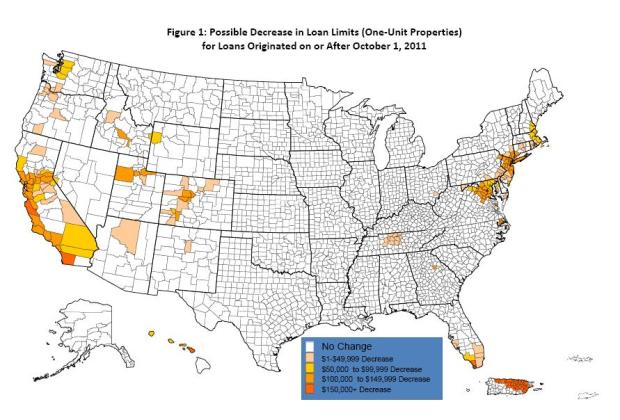
An issue that may have a gigantic impact on the housing market later this year is the lowering of the conforming loan limits. Without an act of Congress, these limits will return to the lower limits that existed prior to 2008. Today, we want to shed light on this issue and what it means to someone thinking about buying either a first home or move-up home valued over $400,000 in certain markets in the country.

What is the ‘Conforming Loan Limit’?

The ‘conforming loan limit’ sets the maximum loan amount, which either Fannie Mae or Freddie Mac are allowed to purchase individual loans. If a loan is larger than this limit, it is considered a ‘jumbo’ loan and is automatically disqualified from being sponsored by Fannie and Freddie. It would have to be handled by the private market.

A Little History

Prior to 2008, the loan limit was $417,000. When prices started to rapidly escalate in certain regions of the country, the limit was increased. In some counties, that limit jumped to over $700,000. These new limits are scheduled to expire this October. If this happens, Fannie Mae and Freddie Mac may no longer be involved in these loans.

What Impact Will This Have on a Buyer?

It will cost more in mortgage payments if buyers are purchasing a home over the limit in a region where the limit changed. The Mortgage Market Note explains:

For the affected borrowers, because mortgage rates for jumbo mortgages tend to be higher than rates for conforming loans, financing costs may be higher… Over the latest year, the difference between mortgage rates for jumbo loans and jumbo-conforming mortgages has varied between about ½ and ¾ of a percentage point.

Just a ½ point increase in mortgage rate on a $500,000 mortgage means an additional $154.84 in your monthly mortgage payment; a difference greater than $55,000 over the life of a 30 year mortgage.

Which Counties are Impacted and to What Degree?

Below is a map of the regions affected from the Mortgage Market Note. You can get a breakdown of each impacted county in this report also.
Bottom Line

If you are thinking about buying a home in the near future, you should know how this issue may impact you. Sit down with a real estate professional familiar with your area for further advice.


Realtors® Go Green with New and Improved Designation

The National Association of Realtors® is modifying its popular Green Designation program to focus on residential real estate practice.

“NAR research has consistently shown that there is a considerable and growing market for green buildings, and many of today’s consumers want homes and communities that are more resource efficient and sensitive to the larger environment,” said NAR President Ron Phipps, broker-president of Phipps Realty in Warwick, R.I. “NAR’s Green Designation helps Realtors® meet that consumer demand for green building practices. These revisions will help Realtors® continue to bring value to buyers and sellers who value eco-friendly and energy-efficient homes.”

Because of high member demand for the residential aspect of the curriculum, the commercial and property management electives will no longer count as credit toward the designation but will be made available to members interested in those areas of study. The changes will include replacing the two-day core course and one-day elective courses with three one-day courses: Green 100: Real Estate for a Sustainable Future (day 1); Green 200: The Science of Green Building (day 2); and Green 300: Greening Your Real Estate Business (day 3).

Students will need to complete all three days to earn NAR’s Green Designation. The updated program will be launched in late summer 2011. Until then, NAR’s Green Resource Council has reduced the prices of the existing online core and elective courses. The core course was $295 and is now $230; the residential elective was $125 and is now $99; and total cost for the full designation was $420 and is now $329.

NAR’s Green Designation was peer-reviewed by the Environmental Protection Agency and the U.S. Green Buildings Council, and received the 2009 Award of Excellence from the American Society of Association Executives. The Green Resource Council has forged strategic relationships within the green industry to create awareness of the designation, advance its mission, and provide continued education to the designee base. Other green industry initiatives include the creation of the Green MLS Toolkit, online at www.GreentheMLS.org.


New FTC Rule Impacts Realtors®’ Short Sale Business

A new rule from the Federal Trade Commission that aims to protect home owners from mortgage relief scams may impact real estate professionals who represent clients involved in short sale transactions. Several hundred Realtors® learned more about the new rule and its impact on their business at the “Risk Management and License Law Forum” during the Realtors® 2011 Midyear Legislative Meetings & Trade Expo in Washington, D.C. today.

National Association of Realtors® General Counsel Laurie Janik overviewed the FTC’s Mortgage Assistance Relief Services rule, which took effect on January 31, 2011. The goal of the rule is to protect distressed home owners from mortgage relief scams and ensure that people who provide counseling, advice and other services to troubled home owners are indeed providing a benefit for the fees they charge. The rule bans all upfront fees for renegotiating mortgage terms and mandates that certain disclosures are made to consumers if a short sale is negotiated with a lender on their behalf or when advertising short sales experience.

“As the leading advocate for home ownership, NAR supports efforts to ensure that mortgage assistance relief services truly benefit consumers,” said Janik. “Nevertheless, NAR has some concerns about the rule and its application to real estate professionals involved in short sales transactions. We are working closely with the FTC to clarify several aspects of the rule in relation to real estate professionals when they are performing traditional real estate functions in a short sale transaction.”

The rule is primarily directed at companies that offer loan modification services to consumers, but it also may impact real estate professionals who represent clients involved in a short sale transaction, especially when advertising short sale negotiation services or other short sale expertise; communicating with a consumer about a possible short sale before the listing agreement is executed; negotiating a short sale on behalf of a consumer; or arranging a short sale negotiation for a consumer. The rule only applies to residential real estate transactions.

In the meantime, Realtors® must already be complying with the rule by not taking any upfront fees and using specific disclosure language. The rule necessitates when and how the disclosures must be presented to consumers and that they are made clearly.

Currently, there are three types of disclosures that a real estate professional may need to make to consumers. First, a real estate professional now needs to include a clear and prominent disclosure in all commercial messages that advertise their short sale services.

Second and third disclosures are required by real estate professionals before they begin mortgage assistance services on their client’s behalf and at the time they present their client with the lender’s short sale approval letter.

“NAR is discussing with the FTC some language in the second and third disclosures and well as some other requirements found in the MARS rule. The FTC is considering possible options to help make the rule more applicable to a real estate brokerage,” said Janik.


 The Impact of Dodd-Frank on Real Estate

Although the 2,314-page Dodd-Frank Wall Street Reform and Consumer Protection Act signed into law last year doesn’t affect real estate brokers and agents as much as, say, mortgage originators, it does have some significant implications for the industry, said Phillip Schulman, a partner at the Washington, D.C. law firm K&L Gates LLP.

In his remarks at the Real Estate Services Forum Thursday during the REALTORS® Midyear Legislative Meetings, Schulman told attendees that the mortgage lending sector was targeted by many of the bill’s provisions.

“[Dodd-Frank] came down hard on loan officers and mortgage brokers. Why? Because they were the ones working with the borrowers,” said Schulman, adding that in the future all originators will be qualified, licensed, and registered, as well as issued a unique identifier.

“Anytime there’s a violation committed by a loan officer, it’s going to be reported in a nationwide system,” he said.

The bill also affects the financial sector, particularly in terms of the structure of securities, which are debts or equities that are packaged for investment. To avoid the financial fraud of the previous decade, Dodd-Frank requires financial companies that create securities to hold a minimum 5 percent stake in them – the exception being securities that are composed of qualified residential mortgages (QRM).

Current QRM requirements for borrowers include no option adjustable-rate mortgages (ARMs), no bankruptcy in the past three years, no prior short sale or foreclosure, and points and fees charged by the lender totaling less than 3 percent of the loan’s value. Furthermore, lenders and regulators have recently recommended implementing a higher minimum down payment.

The increasingly stringent requirements pose a serious challenge to a viable housing market, Schulman noted.

“The eligible loan is shrinking and shrinking, and it’s going to be harder for someone who has any dents or scratches in their credit to get a loan,” he said. “It’s all well and good to get the riff-raff out of the business and get rid of these exotic, fly-by-night financial products, but let’s not throw the baby out with the bath water.

“We just came through a decade of this laissez-faire attitude. The atmosphere was one of easy money. We put millions of Americans in homes who probably should not have been there. Today, Washington is all about risk management. Congress and regulators stepped in and were asked to regulate. So they did what they always do. They overregulated. I think until we earn back the trust of the Congress and the regulators and even the American people, we’re going to continue to be scrutinized like never before.”

Here are a few other important, real estate-related changes brought about by the bill:

Bureau of Consumer Financial Protection:, this new behemoth regulatory agency – which Jay N. Varon, Schulman’s fellow speaker and a litigation partner with law firm Foley & Lardner LLP, characterized as the “centerpiece” of Dodd-Frank – will officially launch on July 21. This organization will encompass a half-dozen current regulatory agencies and 18 consumer statutes, including RESPA. It will also have what Varon called “nuclear” penalties, meaning punishments for violations will be much more stringent than they are now.

Prohibitions on steering and loan-officer compensation:

Dodd-Frank changed the compensation model for loan officers to prevent them from steering consumers into loans that may not be right for them, yet profitable for the lending company. According to Schulman, loan officers will collect the same sum per loan, whether it’s a 30-year fixed mortgage or an option ARM. Still, he said this new arrangement isn’t entirely fool-proof. “Businessmen figure out a way to make every system work. Sure, they’ll pay them 50 basis points for loans of all kinds. But they can also pay them bonuses based on total volume,” he explained.

Appraisals and AMCs:

New regulations in Dodd-Frank are designed to protect appraiser independence, Schulman said. These rules also sunset the Home Valuation Code of Conduct (HVCC), which caused a great deal of consternation among real estate professionals who say it contributed to the collapse of deals after it was enacted in 2009.

TEAM EMPOWERMENT MORTGAGE CHATTER: May 12; News & Headlines; How Much Money Would You Deposit In This Investment; Google Wants Your House To Be As Smart As Your Phone; Global Open House; Banks Less Likely To Budge On Home Prices; The Dollar and Impact

“If you don’t like something, change it. If you can’t change it, change your attitude. Don’t complain.” – by Maya Angelou


NEWS & HEADLINES

HUD announced a conference call for today. FHA Office of Lender Activities and Program Compliance Conference Call/Live Meeting from 2-3 EST. “Topics of Discussion: Audited Financial Statements, Investing Mortgagee Requirements, Third Party Originations.” E-mail your questions both in advance of and during the call to OLAPC@HUD.GOV and to join use the conference dial-in number: (800) 260-0718; Confirmation/Participant Number: 201997.

In Northern California, Walnut Creek to be exact, FHA will conduct a 1-day class on June 7 on “recent changes, highlights of underwriting the FHA appraisal, recap of underwriting & documentation requirements. This training is for Underwriters, Processors, & Loan Officers. It is free but registration required at FHAClass.

HUD also reminded FHA/VA producers that “claim-related payments to HUD must be made through the ‘Claim Remittance’ feature in the FHA Connection. This feature can be accessed through the FHA Connection by selecting Single Family Servicing, Claims Processing, and Claim Remittance. Banking information can be entered securely using one of two methods: (1) the one-time cash flow account setup process, using the Cash Flow Account Setup module in FHA Connection, establishes a banking account that can be used for frequent and recurring remittances, and (2) banking account information can be entered at the time of each remittance. By request to allow a longer transition period, the closing date for the Single Family Claims Lockbox has been extended to May 31, 2011. There will be no further extensions. Any checks received after May 31, 2011, will be returned to the sender and mortgagees may incur interest and – or penalty amounts on delinquent debts. Guidance on this can be found at: HUD.

Wednesday the volatility in our markets continued to pick up slightly. Treasuries and other fixed-income securities opened lower but buyers came into the market and prices gained steadily through the day. Equities sold off sharply on lower commodity prices and increased economic worries. When all was said and done the new 10-year note rallied about .250 in price and down to a yield of 3.16%. Mortgage banker selling was in the mid-to-upper end of its range of $1 to $1.5 billion, and agency MBS prices finished better by .125-.250, resulting in some intra-day price improvements.

Sales increases in building materials, gasoline stations, and restaurants, Retail Sales rose .4% in March. Today we learned that Retail Sales for April were +.5%, due in part to my purchase of SkyMall’s “Teach Your Cat to Use Your Toilet” Program. We also learned that last week’s Jobless Claims dropped from 478k to 434k, with continuing claims about unchanged but the 4-week moving average heading higher, and that the Producer Price Index was +.8% with the core rate +.3%. For the year producer prices are +6.8%.


HOW MUCH MONEY WOULD YOU DEPOSIT IN THIS INVESTMENT?

Conventional wisdom does not always apply. Consider this investment:

  • You determine the length of time and monthly amount you want to contribute.
  • You can always contribute more, but never less. If you do contribute less, all previous contributions will be forfeited.
  • The monies you deposit are not safe from a loss of principal.
  • The monies in the account are not liquid.
  • Your income tax liability actually increases with every contribution.
  • Your money earns a 0% rate of return.
  • When the investment is fully funded, there is NO income paid out.

On these terms, I have yet to have a customer be eager to put money into this investment. As a matter of fact, most are shocked to find out that they have been encouraged to put a large portion of their income in this exact investment! You see, the investment described above is Home Equity – whether it be through a larger than necessary down payment or through pre-payment strategies or even the regular amortization created by taking a shorter term.

Let’s look at the terms of the stated investment one more time:

  • Take a 15, 20 or 30 year loan
  • You can always pay additional money towards your outstanding balance, but if you pay less, and get foreclosed upon, you lose all your payments to reduce the principal.
  • As home values have declined, the monies invested (either from your down payment or other equity reducing strategies) have declined, and your cash has been lost.
  • Home equity is not liquid. You cannot just go get it when you need it. As a matter of fact, usually when you need to access it most (a job loss, disability, or worse) you can’t get it at all, as you won’t qualify for a loan.
  • With each payment on an amortizing fixed rate loan, you are paying more principal than you did in the previous payment. That means you are paying less interest. Since interest is the deductible portion of your payment, with each payment you pay less interest; therefore, less tax deductibility.
  • Home Equity has 0% rate of return. Ask yourself, “What interest rate will the bank give you on your down payment?” The answer is “Zero”. The same holds true for any reduction in principal. Any money used to increase equity (defined as the difference between the home’s value and its outstanding debt) will have a 0% rate of return.
  • When your home is paid off, there is no money paid to you. You are left with a large equity investment, gaining no rate of return.

Bottom Line

There are many factors to consider when deciding what mortgage fits your personal situation. You need to completely understand your individual, short and long-term goals. The “conventional wisdom” is not always the wisest solution. You should seek out the counsel of a good loan officer who understands your goals.


GOOGLE WANTS YOUR HOUSE TO BE AS SMART AS YOUR PHONE

Google kicked off its annual two-day conference for software developers by launching headline-grabbing movie and music services.

But it also announced a more futuristic project at Google I/O called Android@Home. The idea: To make your home as smart as your phone.

So far Google has used Android as an operating system for phones and tablets. Now it apparently has an ambitious plan to turn the home into one giant connected device.

Google wants consumers to be able to control devices and appliances in their homes with their Android devices, which would basically function like a universal remote.

Want to turn off the lights? Use your Android phone. That’s what Google did during an on-stage demonstration on Tuesday. Lighting Science Group is building wireless lighting products — bulbs and switches that can communicate with Android — that should be available in stores by the end of the year.

Making Google’s vision of an Android-automated home a reality will depend on the 5,000 software developers who are attending Google I/O. Google said it wants them to begin building applications to automate houses.

To get the creative juices flowing, it showed off a new home theater system called “Project Tungsten,” which allows users to stream music from Google’s new service to speakers connected to the Android home network. A user can upload music by tapping a CD case equipped with a near field communication device on a Tungsten device. Tap it again and the music plays.


ARE YOU PART OF THE GLOBAL OPEN HOUSE 59 COUNTRIES, 1 WEEKEND ?

The 2011 REALTOR® Nationwide Open House will be held on the weekend of, June 4-5, 2011. This event, which began on a local level a few years ago, is a weekend when REALTORS® across the country – and across the globe – are invited to hold open houses in their area. It is designed to drive buyers’ attention and interest to homes for sale and offers opportunities to educate the public about the benefits of home ownership.

Ask your local association for details and information on how you can participate in this year’s REALTOR® Nationwide Open House.


BANKS LESS LIKELY TO BUDGE ON HOME PRICES

An analysis by Redfin.com shows that bank-owned homes and short sales consistently sell for closer to their list prices than do non-distressed homes.

Redfin trend watcher Tim Ellis writes:

“This held true across every price band, although the volume of distressed sales is certainly weighted toward the low end – we were originally only going to discuss [bank-owned homes] in this post, but the sale-to-list ratios for short sales were so similar that we decided to include them in our analysis as well.”

The study includes homes in 16 markets, including Irvine, where distressed sales were at 42% of total home sales. You can see the sale-to-list ratio in the chart above.

At one point, Ellis cites a Redfin agent in Phoenix, Marcus Fleming, who says:

“Banks are very careful about getting a number of BPOs [broker price opinions] before listing a home. When it goes on the market they are so confident the price is right that for the first 2 weeks they will accept nothing but offers at 100% of list price.”

Fleming says even when the home has been on the market for several months, banks won’t consider offers for less than about 95% of the list price.

Ellis says:

“In general, the more distressed a market is, the bigger the difference between the two sale-to-list ratios. In other words, in a highly distressed market like San Diego, buyers are a lot less likely to get a bank to negotiate on price than they are in a less-distressed market like Denver. Admittedly, the correlation isn’t incredibly strong, but there is definitely a clear trend in that direction.

“In some markets, banks are being especially aggressive with their listings, putting homes up for sale at well below the market value, leading to multiple bids and average sale prices that are higher than the list price. Across the entire data set we analyzed, distressed listings were more than twice as likely to sell for over list price than non-distressed listings.”


THE FALLING DOLLAR AND THE IMPACT ON REAL ESTATE

The U.S. dollar has been weakening for the past two years and the depreciation could continue for the remainder of the year. The dollar is weaker not only against the major foreign currencies of the Euro, Pound, and the Yen, but also against the Russian Ruble, Polish Zloty, South Korean Won, Thai Baht, South African Rand, Brazilian Real, and Mexican Peso.

Why? One key reason is just an unwinding of the strength of the dollar that grew during the 2008/09 financial crisis. Global financial panic always forces the dollar up as investors search for a safe, reliable haven. Now with the financial market recovering quite strongly, the “panic” impact on the dollar is no longer in play. Another reason for the decline in the dollar is a result of the falling confidence that global investors are placing in the U.S. economy. If you had cash to invest, where would you invest – in a country with strong growth prospects or in a country that could be losing competiveness with the rest of the world?

A final important reason for the dollar decline is that the U.S. has been running up a sizeable trade deficit for quite some time. Americans buy far more imported foreign products in relation to exporting U.S.-made products abroad. To help rebalance this persistent trade deficit, the weakening U.S. dollar – in theory – is supposed to help Americans buy fewer foreign products and help sell more American products abroad. John Deere, as an example, has better prospects to sell tractors to Brazil. Also, many Americans may reconsider traveling abroad since the dollar doesn’t go as far in other countries (such as forking over $10 for a Big Mac meal in Rome, for instance, with ketchup costing extra).

However, the weakening dollar could actually worsen the trade deficit if Americans keep buying foreign products, but now at a higher price. Imported oil is one example where Americans are buying out of necessity even at higher prices.

Whichever way one’s take on the desirability or undesirability of the falling dollar goes, one thing is clear as related to the dollar’s impact on real estate. Right now U.S. real estate is cheap, from the perspective of a foreign buyer, which may mean more international purchases this year. Below is a graph of U.S. property prices in different currencies over time.

TEAM EMPOWERMENT MORTGAGE CHATTER: May 11; News & Headlines; Homeownership: Building Family Wealth; Listing Data Not From MLS Has More Errors; 1 in 4 Homes Underwater; Realtors & Techonology; Special Fund Would Help Homeowners Stay In Homes

“To be successful, all you have to do is give up everything you know.” — Asara Lovejoy:  Human potential author and coach

NEWS & HEADLINES

A quick note for anyone interested in FHA lending’s pitfalls, the recent filed lawsuit against Deutsche Bank, and the enforcement tools regulators are using – there is a webinar today on those subjects. The webinar’s discussion will review the charges in the case and potential implications for FHA lending, and participants will be able to submit questions to be answered during the hour-long session from 3-4 EST, 12-1 PST. Webinar Presented by BuckleySandler LLP: “The False Claims Act and FHA Lending: What Does U.S. v. Deutsche Bank Mean for You?” Webinar topics include a summary and analysis of legal theory and corresponding charges in U.S. v. Deutsche Bank AG, et al., pitfalls in FHA Lending, avoiding False Claims Act liability, and beyond, how and when are False Claims Act violations triggered, what other enforcement tools are regulators using, what you can do now to position and protect your company, and insights on where the government and private plaintiff’s bar will go from here.  Clickheretoregister. After registering you will receive a confirmation email containing information about joining the webinar.

Lawsuits seem to be omnipresent in mortgage lending and banking. Here is the latest list of “Professional Liability Lawsuits” from the FDIC – another list you probably don’t want you or your company on: FDICSuits.

Yesterday the commentary mentioned one attribute of Fannie’s portfolio (a large number of Countrywide loans) which contributed to the difference in earnings between Fannie & Freddie. I received some notes, summed up by one Secondary exec in New York. “Fannie’s grappling with Countrywide loans, but remember that Freddie also has a glut of Taylor Bean Whitaker loans. And although both FNMA & FHLMC purchased mortgages down the credit curve several years ago, including subprime mortgages, it was primarily because HUD mandated that they do so. And regarding your Cato Institute quote about abolishing those agencies, readers should know that some people at Cato also support an end to HUD.”

“Freddie’s portfolio isn’t quite as awful as Fannie’s, according to Anthony Sanders, Mercatus Center scholar and a real estate finance professor at George Mason University. He says that Fannie had a larger share of subprime mortgage-backed securities and Alt-A mortgages. Consequently, its losses were more severe last quarter than Freddie’s losses.”

Yesterday’s fixed-income markets saw some volatility yesterday, but unfortunately for lenders the direction was toward lower MBS prices and higher rates. The news primarily consisted of a higher-than-expected print on import prices, the IMF’s preparations for another bailout to Greece (to replace the last one), and the Treasury’s $32 billion 3-yr note auction. Current coupon MBS prices worsened between .125-.250 on average volume while the 10-yr Note dropped nearly .5 and closed at a yield of 3.20%. Traders are definitely seeing the MBS production mix shift from 4.5’s and 5’s down to primarily 4’s (which include 4.25%-4.625% conventional mortgages) although origination is extremely light (barely making $1 billion per day over the past few weeks).

Today we’ve already had mortgage applications for last week, which the MBA said increased 8.2%. The refi number was +9%, hitting its highest level since mid-March, and purchases were up nearly 7%. The 4-week moving average is up nearly 3%, and refi’s account for over 63% of all applications. We also had the March Trade Deficit clock in at $48.18 billion, up from $45.44 billion in February. At 11AM MST the Treasury auctions $24 billion in 10-year notes, which currently is sitting around 3.22% and MBS prices are worse by about .125.


HOMEOWNERSHIP: BUILDING FAMILY WEALTH

The question facing many families making a move today is whether it makes more sense to rent or buy. We have been very upfront in discussing our unwavering belief in homeownership. It is for that reason that today we want to quote from a study issued by an institution with no ties to the real estate business or mortgaging.

The Joint Center for Housing Studies at Harvard University just released a study, America’s Rental Housing: Meeting Challenges, Building on Opportunities. The study discusses the need for a greater supply of quality rental units in America. We agree. However, there were a few nuggets of information found in the study we want everyone to know.

American’s Belief in Homeownership Has NOT Fundamentally Changed

There seems to be some feeling that homeownership has lost it’s luster and perhaps is no longer a component of the American Dream. Harvard explains:

To date, attitudes about owning have become only slightly more negative while attitudes about whether now is a good time to buy are little different than before the housing boom. In the latest Fannie Mae housing survey from October – December 2010, the vast majority of respondents – including renters – continued to believe that homeownership makes more financial sense than renting. In addition, nearly two-thirds of all renters surveyed reported their intention to buy homes in the future.

Homeownership Creates Wealth

Because prices have fallen dramatically in many parts of the country in the last five years, some are too easily dismissing homeownership’s role in building family wealth over the last century. The study explains:

In addition, renters have only a fraction of the net wealth of owners. Near the peak of the housing bubble in 2007, the median net wealth of homeowners was $234,600 – about 46 times the $5,100 median for renters. Even if homeowner wealth fell back to 1995 levels, it would still be 27.5 times the median for renters.

The recent fall in prices can’t wipe out the 100 year history housing has as a good long-term investment.

Bottom Line

The study was promoting the need for the construction of more rental housing for the average American family. However, when it came to a discussion on building wealth, Harvard offered:

“And for individuals as well as businesses, owning rental properties is an avenue for wealth creation.”

And how do these individuals and businesses create that wealth. Owning the real estate and collecting rent from their tenants to offset the mortgage payments. Build your family’s wealth – not your landlord’s. We believe OWNERSHIP almost always makes the most sense.


LISTING DATA NOT FROM MLS HAS MORE ERRORS

Listing data that doesn’t come directly from a multiple listing service data is more likely to have inaccurate price and status information, according to research by Trulia.

Trulia found that third-party syndicators of listing data that did not come from an MLS posted a 21.3 percent error rate regarding the listing’s price or status. Trulia says the problem is that real estate professionals submit the data to these syndication sites but often fail to return to the site to update the listing when information changes, which causes a “significant increase of disparate data sources resulting in less accurate data online,” according to Trulia.

Meanwhile, third-party re-syndicators of MLS data had a 10.2 percent error rate, direct feeds from brokers posted a 5.6 percent error rate, and direct feeds from franchises had a 3.9 percent error rate, according to Trulia’s research.

Trulia’s white paper was based on an analysis more than 430,000 listings between Feb. 15 and April 15 to uncover discrepancies in listing data.


1 IN 4 HOMES WITH MORTGAGES ARE UNDERWATER

The number of home owners who owe more on their mortgage than their house is worth continues to increase. About 28 percent of homes with mortgages are now underwater, according to Zillow.com’s latest Home Value Index. That is up from 27 percent reported during the last three months of 2010.

A flood of foreclosures continues to weigh on many markets and is putting downward pressure on home prices.

Zillow’s latest index, which covers 132 markets, showed that 97 percent of home owners saw a decrease in home values.

However, three real estate market bright spots were uncovered: Fort Myers, Fla., Champaign-Urbana, Ill., and Honolulu, which all posted quarterly increases. Home values in those cities increased 2.4 percent, 0.8 percent, and 0.3 percent, respectively.


REALTORS® and Technology

Technology has changed dramatically over the last 10 years and had a strong impact on the REALTOR® business. New forms of technology have enhanced mobility and improved efficiency, but they have also eliminated a level of control from the average real estate agent.

Consumers and Technology

Consumers have fully embraced the internet. According to the Bureau of the Census, in 1997 only 18.0 percent of Americans had internet at home; by 2009, that figure had jumped to 68.7 percent. The internet is no longer just a source of information and e-commerce, but a means of creating and expanding relationships, both personal and professional. Friendster gave way to MySpace, which gave way to the social media giant Facebook. The number of active members on Facebook jumped from just one million users in December of 2004 to more than 500 million by the end of 2010. Today blogs are common and for those for whom the speed and frequency of interaction on these sites are not enough, registered users on Twitter now total 175 million with an average of 95 million tweets per day.

According to NAR’s 2010 Profile of Home Buyers and Sellers, the share of buyers who searched “frequently” on the internet for their home rose from 71 percent in 2003 to 89 percent in 2010. The share of homebuyers who found their home on the internet jumped from 8 percent in 2001 to 37 percent in 2010. Among buyers who used the internet, the features most often used were photos and detailed information about the property. Buyers were less interested in information on “days on market” and comparables. This pattern suggests that consumers use online information about listings to better educate themselves for the purchase decision, but they are less interested in information that would help them with pricing or strategies of the purchase process. Consumers want to better understand the particulars of the property and leave the process to their REALTOR®.

REALTORS® and Technology

The march of technology has also left an imprint on REALTORS®. REALTORS® were quick to adopt both e-mail and mobile phones. As early as 2002, 96.6 percent of REALTORS® had a mobile phone. At that same time, use of other wireless devices, particularly those withe-mail or internet capabilities, was low at only 17.4 percent, and less than a third (31.7%) of REALTORS® used a pager. Desktop computers were used by almost 73 percent of REALTORS® at their place of business and 84 percent had a desktop computer at home.

By 2010, the technology used by REALTORS® was different. Pagers disappeared and only 16 percent of REALTORS® planned to buy a desktop PC – a trend that reflects the demise of the brick-and-mortar office. Technology enhanced mobility and REALTORS® took advantage of that, with 34 percent planning to buy a laptop, 21 percent selecting an iPad and 42 percent opting for a smart phone.

The internet allows REALTORS® to market listings to a much broader audience than before. In 2010, the site most frequently used by REALTORS® to list their properties was REALTOR.com, followed by their broker site, and their personal site. Magazines, national franchises, and local newspapers, traditional sources of listings, had all fallen below a 40 percent share.

Conclusion

Technology has had a substantial impact on the lives of both consumers and REALTORS® over the last decade. Consumers have embraced the internet as a search tool, but also as a social outlet. REALTORS® embraced the internet as well, and property listings now flourish on line. REALTORS® are also increasing their use of social media as a means of expanding their sphere of influence and lead generation. Gadgets have also had an impact, untethering REALTORS® from their offices and enabling them to communicate much easier. But, while technology has been broadly adopted by the REALTOR® community, social media remains the avenue of younger REALTORS®. Real estate is a fast and fluid business and REALTORS® will continue to seek out and adopt those technological that augment their business. The next 10 years are likely to bring dramatic changes in the ways REALTORS® use those technologies.


SPECIAL FUND WOULD HELP OWNERS STAY IN HOMES

State attorneys general are proposing a special fund, that could be as large as $20 billion, to help troubled borrowers stay in their homes.

State attorneys general are meeting this week in Washington, D.C., to continue negotiations with federal regulators and the country’s largest mortgage servicers. The settlement negotiations are expected to include talks about the special fund as state attorneys general continue to seek fines and other punishment of mortgage servicers for bad foreclosure practices.

Proposals from state attorneys general being discussed include using some of the money in the fund to write down the principal balance for some troubled home owners, The Washington Post reports. Banks have strongly argued against such a move, questioning the fairness for other home owners in doing that. Another option state attorneys general may propose is to use the funds to support state-run aid programs, mediation services, and foreclosure hotlines to help struggling home owners.

The ongoing negotiations are one of many taking place among government agencies to reach settlements with banks regarding shoddy foreclosure practices.

TEAM EMPOWERMENT MORTGAGE CHATTER: May 10; News & Headlines; 5 Reasons You Should Consider Selling Now; Slow Economic Recovery Blamed On Housing; Working for Tomorrow’s Home Owners Today; A Real Estate FAQ for iPad; 6 Ways To Gain Referrals -Social Media

“One of the penalties of leadership is the necessity or willingness, on the part of the leader, to do more than they require of their followers.” – Napoleon Hill

NEWS & HEADLINES

Fannie & Freddie recently released results that appear to point to the different focus in the past of their two companies. One reader wrote, “Freddie Mac reported its first true net profit in almost two years, earning $676 million in the first quarter and not asking the taxpayer for more money. But Fannie reported at $6.5 billion loss for the quarter, and asked Treasury for $8.5 billion in taxpayer money. From my vantage point, the difference rests in the amount of Countrywide business that Fannie bought in the past – CW was Fannie’s best customer for several years, selling Fannie a variety of A-paper, alt-A, pay option ARMs, and other products. I bet that if you take Countrywide out of the equation, Fannie would show similar results to Freddie. But last year Fannie agreed to one lump sum from BofA to settle the bulk of buyback claims – good for BofA, bad for Fannie.”

By the way, at this point the conforming loan level in the higher-priced areas will indeed drop to $625,500 from $729,750. Although it is not set in stone and could be subject to some political wrangling, few doubt that it will drop. Here is Fannie’s memo stating the loan limitsFannie along with the FHFA’s.

Zillow posted some housing numbers that certainly would make a bridge shake a little. There seem to be dozens of house price indices, but the one from Zillow yesterday showed that home values posted the largest decline in the first quarter since late 2008. Home values fell 3% in the first quarter from the previous quarter and 1.1% in March from the previous month, and Zillow reports prices have now fallen for 57 consecutive months. Our economy needs job & housing, housing and jobs, to truly recover, and although mortgage rates continue to be low, the expiration of the housing tax credit and the continued flow of foreclosures hitting the market aren’t helping prices. Detroit, Chicago and Minneapolis posted the largest declines during the first quarter of the top 25 metro areas tracked by Zillow, while Pittsburgh, Dallas and Washington posted the smallest declines.

Wall Street continues to see good interest by investors in mortgage products, “…buying from all investor types…Japanese, Real Money and Central Banks have been the largest – the market continues to under estimate the short base…,” which is another way of saying that Central Banks and investment firms have an enormous amount of cash to be put to work. And specifically for mortgages, banks have been very large buyers of MBS (per the H8 data). Monday was very quiet, with the 10-yr yield closing at 3.14% and MBS prices a shade better/higher as there is still a flight to safety bid on continued worries about European debt issues – particularly related to Greece.

This morning we learned that April Import Prices were +2.2%, higher than expected, and Export Prices were +1.1% – neither of which are really market-moving numbers. At 10AM EST Wholesale Trade for March is reported, also not a market-moving number, but at 1PM EST we have a $32 billion 3-year note auction by the Treasury, and this can shift rates somewhat. Currently we find the yield on the 10-yr slightly higher at 3.17% and MBS a tad lower.


 5 REASONS YOU SHOULD CONSIDER SELLING NOW

If you plan on moving anytime in 2011, you should strongly consider selling your house now rather than waiting. Here are five reasons why:

1.) This is when your house will get the most exposure

The spring, and particularly the month of May, is when most buyers enter the real estate market. This surge of buyers dramatically increases the exposure for your house . The best chance of getting quality offers (perhaps even multiple offers) is RIGHT NOW!

2.) Foreclosures and short sales will increase in about 90 days

The good news is that the number of people paying their mortgage on time is increasing. This will lead to less distressed property sales later this year and throughout 2012. The not-so-good news is that there is still a large inventory of existing foreclosures and short sales that will still be coming to market.

As an example, LPS reported in their latest Mortgage Monitor that:

  • There are still twice as many loans going 90+ days delinquent as are starting foreclosure
  • There are almost three times the number of foreclosure starts as there are foreclosure sales
  • Distressed property inventory levels are almost 45 times the rate of monthly foreclosure sales

This means that there is a backlog of properties which will start coming to the market in about 90 days as banks clear up their paperwork challenges. These properties sell at dramatic discounts. They will be your competition. Both Fannie Mae and Freddie Mac have recently discussed the magnitude of this challenge.

3.) Interest rates have risen over the last six months

Interest rates have stabilized recently. However, in the last six months, interest rates have climbed over 1/2%. Every time the rates increase 1/4%, approximately 250,000 buyers are eliminated from qualifying for a mortgage. In an environment of volatile rates, waiting could mean that there will be fewer buyers eligible to purchase your house. It also could mean that you will pay a higher rate on the next home you buy.

4.) Qualifying for a mortgage is about to get even more difficult

Besides increasing rates, there are other factors that will hinder a buyer’s ability to qualify for a mortgage as we move forward. Lending standards have been getting tighter over the last year. And as the government debates the new proposed guidelines (QRM), banks are gearing up for even more stringent standards.

Morgan Stanleyrecently stated:

“Recent developments in issues such as GSE reform, Dodd-Frank securitization rules, and foreclosure settlement issues suggest a tighter and more expensive environment for mortgage credit.”

This may impact any potential purchaser for your property and may also impact your next purchase.

5.) It’s time to get on with your life

Probably the most important reason to sell is so you can get on with your life. You placed your home on the market for a reason. Do not allow a less-than-stellar housing market prevent you from reaching your goals as an individual or as a family. Think about the reasons you decided to move in the first place. Are these reasons still important to you? If you have to take less than you were originally hoping to get for your house, your family has a question to ask each other: Is the dollar difference in sales price worth putting off our plans? Only you and your family know the answer to that question.

Bottom Line

If you plan to sell this year, the reasons above prove that selling now makes more sense than waiting to later in the year. Sit with a real estate professional in your area today to fully understand your best option.


 WORKING FOR TOMORROW’S HOME OWNERS TODAY

REALTORS® from across the country are meeting with legislators, public policy makers, and industry leaders this week to address pressing concerns and issues that affect home owners, aspiring home owners and real estate investors everywhere as the REALTORS® Midyear Legislative Meetings & Trade Expo begins.

“As leading advocates for home ownership, housing issues, and private-property rights, REALTORS® know that the time for action is now,” 2011 NAR President Ron Phipps said. “We need to make sure that our children and grandchildren have the same opportunities to build their futures through home ownership, just as many in our generation and generations past have.”

More than 8,000 REALTORS® and guests are expected to attend the meetings, which run here through May 14. During the week, REALTORS® will meet with legislators on Capitol Hill to urge action toward streamlining short sales, ensuring access to affordable financing, and preserving the tax benefits associated with home ownership.

REALTORS® will also participate in sessions with a number of government officials and industry experts, including representatives from the Federal Housing Administration, National Economic Council, Fannie Mae, Freddie Mac, Mortgage Bankers Association of America, Center for Responsible Lending, and the National Urban League.

“The issues facing our industry – like the mortgage interest deduction, foreclosures and short sales, affordable financing, and available credit – don’t just affect people who own a home,” Phipps said. “Home ownership shapes communities and strengthens the nation’s economy. This week and every week, REALTORS® are at the ready to keep housing first on the nation’s public policy agenda, because housing and home ownership issues affect all Americans.”


SLOW ECONOMIC RECOVERY BLAMED ON HOUSING

While the employment picture continues to gradually improve, the economy is not recovering at the pace some experts had hoped for, and some are pointing fingers at the housing market for the slow recovery.

Federal Reserve Chairman Ben Bernanke says the economy is recovering at a “moderate pace” and that a high number of foreclosures and home owners who are “underwater” on their mortgages continues to drag down housing prices and the economy.

“Declines in the values of homes and stocks sharply reduced the wealth of many Americans during the crisis,” Bernanke says. “Three-fifths or more of families across all income groups reported a decline in wealth between 2007 and 2009, and the typical household lost nearly one-fifth of its wealth, regardless of income group.

“Moreover, one in eight of the households … started the crisis with zero or negative net worth and thus had scant resources to fall back on to maintain their standard of living during bouts of unemployment.”

However, there are signs the outlook is starting to improve. The construction industry in April increased employment by 9,000, which is its first monthly increase in years and may be a sign that the sector is finally in recovery mode. Overall, unemployment continues to decline, which will help more households start to feel more financially secure. However, long-term unemployment remains historically high, particularly among the young, minorities, and those with less education.


A REAL ESTATE FAQ FOR iPAD

There is a lot of interest in the iPad and in tablet computing in general, and when I write about it I get questions. There are not many practical articles about the iPad for Realtors because the device is still so new.

Here are the most common questions I have encountered, and my answers:

1. Can I print from an iPad? Yes, you can print from the iPad. It uses wireless printing and only works with some printers. The details can be found on the Apple Web site. I have never had any need or desire to print from my iPad.

In fact, for me part of the beauty of the device is that I use less paper. There are alternatives to printing from the iPad — one is putting documents to be printed in Dropbox and printing them from a computer.

2. Can I access the multiple listing service from my iPad? I cannot answer that question for everyone, but I can access my MLS and I don’t have to use the mobile version or an app. I can see the MLS and use it just like I would on my PC.

The best way to find out if your MLS is accessible from the iPad is to ask someone who has one or go to an Apple store and test it with your MLS system. I have been told by agents in some states that they cannot access their MLS on anything but a PC.

3. Does the iPad have a USB Port? The iPad does not have a USB Port, and you probably will not miss it. Files can be placed in Dropbox. The Dropbox app on the iPad makes it easy to share files across platforms. It acts as a virtual USB drive. Files can also be easily emailed from your computer to an iPad.

4. Can I write a real estate contract on my iPad?I have been writing contracts on my iPad and the electronic contracts I use are all in PDF format. I am using an app called Noterize.  I have tested other apps, and Noterize is by far the easiest to use. I keep blank contracts in Dropbox.

I access them when I need them and can type or write on them and I can have my client sign them on the screen. I can email them from the iPad and in general I don’t need to print contracts anymore.

5. How much does Internet access for the iPad cost? All iPads work on Wi-Fi and some work on 3G networks. Wi-Fi access is usually free and no data plan is required. The 3G models require a data plan for accessing the 3G network. Plans start at $15 dollars a month for limited access. IPads with 3G are available via mobile carriers AT&T or Verizon.

I own a 3G unit and I recommend this version for real estate pros because we are not always in an office or a place with Wi-Fi when we meet with clients.

In general, I think the apps that we choose depend upon how we work. The location-based apps are useful for working with buyers and sellers, as is the presentation software. The iPad makes it easy to access and view any kind of information that we need on the job.

If you are a note taker you will appreciate the Evernote app for the iPad. It can be used on your phone, tablet or PC to write notes or clip Web pages. I start a notebook in Evernote for each client, and the notebooks become my client files, complete with legal contracts, notes, photographs, voice notes and even emails. Everything is tagged for easy retrieval and can be printed if needed.

There are so many more apps for the iPad today than there were a year ago, and so many more ways to use it. We were all skeptical about the device at first, but now it looks like it is here to stay and will keep getting better.

The best way to learn how to use an iPad for business is to use it and to experiment with apps and to ask others which apps they like.


6 WAYS TO GAIN REFERRALS WITH SOCIAL MEDIA

Social media makes it easier to stay connected with hundreds of people. But that doesn’t mean that all social media activities are created equal. Focus on these six goals, and you will travel further and faster down a path of building meaningful referral business through your online activities.

1. EXPAND YOUR CONNECTIONS

Your sphere of influence grows with each new connection. To find more people you may know, look at your Facebook friends’ friends (or your LinkedIn contacts’ contacts; or who is following who on Twitter). Meet new people by joining groups that share your interests. Use software applications to find out where people “live” online so you can reach out and connect with them. For example, Xobni runs in tandem with your Outlook Inbox and identifies online profiles linked to any e-mail you receive.

2. SHARE MEANINGFUL CONTENT

The best way to prevent others from hitting the ignore button is to make sure everything you post online is interesting to at least some of your friends and acquaintances. This can be even more tricky on Twitter, where character limitations add to the challenge of making content both short and meaningful. Learn how to strike the right balance between the frequency and value of your posts.

3. DEMONSTRATE INTEREST

Everyone likes to be acknowledged, so take time to read and comment upon other peoples’ content. On Facebook, the Like button makes it especially fast and easy to say “I hear you.”

4. BE HELPFUL

One of the best ways to be helpful is to answer questions. Do this on real estate-oriented sites like Zillow and Trulia and you’ll be showcasing your knowledge and expertise to prospective buyers. Do the same on professional networks like LinkedIn, the ABR® Network, and Active Rain, and you’ll gain credibility with other professionals.

5. BUILD SOCIAL CAPITAL

Random acts of kindness, like posting positive feedback on a Facebook business page, or writing an unsolicited referral on LinkedIn, can generate powerful good will with others. In addition to gaining the personal sense of satisfaction that comes from helping others, it’s very likely that such acts may later be reciprocated with new referral business.

6. BECOME A LOCAL AUTHORITY

If all real estate is local, use social networking to build your reputation as a local expert. Create a Facebook group promoting local events (365 Things to Do in Your Town) or a consortium of local businesses, perhaps working in partnership with other professionals focused on real estate related services (attorneys, lenders, tax experts, home improvement specialists, etc.).

TEAM EMPOWERMENT MORTGAGE CHATTER: May 9; News & Headlines; Shadow Inventory; Half-Century of Decline Ends; In Time For Buying Season, Rates Hit Yearly Lows; C.A.R. Inroad into Short Sale Improvements; Gov’t Looks To Reduce Real Estate Inventory

“There is no scarcity of opportunity to make a living at what you love to do, there is only scarcity of resolve to make it happen.” – Wayne Dyer

NEWS & HEADLINES

It is not often that lenders have the potential of less paperwork. Small lenders noted that HUD recently waived the requirement that they submit annual audited financial statements to HUD. The requirement states that supervised lenders seeking FHA lender approval or renewal must electronically submit audited financial statements to FHA within 90 days of their fiscal year end. The waiver which goes through next April and which NCSHA sought in comments to HUD, suspends the requirement for a calendar year only for supervised lenders that possess less than $500 million in assets. Supervised lenders that qualify for this waiver must complete all other approval and renewal requirements, including submitting the online certification and paying the renewal fee. In addition, the waiver does not apply to the requirement that supervised lenders submit an independent auditor’s opinion of internal control and compliance with HUD programs. FHAFinancials

Fannie Mae also announced that effective June 1 servicers are no longer required to submit Form 571 requesting payment of incentive fees for eligible pre-foreclosure sales and deeds-in-lieu of foreclosures closed in HSSN. Instead, servicers will receive payment of approved incentive fees once per month during the month following the pre-foreclosure sale or deed-in-lieu of foreclosure. Fannie Mae also announced that it is modifying the Servicing Guide to account for an extension of the expiration of stay of foreclosure proceedings and other legal proceedings pursuant to the Helping Heroes Keep Their Homes Act of 2010. Until December 31, 2012, foreclosure and other legal proceedings on eligible mortgage loans must be stayed for nine months following the termination of a service member’s active duty. Here is the announcement: Form571 

Fannie Mae also announced that it will seek $8.5 billion in Treasury Department aid to balance its books after reporting a $6.5 billion loss in the first quarter. Fannie Mae is requesting the money to eliminate a net worth deficit of $8.4 billion for the three-month period that ended March 31. The first-quarter loss was partly attributable to a $2.2 billion dividend payment to the Treasury, along with credit losses and expenses for bad loans totaling $11 billion.

On to the markets and interest rates! For market-moving scheduled economic news this week, today we will have zip, tomorrow are import & export prices, Wednesday are some trade figures, Thursday things pick up with the Producer Price Index, Retail Sales, and Jobless Claims, and on Friday the 13th is the Consumer Price Index. That all being said, eyes appear to be more on volatility in commodity prices, especially after the killing of Osama bin Laden which helped trigger the commodity selloff. Commodity prices were already poised to fall, reflecting recent interest rate hikes in China and India, designed to cool those economies off, as well as higher margin requirements on certain metals trading, most notably silver.

Friday’s Non-Farm Payrolls was a surprise with 244k jobs (268K in the private sector) but the unemployment rate did tick up by .2%. Recently 10-yr Treasury notes hit their lowest yields of 2011 (3.13%) and agency MBS prices are indeed good. But this week is a new week, with the economic news listed above along the refunding supply starting tomorrow with $32 billion in 3-yrs, $24 billion 10’s, and $16 billion 30s. The 10-yr is at 3.17%.


SHEDDING A LITTLE LIGHT ON SHADOW INVENTORY

Last week, we posted a blog titled: The Impact of Distressed Properties on Neighboring Values. In the article, we said there would be more distressed properties coming to market in the next six months and that these properties would put added downward pressure on prices of other homes in the area. Some questioned our assumption that foreclosures were about to increase and others questioned our assertion that they would have a negative impact on values. We want to qualify both of our statements today.

Distressed properties are about to increase

We have been in the ‘eye of the storm’ regarding the shadow inventory of foreclosure properties for the last several months. Foreclosures have been delayed by court systems mandating that the banks have their paperwork in order. Just last week, Fannie Mae addressed this issue in a report:

“Our foreclosure rates remain high. However, foreclosure levels were lower than what they otherwise would have been in the first quarter of 2011 due to the delays caused by servicer foreclosure process deficiencies and the resulting foreclosure pause.”

In theirFirst Quarter 2011 Financial Results Supplement, Freddie Mac, also addressed this issue last week:

“We expect the pace of our REO acquisitions to increase in the remainder of 2011, in part due to the resumption of foreclosure activity by servicers, as well as the transition of many seriously delinquent loans to REO.”

More foreclosures will be coming to the market throughout 2011.

Distressed properties impact prices of surrounding properties

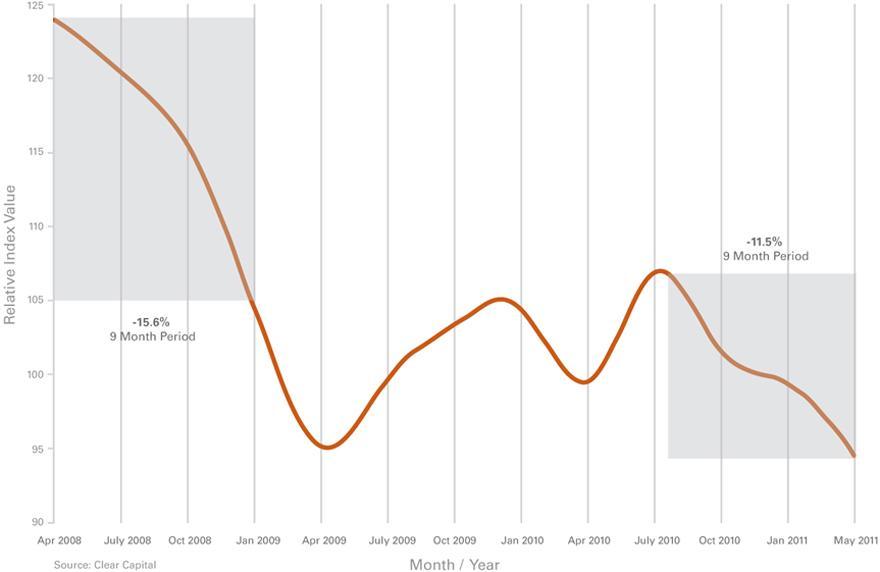
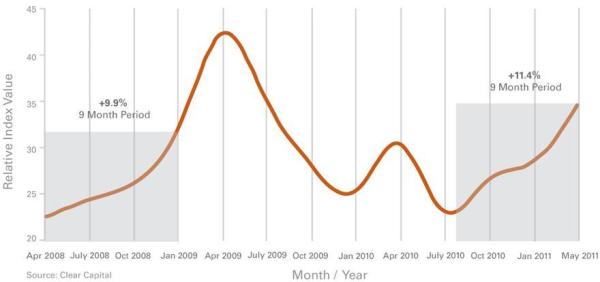
Clear Capital discussed this point in their May 2011 Market Report. In the report they used two graphs to emphasize the connection. In the first graph, they charted the national saturation rate of foreclosures (REOs) from 2008 until the present.

In the second graph they charted national home prices during the same time period.

We can see that as the saturation rate of foreclosures increase, prices decrease.

Bottom Line

More foreclosures will be coming to market and they will have an impact on values. How will your neighborhood be affected? Sit down with a local real estate expert to find out.


HALF-CENTURY OF DECLINE ENDS: HOUSEHOLD SIZE IS UP

Based on 2010 Census data on 12 states and the District of Columbia, the average household size is creeping up after falling for the past 50 years.

In Florida, the average household size rose to 2.48 persons per household from 2.46 a decade ago. The Sunshine State, along with Tennessee, also recorded the biggest increase in average household size among renters.

Experts attribute household expansion to the economic downturn, with young adults who are unable to find jobs living with their parents and people who lost their homes to foreclosure moving in with family or friends. Ohio State University sociology professor Zhenchao Qian reports a jump in young adults between the ages of 19 and 29 who live with their parents to 34 percent in recent years from 25 percent in 1980.

Brookings Institution demographer William Frey says immigrants living with in-laws and other relatives also has contributed to the larger household size.


 IN TIME FOR BUYING SEASON, RATES HIT YEARLY LOWS

The 30-year fixed-rate mortgage, a popular choice among buyers, sank even lower this week, matching its yearly low of 4.71 percent from January, reports Freddie Mac in its weekly mortgage market survey. Last year at this time, the 30-year fixed-rate mortgage averaged 5 percent.

Meanwhile, the 15-year fixed-rate hit a new yearly low of 3.89 percent this week. Last week, the 15-year fixed-rate mortgage averaged 3.97 percent. The 15-year rate averaged 4.36 percent last year at this time. It reached its lowest level on record in November when it averaged 3.57 percent.

The one-year adjustable-rate mortgage averaged 3.14 percent, down from last week’s 3.15 percent. Last year at this time, it averaged 4.07 percent.

“Weaker economic data reports reduced Treasury bond yields and allowed mortgage rates to drift lower for the third consecutive week,” says Frank Nothaft, Freddie Mac’s chief economist.


 C.A.R. MAKES INROADS INTO SHORT SALE IMPROVEMENTS

C.A.R.’s efforts to address the issues related to the difficulties of the short sale process are starting to gain traction.

Late last week, the Federal Housing Finance Agency (FHFA) announced it has directed Fannie Mae and Freddie Mac to establish consistent policies and processes for the servicing of delinquent loans. The alignment will help servicers do a better job of resolving delinquencies in a more consistent and expeditious manner, keep more consumers in their homes whenever possible and minimize losses to companies and taxpayers.

The directive will streamline and expedite borrower outreach, align mortgage modification terms and requirements, and establish a consistent schedule of performance-based incentive payments and penalties.

The updated guidelines also prevent servicers from seeking foreclosure at the same time a borrower is being considered for a loan modification.

FHFA, Fannie Mae, and Freddie Mac said these directives are in response to concerns about servicer performance raised throughout the industry and government.

C.A.R. has been meeting regularly with industry regulators, lenders, and servicers to press for improvements to the short sale process and will continue to do so until significant improvements are made.

More info: http://www.fhfa.gov/webfiles/21190/SAI42811Final.pdf


GOV’T LOOKS TO REDUCE REAL ESTATE INVENTORY

The Obama administration is looking to get rid of 14,000 surplus properties that the federal government owns around the country and is costing taxpayers money to maintain.

The surplus properties include everything from unused roads and empty lots to warehouses and office buildings.

“The government can no longer foot the bill for vacant buildings,” says Rep. Jason Chaffetz, R-Utah, who also has authored a bill to quickly dispose of the government’s surplus property, but without using a special commission as the Obama administration has proposed.

The federal government spent about $134 million to maintain surplus buildings in 2009. The Obama administration says that improving the government’s management of surplus properties stands to save taxpayers $15 billion over several years.

The Obama administration is proposing a special commission be used to handle the surplus property in order to try to sidestep problems that have hindered the sale of these properties in the past. The presidentially-appointed, seven-member Civilian Property Realignment Board would evaluate surplus federal properties and make recommendations to “significantly reduce” the government’s real estate inventory, which ultimately would be voted upon by Congress.

The government believes there are some 12,000 surplus federal properties within the U.S. and about 2,000 overseas. The commission would not deal with military, national security sites, national parks, or wildlife refuges.

TEAM EMPOWERMENT MORTGAGE CHATTER: May 6; News & Headlines; Impact of Distressed Properties on Neighboring Values; ‘Home Rescue Fair’ Tries to Curb Foreclosures; Do You Need a Buyer’s Agent?; 5 Ways To Keep Your Client Data Secure; Today’s Rates

To All The Wonderful Mothers…Happy Mothers Day From Zackry Cooper & Team Empowerment


“He who enjoys good health is rich, though he knows it not” – by Italian Proverb

NEWS & HEADLINES

Rates are improving, and agency MBS prices yesterday improved by .375-.50. Fannie & Freddie 4’s closed yesterday about 100.375. By and large, these securities are filled with 4.25-4.625% 30-yr mortgages. Let’s be conservative and add a point (1.0) for the value of servicing, and suddenly “the market” is paying nearly 101.50 (1.50 rebate) for a 4.50% 30-yr agency mortgage. Below that there will be some buy-downs, and above it will be some buy-ups, and it depends on rate lock period, but that’s about the pricing. This leads into…

Rates are about the best they’ve been all year. Remember all those sparkly clean 5% or even 5.50% 30-yr agency loans that the originators were producing in the last 6 months? Many of them may be coming back as refi’s. But keep in mind that loan-level price adjustments (LLPA’s) have changed, as has the FHA MIP’s, so recent prepayment speeds have been in transition over the past few months due to those, and due to servicers prioritizing loan processing for one agency over the other. And if you think components such as LLPA’s, MIP’s, and increased documentation impact the borrower’s ability to refinance, just wait and see what comes out of the QRM public comment period.

Mortgage security traders hardly know which way to turn, and I read several divergent ideas about what is going on and where investors should place their bets – any of which can be confusing to anyone not well versed in MBS lingo. But this is more relevant for originators: “Freddie Mac reported that 30-year fixed mortgage rates averaged 4.71% this week which matches the lowest level seen this year. Refi activity is likely to have increased this week as more of the 5% coupon enters into the refi window; however, a significant pickup is not expected unless mortgage rates rally to 4.50%, said a Credit Suisse report.”

Yesterday I mentioned the latest from Freddie Mac about not requesting government funds given the quarterly results. I received a helpful note: “Thanks for earnings update. One small correction, which is that this is actually the fourth time since the government took Freddie over that it reported quarterly earnings and did not ask for a Treasury draw (not the first as you reported). Freddie’s earnings are up, delinquencies down, and even its REO inventory dropped 10% in the last quarter – good things.”

Last month the government reported that the economy added 216,000 jobs in March, and the unemployment rate dipped to 8.8%. But although the number of unemployed has declined by 1 million since November, hourly earnings growth remains anemic, having been flat in four of the past five months, and don’t expect high gas prices to help the retail and leisure/hospitality industries and therefore job counts.

As mentioned above, Treasuries and MBS’s rallied yesterday. The 10-year note closed better by nearly .5 at a yield of 3.17%. Some of the commodities are coming off of their high levels, so perhaps we’ll see some better prices at the gas pump which would tend to help the consumer’s outlook. The expectations were for this morning’s numbers to show that job growth slowed in April (+185k) and that the unemployment rate was unchanged (8.8%). But nonfarm payrolls came out at +244,000, and the Unemployment Rate was 9.0% for April. The 10-yr shot up to 3.21% and MBS prices are worse by roughly .250.


THE IMPACT OF DISTRESSED PROPERTIES ON NEIGHBORING VALUES

The banks are finally getting their foreclosure paperwork in order. They will start bringing larger numbers of distressed properties to market over the next six months. We must realize that this influx of discounted inventory will have an impact on the values of neighboring homes. How large an impact?

According to RealtyTrac a foreclosure sells for 59% of the value of a similar non-distressed property. Therefore, this foreclosure inventory will affect values in two ways:

1.) As Discounted Competition

Obviously, a segment of purchasers will prefer the discounted property based on price alone. Even if the distressed property is in need of substantial repair, the buyer is getting the property at a 41% discount. Price is determined by supply and demand. Distressed properties will eat up a portion of the demand for housing and that will put downward pressure on all values.

2.) As Comparable Sales on Your Appraisal

Even after you put your house into contract, this distressed inventory can still impact your transaction. Unless your purchaser is paying all cash, there will be an appraisal of your property by the bank who is giving the mortgage to your buyer to complete the purchase. Because of the volume of distressed properties selling in almost every market, banks are instructing appraisers to use these discounted sales in determining values of non-distressed sales. We can argue the logic of this some other time. At this point, we must simply be aware that this is taking place.

Bottom Line

Over the next several months, banks will be moving substantial numbers of foreclosures onto the market. This will impact values of other homes in the region. If you are considering selling, now might be the best time. You want to be sold and closed before these properties come to market and impact your price.


‘HOME RESCUE FAIR’ TRIES TO CURB FORECLOSURES

With foreclosures up nearly 42 percent last month, the city of Las Vegas is hosting a Home Rescue Fair to help teach home owners how they can save their homes.

At the event, home owners facing foreclosure or financial hardship will be able to have face-to-face sessions with loan specialists, housing counselors, and attorneys and attend workshops to learn how they can keep their home. Several local services – such as in education, job placement, and public benefits – will also be available at the Home Rescue Fair, which runs May 20-21.

Las Vegas’ real estate market continues to be one of the most plagued in the country by a high number of distressed sales, which is bringing its housing prices down. Home prices in the Las Vegas metro dropped to $117,000 in March, which is the lowest level since January 1996. Distressed sales accounted for 69 percent of all market transactions in March, according to DataQuick.

The foreclosure problem doesn’t seem to be easing either. Lenders foreclosed on 3,331 single-family homes and condos in March, which is up 41.6 percent from February, according to DataQuick.

However, high inventories are slowly being chipped away. Nearly 5,000 homes sold in the Las Vegas-Paradise metro area in March, the highest volume in five years, DataQuick reports. Sales increased 27.3 percent compared to one month prior, with demand mostly coming from investors and cash buyers who were snatching up bargain-priced distressed properties.


DO YOU NEED A BUYER’S AGENT?

After years of trepidation, home buyers are finally beginning to wade back into the housing market. But as they do, many are making the surprising choice to hunt alone, rejecting the assistance of what’s known in real estate as a buyer’s agent.

For years, house-hunters have had the option to work with a real estate agent who shows them properties and may ultimately negotiate the price – a counterbalance to the agent who almost invariably represents the seller. But now fewer buyers are taking it. Of the buyers who purchased a property through a real estate agent, just 57% had buyer representation, according to a 2010 report by the National Association of Realtors. That’s down from 62% in 2009 and 64% in 2006, before the housing bust. Also, fewer buyers are first learning about the home they purchase from real estate agents: just 37% are reporting real estate agents as their first source of information on the home they purchased, down from 50% a decade ago, according to NAR.

Many experts think this is a bad move – worse, for example, than trying to sell a house without an agent. For one thing, in most cases, a buyer doesn’t pay an agent; the buyer’s agent splits the commission with the seller’s agent, so the services are essentially free to the buyer. Also, a buyer’s agent can usually access historical price data for home sales in the area, which means he can recommend a bidding strategy that targets comparable properties that sold for less, rather than the mid-range. John Vogel, adjunct professor of real estate at the Tuck School of Business at Dartmouth College, calls going through this process alone “a mistake.”

There are lots of reasons buyers may choose to represent themselves. The real estate listings and detailed information that was once only available to real estate agents – like median sales prices in a neighborhood, the amount of days a home has been on the market, and how many price cuts it has endured – are now online. And because most buyers’ agents don’t get paid until a home is purchased, they have a strong incentive to see you buy something quickly, Vogel says: They may not tell a client to wait for prices to fall further.

On the other hand, some house-hunters may think they are working with a buyer’s agent, when in reality, they’re actually dealing with a seller’s agent. Many buyers contact the agent listed with the property or walk into an open house thinking the agent is working in their favor, says Paul Howard, a buyer’s-only broker licensed in New Jersey and Pennsylvania. Or some buyers may start working with an agent who has their interest at hand, but the house they want to buy is listed with the real estate company the agent works for; at that point, buyers should have the option to find an agent not tied to the property. Some seller’s agents may also discourage prospective buyers at the beginning of their search from seeking out a buyer’s agent. Commissions are already lower due to declining home values, and some would prefer not to split it, says Ginger Wilcox, head of training for buyers’ and sellers’ agents at Trulia.com. “Agents are fighting for their commissions.”

Still, in many cases buyers may be at an advantage when they work with a buyer’s agent – at least compared to relying on a seller’s agent for advice or guidance. A seller’s agent is contractually obligated to help make the sale happen in the seller’s favor, often as close to the asking price as possible. Buyers’ agents can also suggest home inspectors and financing companies they’ve worked with before, says David Kent, president of the National Buyer’s Agent Association; they’re not supposed to make money off the referrals.

When searching for a buyer’s agent, experts recommend putting a few through their paces first. The most helpful agents won’t just rely on what’s listed online, says Vogel. Instead, they might drive around a neighborhood looking for signs of properties that are for sale by owners or mail letters to existing homeowners alerting them to a buyer who’s interested in a similar property to theirs. And by the time a buyer enters into a contract, his agent should be there to look for red flags.


5 WAYS TO KEEP YOUR CLIENT DATA SECURE

You can’t run your business without collecting personal and financial information about your clients. Yet, if sensitive data falls into the wrong hands, it can lead to fraud and identity theft.

Given the cost of a security breach – losing your customers’ trust and perhaps even defending yourself against a lawsuit – safeguarding personal information is just plain good business.

1. Take stock of what you have.

Know what personal information you have in your files and on your computers. Understanding how personal information moves into and out of your business and who has access to it is essential to assessing security vulnerabilities.

2. Secure your Web applications.

Pay particular attention to the applications on your Web site through which you collect information and consumers request information. These can be vulnerable to a form of hacking known as injection attacks, in which a hacker inserts malicious commands into your online form. Once the commands are in your system, the hacker can grab your data.

3. Secure your points of connection.

It’s one thing to secure your computer system; it’s another to secure the devices and applications that connect to it. These include laptops, cell phones, and your Web site. If your laptop has been compromised, it can open a door into your system.

The same thing applies to vendors who provide data processing or other services on a contract basis. If their computer is compromised, they can infect yours when they access your system. You’ll also want to limit storage of your sensitive information to only computers that don’t connect to the Internet.

4. Don’t trust just anyone.

Your security measures are only as thorough as the people who work with you. Assistants and team members must agree to uphold the confidentiality of your sensitive information and participate in training on keeping your data secure. If there’s ever any doubt, withhold their access to sensitive data.

5. Think about physical security too.

Many data compromises happen the old-fashioned way – through lost or stolen paper documents. Often, the best defense is a locked door or an alert employee. Store paper documents, sensitive files, and backups in a locked room or file cabinet.

TEAM EMPOWERMENT MORTGAGE CHATTER: May 5; News & Headlines; The 4 C’s of Mortgage Underwriting; REO Inventory Reaches All-Time High; Gallup Poll: Americans Say Buy Now; How To Reach a ‘Camouflage’ Buyer

“I do not think there is any other quality so essential to success of any kind as the quality of perseverance. It overcomes almost everything, even nature. “ – John D. Rockefeller

NEWS & HEADLINES

Freddie Mac’s employees may want a margarita tonight after reporting a $676 million quarterly profit, and indicated it would not seek additional funds from the US Treasury this quarter for the first time since it was taken over by the government nearly three years ago. But Freddie said that over the long term it was unlikely to earn more than the dividends owed to the Treasury on preferred stock issued as part of its bail-out and therefore expected to request additional funds in future periods. The CEO said, “Continued improvements on the employment front and in early-stage delinquencies were positive signs during the quarter, but we believe large inventories of unsold homes and a high number of distressed sales will continue to put downward pressure on home prices in many neighborhoods.”

Importantly for the industry, Freddie Mac also said that its requests to banks to repurchase faulty loans declined to $3.4 billion at the end of the first quarter, compared with $3.8bn at the end of the fourth quarter of 2010. More than 40% of loans owned by Freddie Mac were originated after 2009 and those loans have far higher equity and lower delinquency rates than those issued in 2006 and 2007.

A segment of the population looks forward to the Special Swimsuit Edition of Sports Illustrated, or Time Magazine’s Man of the Year Edition. Somehow, I don’t think that the FDIC’s answer will garner quite the attention, but it is useful to servicers nonetheless. “Supervisory Insights Special Foreclosure Edition” can be found at FDIC.

This is not good news, but it is not unexpected, for anyone following shadow inventory numbers. The report shows the FHA REO inventory was at 68,801 at the end of February, up 54.2% from February 2010! HUDREO

Yesterday the MBA reported what lock desks everywhere already knew, and that was that residential mortgage applications increased 4% from one week earlier. Refinancing apps picked up 6% and purchases were up .3%. With these lower rates refi’s are accounting for nearly 63% of apps, and ARM share is up to 6.7%.

And yesterday rates continued to drop, with the ADP private payroll employment numbers yesterday coming in weaker than expected (179k versus 200k) and the ISM Service coming in at their weakest levels since last August (“slumped” is the word one report used). The US continues to need to finance its deficit, which includes selling $72 billion next week ($32 billion 3-yr on the 10th, $24 billion in 10-yr’s on the 11th, and $16 billion in 30-yr’s on the 12th).

How about these rates this morning? The yield on the 10-yr this is below 3.20%, down to 3.17%. Jobless Claims this morning came out up 43,000 to 474,000 claims last week. Productivity numbers also showed an increase, which is helpful, but stocks and bonds are reacting to the Jobless Claims increase. Agency MBS prices are better by between .125-.250.


THE 4 C’S OF MORTGAGE UNDERWRITING

With Spring upon us, and new buyers out looking for houses, I thought today might be a good time to review the basics of what lenders look for as they decide to approve (or deny) mortgage applications. For at least 25 years, I have heard them called – The 4 C’s of Underwriting – Capacity, Credit, Cash, and Collateral. Guidelines and risk tolerances change, but the core criteria do not.

CAPACITY

CAPACITY is the analysis of comparing a borrower’s income to their proposed debt. It considers the borrower’s ability to repay the mortgage. Lenders look at two calculations (we call ratios). The first is your Housing Ratio. It simply is the percentage of your proposed total mortgage payment (principal & interest, real estate taxes, homeowner’s insurance and, if applicable, flood insurance and mortgage insurance – like PMI or the FHA MIP) divided by your monthly, pre-tax income. A solid Housing Ratio (often called the front end ratio) would be 28% or less; although, many times loans are approved at a significantly higher number. That’s because your front end ratio is looked at in conjunction with your back end ratio. The back end ratio (referred to as your Debt Ratio) starts with that mortgage payment calculation from the Housing Ratio and adds to it your recurring debts that would show up on your credit report (auto loans, student loans, minimum credit card payments, etc.) without taking into consideration some other debts (phone bills, utility bills, cable TV). A good back ratio would be 40% or less. However, many loans are granted with higher debt ratios. Understand that every application is different. Income can be impacted by overtime, night differential, bonuses, job history, unreimbursed expenses, commission, as well as other factors. Similarly, how your debts are considered can vary. Consult an experienced loan officer to determine how the underwriter will calculate your numbers.

CREDIT

CREDIT is the statistical prediction of a borrower’s future payment likelihood. By reviewing the past factors (payment history, total debt compared to total available debt, the types of monies: revolving credit vs. installment debt outstanding) a credit score is assigned each borrower which reflects the anticipated repayment. The higher your score, the lower the risk to the lender which usually results in better loan terms for the borrower. Scores below 620 are difficult (though not impossible); scores from 620-660 are mediocre; those from 660-720 are considered good; and above 720 are very good. Your loan officer will look to run your credit early on to see what challenges may (or may not) present themselves.

CASH

CASH is a review of your asset picture after you close. There are really two components – cash in the deal and cash in reserves. Simply put, the bigger your down payment (the more of your own money at risk) the stronger the loan application. At the same time, the more money you have in reserve after closing the less likely you are to default. Two borrowers with the same profile as far as income ratios and credit scores have different risk levels if one has $50,000 in the bank after closing and the other has $50. There is logic here. The source of your assets will be examined. Is it savings? Was it a gift? Was it a one-time settlement/lottery victory/bonus? Discuss how much money you have and its origins with your loan officer.

COLLATERAL

COLLATERAL refers to the appraisal of your home. It considers many factors – sales of comparable homes, location of the home, size of the home, condition of the home, cost to rebuild the home, and even rental income options. Understand the lender does not want to foreclose (they aren’t in the real estate business), but they do need to have something to secure the loan against, in case of default. In today’s market, appraisers tend to be conservative in their evaluations. Appraisals are really the only one of the 4 C’s that can’t be determined ahead of time in most cases.

Now, each of the 4 C’s are important, but it’s really the combination of them that is key. Strong income ratios and a large down payment with strong reserves can offset some credit issues. Similarly, long and strong credit histories help higher ratios…and good credit and income can overcome lesser down payments. Talk openly and freely with your loan officer. They are on your side, advocating for you and looking to structure your file as favorably as possible.


REO INVENTORY REACHES ALL-TIME HIGH

The national inventory of REO properties rose in March to a record high of 2.2 million. Foreclosure starts also increased by 33 percent month-over-month, according to the March Mortgage Monitor report by Lending Processing Services Inc.

However, it’s not all doom and gloom for the housing market. The report revealed a significant increase in foreclosure sales, which is helping to chip away at the swelling inventories that are battering many markets.

Also, delinquencies continue to decline, which is a sign of fewer foreclosures brewing in the pipeline. Delinquencies fell more than 11 percent in March from February – the lowest level since 2008 and a nearly 20 percent year-over-year decline, according to Lender Processing Services Inc. The total U.S. loan delinquency rate, which is for loans 30 or more days past due (but not in foreclosure), is 7.78 percent.

States with the highest percentage of loans where home owners have fallen behind are Florida, Nevada, Mississippi, New Jersey, and Georgia.

On the other hand, states that boast the lowest percentage of delinquent loans are Montana, Wyoming, Alaska, South Dakota, and North Dakota.


GALLUP POLL:AMERICANS SAY BUY NOW

With dropping home values in many markets mixed with interest rates at historical lows, homes are more affordable now than they’ve been in the last 35 years, reports Zillow.com.

The average buyer nowadays can expect to spend about 17 percent of her monthly gross income on a mortgage, which compares to a 25 percent average since 1975, Zillow reports.

With affordability high, Americans seem to be getting the message about the value of home ownership. Nearly 70 percent of Americans say now is a good time to buy a home, according to a recent Gallup poll.

Men are about 16 percent more likely to say now is a good time to buy a home than women. And Americans living in the West are most favorable toward buying (75 percent), which compares to 64 percent of Americans who live in the South who say now is a good time to buy.

Americans with higher incomes also expressed more of an interest in home ownership, according to the Gallup poll. Americans who make $75,000 or more a year are 18 percent more likely to say that 2011 is a good time to buy a home than those making $30,000-$75,000.


 HOW TO REACH A CAMOUFLAGE BUYER

More buyers today are trying to camouflage themselves and downplay their interest in real estate, often telling agents they’re “just looking,” observes Scott DiGregorio, sales manager at Primary Residential Mortgage in Fort Myers.

“The buyers have changed, the times have changed and the market has changed, yet real estate agents are taught to do things the way they did 35 years ago. It’s insane,” DiGregorio says.

The key today is to use your marketing to educate customers, not sell them. DiGregorio features reports on his Web site to download, hosts webinars, and uses drip campaigns to periodically send e-mail reports that he says addresses buyers’ main fears when it comes to buying a home.

“Do not try to sell in these e-mails,” says DiGregorio. “Do not try to close in these e-mails. Make sure you’re doing nothing but educating.”

Drip e-mail campaigns, social media, and other marketing strategies all can help agents build trust with customers, DiGregorio says.

But in building trust and educating the buyer about home ownership, DiGregorio says that may sometimes require agents to walkaway from prospects.

“I firmly believe some people shouldn’t buy a house right now,” DiGregorio says. “We have to be OK with that and we have to help people make that decision.”

TEAM EMPOWERMENT MORTGAGE CHATTER: May 4; Is Short Sale or Foreclosure My Best Option?; 4 Keys to Selling in Today’s Market; Buying Beats Renting; Survey Shows Potential Growth in Online Ad Spending; Buyers Bypass ‘Fixer-Upper’, Want Move-In Ready

“You are much grander than you think you are.” — Asara Lovejoy: Human potential author and coach


IS SHORT SALE OR FORECLOSURE MY BEST OPTION?

We get asked this question quite often. In a rapidly changing market, it is difficult to give absolute answers. Much depends on your family’s personal situation. However, if you realize that you can no longer make the payments, you may have to decide between doing a short sale or letting the home go to foreclosure. Here are three things you may wish to consider:

1.) Impact on Your Future Ability to Get a Mortgage

There are many different lending institutions, each with their own requirements when it comes to your ability to obtain a mortgage in the future. However, a common trend is to be much more lenient with someone working through a short sale rather than letting the house go to foreclosure. As an example, the Fannie Mae site, Know Your Options explains you:

May be able to get a Fannie Mae mortgage to purchase a home sooner (in as little as 2 years) than if you went through foreclosure (at least 7 years)

You can get further information here. However, in a rapidly changing environment, make sure you get the latest information available from the actual lending institutions mentioned.

2.) Impact on Your Credit Score

There has been much dialogue on this issue. The question is whether or not a foreclosure will have a more severe impact on your credit score than a short sale. A recent FICO study sheds needed light on this question. Here is a chart from that report.

The first chart shows the impact on the score for each stage of delinquency, and the second shows how long it takes the score to fully “recover” after the fact.

We can see that there is very little difference in impact on your credit score whether you choose a short sale or a foreclosure.

3.) Impact on Your Family during the Move

Usually a family asking this question is already experiencing major financial difficulties. This may be putting immense pressure on both parents and the children. If you allow your home to go to foreclosure, you move and leave it vacant or you stay waiting for an official to knock on your door demanding you move. That added burden can cause even more stress for a family.

In the short sale process, you work with the bank and pre-determine the day you will move. The new purchasers usually move in the same day. Your family moves with a plan and you don’t leave the neighborhood with a vacant house to deal with. There is a level of dignity in this type of move that does not always take place in a foreclosure situation.

Bottom Line

For several reasons, a short sale may be the better option for your family. It is best to get professional advice if faced with this decision.


 4 KEYS TO SELLING IN TODAY’S MARKET

Home sales and prices are still dropping around the country as huge inventories of foreclosures and short sales continue to weigh on many markets. So how can traditional sellers stand out in a crowded real estate marketplace? CNNMoney.com recently highlighted several keys to getting a home sold in a tough real estate market.

1. Cut your price by a lot. Buyers nowadays want to feel they are getting a “steal,” real estate experts say. But some sellers may be tempted to list a property above fair market value just to test out the market and see if they can get a taker. In the past year, about 25 percent of sellers who initially listed their homes too high ended up having to reduce the price, according to Trulia.com.

“The first 30 days on the market are the most important,” says Elizabeth Kamar, a real estate professional in Norwalk, Conn. That crucial time is when the home gets the most attention and showings. For sellers who aren’t realistic about the price from the get-go, they often end up with less than they would have if they priced it right initially, Kamar says.

Experts also note that if after 30 days on the market there are still no buyers, sellers may need to make a big move.

“When a property sits, people start thinking it must be listed too high,” says Ellen Klein, a real estate professional in Rockaway, N.J. She suggests making a giant price cut–as much as 10 percent of the asking price–which may be extra motivation for buyers to take a second look or attract a new pool of potential buyers seeking a lower price range.

2. Play hardball in negotiations. Sellers shouldn’t feel they have to accept any lowball offer that comes their way. However, if a buyer is willing to negotiate, that’s when sellers need to try to set aside feelings of anger or insult and start to counteroffer, says Mabel Guzman, president of the Chicago Association of REALTORS®. Guzman says the ideal is that you’ll be able to negotiate within $10,000 to $20,000 of an acceptable offer. Using incentives–such as agreeing to leave the appliances–may get buyers to budge in agreeing to a higher price.

3. Stage it. Staging is becoming popular in trying to sell mid-range homes. Professional stagers will help home owners highlight key areas of a home and often rearranges furniture or bring new furniture in, repaint, and get the home looking like it’s ripped from a catalog. Real estate brokers say that proper staging can actually speed up a sale and increase the final sales price too.

4. Get the home in front of as many buyers as possible. The real estate professional needs to get creative in the marketing to make sure the home gets a lot of attention from buyers. “The more eyeballs that get on the listing, the better,” says Katie Curnutte of the real estate information web site Zillow.com.

One key: Boosting the home’s online presence. Having 20 instead of five photos will nearly double the number of hits the property gets on the Web, according to Zillow.com. Incentives can also draw out buyers, such as with offers to cover a buyer’s closing costs, pay the first year’s property taxes, or even a $1,000 gift card (and maybe one for the buyer’s agent too). (Note: You must disclose any such gifts or payments when the offer is agreed on.)

Source: CNNMoney.com


 BUYING BEATS RENTING IN 80 PRECENT OF U.S. CITIES

Thanks to falling home prices and rising rents, would-be home buyers have the upper hand this house-hunting season. In nearly 4 out of 5 major U.S. cities, it’s now cheaper to buy a home than to rent. That’s up from 72 percent of cities last quarter, based on the Rent vs. Buy Index released by online real estate resource Trulia.

“With home prices nearing a double-dip and more foreclosures expected to flood the housing market over the next two years, the decision between renting and buying a home across most of the country has clearly moved in favor of buying,” said Ken Shuman, head of communications at Trulia, in a press release. “As we head into the summer buying season, those looking to buy a home should be encouraged by improvements in the market and feel optimistic about their chances of finding an affordable home, much more so than in previous years.”

Areas with the most affordable housing market conditions tend to be cities hardest hit by the foreclosure crisis, including Las Vegas, Phoenix, and Miami. Meanwhile, those with more affordable rental markets included New York City, Los Angeles, and Seattle. Omaha, San Jose, and Detroit had some of the largest quarter-over-quarter jumps in favor of homeownership.

The time factor is one of many stumbling blocks preventing house hunters from making the jump from window shoppers to homeowners, Miller says. During the housing boom, homeowners were virtually guaranteed to make money or at least break even on their home sales, regardless of the period they owned the home. In today’s market, experts see home prices appreciating much slower, therefore home owners will have to make a longer commitment to their housing investments than in previous years. “The future upside is much farther down the road,” he says. “You’re looking at five, maybe 10 years out of this sort of rocky bottom.”

Until consumers regain confidence in the housing market and economy, Miller and others expect the rental market will continue to benefit from apprehensive house hunters. “There’s been some erosion in attitudes toward homeownership,” says Eric Belsky, managing director of the Joint Center for Housing Studies at Harvard University. “There’s two parts to the home buying decision: the will and the way.”

Despite the numerous obstacles for prospective home buyers, experts remain confident that improving employment and economic data will breathe life into the housing market this spring and summer. More Americans signed contracts to buy homes in March, according to the National Association of Realtors’ pending homes sales index–up 5.1 percent–a signal that could mean more house hunters are snapping up bargains. “We’re sort of in that in-between phase,” says Heather Fernandez, vice president of marketing at Trulia. “People aren’t running out to buy that dream house yet because they’re not that confident. But we’re starting to see consumer confidence shift, people are more interested in home buying, rental rates are still high, and therefore, just based on the numbers, increasingly homeownership is becoming more affordable across the U.S.”

Source: CNNMoney


 SURVEY SHOWS POTENTIAL FOR GROWTH IN ONLINE AD SPENDING

One in four Realtors spent less than 10 percent of their advertising budget online last year, suggesting there’s still plenty of room for growth in 2011, according to a survey by ThinkEquity LLC.

The online survey of 162 Realtors found 47 percent spent more than half of their advertising budget online last year, and that 58 percent of agents were planning to increase their online ad spending in 2011. One in three said they spent 61 percent or more of their advertising budget online.

“Compared to print advertising, our survey results show respondents overwhelmingly believe Internet advertising is much more valuable,” ThinkEquity analysts said in a report on the survey.

Among those surveyed, 68 percent said print advertising is of little or no value for classified listings, and 60 percent said print was of little or no value for lead generation. A majority of agents said print ads are still useful for brand building, including 17 percent who said print ads were “high value” when used for that purpose.

In contrast, the percentage of agents who believed Internet advertising was of little or no value for classified listings, lead generation and brand building was below 20 percent.

Most of those surveyed — 58 percent — said they plan to increase their online ad spending in 2011, while 39 percent said they plan to decrease print ad spending.

The vast majority of agents said their listings appear on their multiple listing service’s public-facing website (92 percent), Realtor.com (86 percent), their broker’s site (74 percent), their own website (72 percent) and Trulia (70 percent).

Just over half of Realtors say they or their broker pay for enhanced listings on Realtor.com, and the survey found that Realtor.com’s enhanced listings are considered to be of greater value than featured home and featured agent advertising.

While 70 percent said they saw at least some value in enhanced listings — including 18 percent who rated them as “high value” — 48 percent of agents found Realtor.com’s “Find a Realtor” search tool to be of little or no value. Featured homes and featured agent ads were rated of little or no value by 43 percent of those surveyed.

With 11 percent of agents saying they had previously paid for enhanced listings but no longer do — and only 2.6 percent saying they are considering paying for enhanced listings in the future — Realtor.com “may need to look to additional products to significantly expand revenues,” the report’s authors concluded.

According to Williamsburg, Va.-based research and consulting firm Borrell Associates, companies in the real estate industry spent an estimated $20.2 billion on advertising in 2010.

Borrell estimates that real estate agents and brokers accounted for 42 percent of that spending ($8.43 billion), followed by mortgage providers ($8.26 billion), rental property managers ($1.89 billion), and real estate developers ($1.6 billion).

Within the real estate category, agents and brokers spent the highest percentage of their ad budgets online (64 percent), followed by newspapers and other print (24.7 percent), direct mail (5.3 percent) and broadcast and cable TV (3.3 percent).

“The share of ad budgets that the real estate industry is spending on the Internet is obscene and may actually be a bit out of kilter,” said CEO Gordon Borrell. “Only one other advertising category that I know of — job recruiters — spends half its ad budget on one medium.”

Borrell said successful marketers employ “a more equitable mix of media” that includes print, broadcast, online and mail.

The biggest chunk of the $5.39 billion that Borrell estimates agents and brokers spent on online ads in 2010 was for email advertising ($2.16 billion), followed by paid search ($1.29 billion), targeted display ads ($1 billion) and so-called “run of site” display ads that rotate in less prominent spots ($783 million). Borrell estimates that agents and brokers spent an estimated $136 million on streaming video ads and $17 million on streaming audio.

“I suspect that real estate advertisers have just begun figuring out that they’ve put too much money into buying keywords and online banners,” Borrell said. Those advertisers are likely to “adjust the dials somewhat and may even shift a little ad spending toward broadcast, particularly TV.”

But Borrell said that because real estate is proximity-based and mobile devices can serve as home locators, it could also become “the biggest category of all for mobile marketing.”


 BUYERS BYPASS ‘FIXER-UPPER’, WANT MOVE-IN READY

More buyers are shunning “as-is” properties in favor of homes that are in move-in condition, according to real estate professionals and recent surveys.

For example, a Coldwell Banker survey recently found that 87 percent of first-time buyers say they desire a “move-in” ready home.

“This is absolutely the story of this market. It seems buyers will pay a premium, engage in a bidding war, and even overpay just to avoid buying a “project” house,” says Beth Freed of Terrie O’Connor REALTORS® in Ridgewood, N.J.

As such, real estate pros are advising their sellers to fix up their homes for quicker sales. “There is no question homes that have been spruced up for the market sell quicker,” says Kate Conover with RE/MAX in Saddle River, N.J.

That doesn’t mean major, costly renovations that sellers won’t likely get back on the sale price either, she says. Instead of a major kitchen or bath renovation, just repainting the home or removing the clutter can go a long way in freshening up a home. Also, don’t forget about curb appeal: Freshen up the flowerpots, trim the bushes, and paint the front door, if it’s starting to show wear and tear.

Also with buyers wanting “move-in” ready homes, real estate pros say it’s crucial that sellers address any major maintenance and safety issues – such as leaky roofs – before the home even goes on the market.

TEAM EMPOWERMENT MORTGAGE CHATTER: May 3, Almost 14,000 Houses Sold Yesterday; Home Owners to Congress: Leave MID Alone; Bailing On Mortgage Not A Good Idea; 3 Ways to Avoid Legal Trouble In Real Estate

Do You Google Places? Check Out Zackry Cooper on Google Places & write a review today!


“You can have brilliant ideas, but if you cannot get themacross, your ideas will not get you anywhere.” — Lee Iacocca: Businessman, author, former CEO of Chrysler Corporation


ALMOST 14,000 HOUSES SOLD YESTERDAY

One of the biggest misconceptions in today’s housing market is that homes are not selling. That is simply not true. Last month’s Existing Sales Report from the National Association of Realtors (NAR) showed that homes were selling at an “annual rate of 5.10 million”. That’s an average of 13,973 every day – 365 days a year!

And the monthly Pending Sales Report, which measures the number of houses going into contract each month, has showed increases in six of the last nine months prompting Lawrence Yun, NAR’s chief economist to say:

“Since reaching a cyclical bottom last June, pending home sales have posted an overall gain of 24 percent and demonstrate the market is recovering on its own. The index means modest near-term gains in existing-home sales are likely.”

We realize that 40% of the sales are distressed properties and that 22% of buyers are investors. Yet, that still doesn’t negate the fact that homes are in fact selling… and 60% of them are NOT foreclosures or short sales.

And Yun believes this uptick will continue:

“Based on the current uptrend with very favorable affordability conditions, rising apartment rents and ongoing job creation, existing-home sales should rise around 5 to 10 percent this year.”

Bottom Line

Homes are selling. You probably will need to offer a compelling price if you put your house on the market. But if you do, it will sell.


 HOME OWNERS TO CONGRESS: LEAVE MID ALONE

More than half – 53 percent – of home owners recently surveyed say they want Congress to leave the federal tax credit for home owners alone, according to a recent opinion poll at http://www.HousingPredictor.com . Those surveyed also say they want Congress to instead focus its efforts on instituting other tax advantages to stimulate the real estate market.

Some congressional leaders have raised the issue of trimming the mortgage interest deduction as a way to increase federal taxes and alleviate the ongoing budget crisis.

The mortgage interest deduction allows home owners to write off the mortgage interest and state taxes paid as itemized deductions on their personal federal income taxes.

The National Association of REALTORS® has strongly opposed any cut to the mortgage interest deduction and has lobbied Congress to protect it.


BAILING ON MORTGAGE NOT A GOOD IDEA

An estimated 11 million home owners owe more on their mortgage than their property is currently worth. That’s made more home owners consider walking away from their mortgage and home ownership, even those who can still comfortably afford to make their payments (known as “strategic default”).

Walking away from a mortgage usually results in either a short sale or foreclosure. So what are the consequences of walking away? There may be far more consequences than what most home owners ever considered.

The consequences include everything from badly affected credit to potential tax consequences and deficiency risks. There are even possible professional implications, Justin McHood with Academy Mortgage in Chandler, Ariz., warns in an article at Zillow.com.

Home owners’ credit scores will be badly hit regardless of whether they attempt a short sale or have their property foreclosed on. (See How Missed Mortgage Payments Hurt Credit Scores)

There also could be the potential for deficiency risks when walking away from a home, which largely varies from state to state. (View anti-deficiency laws by state.) In some states, lenders may sue you for the difference between what you owe and what your short-sale or foreclosure proceeds are, McHood notes.

Home owners considering walking away also should weigh the potential difficulty they may face from moving too. For example, if moving into a rental property, they’ll have to convince a landlord to rent to them after they have the red flag of missed mortgage payments on their credit record. And paying for moving expenses – which many walkaways fail to consider – can quickly add up too.

Plus, home owners may find professional consequences from walking away from a mortgage, as the number of employers eyeing employees’ credit profiles continues to grow.


 3 WAYS TO AVOID LEGAL TROUBLE IN REAL ESTATE

Real estate transactions can be a gold mine for legal disputes. Inman News columnist and real estate coach Bernice Ross recently highlighted common sources of real estate litigation and behaviors you’ll want to avoid to keep yourself out of legal trouble. Here are three:

1. Don’t speculate on the property’s condition. Ross cautions real estate pros in diagnosing any issue regarding the property’s condition when you don’t know the exact cause. For example, she recalls an incident when buyers asked her about a brown spot on the ceiling, which, unknowingly, ended up being caused by a beehive that contained tons of pounds of leaking honey.

When buyers ask about a property’s condition, such as in the case of that brown stain on the ceiling, Ross suggests responding this way: “I don’t know what caused the stain on the ceiling. If you are interested in the property, then it’s extremely important to hire a competent roofer and physical inspection service to thoroughly investigate the condition of the property.”

2. Don’t guess on how much a seller will take for a property. If a buyer asks you how much the seller will take on an offer for the home, you’d be best to respond: “The only way to know for sure is to write an offer,” Ross says. After all, she adds, you don’t even know if the seller will sell for the asking price, so speculating on any price isn’t a good move.

3. Watch what you reveal about the characteristics of a neighborhood. Buyers might ask you if the home they’re interested in is located in a “good family neighborhood that has a low crime rate,” but be careful how you respond to that, Ross warns, or you could violate Fair Housing laws.

Whenever buyers ask about crime, a neighborhood’s ethnic composition, and about the families who live there, provide the buyers with resources to view online, such as school, demographic, and crime data. They can judge it for themselves and then you won’t risk providing inaccurate information or appear steering your buyers away from a particular area, Ross says.

TEAM EMPOWERMENT MORTGAGE CHATTER; April 29; News & Headlines; Should YOu Get A Second Opinion?; Renting: Truly or Better Option?; NAR: Resale Real Estate Prices to Fall 2% in 2011; Today’s Rates

RPM NOW ALLOWS FLIPS WITHIN 90 DAYS WITH NO MORE THAN 20% INCREASE IN RESALE PRICE

“There are no accidents… there is only some purpose that we haven’t yet understood.” — Deepak Chopra: Speaker and writer on spirituality and mind-body topics


NEWS & HEADLINES

Ask the person standing next to you, “In the first quarter of 2011, how many housing units are there in the US?” The answer is 131 million. Of those, about 86% are occupied, 57% by owners, 29% by renters, and 14% (nearly 19 million units) are vacant. In this country the home ownership rate is about 66%, down slightly from the previous quarter and year. The Census Bureau reports that the homeownership rates were highest for those householders ages 65 years and over (81%) and lowest for those under 35 years of age (38%) – no surprise there. Lastly, the homeownership rate for non-Hispanic Whites was highest at 74%, while “Black Alone householders” was lowest at 45%. CensusHouseholds

Borrowers can obtain their IRS Transcripts within minutes, many times before they are available to lender. They can just call 800-908-9946, press (1) for English, give their social security number when prompted, and give the street numbers of their address on their tax returns. The borrower should then listen to the automated message and when it prompts to submit an order by pressing (1) don’t – the borrower should hit zero (0) until it brings them to the operator. At that time the borrower can verbally request a faxed copy of the years’ transcripts needed, but remember that the borrower will be asked personal questions for all people on returns will be asked such as: what form they filed, address, SSN’s, names, number of people on returns, whether it is a business or personal fax, etc.

Who has been buying securities backed by mortgages? Over the three week period ending on April 13, domestic bank holdings of agency MBS have increased by $26 billion (from $1,093bn to $1,119bn). This sharp rise occurred after bank holdings of agency MBS remained nearly flat for about 3-4 months. In addition, a major portion of the recent spike in bank holdings of agency MBS can be attributed to the purchases of large banks instead of small banks (large bank holdings are up $21.5bn over the three week period ending on 4/13). This is unlike with the prior 3-4 months when agency MBS holdings of small banks continued to increase while those of large banks remained flat or even declined. It is also apparent that domestic banks that were aggressively growing their Treasury holdings (and agency debt) instead of agency MBS holdings in 2009 and 1H’10 are preferring agency MBS over Treasuries over the past several months.

Things seem pretty slow out there, with a light day in Asia, Europe wrapped up with the wedding holiday today and Bank Day coming up on Monday, and the devastation in the South from the tornadoes. 170 tornadoes through 6 states! (Japan’s markets were closed today, and next Tuesday through Thursday as the Golden Week holidays begin.)

Yesterday rates improved as Initial Jobless Claims jumped 25K last week with continuing claims posting a decrease. Pending Home Sales for March came in much stronger than expected, possibly due to buying ahead of the FHA MIP change. The 1st quarter GDP printed worse than expectations at +1.8% (is the economy slowing back down, or did it pick up in the first place?), and a weak 7-yr auction. The 10-year note closed higher by 14+/32s (3.314%) and rate-sheet MBS prices were better by about .250-.375.

Today we have/had had the Employment Cost Index, Personal Income & Spending, the Chicago PMI, and a Michigan Sentiment number. Personal income and spending both posted larger-than-expected gains in March. After Exxon produced a 1Q profit of $10.7B earlier this week, Chevron announced net income of $6.21B (last year’s first quarter: $4.55B) due to higher oil prices. Remember that we have more news ahead of us, MBS prices are better by about .125.


SHOULD YOU GET A 2ND OPINION?

Buying and/or financing a home are major decisions for anyone. We all look for referrals from friends, family and co-workers who have gone through the process successfully. But we wonder….

“Are there geographical differences?”

“Has the market changed since they did their transaction?”

“How has the ever-changing technology impacted real estate since their closing?”

“Are my personal circumstances (income, assets, and credit) the same as the person who is giving the referral?”

So, how do you know if the agent and/or loan officer you are working with (regardless of how you found them) is a “keeper”? It got to be more than a personality match in the current environment. It’s about effectiveness and leadership. I believe that you need to judge them by three criteria:

1. Are they an EXPERT?

Do they know everything about the home, the neighborhood, the other available homes, the pricing trends, the loan product and qualification thresholds, etc.? Are they able to target a likely buyer, if you are selling? Are they certified or have specific designations? What formal training have they had (say, in the art of negotiating, as an example). Do they know anything about quality of construction or when you are likely to need to replace a roof or boiler?

2. Are they looking to serve?

Unfortunately, many sales people operate in their personal best interests. Today, more than ever, you need someone who puts your needs ahead of their own. Whether you are looking to sell quickly or for the most money, you need an agent who acts in the best ways to help you achieve those objectives. Likewise, when looking to buy, is your agent asking you the right questions and listening, so that they can streamline your search?

3. Do they have creative solutions to your challenges?

Are their presentations to you basically the same as every other agent? Do their print ads, postcards, open house plans, and promises of fifty websites sing as monotonous? You need an agent with unique approaches though marketing plans that are comprehensive with online and offline components that speaks to a targeted buyer pool (Gen X, Gen Y, Baby Boomers, certain employment groups, particular cultural components, and so on).

If you believe you are working with a great agent and/or loan officer, thank your lucky stars and be loyal to them because they are worth their weight in gold. On the other hand, if you’re concerned that you have a run-of-the-mill person, don’t settle! Go on a search for excellence. It’s too important not to.


 RENTING: TRULY A BETTER OPTION?

After the last five years, more and more people are hesitant about purchasing a home. We definitely understand their concern. However, is the alternative option actually a better choice? Renting in the current housing market might not make good financial sense. Just this week the Harvard University Joint Center for Housing Studies released a report analyzing conditions in the rental market. The study found:

Rental markets are now tightening, with vacancy rates falling and rents climbing. With little new supply of multifamily units in the pipeline, rents could rise sharply as demand increases.

This increase in rental costs is already taking place. In their

Spring 2011 Housing Report released earlier this week, hotpads.com stated:

…that rental listing prices across the US climbed 7.4 percent while for sale listing prices retreated 8.8 percent since this time last year (April 2010 – April 2011).

Just yesterday, Trulia released its second quarter

2011 Rent vs. Buy Index. In the report, they stated that buying a home has become more affordable than renting in nearly four out of five (78%) major cities.

“With home prices nearing a double dip and more foreclosures expected to flood the housing market over the next two years, the decision between renting and buying a home across most of the country has clearly moved in favor of buying,” says Ken Shuman, Head of Communications at Trulia. “As we head into the summer buying season, those looking to buy a home should be encouraged by improvements in the market and feel optimistic about their chances of finding an affordable home, much more so than in previous years.”

“Aspiring homeowners should focus their energies on locking down a low mortgage rate sooner than later. While home prices are unlikely to return to pre-crash levels, today’s low interest rates will likely rise thanks to inflation and spikes in the Fed rates,” notes Shuman. “As the government wind downs its role in the mortgage markets higher mortgage interest rates will be inevitable.”

Bottom Line

Though purchasing a home is not an easy decision after what has taken place in the market over the last five years, realize rental prices are about to soar. You should probably take this into consideration when determining your best housing choice.


NAR: RESALE REAL ESTATE PRICES TO FALL 2% IN 2011

A National Association of Realtors index that tracks pending sales of existing homes rose 5.1 percent in March but dropped 11.4 percent compared to the same month last year.

Also today, NAR released its latest annual forecast, which anticipates a 1.8 percent drop in the median price of U.S. existing homes — the previous forecast, released in March, had anticipated a 1 percent drop in the median U.S. existing-home price.

Regionally, the Pending Home Sales Index — which is based on sales for which the contract has been signed but the transaction has not yet closed — rose 10.3 percent in the South, 3.1 percent in the West and 3 percent in the Midwest while dipping 3.2 percent in the Northeast from February to March.

And the index dropped 18.4 percent in the Northeast, 16.6 percent in the Midwest, 10.5 percent in the South and 4.1 percent in the West on a year-over-year basis in March.

An index score of 100 is equal to the average level of contract activity during 2001, according to NAR, which was the first year of data to be examined for the index. The index stood at 94.1 in March 2011, compared to 89.5 in February and 106.2 in March 2010. Regionally, the index score was 63.4 in the Northeast, 83.5 in the Midwest, 103.7 in the West and 110.2 in the South in March 2011.

In its economic forecast, NAR anticipates the median existing-home price will be $169,800 this year, down from $172,900 in 2010, and is expected to rise 3.9 percent, to $176,500, in 2012. Sales of existing homes are expected to climb 7.7 percent this year, to 5.28 million, and to climb another 5.9 percent in 2012, to 5.6 million.

NAR expects the median new-home price will climb 1.4 percent this year, to $224,100, and to rise another 3.1 percent in 2012, to $231,000. In its previous outlook, released last month, NAR had forecast a new-home price of $222,300 in 2011.

New single-family home sales are expected to dip 0.5 percent this year, to 320,000, according to the latest economic outlook, and to rise a whopping 52 percent in 2012, to 487,000.

NAR also expects the national unemployment rate to average 8.8 percent in 2011, an improvement from the 9.6 percent rate in 2010, and to improve to 8.6 percent in 2012. The interest rate for a 30-year fixed-rate mortgage is expected to average 5.2 percent this year, and to climb to 6 percent in 2011.