RPM Mortgage

TEAM EMPOWERMENT MORTGAGE CHATTER: August 17; Home Ownership Trumps Renting in 75% Cities, Survey Says; The Economy: Why All The Panic?; Borrowers Opt for Shorter Loan Terms

“I can’t do it” never yet accomplished anything; “I will try” has performed wonders.” – By George P. Burnham

 

 You have to keep yourself on task, and if we can’t find methods to do so it can ultimately “kill” us.

I’ve empowered my team to help keep me on track, consequences would be 10 push ups for me, and 10 for the team if they forget to remind me.

We make it fun, yet keeping it productive. 🙂


HOME OWNERSHIP TRUMPS RENTING IN 75% OF CITIES, SURVEY SAYS

Low interest rates and falling home values have made home ownership make more financial sense than renting in most major cities, according to Trulia’s Summer Rent vs. Buy Index.

Trulia found that buying a home is cheaper than renting in 74 percent of the country’s 50 largest cities. Trulia compared the cost of buying and renting a two-bedroom apartment, condo, or townhouse in the nation’s 50 largest cities.

Buying a home particularly in cities plagued by foreclosures proves to be much cheaper than renting, according to Trulia. Below are the top five places where buying beats renting by the most, as well as the few cities where renting may make more sense.

Top 5 Cities Where Buying Beats Renting

1. Las Vegas

2. Detroit

3. Mesa, Ariz.

4. Fresno, Calif.

5. Arlington, Texas

Top 5 Cities Where Renting is Cheaper Than Buying

1. New York

2. Fort Worth, Texas

3. Omaha, Neb.

4. Seattle, Wash.

5. San Francisco, Calif.


THE ECONOMY: WHY ALL THE PANIC?

For the last couple of weeks, all we have heard is how bad the current economic situation is. “The markets are going to crash and interest rates are going to skyrocket.” Panic has definitely engulfed the entire country.

Consumer confidence, as measured by the University of Michigan’s Consumer Sentiment Survey, has fallen to a number not seen in thirty years. This panic has actually had a negative impact on the economy.

It was said best by Mark Zandi, chief economist at Moody’s Economy:

“Confidence normally reflects economic conditions; it doesn’t shape them”

Yet at times, particularly during economic turning points, cause and effect can shift. Sentiment can be so harmed that businesses, consumers and investors freeze up, turning a gloomy outlook into a self-fulfilling prophecy. This is one of those times.”

What does the data actually show?

We decided to look at certain economic indicators and compare them to the numbers from a year ago. Here is what we found:
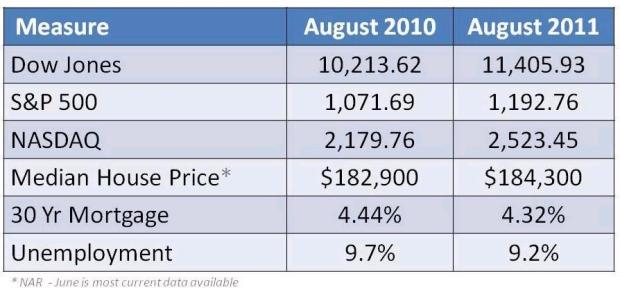
We are not making the argument that the current numbers are worth celebrating. We are only suggesting that the sky is not falling.

Bottom Line

Conditions aren’t as dire as some are professing. Make good sound financial decisions based on your own economic conditions. There is no need to panic.


BORROWERS OPT FOR SHORTER LOAN TERMS

Record-reaching low interest rates have prompted more home owners to shorten the terms of their mortgages. Thirty-four percent of refinancers changed their loan to a 20- or 15-year mortgage during the first quarter — the highest level in seven years, Freddie Mac reports.

Mortgage companies are also reporting a higher demand for shorter-term mortgages. For example, LendingTree reports that 15-year mortgages have increased 30 percent from a year ago.

Quicken Loans recently debuted a product that allows borrowers to select the term of their mortgage. The most popular mortgage term selected is 8 years, followed by 13 years.

“Mortgage-burning parties are back,” Bob Walters, chief economist for Quicken Loans, told USA Today.

Shortening the term of a mortgage can save home owners “tens or even hundreds of thousands of dollars in interest costs,” Keith Gumbinger, vice president of HSH Associates, told USA Today. Some borrowers are finding that refinancing into a shorter term may not even increase their monthly payments, since 15-year rates are so low.

However, some borrowers who want to refinance are finding they’re being shut out, experts say. Home owners who don’t have a credit score of 720 or higher or don’t have at least 20 percent in home equity may not qualify for the lowest rates.


FSBO A NO GO!

This blog prides itself on the quality of real estate information we deliver each and every day. We try to gather empirical evidence to validate the positions we take. We do not use just an anecdotal story to make a point. We also do not get caught up in the sensationalism of the moment. However, today will be different.

We can’t resist commenting on the story which recently appeared in the Wall Street Journal regarding Colby Sambrotto, the founder and former CEO of forsalebyowner.com. It seems the founding father and lifelong evangelist of the concept of selling your home without a real estate agent was forced to hire a broker to sell his home after failing at what he preaches others should do.

After failing to sell his NYC apartment on his own as a For Sale By Owner (FSBO), Sambrotto hired a broker and paid a 6% commission in order to get the job done. His personal experience helps refute some of the myths Sambrotto has been espousing for over a decade. Let’s look at two of those myths:

Myth #1 – You Will Pocket More Money Selling on Your Own

Most FSBO sites say you can save the commission by selling on your own. What happened in Sambrotto’s sale?

From the WSJ article:

“The broker, Jesse Buckler, said he told Mr. Sambrotto the apartment in the Lion’s Head building on West 19th Street near Sixth Avenue was priced too low and wasn’t drawing the right buyers.

By May, it went into contract, he said, after attracting multiple offers. It closed in the last few days for $150,000 more than the original asking price.”

Myth #2 – The Internet Alone Can Sell Your Home

Many have said that, with the introduction of home search on the internet, hiring an agent is no longer a necessity. What happened to the FSBO guru when he attempted to only depend on the internet?

From the WSJ article:

“Looking to move his family to the suburbs, [Mr. Sambrotto] said he carefully staged his apartment for sale himself, and put it on the market. But after using a mix of websites to publicize his apartment, he said he had only “middling success” and switched to a broker because many buyers were so reliant on brokers.”

Bottom Line

There is a reason the real estate industry has been around for centuries: it performs a valuable service.

 

TEAM EMPOWERMENT MORTGAGE CHATTER: August 16, Freddie Offers Cash Incentives for Buying Condos; Keep Clients By Being A Real Estate Expert; Things To Consider Before Renting a Home You Can’t Sell; Homeownership: Still The American Dream

“Keep away from people who try to belittle your ambitions.

Small people always do that, but the really great make you feel that you, too, can become great.”

– by Mark Twain


I HAD TO SHARE ONE OF THE MANY THINGS I’VE HAD ON MY BUCKET LIST THAT AS OF FRIDAY I CAN CHECK OFF.

I CONQUERED THE HALF DOME HIKE AND IT WAS AN AMAZING EXPERIENCE!


 FREDDIE OFFERS CASH INCENTIVES FOR BUYING CONDOS

Freddie Mac’s HomeSteps unit is offering cash to buyers willing to purchase one of its foreclosed condos that has been lingering on the market. HomeSteps is hoping to unload some of its high inventory of foreclosed condos through the incentive program, known as HomeSteps Condo Cash.

Through the “Condo Cash” program, condo buyers of HomeSteps properties can get up to $1,500 to help pay for standard home owner association dues.

The offer is only valid to owner-occupant buyers and on HomeStep condos that have been on the market for at least 120 days. To participate, buyers must submit offers between Aug. 15 and Nov. 15, and close escrow by Dec. 30.

Some of the homes also come with a two-year Home Protect home warranty to cover electrical, plumbing, air conditioning, heating, and other major appliances and systems. Home Protect also is offering up to 30 percent discounts on the purchase of new appliances (see http://www.homesteps.com/smartbuy/ for more information).


KEEP CLIENTS BY BEING A REAL ESTATE EXPERT

Although 84 percent of home buyers say they would use the same real estate agent for future transactions, the percentage of those who actually do so is lower.

Experts say there are several ways that agents can ensure that they are not forgotten by past clients — such as sending “Just Listed” and “Just Sold” postcards to the whole neighborhood and past clients to broadcast their success.

They should constantly remind people of who they are and what services they offer to ensure they remain visible, and they should use unique marketing to generate attention.

Additionally, agents should reach out to past customers and prospects who might be experiencing financial troubles; and they should act as a consultant to past clients to determine whether they are eligible to claim the federal home buyer tax credit, positioning themselves as a real estate expert.


THINGS TO CONSIDER BEFORE RENTING A HOME YOU CAN’T SELL?

In this difficult housing market, more and more homeowners are considering renting their house instead of adjusting the price. We strongly believe that residential real estate is a great investment and therefore can understand this thinking. However, if you have no desire to actually become an educated investor in this sector, you may be headed for more trouble than you were looking for.

Before renting your home, you should take the following steps to make sure this is the right course of action for you and your family.

Set a consultation appointment with an eviction attorney

People rent out their homes assuming that every tenant will pay the rent every month. We must realize, because of the current economy, there are millions of people not paying their mortgage. There is a chance you may rent to someone who at some point can’t (or simply won’t) pay you the rent. Understand what the legal challenges of eviction could potentially be before deciding to rent your home

Interview property managers

If you are not a full-time investor, hire a professional to handle the property. You need someone to find a qualified tenant, collect the rent and manage the problems. You don’t want to have to make collection calls. What would you say if a tenant told you that they had enough money to either buy food for their children or pay you your rent but not both? You need a person experienced with these situations to help.

You also don’t want to receive calls at all hours of the day and night regarding maintenance issues or challenges a neighbor may be creating for your tenant.

Create an honest budget

Sure, you will receive revenue in the form of rent. However, don’t forget you will also have expenses. Some of the expenses you should consider:

  • Mortgage Payment (unless there is no mortgage on the home you will rent out)
  • Property Taxes
  • Maintenance Expenses such as repairing or replacing: roof, heating/air conditioning unit, appliances, etc.
  • Insurance – Check with your insurance company who may suggest or demand that you increase your liability coverage.

Bottom Line

Again, renting out residential real estate historically is a great investment. However, it is not without its challenges. Make sure you have decided that you want to rent the house because you want to be an investor, not because it looks like an easier way out than selling the house.


HOMEOWNERSHIP: STILL THE AMERICAN DREAM

Yesterday, Fannie Mae released their National Housing Survey for the second quarter of 2011. They survey the American public on a multitude of questions concerning today’s housing market. Each quarter, we like to pull out some of the findings we deem most interesting. Here they are for the most recent report:

Most Important Reasons to Buy a Home

When we talk about homeownership today, it seems that the financial aspects always jump to the front of the discussion. However, the study shows that the four major reasons a person buys a home have nothing to do with money. The top four reasons, in order, are:

  • It means having a good place to raise children and provide them with a good education
  • You have a physical structure where you and your family feel safe
  • It allows you to have more space for your family
  • It gives you control of what you do with your living space (renovations and updates)

The Home as an Investment

Though most people purchase a home for non-financial reasons, everyone realizes there is a money component to homeownership. Here is what they said on this issue:

  • 65% of the general population (and 67% of homeowners) believe that homeownership is a “safe” investment.
  • 56% believe that homeownership has more potential as an investment than any other traditional asset class.
  • 69% think that now is a good time to buy a home (this number has increased in each of the last two quarters)

Rent vs. Buy

We are always interested in the difference people see in renting vs.. owning.

  • 63% of renters have aspirations to someday own their own home
  • 72% of renters think that owning is superior to renting
  • 95% of homeowners see homeownership as a positive experience (4% see it as a negative experience) while 82% of renters see renting as a positive experience (17% see it as a negative experience)
  • 96% of homeowners live in a single family residence while 46% of renters live in a multi-unit building

Bottom Line

Even in difficult times, Americans still realize the value of homeownership.

TEAM EMPOWERMENT MORTGAGE CHATTER: August 15; House Prices: Explaining The Recent Uptick; Are You A Homebuyer On The Fence?; Habitat for Humanity; What If You Could Buy Shoes?; Foreclosures Fall for 10th Straight Month

“People often say that motivation doesn’t last. Well, neither does bathring – that’s why we recommend it daily. ” 

-Zig Ziglar: Motivational author and speaker


HOUSING PRICES: EXPLAINING THE RECENT UPTICK

Several pricing indices have reported that, on a month-over-month basis, home values have ticked up slightly over the last quarter. This has caused some to call the bottom to the housing market – at least from a price standpoint. We must realize that prices are determined by supply and demand.

Demand has indeed shown improvement in many parts of the country. However, the supply side of the formula is being impacted by legal issues. The number of foreclosures coming to market has been slowed dramatically by the courts as the banks still struggle with improperly filed paperwork. This inventory will eventually find its way to the market and again put downward pressure on values.

Here is a chart showing the challenge:

Bottom Line

If you are selling, there currently is a window of opportunity to get your best price before the distressed properties are released.


Is looking for enthusiastic people to donate their time! 100% of net proceeds help rehabilitate and build homes in Solano & Napa counties.

Volunteer Opportunities:

  • Donation Pick-Up
  • Pricing Assistant
  • Warehouse Clerk
  • Customer Service
  • Greeter
  • Warehouse Custodian

Please contact:

Judi Urbanik, ReStore Volunteer Coordinator

Phone: 707-365-3778 Email: judiurbanik@gmail.com

http://www.SolanoNapaHabitat.org


WHAT IF YOU COULD BUY SHOES…?

What if there was a shoe store that had:

An unparalleled selection of shoes of every size, color, and price range

The shoes were discounted 30% or more

You had a credit card that would finance the shoes for 30 years at 4.5%

How many shoes would you buy? My bet is there would be a line around the block. Well, today, real estate is like that shoe store (incredible selection, terrific bargains and excellent financing terms). But there’s more….

Shoes go in and out of style. Homeownership is still the American Dream.

Shoes are worth less once you wear them. Homes will appreciate in value over time.

Shoes get disposed of. Homes are lasting.

And while many can recount memories created in certain shoes, everyone can remember their first home, their first family gathering, the countless holidays shared. There is also the ability to decorate to your tastes, the stability (and lower crime rate) in homeownership neighborhoods and the higher level of education achieved by kids who grow up there.

If you’d stand in line to buy shoes, what’s stopping you from exploring a home? Despite some media perceptions, there is mortgage money available with reasonable down payment requirements at extremely low rates…talk to a loan officer. There are some great deals out there with short sales, foreclosures and regular transactions also!

Happy Shopping!


FORECLOSURES FALL FOR 10TH STRAIGHT MONTH


Foreclosure filings dropped once again in July, hitting their lowest level since November 2007, as processing delaysand foreclosure prevention measures enabled a larger number of delinquent borrowers to remain in their homes.

Filings were down 4% compared to June and were 35% lower than July 2010, marking the tenth straight month of year-over-year declines, according to RealtyTrac, a leading online marketer of foreclosed properties.

RealtyTrac reported that 212,764 U.S. homes received some kind of foreclosure filing — notice of default, notice of auction sale or completed foreclosure — during the month. Bank repossessions totaled 67,829, down 33.6% from the peak month of September, 2010 — when banks took back 102,134 homes, and off 27% from 12 months earlier.

The steep foreclosure drop, according to RealtyTrac CEO James Saccacio, was triggered by a foreclosure processing slowdown that was sparked by the “robo-signing” controversy last fall. As a result of the scandal, in which the banks were accused of mishandling paperwork and failing to follow proper protocols, banks are being much more careful and many filings have been delayed.

“[T]he downward trend in foreclosure activity has now taken on a life of its own,” said Saccacio. “It appears that processing delays, combined with the smorgasbord of national and state-level foreclosure prevention efforts, may be allowing more distressed homeowners to stave off foreclosure.”

There were some small glimmers of hope in RealtyTrac’s report. One promising sign was the steep plunge in initial notices of default, which fell 39% year-over-year to fewer than 60,000.

The decline may indicate that fewer borrowers are falling behind on payments.Or, it could mean lenders are not filing those notices as promptly as they have in the past, according to Rick Sharga, a spokesman for RealtyTrac.

The company analyzed initial default notices in California and discovered that the average sum of missed payments has risen to $78,000 from $17,000 over the past four years. Sharga attributed the jump to delays in filing the initial papers.

Getting rid of repossessed homes

RealtyTrac’s release came a day after the Federal Housing Finance Agency (FHFA), the Treasury Department and the U.S. Department of Housing and Urban Development announced they were seeking suggestions on how to dispose ofthe 92,000 repossessed homes now owned by Fannie Mae, Freddie Mac and the Federal Housing Administration (FHA).

Homeownership reaches lowest level since 1965

FHFA, the agency that supervises Fannie/Freddie, and HUD, which oversees FHA loans, want to be able to reduce that inventory quickly and in a manner that helps stabilize communities that have been hard hit by foreclosures.

They’re seeking proposals from private enterprises, municipalities and non-profits that will result in bulk sales and result in their refurbishment and eventual resale or rental.

Hardest hit markets

Among the markets where these efforts may be most concentrated are those hardest hit by the foreclosure crisis. According to RealtyTrac’s report, Las Vegas continued to record the highest rate of foreclosures in the nation, with a filing for every 99 homes, but the gap between “Sin City” and other metro areas has shrunk.

Foreclosure filings in Stockton, Calif. jumped 57% month-over-month, one for every 124 homes, the second highest rate.

Nevada continued to post the highest foreclosure rate of any state, one filing for every 115 homes. California, one in every 239 homes came in second place, and Arizona, one in every 273 homes, was third.

TEAM EMPOWERMENT MORTGAGE CHATTER: August 9; New Addition To Our Team, Lisa Ricketts; News & Headlines; Are You A Buyer On The Fence?; Feds to Keep Rates At Record Low

“The only thing that stands between a man and what he wants from life is often merely the will to try it and the faith to believe that it is possible.” 

-Richard M. DeVos

JOIN US IN WELCOMING THE NEWEST ADDITION TO TEAM EMPOWERMENT LISA RICKETTS


YOUR CLIENT CARE COORDINATOR

Lisa has joined our team bringing with her a background in both the banking and title industries. We are excited to have her become part of Team Empowerment. As your Client Care Coordinator she will assist you and your buyer(s) once you’ve received an accepted contract. It is her responsibility to maintain target dates, provide you and your buyer(s) with the most up to date information on a weekly basis, also known as our World Class Updates every Wednesday.

Along with her experience she brings to the team a very positive attitude and common goal of all of ours, which is to bring your buyer(s) a pleasant and enjoyable experience within their purchase transaction. Working closely with you and your buyer(s) you will find that she is just as passionate about providing great quality service as it is to put the keys into your buyer(s) hands to their new home.

You’re encouraged to introduce yourself or provide Lisa with a welcoming phone call or email by contacting her directly at:

Phone: 925-295-9361

Email at lricketts@rpm-mtg.com.

Please note that Lisa is also able to assist you should you need immediate assistance for questions on loans in process, or if you have any other questions or concerns.

NEWS & HEADLINES

Productivity of U.S. workers dropped 0.3% in 2Q2011, pushing labor costs up from 2010’s record low and Unit Labor Cost rose 2.2%. Falling efficiency and rising costs hurt profits and mean companies have less incentive to take on staff or increase pay, representing another obstacle to the recovery after growth almost stalled in the first half of the year.

Fed May Boost Stimulus Pledge. Bernanke isn’t scheduled to hold a press briefing following today’s FOMC meeting, as they are only after two day meetings. There is speculation that the 2:15 FOMC statement will indicate a increase in the commitment to monetary stimulus due to a faltering economic recovery and a U.S. credit- rating cut provoked a rout in global stocks. Federal Reserve policy makers are facing mounting pressure to do more to bolster the world’s largest economy as shares plunge. A survey showed 42% of respondents said more bond purchases are very unlikely, and 29% as somewhat unlikely. The statement wording is a delicate balancing act as such a step may backfire because it could panic investors by signaling the economy is in worse shape than the Fed thought.

Treasuries Fall on Speculation Fed Will Offer Increased Economic Stimulus. UST and MBS prices fell and U.S. stocks rose early Tuesday on speculation the Federal Reserve will act to restore confidence in financial markets following S&P’s downgrade to US debt. Yesterday’s global selloff caused the Dow to plunge 634.76 points, its sharpest one-day decline since the financial crisis in 2008 and wiped out $1 trillion from the nation’s market value, After the first-ever downgrade of the U.S.’s sovereign-debt rating, investors world-wide poured their money into-not out of-U.S. Treasurys. Worries about the U.S. economy and the European debt crisis out trumped concerns about the U.S. downgrade as treasurys tend to outperform other assets during times of slow economic growth or recession, as prices usually rise along with pessimism about the economy.

Let me know what I can do to assist you with your buyers!

FED TO KEEP RATES AT RECORD LOWS AT LEAST THROUGH MID 2013

The Federal Reserve pledged for the first time to keep its benchmark interest rate at a record low at least through mid-2013 in a bid to revive the flagging recovery after a worldwide stock rout.

The Federal Open Market Committee discussed a range of policy tools to bolster the economy and said it is “prepared to employ these tools as appropriate,” it said in a statement today in Washington. Three members of the FOMC dissented, preferring to maintain the pledge to keep rates low for an “extended period.”

The decision represents the biggest effort since November to spark the U.S. economy and revive confidence while stopping short of initiating a third round of large-scale asset purchases. Chairman Ben S. Bernanke and his colleagues acted after reports showed the economy was slowing and an unprecedented downgrade to the U.S. credit rating sent stocks tumbling from Sydney to New York.

The Fed offered a dimmer view of the economy than it did in the last statement in late June. “Economic growth so far this year has been considerably slower than the committee had expected,” it said. The Fed also said it expects a “somewhat slower pace of recovery over coming quarters,” adding that “downside risks to the economic outlook have increased.”

The Fed left its target for the federal funds rate in a range of zero to 0.25 percent, where it’s been since December 2008. It said it will maintain its policy of reinvesting maturing securities without saying for how long.

Richard Fisher, president of the Dallas Fed, Charles Plosser of Philadelphia and Narayana Kocherlakota of the Minneapolis Fed all dissented.

Stocks Fall

The Fed’s decision came after Standard & Poor’s unprecedented downgrade of the U.S. credit rating on Aug. 5 sent share prices tumbling on concern a global economic slowdown will deepen. Fitch Ratings and Moody’s Investors Service affirmed their top grades for U.S. debt.

The Standard & Poor’s 500 Index tumbled 6.7 percent yesterday in New York, its biggest decline since December 2008.

The drop has wiped out all the gains in stocks since Nov. 3, 2010, when the Fed announced it would buy $600 billion of government bonds, its second round of asset purchases.

Treasuries surged yesterday as investors sought the safety of government debt. Yields on 10-year notes fell 22 basis points, or 0.22 percentage point, to 2.32 percent, the least since January 2009.

Europe’s debt woes added to the market turmoil. Central bankers and finance ministers from the Group of Seven nations pledged Aug. 7 to “take all necessary measures to support financial stability and growth.”

European Debt

The next day, the European Central Bank began buying Italian and Spanish bonds in its riskiest attempt yet to battle the continent’s sovereign debt crisis.

While U.S. inflation rates have risen, they are still below the Fed’s informal target range of 1.7 to 2 percent. A measure of consumer-price gains, stripping out food and energy, stood at 1.3 percent for the 12 months ending in June. That’s up from 0.9 percent for the 12 months ending December.

Bernanke told Congress on July 13 that the Fed was prepared to buy more Treasury bonds if the economy appeared in danger of stalling or if the threat of deflation looked like it was going to re-emerge, while repeating his forecast for a pickup in growth in the second half of the year.

Recent economic data have cast doubt on his outlook.

Gross domestic product expanded at a 1.3 percent annual pace in the second quarter, less than forecast by economists, a July 29 government report showed. The economy almost stalled in the prior quarter, growing at a 0.4 percent pace, the weakest three-month period since the recovery began in June 2009.

Deeper Recession

The same report showed that the recession was about 25 percent deeper than previously estimated, leaving GDP short of its 2007 peak and the economy more vulnerable to another contraction.

Consumers cut spending in June for the first time in almost two years, the Commerce Department said Aug. 2.

“The consumer environment remains very tough,” Michael Polk, chief executive officer of Atlanta-based Newell Rubbermaid Inc., said on a conference call with analysts on July 29. He said a “difficult” U.S. economy was among the reasons the maker of Rubbermaid containers and Sharpie pens had cut its full-year profit and sales forecasts.

Hiring has slowed as employers lost confidence in the recovery. Average monthly payroll gains fell to 72,000 in the three months through July, from 215,000 in the prior three months. The jobless rate fell to 9.1 percent in July from 9.2 percent in June as Americans gave up looking for work.

“When we have the kind of combination of sub-par growth, stubbornly high unemployment and a big debt overhang, you need low interest rates,” Carmen Reinhart, a senior fellow at the Peterson Institute for International Economics in Washington, said on Aug. 5.

The housing market has also been a drag on growth as sliding home prices cut into consumer confidence and wealth.

Sales of existing homes, the largest portion of the housing market, totaled 4.77 million on an annualized basis in June, a

34 percent drop from their pre-recession peak in September 2005.

The S&P/Case-Shiller index of property values in 20 cities declined 4.5 percent in May from a year earlier, the most in 18 months, and homeownership at 65.9 percent is at its lowest point since 1998, even as affordability is close to a record high.

“We’re still in a market that is clearly bouncing along the bottom on housing and new construction,” Christopher M.

Connor, chief executive officer of Sherwin-Williams Co., said on a July 21 conference call. The Cleveland-based company, the largest U.S. paint maker, also cut its full-year profit forecast because of rising raw material costs.

Manufacturing, which had been one of the few bright spots in the economy, grew in July at its slowest pace in two years, the Institute for Supply Management said on Aug. 1.

The recovery is sputtering just as the existing fiscal stimulus programs expire and the federal government moves toward reducing budget deficits.

The debt deal signed by President Barack Obama on Aug. 2 would cut $2.4 trillion or more off budget deficits over 10 years.

The expiration of current fiscal stimulus programs will slice 1.5 percentage points off economic growth next year, according to economists at JPMorgan Chase & Co. and Deutsche Bank Securities.

TEAM EMPOWERMENT MORTGAGE CHATTER: August 8; News & Headlines; Will the S&P Downgrade Affect Interest Rates?; More Homeowners Get Loan Modification Help; Youth Generation Hit Hard By Recession

“Without a struggle, there can be no progress” -Frederick Douglass

 NEWS & HEADLINES

 S&P: United States of America Long-Term Rating Lowered To ‘AA+’ On Political Risks And Rising Debt Burden; Outlook Negative: Text of S&P press release: ” We have also removed both the short- and long-term ratings from CreditWatch negative. · The downgrade reflects our opinion that the fiscal consolidation plan that Congress and the administration recently agreed to falls short of what, in our view, would be necessary to stabilize the government’s medium-term debt dynamics. More broadly, the downgrade reflects our view that the effectiveness, stability, and predictability of American policymaking and political institutions have weakened at a time of ongoing fiscal and economic challenges to a degree more than we envisioned when we assigned a negative outlook to the rating on April 18, 2011. Since then, we have changed our view of the difficulties in bridging the gulf between the political parties over fiscal policy, which makes us pessimistic about the capacity of Congress and the Administration to be able to leverage their agreement this week into a broader fiscal consolidation plan that stabilizes the government’s debt dynamics any time soon. The outlook on the long-term rating is negative. We could lower the long-term rating to ‘AA’ within the next two years if we see that less reduction in spending than agreed to, higher interest rates, or new fiscal pressures during the period result in a higher general government debt trajectory than we currently assume in our base case.”

Stocks Fall, Treasuries Rally on U.S. Rating. Bonds were higher overnight as equity markets take another bath on reaction to S&P’s downgrade of the U.S. AAA rating late Friday (to AA+). Initially the market did get hit when it first started trading in Tokyo, but the equity losses have been sharp enough to help bonds rally. The benchmark 10-year UST note yield fell to 2.41%, the lowest level since October, and the 2yr UST yield hit a fresh record low of 0.232%. The price move underlines the dilemma confronting investors: there are few alternative safe-haven assets out there that can match the depth and liquidity of the Treasury market, with over $9.3 trillion in debt outstanding. The US Debt downgrade from triple-A to double A-plus by Standard and Poor’s isn’t a big surprise to investors as the rating firm has signaled such a move in recent weeks. Yet the decision late Friday evening came following the biggest weekly selloff in U.S. stocks since the 2008 financial crisis. Fears about the U.S. economy faltering further and the euro-zone debt crisis have spooked investors’ sentiment and increased worries that the downgrade could further undermine confidence by U.S. consumers to spend and businesses to expand, increasing anxiety and outlook for the global economy.

Global Economy Near Tipping Point as Markets Eye FOMC Meeting. Tuesday’s monetary policy meeting by the Federal Reserve may provide further stimulus even though the options are running thin at the moment. One way for the Fed to provide stimulus is to signal that the key policy rate will stay where it is longer than many thought. Interest rate futures indicate the first rate hike will come in the first half of 2012, pushed out from next year.

Fannie Mae, Freddie Mac Ratings Cut by S&P Amid Reliance on U.S. Backing. Standard & Poor’s lowered credit ratings for Fannie Mae, Freddie Mac, and other lenders backed by the federal government.


WILL THE S&P DOWNGRADE AFFECT INTEREST RATES?

Standard & Poor downgraded the U.S.’s credit rating on Friday, despite Congress reaching a deal in the final hours on the debt ceiling crisis last week. And now many of your customers may be asking: What does this mean for interest rates?

“The impact on your wallet of the Standard & Poor’s downgrade of the nation’s credit rating is similar to what would happen if your own credit score declined: The cost of borrowing money is likely to go up,” the Washington Post explained in the aftermath of S&P’s decision.

S&P downgraded the U.S.’s top-notch AAA credit rating for the first time in history, moving it down one notch to AA+; the rating reflects a downgrade in S&P’s confidence in the U.S. government’s ability to repay its debts over time. It’s not clear, however, whether S&P’s downgrade will instantly effect rates, analysts say.

The 10-year Treasury note is considered the basis for all other interest rates. And “the downgrade could increase the yields on those bonds, forcing the government to spend more to borrow the same amount of money,” the Washington Post article notes. “Many consumer loans, such as mortgages, are linked to the yield on Treasurys and therefore would also rise.”

While consumers who have fixed interest rate mortgages will be immune to any changes in borrowing costs, home buyers shopping for a loan or those with mortgages that fluctuate may see a rise in rates later on, some analysts say.

Mark Vitner, senior economist at Wells Fargo Securities, told the Associated Press that he doesn’t expect the downgrade to drive up interest rates instantly since the economy is still weak and borrowers aren’t competing for money and driving rates higher. However, he expects in three to five years, loan demand will be much higher and then the downgraded credit rating might cause rates to rise.

Analysts are still waiting to see if the other rating agencies, Moody’s and Fitch, follows S&P’s lead in its downgrade of the U.S. credit rating. If so, the aftermath could be much worse, analysts say.

The debt deal reached by Congress last week was expected to save the U.S. from any credit rating downgrade. However, S&P said lawmakers fell short in its deal. Congress’ deal called for $2 trillion in U.S. deficit reduction over the next 10 years; S&P had called for $4 trillion.

VIDEO: NAR Chief Economist Lawrence Yun on U.S. Debt Downgrade: Impact on Real Estate


MORE HOME OWNERS GET LOAN MODIFICATION HELP

In June, the Home Affordable Modification Program helped 657,044 home owners avoid foreclosure through permanent loan modifications – that’s up from 633,459 in May, according to Treasury Department statistics released Friday.

However, while the number has grown, the numbers still fall short of the initial goal to help 3 million to 4 million borrowers through HAMP, which since 2009 has reduced mortgage payments to help borrowers avoid foreclosure. (Home owners in the program must make a few trial payments before the loan modification becomes permanent.)

For underwater home owners – those who owe more on their mortgages than their home is currently worth – about 6,941 have participated in a principal-reduction program, up from 4,911 last month, the Treasury Department reported late last week. For borrowers who qualified to have their loan balances reduced, they’ve seen median principal reductions of $67,751, or 30.7 percent.

“We’re continuing to see a slight improvement in home prices and a decline in mortgage defaults as our foreclosure prevention programs reach more borrowers upstream in the process,” says Raphael Bostic, Housing and Urban Development assistant secretary. “But we have much more work to do to help the market recover and to reach the many households there and across the nation who still face trouble.”


YOUNG GENERATION HIT HARD BY RECESSION

The recession has hit the younger generation hard and is forcing them to delay many major life changes and purchases, according to a new survey. About 44 percent of Millennials – people aged 18 to 29 – say they will have to delay buying a home due to economic factors, according to a survey conducted by The Polling Co. Inc./WomanTrend.

About 75 percent say they have or will delay a major life change or purchase due to economic factors, and 30 percent say the bad economy has prompted them to delay changing jobs or cities. What’s more, nearly 25 percent say they will delay starting a family, and 18 percent say they will delay getting married.

Such delays by the younger generation has started to affect household formation. Many young professionals are moving back in with their parents to curb costs, which has caused household to grow in recent years after facing decades of declines.

“The impact of the poor economy, in human terms, has been devastating. This is especially true for young Americans, whose lives have been interrupted and dreams put on hold due to the lack of economic opportunity,” says Paul T. Conway, president of Generation Opportunity.

TEAM EMPOWERMENT MORTGAGE: August 4; Mortgage Rates Plunge, Historic Lows!; 5 Quick Tips for August 2011; Top Priorities of 1st Time Home buyers; Big Changes Coming For Appraisals; Thank God I Didn’t Buy Gold at $400 an Ounce!

“What you can do or dream you can do, begin it; boldness has genius, power, and magic in it” 

-Johann von Goethe: Was a German poet, novelist, and dramatist

MORTGAGE RATES PLUNGE, HISTORIC LOWS

REALTORS, this is a great opportunity for you to check-in with your clientele going back 2 years. Rates are at a historic low! Even if your client thinks they’re at the lowest rate possible, tell them to contact me just for 5 minutes of their time to make sure they are. They can likely save money on their monthly mortgage payment!

Zackry Cooper: 925-295-9350

NEW YORK (CNNMoney) — As Congress and President Obama hammered outa debt deal over the past week, mortgage rates plunged — hitting new lows in some instances.

The 30-year fixed rate, usually the most popular choice for homebuyers, fell to 4.45% from 4.57% last week — its lowest point since last November, according to the Mortgage Bankers Association.

Meanwhile, the rate on the less popular 15-year fixed plunged to a new record low of 3.52%, down from 3.67% a week earlier.

The up-front points lenders charged dropped as well, to 0.78 from 1.14 for 20%-down loans, according to the industry group.A homebuyer financing a $200,000 mortgage could save $14 a month and pay $720 less at closing based on the current points.

The rock-bottom interest rates drove up total mortgage applications — both for purchases and refinancings — by about 7%, compared with a week earlier, said Michael Fratantoni, the Mortgage Bankers Association’s vice president of research and economics. While the increase may seem substantial, he noted that applications are still well below last year’s level.

“Refinance application volume increased, but even though 30-year mortgage rates are back below 4.5 percent, the refinance index is still almost 30 percent below last year’s level. Factors such as negative equity and a weak job market continue to constrain borrowers,” he said.

Responsible homeowners left out in the cold

On Bankrate.com Wednesday, a 30-year fixed was available that carried an annual percentage rate of just 4.03%. The overnight average was 4.37%, the site reported.

Mortgage rates are following bond yields lower, explained Greg McBride, Bankrate’s chief economist. The yield on 10-year Treasury notes hit 2.6% on Wednesday down from 3.03% the last week of July.

“The plunge in Treasury yields is because we’ve been hit with a string of poor economic readings,” said McBride.

Those include a weak GDP report and slowdowns in manufacturing, consumer spending and hiring.

Job killing companies

With rates so low and home prices down more than 30% from peak, there has probably never been a more affordable time to buy a home.

For some buyers though, “Time is of the essence.,” said McBride. “The loan limits (for Fannie/Freddie mortgages) drop on October 1 so acting now for closing by Sept. 30 is important for buyers in the upper price levels.”

5 QUICK TIPS FOR AUGUST 2011

1. Price it Right From the Start

It is crucially important that we try our best to price our listings correctly right out of the gate. We know it is difficult in today’s volatile market to place the correct price on any property. However, the consequences to the seller if we don’t do this can be severe for two reasons. First, in a market where prices continue to decline, any additional time taken to sell the home only means a lower selling price. The other reason: research has shown that properties that have experienced price adjustments wind up taking longer to sell and sell for less money no matter what the current market conditions are.

2. Window of Opportunity

While the banks are trying to correct and substantiate their foreclosure paperwork, large inventories of distressed properties coming to market have been delayed. That gives our current listing inventory a ‘window of opportunity’ to sell before the additional downward pressure of these distressed properties is felt.

3. Conforming Loan Limits

It will take an act of Congress to keep loan limits from falling on government backed jumbo loans in many of the higher priced regions in the country this October. This will result in consumers paying as much as ½ to ¾ of a point more on the rate of their 30 year mortgage.

4. August is a Great Time for Education

The two best months for real estate professionals to take education are August and December. These months rank 11th and 12th in regard to transaction counts in most markets. That means that the time invested in taking a class in either of these months is less expensive when factoring in possible lost business. You may decide to take a single class, take classes toward a designation or increase a skill set such as photography or enhancing your social media presence. August is a great time for investing time to make yourself more proficient in a certain aspect of real estate.

5. Remember, it’s up to YOU

Let’s keep it simple. Your success is determined by one and only one thing: your commitment to it. Don’t just want success – BE COMMITTED TO IT!


TOP PRIORITIES OF FIRST-TIME HOME BUYERS

First-time home buyers make up a big chunk of home buyers. So what are their top priorities when shopping for a home? Bankrate.com recently featured “must-haves” for first-time home buyers. Here are a few top priorities:

Affordable price. “Unlike a trade-up buyer, they don’t have any equity to roll into the purchase of their next home, so coming up with a down payment and the financial aspects of buying a home is the first concern,” says Paul Bishop, vice president of research for the National Association of REALTORS®. Fortunately, home affordability is at one of its highest in years and a large inventory of homes on the market provides plenty of options, which is helping first-time buyers find a good home at a great price.

Room to grow. Ken Shuman, Trulia.com spokesman, says that first-time home buyers often find its smart to search for a first home that not only accommodates their needs now but one that can accommodate them in 10 years, too. Space to accommodate growing families will likely be a higher priority than upgrades, such as granite countertops, Shuman says.

Turnkey. Surveys have recently shown first-time home buyers showing a preference for homes that are in move-in condition and in stable neighborhoods, rather than fixer uppers in depressed neighborhoods. In evaluating whether a home has been well-maintained, MacDonald suggests watching for such things as rotten trim on the exterior, dirty air-return ducts or a dirty filter in the HVAC system, or a damaged roof or gutters.

BIG CHANGES COMING FOR APPRAISALS. WHAT RPM HAS DONE TO KEEP YOU AHEAD OF THE COMPETITION.

RPM owns and operates its appraisal services, it’s known as ASI (Appraisal Services, Inc.). Many changes have occurred in the appraisal industry over the last two years with even more to come.


CHECK OUT FLYER

Starting September 1, the way appraisers report their findings and the way they deliver a report will change. UAD stands for Uniform Appraisal Dataset which is the first part in a series of changes for how the overall loan is delivered to the GSE’s. They are doing this to make the appraisals more standardized as to what an appraiser might consider good condition in Texas is vastly different than what an appraiser in Connecticut might think. There are a total of 72 additions to the form with 60 being mandatory and 12 being optional. Phrases like neutral, beneficial and adverse will become standard. Very Good, Good and Average will be replaced in condition and quality fields with a 1 through 6 rating with 1 being exceptional and 6 being horrible. ASI has completed courses, seminars and webinars to help educate the appraisers on these changes, assist the underwriters, and to answer your questions when you see the new forms. Appraisals will also have to be delivered in both a PDF and XML format.

Some of the important changes are:

1) FHA and VA are also using the UAD reports but not the delivery method

2) Appraisals MUST be sent to the GSE’s before the loan for conventional and jumbo loans (Not FHA or VA)

3) If the lender orders a field review that review is sent with the loan and not the original appraisal

4) If an appraisal is sent to the GSE’s in the new format incorrectly it will be kicked out and deemed unacceptable

5) GSE’s wont accept a C5 or a C6 rating for condition

6) Any C6 issue makes the whole property a C6 rating unless subject to repair

Make no mistake these are major changes in the appraisal world in both reporting and technology. As a Realtor who uses Zackry Cooper you will have a huge advantage over your competition because we are working on ways to streamline it, and guarantee the reports acceptance into the GSE system.

Here is a link to a webinar if you would like to familiarize yourself with the changes. Click Here

THANK GOD I DIDN’T BUY GOLD AT $400 AN OUNCE

We hope that headline grabbed you. The reason we used it was to bring some perspective to the debate as to whether or not homeownership is a wise investment in today’s troubled market. A family should never look at the purchase of a home simply as a financial investment. It is so much more than that. But, even if we look at it as only an investment, we must look at it in the long term. Let’s use gold as an example.

Gold had dropped from over $400 an ounce to $250 an ounce (a 40% decline) from February 1996 to August 1999. People were so glad they hadn’t bought at $400 an ounce.

Lord William Rees-Mogg, the current Chairman of The Zurich Club, in 1997 said:

“No investment has been so thoroughly exploded as gold; most people think that there will no more be another gold boom than there will be another boom in tulip futures in The Netherlands.”

Everyone knows what happened next. The proclamation of gold’s death was rather premature. Gold rose from $250 an ounce to over $1,500 an ounce in the next twelve years.

If we look at real estate in the long term, we can see that it has been a great vehicle for building family wealth. The Federal Reserve’s Survey of Consumer Finances, conducted once every three years, provides a snapshot of family income and net worth. Their survey has shown every time that homeowners’ net worth far exceeds that of renters. Here is the breakdown of the last several surveys:

1998 – Homeowner net worth exceed renters by 31x

2001 – Homeowner net worth exceed renters by 36x

2004 – Homeowner net worth exceed renters by 41x

2007 – Homeowner net worth exceed renters by 46x

The 2010 survey is not out yet but the National Association of Realtors’ has estimated that number to be approximately 41x in 2010. You may be thinking this is no longer the case based on the current fall in home values which have dropped back to 2000 – 2002 prices.

Harvard University just completed a study that showed:

“Even if homeowner wealth fell back to 1995 levels, it would still be 27.5 times the median for renters.”

Bottom Line

We are not predicting that real estate will see the same levels of appreciation that gold did. However, we do believe that the real estate market will rebound strongly.

TEAM EMPOWERMENT MORTGAGE CHATTER: July 29; REALTORS: Join Us For A REALTOR ONLY Conference Call with Reeta Casey; Big Changes To Appraisals; To Save Home Values, Bill Asks Banks To Rent Foreclosures

“Human beings, by changing the inner attitudes of their minds, can change the outer aspects of their lives.”

-William James: Was a philosopher and psychologist


REALTORS:

REALTOR ONLY CALL WITH RICK RUBY’S PARTNER – REETA CASEY

Bring your lunch and join us for an exclusive conference call with Reeta Casey

TOPIC: “Expand Your Prospecting”

(Also: Happy Hours, Expired’s, Open Houses, and Questions/Answers (please prepare questions for Reeta)

WHERE: 2175 N. California Blvd, Ste. 315. Walnut Creek, CA 94596 (Conference Room – 3rd Floor)

WHEN: Wednesday August 3rd, 2011

TIME: 12:00 pm – 1:00 pm (please arrive at 11:30 am)

RSVP Today with Sherrell

Phone: 925-296-3840 or E-mail: sayers@rpm-mtg.com  (Due To Limited Seating You MUST RSVP)

Reeta Casey Website

Zackry Cooper Website

Rick Ruby Website


BIG CHANGES COMING FOR APPRAISALS. WHAT RPM HAS DONE TO KEEP YOU AHEAD OF THE COMPETITION

RPM owns and operates its appraisal services, it’s known as ASI (Appraisal Services, Inc.). Many changes have occurred in the appraisal industry over the last two years with even more to come.

CHECK OUT FLYER

Starting September 1, the way appraisers report their findings and the way they deliver a report will change. UAD stands for Uniform Appraisal Dataset which is the first part in a series of changes for how the overall loan is delivered to the GSE’s. They are doing this to make the appraisals more standardized as to what an appraiser might consider good condition in Texas is vastly different than what an appraiser in Connecticut might think. There are a total of 72 additions to the form with 60 being mandatory and 12 being optional. Phrases like neutral, beneficial and adverse will become standard. Very Good, Good and Average will be replaced in condition and quality fields with a 1 through 6 rating with 1 being exceptional and 6 being horrible. ASI has completed courses, seminars and webinars to help educate the appraisers on these changes, assist the underwriters, and to answer your questions when you see the new forms. Appraisals will also have to be delivered in both a PDF and XML format.

Some of the important changes are:

1) FHA and VA are also using the UAD reports but not the delivery method

2) Appraisals MUST be sent to the GSE’s before the loan for conventional and jumbo loans (Not FHA or VA)

3) If the lender orders a field review that review is sent with the loan and not the original appraisal

4) If an appraisal is sent to the GSE’s in the new format incorrectly it will be kicked out and deemed unacceptable

5) GSE’s wont accept a C5 or a C6 rating for condition

6) Any C6 issue makes the whole property a C6 rating unless subject to repair

Make no mistake these are major changes in the appraisal world in both reporting and technology. As a Realtor who uses Zackry Cooper you will have a huge advantage over your competition because we are working on ways to streamline it, and guarantee the reports acceptance into the GSE system.

Here is a link to a webinar if you would like to familiarize yourself with the changes. Click Here


TO SAVE HOME VALUES, BILL ASKS BANKS TO RENT FORECLOSURES

As a glut of foreclosures on the market weighs down home values across the country, a bipartisan bill introduced this week in the House proposes a solution to reducing the high inventories: Rent the properties out.

The proposed bill, Neighborhood Preservation Act of 2011 (H.R. 2636), calls on banks and the government-sponsored enterprises–Fannie Mae and Freddie Mac–to start renting out some of their foreclosed properties to reduce REO sales and “stabilize home values and restore confidence in the housing markets.”

The bill would authorize federally chartered institutions to enter into a long-term lease–for up to five years–with the occupant of the property or with another person, and then at the end of the agreement provide an option to buy the home to the tenant.

The bill could allow delinquent borrowers to remain in their homes but they would have to agree to pay rent and still sign over the deed to the bank or GSE, National Mortgage News reports.

According to the bill, this would allow the foreclosed property to remain occupied during the still-sluggish housing market and “preserve the property itself as well as the aesthetic and economic values of neighboring homes and even whole neighborhoods.”

“As Americans across the country are affected by this unrelenting foreclosure crisis, it is imperative that Congress address this issue,” Congressman Gary Miller, R-Calif., who introduced the bill, said in a statement.


TEAM EMPOWERMENT MORTGAGE CHATTER: July 22; REALTORS: You’re Invited To A FREE Exclusive Event; FHA New Rules: More Pain to Condo Market; Existing-Home Sales Slip But Prices Stabilize; Gen “Y” To Lead Massive Increase To Housing Demand

“If you aren’t fired with enthusiasm, you will be fired with enthusiasm.” -Vince Lombardi: Was a football coach and speaker


REALTORS:

FREE EXCLUSIVE SPEAKING EVENT ON MONDAY JULY 25, 2011

SPEAKER: Rick Ruby of The CORE Training, Inc. (Also Zack’s personal coach for the last 2 years)

TOPIC: “How To Turn Buyers Into Closed Transactions And Exceed Your Goals for 2011”

Click on image for more information and to RSVP TODAY (Click on Realtor Tab)! (Due To Limited Seating You MUST RSVP)

Zackry Cooper Website

Rick Ruby Website

The CORE Training, Inc. Website


FHA’s NEW RULES: MORE PAIN FOR CONDO MARKET

Is the Federal Housing Administration taking a back-door exit away from condos — a key real estate segment in which it’s recently built up market shares of 40 percent and higher in many urban areas?

Could the agency be tightening its rules in order to cut loan volume in the months ahead, potentially putting thousands of unit sellers, buyers, homeowners associations and realty agents in a mortgage-money squeeze?

FHA adamantly denies that it’s doing anything of the sort, and insists that new rules rolled out at the end of last month represent prudent responses to the serious risks the agency’s insurance funds confront.

But condo industry executives and community managers say FHA’s tougher regulations have a wet-blanket effect on associations’ ability — and willingness — to get their projects approved for financings by the agency. Without an entire project certified, potential buyers of units cannot obtain FHA-backed loans, which in turn makes it more difficult for current unit owners to sell and could depress property values.

FHA’s low down payment minimums — 3.5 percent — and relatively generous credit and debt ratio policies have made it the go-to financing source during the past several years for moderate-income buyers who previously would have sought conventional mortgages. With high-cost-area mortgage limits of $729,750 — at least until Oct. 1, when they are scheduled to drop — FHA has even become a player in some upper-end condo communities.

The biggest complaint about the new FHA rules, is the requirement that anyone who signs an application for certification or recertification of a project must assume full responsibility under federal law for the accuracy of every piece of information contained in the submission.

The penalties for subsequent findings that information was inaccurate or omitted can be severe — ranging up to $1 million in fines and 30 years in prison for the worst infractions.

Since the certification package submission covers myriad items that can be difficult to pin down precisely — such as the percentage of units currently occupied by renters on a given date, or whether project documents are in full compliance with every state law and regulation — many association boards and managers are reluctant to stick their necks out to guarantee accuracy of the unknowable under threat of future federal fines.

Condo boards, unit owners and managers also are upset by other rules from FHA, including:

1. A Requirement that no more than 15% of all units in the profject are no more than 30 days delinquent on their condo assessments, including bank-owned (REO) units, which are notorious for nonpayment of fees.

Often condo boards can’t even determine who actually owns a foreclosed unit, said Andrew Fortin of the 30,000-member Community Associations Institute trade group, “so how can FHA expect volunteer condo boards to find this information and collect the assessments?”

Worse yet, he said, most boards or management companies don’t learn about delinquencies on assessments until well after 30 days.

Plus, FHA’s new rule conflicts directly with some state laws, such as in North Carolina, where boards are prohibited from even seeking to collect fees until they are more than 30 days delinquent.

2. A Requirement that not only must condo boards carry fidelity insurance on their officers, but that management companies must carry policies as well.

According to Fortin, that requirement conflicts with state law in Maryland, where condo boards already must purchase fidelity insurance for their management companies. Under a strict reading of the rules, he said, that means management companies will be forced to buy what amounts to double coverage.

3. A variety of technical rules that may hamper condo conversions and so-called gut rehabs.

For example, Philip Sutcliffe, principal of the condominium consulting firm Project Support Services, said FHA’s new rule requiring full, professionally prepared studies of financial reserves will be too expensive for many projects to afford. Sutcliffe said he sometimes wonders whether “anyone at (the U.S. Department of Housing and Urband Development) truly understands how condominiums work in the real world.”

As a consequence of these and other concerns about the new rules, recertifications of existing condo projects for FHA mortgage insurance are lagging. An FHA official confirmed to me that just 1,000 of approximately 12,000 projects eligible have done so in recent months — a no-show rate that critics call ominous.

In response, FHA officials argue that most of the agency’s rules track similar requirements in the conventional financing marketplace. Moreover, they say, at a time when condo projects have taken especially hard hits in the housing downturn — and many projects in places like Florida, Arizona and Nevada have experienced soaring rates of delinquency and foreclosure — they have a duty to protect FHA’s insurance funds against avoidable losses.

Asked whether a calculated phasedown of FHA’s condo volume lurks behind the toughened rules, Lemar Wooley, a spokesman for the agency, said “that is not the case. FHA is committed to continuing its mission of providing affordable, sustainable homeownership opportunities while managing and mitigating risk. Our new condo guidance is consistent with that commitment.”

READ MORE ON THE FHA CONDOMINIUM POLICY GUIDELINES

FHA-APPROVED CONDOMINIUM APPROVED LOOK-UP


EXISTING-HOME SALES SLIP, BUT PRICES STABILIZE

Existing-home sales eased in June as contract cancellations spiked unexpectedly, although prices were up slightly, according to the National Association of REALTORS.

Sales gains in the Midwest and South were offset by declines in the Northeast and West. Single-family home sales were stable while the condo sector weakened.

Total existing-home sales, which are completed transactions that include single-family, townhomes, condominiums and co-ops, declined 0.8 percent to a seasonally adjusted annual rate of 4.77 million in June from 4.81 million in May, and remain 8.8 percent below the 5.23 million unit level in June 2010, which was the scheduled closing deadline for the home buyer tax credit.

Lawrence Yun, NAR chief economist, said this is an uneven recovery. “Home sales had been trending up without a tax stimulus, but a variety of issues are weighing on the market including an unusual spike in contract cancellations in the past month,” he said. “The underlying reason for elevated cancellations is unclear, but with problems including tight credit and low appraisals, 16 percent of NAR members report a sales contract was cancelled in June, up from 4 percent in May, which stands out in contrast with the pattern over the past year.”

Yun cited other factors in the sales performance. “Pending home sales were down in April but up in May, so we may be seeing some of that mix in closed sales for June. However, economic uncertainty and the federal budget debacle may be causing hesitation among some consumers or lenders.”

The national median existing-home price for all housing types was $184,300 in June, up 0.8 percent from June 2010. Distressed homes – foreclosures and short sales generally sold at deep discounts – accounted for 30 percent of sales in June, compared with 31 percent in May and 32 percent in June 2010.

According to Freddie Mac, the national average commitment rate for a 30-year, conventional, fixed-rate mortgage was 4.51 percent in June, down from 4.64 percent in May; the rate was 4.74 percent in June 2010.

REGIONAL PERFORMANCE

Existing-home sales in the Northeast fell 5.2 percent to an annual pace of 730,000 in June and are 17.0 percent below June 2010. The median price in the Northeast was $261,000, up 3.1 percent from a year ago.

Existing-home sales in the Midwest rose 1.0 percent in June to a pace of 1.04 million but are 14.0 percent below a year ago. The median price in the Midwest was $147,700, down 5.3 percent from June 2010.

In the South, existing-home sales increased 0.5 percent to an annual level of 1.86 million in June but are 5.6 percent belowJune 2010. The median price in the South was $159,100, down 0.1 percent from a year ago.

Existing-home sales in the West declined 1.7 percent to an annual pace of 1.14 million in June and are 2.6 percent below a year ago. The median price in the West was $240,400, up 9.5 percent from June 2010.

GEN Y TO LEAD ‘MASSIVE INCREASE IN HOUSING DEMAND’

Watch out for Generation Y: This large, diverse, well-educated generation will drive the housing market recovery over the next 10 years, according to economists with the University of Southern California Lusk Center for Real Estate.

Gen Y (15-32 year olds) boasts about 77.4 million members, which is about equal in size to the baby boomers (46-64 years old). Yet, Gen Y is much more diverse and educated (60 percent of Gen Y goes to college), according to the center, which recently presented its findings at the USC Lusk Center Orange County Executive Briefing.

Stan Ross, Lusk Center Chairman of the Board, says that “baby boomers and Gen Y comprise 50 percent of the population and will soon be part of the largest U.S. wealth transfer ever.”

As more of this age group joins the work force, “they will produce a massive increase in housing demand,” forecasts the USC’s Lusk Center.

However, Ross points out “these kids are concerned. They have watched the stock market, financial markets, and economy wipe out their parents’ retirement plans. As a result, they will choose lower-risk investment strategies.”


TEAM EMPOWERMENT MORTGAGE CHATTER: July 21; REALTORS: You’re Invited To A FREE Exclusive Event; Carbon Monoxide Detector Law Now In Effect; More Homeowners Turn To ‘Homesharing’; Real Estate Sales Slump Continues in June

“Our greatest battles are that with our own minds” -Jameson Frank


REALTORS: 

FREE EXCLUSIVE SPEAKING EVENT ON MONDAY JULY 25, 2011

SPEAKER: Rick Ruby of The CORE Training, Inc.  (Also Zack’s personal coach for the last 2 years)

TOPIC: “How To Turn Buyers Into Closed Transactions And Exceed Your Goals for 2011”

Click on image for more information and to RSVP TODAY (click on REALTORS tab)! (Due To Limited Seating You MUST RSVP)

Zackry Cooper Website

Rick Ruby Website

The CORE Training, Inc. Website


 CARBON MONOXIDE DETECTOR LAW EFFECTIVE 7/1/11

Don’t forget that there is a new carbon monoxide detector law in effect. Please be aware, this can be an additional fee to your borrowers should they need a re-inspection on their appraisals if the home does not have these installed.

This law required detectors to be installed in every “dwelling unit headed for human occupancy.” The California legislature also modified both the TDS (for residential one-to-four unit real property) and MHTDS (for manufactured homes and mobilehomes) to include a reference to carbon monoxide detector devices.

Every owner of a “dwelling unit intended for human occupancy” must install an approved carbon monoxide device in each existing dwelling unit having a fossil fuel burning heater or appliance, fireplace, or an attached garage.

The applicable time periods are as follows:

(1) For all existing single-family dwelling units on or before July 1, 2011.

(2) For all other existing dwelling units on or before Jan. 1, 2013.

(Cal. Health & Safety Code § 17926(a).)

This new law requires the owner “to install the devices in a manner consistent with building standards applicable to new construction for the relevant type of occupancy or with the manufacturer’s instructions, if it is technically feasible to do so” (Cal. Health & Safety Code § 17926(b)).

The following language comes packaged with carbon monoxide (CO) detectors:

For minimum security, a CO Alarm should be centrally located outside of each separate sleeping area in the immediate vicinity of the bedrooms. The Alarm should be located at least 6 inches (152mm) from all exterior walls and at least 3 feet (0.9 meters) from supply or return vents.

Building standards applicable to new construction are as follows (overview summary only):

· Section R315 et seq. of the 2010 edition California Residential Code (CRC) [effective Jan. 1, 2011] (applicable to new one-to-two family dwellings and townhouses not more than 3 stories and also where work requiring a permit for alterations, repairs or additions exceeding one thousand dollars in existing dwellings units):

Installed outside of each separate sleeping area in the immediate vicinity of the bedroom(s) in dwelling units and on every level including basements within which fuel-fired appliances are installed and in dwelling units that have attached garages.

· Section 420 et seq of the 2010 edition California Building Code (CBC) [effective Jan. 1, 2011] (applicable to other new dwelling units and also where a permit is required for alterations, repairs or additions exceeding $1,000 in existing dwelling units):

Installed outside of each separate sleeping area in the immediate vicinity of the bedroom(s) in dwelling units and on every level including basements within which fuel-fired appliances are installed and in dwelling units that have attached garages.

A violation is an infraction punishable by a maximum fine of $200 for each offense. However, a property owner must receive a 30-day notice to correct first. If an owner who receives such a notice fails to correct the problem within the 30-day period, then the owner may be assessed the fine. (Cal. Health & Safety Code § 17926(c).)

The only disclosure obligations are satisfied when providing a buyer with the TDS or the MHTDS. If the seller is exempt from giving a TDS, the law doesn’t require any specific disclosures regarding carbon monoxide detector devices. (See Cal. Civ. Code §§ 1102.6, 1102.6d.)

The Homeowners’ Guide to Environmental Hazards also will include information regarding carbon monoxide.

All landlords of dwelling units must install carbon monoxide detectors as indicated in Question 4. The law gives a landlord authority to enter the dwelling unit for the purpose of installing, repairing, testing, and maintaining carbon monoxide devices “pursuant to the authority and requirements of Section 1954 of the Civil Code [entry by landlord].”

The carbon monoxide device must be operable at the time that a tenant takes possession. However, the tenant has the responsibility of notifying the owner or owner’s agent if the tenant becomes aware of an inoperable or deficient carbon monoxide device. The landlord is not in violation of the law for a deficient or inoperable carbon monoxide device if he or she has not received notice of the problem from the tenant.

(Cal. Health & Safety Code § 17926.1.)


READ MORE ON THE C.A.R WEBSITE (Login Required To Read Details)


MORE HOME OWNERS TURN TO ‘HOMESHARING’

Home owners looking for additional income are opening up their homes and renting out spare bedrooms to offset mortgage costs, which has made “homesharing” the latest trend catch on in some parts of the country, particularly in affluent areas.

Homesharing “started where it was mostly elderly people living on fixed incomes that needed to rent out a room to supplement their income or they were frail and needed help in the house. So they would offer a lower rent to somebody that would help,” says Jackie Grossmann, a homesharing coordinator in Deerfield, Ill. “But now it’s really moved to boomers, who have lost [their] savings.”

While baby boomers are looking for roommates to help offset the costs of home ownership, the roommates are looking for inexpensive housing in “homesharing” arrangements for any number of reasons, such as job loss, divorce, job relocation, and more.

Some programs have even sprung up to help play matchmaker to home owners and renters. In the high-priced area of Deerfield, Ill., for example, the Interfaith Housing Center of the Northern Surburbs offers the North Suburban Homesharing, a free service that matches roommates looking for inexpensive housing with home owners seeking extra cash.

REAL ESTATE SALES SLUMP CONTINUES IN JUNE

After stumbling in April and May, existing-home sales continued to slip in June compared to the month before, according to the latest monthly report from the National Association of Realtors.

Completed sales of existing single-family homes, townhomes, condominiums and co-ops dipped 0.8 percent to a seasonally adjusted annual rate of 4.77 million in June from 4.81 million in May, the report said. Sales fell 8.8 percent compared to June 2010, the scheduled closing deadline for a federal homebuyer tax credit program.

Lawrence Yun, NAR’s chief economist, said in a statement that there was “an unusual spike” in contract cancellations last month.

“The underlying reason for elevated cancellations is unclear, but with problems including tight credit and low appraisals, 16 percent of NAR members report a sales contract was canceled in June, up from 4 percent in May, which stands out in contrast with the pattern over the past year,” Yun said.

The national median price for existing homes rose 0.8 percent year-over-year last month, to $184,300. Distressed properties, typically sold at a discount, made up 30 percent of sales in June, down from 31 percent in May and from 32 percent in June 2010, the report said.


TEAM EMPOWERMENT MORTGAGE CHATTER: July 20; REALTORS: You’re Invited To A FREE Exclusive Event; Carbon Monoxide Detector Law Now In Effect; Fannie, Freddie May Lose Top Credit Rating; Help On The Way For Underwater Homeowners?

“Being challenged in life is inevitable, being defated is optional.”

-Roger Crawford: Motivational author and speaker


REALTORS:

FREE EXCLUSIVE SPEAKING EVENT ON MONDAY JULY 25, 2011

SPEAKER: Rick Ruby of The CORE Training, Inc. (Also Zack’s personal coach for the last 2 years)

TOPIC: “How To Turn Buyers Into Closed Transactions And Exceed Your Goals for 2011”

Click on image for more information and to RSVP TODAY **Go To REALTORS Tab**!

(Due To Limited Seating You MUST RSVP)


Zackry Cooper Website

Rick Ruby Website

The CORE Training, Inc. Website


 CARBON MONOXIDE DETECTOR LAW EFFECTIVE 7/1/11

Don’t forget that there is a new carbon monoxide detector law in effect. Please be aware, this can be an additional fee to your borrowers should they need a re-inspection on their appraisals if the home does not have these installed.

This law required detectors to be installed in every “dwelling unit headed for human occupancy.” The California legislature also modified both the TDS (for residential one-to-four unit real property) and MHTDS (for manufactured homes and mobilehomes) to include a reference to carbon monoxide detector devices.

Every owner of a “dwelling unit intended for human occupancy” must install an approved carbon monoxide device in each existing dwelling unit having a fossil fuel burning heater or appliance, fireplace, or an attached garage.

The applicable time periods are as follows:

(1) For all existing single-family dwelling units on or before July 1, 2011.

(2) For all other existing dwelling units on or before Jan. 1, 2013.

(Cal. Health & Safety Code § 17926(a).)

This new law requires the owner “to install the devices in a manner consistent with building standards applicable to new construction for the relevant type of occupancy or with the manufacturer’s instructions, if it is technically feasible to do so” (Cal. Health & Safety Code § 17926(b)).

The following language comes packaged with carbon monoxide (CO) detectors:

For minimum security, a CO Alarm should be centrally located outside of each separate sleeping area in the immediate vicinity of the bedrooms. The Alarm should be located at least 6 inches (152mm) from all exterior walls and at least 3 feet (0.9 meters) from supply or return vents.

Building standards applicable to new construction are as follows (overview summary only):

· Section R315 et seq. of the 2010 edition California Residential Code (CRC) [effective Jan. 1, 2011] (applicable to new one-to-two family dwellings and townhouses not more than 3 stories and also where work requiring a permit for alterations, repairs or additions exceeding one thousand dollars in existing dwellings units):

Installed outside of each separate sleeping area in the immediate vicinity of the bedroom(s) in dwelling units and on every level including basements within which fuel-fired appliances are installed and in dwelling units that have attached garages.

· Section 420 et seq of the 2010 edition California Building Code (CBC) [effective Jan. 1, 2011] (applicable to other new dwelling units and also where a permit is required for alterations, repairs or additions exceeding $1,000 in existing dwelling units):

Installed outside of each separate sleeping area in the immediate vicinity of the bedroom(s) in dwelling units and on every level including basements within which fuel-fired appliances are installed and in dwelling units that have attached garages.

A violation is an infraction punishable by a maximum fine of $200 for each offense. However, a property owner must receive a 30-day notice to correct first. If an owner who receives such a notice fails to correct the problem within the 30-day period, then the owner may be assessed the fine. (Cal. Health & Safety Code § 17926(c).)

The only disclosure obligations are satisfied when providing a buyer with the TDS or the MHTDS. If the seller is exempt from giving a TDS, the law doesn’t require any specific disclosures regarding carbon monoxide detector devices. (See Cal. Civ. Code §§ 1102.6, 1102.6d.)

The Homeowners’ Guide to Environmental Hazards also will include information regarding carbon monoxide.

All landlords of dwelling units must install carbon monoxide detectors as indicated in Question 4. The law gives a landlord authority to enter the dwelling unit for the purpose of installing, repairing, testing, and maintaining carbon monoxide devices “pursuant to the authority and requirements of Section 1954 of the Civil Code [entry by landlord].”

The carbon monoxide device must be operable at the time that a tenant takes possession. However, the tenant has the responsibility of notifying the owner or owner’s agent if the tenant becomes aware of an inoperable or deficient carbon monoxide device. The landlord is not in violation of the law for a deficient or inoperable carbon monoxide device if he or she has not received notice of the problem from the tenant.

(Cal. Health & Safety Code § 17926.1.)

READ MORE ON THE C.A.R WEBSITE (Login Required To Read Details)


FANNIE, FREDDIE MAY LOSE TOP CREDIT RATING

Standard & Poor’s cautioned Fannie Mae and Freddie Mac that they may lose their top credit ratings if lawmakers don’t soon raise the government’s borrowing limit to avoid default.

The S&P also said that the government-sponsored enterprises could potentially default on their debts since they are so reliant on the U.S. government for funding. Fannie and Freddie own or guarantee about half of all U.S. mortgages.

Congress is frantically trying to come up with a solution to raise the $14.3 trillion borrowing limit to avoid a default by an Aug. 2 deadline. If they are unable to come up with a compromise, analysts say it could have a devastating effect on the U.S. economy, particularly the already fragile housing market.

If the government defaulted on its bonds, the government likely would have to raise interest rates dramatically, which in turn would hamper home ownership, analysts say.


HELP ON THE WAY FOR UNDERWATER HOME OWNERS?

A bill introduced in the Senate aims to remove barriers for underwater home owners looking to refinance. “The Helping Responsible Homeowners Act” would order Fannie Mae and Freddie Mac to waive fees and remove barriers that are keeping underwater borrowers from refinancing to lower mortgage rates.

The bill, authored by Sen. Barbara Boxer, D-Calif., has gained more momentum in Congress after Sen. Johnny Isakson, R-Ga., who ran one of the nation’s largest real estate brokerages, also signed on to sponsor it.

“The time to help struggling home owners is now while interest rates remain at near-historic lows,” Boxer says. “This legislation would help millions of responsible home owners who are making their payments, but are still struggling to make ends meet. By helping these home owners refinance at lower rates, we will put thousands of dollars back in the pockets of families and strengthen our economy.”