Zackry Cooper

Team Empowerment Mortgage Chatter: June 7; News & Headlines; Why It’s Time To Buy; Are Home Prices Headed Up or Down?

“No matter how much pressure you feel at work, if you could find ways to relax for at least five minutes every hour, you’d be more productive” – Dr. Joyce Brothers: Psychologist and advice columnist


NEWS & HEADLINES

Over in the agency side of the world, Fannie and Freddie have both been busy in recent weeks. Fannie Mae announced it has approved Genworth Residential Mortgage Assurance Corporation (GRMAC) as an insurer of conventional mortgage loans in a limited number of states. The insurer is responsible for compliance with its state limitations and which entity is used: Genworth. Fannie has spread the word regarding policy changes regarding deferred student loans, documentation requirements for retirement accounts, prohibition of certain mortgage insurance agreements, DU resubmission policies, MERS updates, and two other miscellaneous items. Fannie Mae is “requiring servicers, in determining whether a borrower faces imminent default, to apply the evaluation methods now used only for HAMP modifications to non-HAMP modifications secured by owner-occupied properties. In addition, Fannie Mae is requiring servicers to use Fannie Mae Network Providers to obtain broker price opinions or appraisals to complete the evaluation of preforeclosure sales and deeds-in-lieu of foreclosure.” In addition, Fannie will be conducting a reapplication process for the Retained Attorney Network in 16 states, is updating the maximum number of allowable days in which routine foreclosure proceedings are to be completed in each jurisdiction, announcing new servicer requirements to streamline and simplify servicing processes related to delinquency management, updating the Servicing Guide to simplify the existing servicing fee structure for mortgage loan modifications while making the servicing fee comparable to that of other secondary market investors, and reminded clients that if a mortgage loan is registered with the MERS and “is originated naming MERS as the original mortgagee of record, MERS must not be named as the loss payee on property insurance policies.” All of these can be viewed at Fannie.

Across the agency aisle and down the road a ways, Freddie Mac has made changes to its selling requirements to improve the quality of appraisal data and introduce additional borrower qualification sources. FreddieQualification. Freddie has also revised its credit requirements to “Provide an avenue for borrowers with unrestricted access to eligible assets to utilize those assets to qualify for a mortgage” for manually underwritten loans as long as the borrower “must not currently be using the eligible assets as a source of income.” Freddie also announced that an increase in the limit for “credit card charges, or the use of a cash advance or an unsecured line of credit to pay mortgage application fees. We are increasing the maximum amount a borrower may charge to a credit card, or receive from a cash advance or unsecured line of credit to pay fees associated with the mortgage application process from 1 percent of the mortgage amount to the greater of 2 percent of the mortgage amount or $1,500. Additionally, we are removing the provision regarding the maximum allowable amount of $500 for appraisals and credit reports.”

In September Freddie is amending property eligibility and appraisal requirements related to property underwriting and review of appraisals and taking another step in the implementation of UAD (Uniform Appraisal Dataset). Freddie also announced revised eligibility requirements for manufactured homes, incomplete improvements including energy conservation improvements (effective September 1), appraisal photographs (effective March 19, 2012), transmitting appraisal reports (effective March 19, 2012), and seller warranties for Established Condominium Projects and New Condominium Projects. As always, for these and everything Freddie, go to the source at FreddieBulletins.

On the FHA/VA side, GNMA speeds will likely remain depressed as originators brace for increased put-back risks by the FHA. Late last year, HUD proposed new rules to streamline the process of indemnifications related to underwriting defects and more recently “the proposed Biggert FHA bill seeks to expand HUD’s authority to pursue indemnification to more lenders (currently, HUD’s right is limited to 29% of all FHA lenders, or 70% of total FHA origination).”

Yesterday was pretty quiet, market-wise, and don’t look for much more today. Tradeweb’s MBS volume registered at 52% of the 30-day average with all sectors below normal. On no news the 10-year Treasury note closed at a yield of 3.00%, nearly unchanged, and MBS prices were also flat to Friday’s close. Today we do, however, have yet another auction starting up – this time $66 billion for the week with $32 billion in 3-yr notes. And we have a speech by Chairman Bernanke on “The U.S. Economic Outlook” at the International Monetary Conference in Atlanta, GA at 3:45 EST.


WHY IT’S TIME TO BUY

Back in June 2006, when the housing market peaked, the prospect of a five-year national housing bust seemed unimaginable to most people. And yet here we are, with the latest Standard & Poor’s Case-Shiller index showing that prices hit new bear-market lows, falling back to 2002levels nationally and to 1990s levels in some battered regions.

Despite all the gloom, however, there are growing indications that it is a good time to buy. Mortgage rates, which fell to 4.55% for the week ending June 2, according to Freddie Mac, are near 50-year lows. Homes have become more affordable than they have been in years: According to Moody’s Analytics, the ratio of home prices to income is now 20.9% lower than the 15-year average through 2010, and 12.5% lower than the 1989-2004 average. A historic glut of homes, meanwhile, has created a buyer’s market: There were about 15 million vacant homes in the U.S. last year, according to John Burns Real Estate ConsultingInc.-some 3.1 million more than normal.

Such conditions might not last long. Moody’s Analytics predicts that the number of distressed sales will begin to fall in 2013, and that prices will begin to edge upward then. Home building is at a virtual standstill, so the supply overhang isn’t likely to get much worse. Meanwhile, demographic indicators such as “household formation”-the number of new households each year-are on the rise, and promise to take a bite out of the glut in coming years.

The upshot: “While we might not see rapid growth in the next couple of years, there are a tremendous number of positive signs that could lead to a rebound,” says Anthony Sanders, a real-estate finance professor at George Mason University.

The short-term outlook isn’t encouraging. Job growth remains weak, foreclosure sales are making up more of the market, and economists are predicting that home prices will fall more in the coming months.

But the long-term benefits of homeownership remain very much intact. For now, at least, you can deduct the mortgage interest on your taxes-a big perk for people in higher tax brackets. You get to paint your walls any color you wish, without having to clear it with a landlord. And assuming you can buy a home for about the same price as you can rent one, buying will give you the ability one day to live rent-free. Come retirement time, a paid-off mortgage means your monthly expenses are significantly reduced, and you have a chunk of equity to play with.

So what might the next five years look like? Once the foreclosure mess begins to clear up, say housing economists, the traditional drivers of the housing market-demographics, affordability, loan availability, employment and psychology-should take over.

Here is a glimmer of what the future may hold: While overall home prices fell by 7.5% in April over the same period a year earlier, according to CoreLogic, a Santa Ana, Calif., provider of real-estate data and analytics, if you exclude distressed sales, prices were off just 0.5%. So if you are in a market that isn’t battered by foreclosures, you may be close to a bottom already.


ARE HOME PRICES HEADED UP OR DOWN?

Here are two headlines that appeared in print last week:

LA Times: Case-Shiller Home Price Index Hits New Low

Forex: CoreLogic: Home Price Index Increased 0.7%

In the Los Angeles Times story, David Blitzer, chairman of the S&P index committee, was quoted as saying:

“This month’s report is marked by the confirmation of a double-dip in home prices across much of the nation. Home prices continue on their downward spiral with no relief in sight.”

In the second article, Forex quotes Mark Fleming, chief economist for CoreLogic:

“While the economic recovery is still fragile and one data point is not a trend, the month-over-month increase based on April sales activity is a positive sign.”

The Case Shiller and the CoreLogic price indices are both very well respected. How can they come to seemingly opposite conclusions? There are two reasons for this.

1. Each Index Has a Different Lag Time

Each report is actually looking at data from different periods of time. Therefore, they are not technically comparing apples to apples.

The Case Shiller Index Methodology:

The CSI is reported with a two-month lag and is based on three months of data. For example, data released in January 2011 was for the three months ended November 2010 (November, October, September 2010).

The CoreLogic Index Methodology:

The CoreLogic HPI is published on approximately a 5 week lag from the end of the data collection period. For example, the CoreLogic January HPI will be published in mid-March.

2. The REO Saturation Level Has Changed

The Case Shiller report covered data several months old. This data would contain transactions where prices were negatively impacted by the large number of distressed properties on the market

However, inventories of distressed properties have decreased recently because the process of foreclosure has slowed. The CoreLogic data, being more current, would have fewer homes impacted by distressed properties. Therefore, prices would be higher.

The difference in time table helps explain some of the conflict in the conclusions of the reports. Once the banks again start to introduce more distressed properties to the market, prices will again be negatively impacted.

Bottom Line

Prices of properties in your region will not be determined by the different price indices. Prices will be determined by the supply of homes available in ratio to the demand for those homes in your area. Whether you are buying or selling, check with a local real estate professional to help you analyze these numbers.

 

TEAM EMPOWERMENT MORTGAGE CHATTER: June 2; News & Headlines; 10 Reasons to Attend Real Estate Connect SF; Home Price Bargains Coming This Summer

“If we do not learn to live together as friends, we will die apart as fools” – Martin Luther King


NEWS & HEADLINES

In a recent article, Caroline Baum pointed out that the yield curve “says” that there will be no recession. “With the Federal Reserve’s benchmark rate at zero to 0.25 percent and the 10-year Treasury note yielding 3.06 percent, the spread between the two interest rates is among the widest in history. It’s the reverse configuration (an inverted yield curve with short rates above long rates) that augurs recession… When the yield curve is steep, as it is now, it’s an inducement for banks to expand their balance sheets — borrow short, lend long — and increase the money supply. That bank credit isn’t growing now owes more to the hangover from a period of excess leverage and new-found religion on lending standards than any restrictive policy on the part of the Fed…A $15 trillion economy doesn’t turn on a dime. Listening to the media, you’d think that one day inflation is ready to take off and the next the economy is struggling to stay afloat.”

The ADP Private Sector Employment number only increased by 38,000 in May, far less than the 175k that was expected. But remember that the ADP number, while it grabs headlines, is of dubious predictive ability for tomorrow’s government-produced employment number. Over the last 6 months alone ADP’s initial figure has ranged from understating the gain in jobs by 5k to overestimating it by 184k!

But the ADP only started the market moving yesterday, making everyone who locked in a loan earlier in the week wish that they hadn’t. The ISM Purchasing Managers’ index fell in May, and was much lower than expected. In fact, it was the lowest reading in a year. Construction Spending increased 0.4% in April although during the first 4 months of 2011, construction spending is 8.4% below the same period in 2010. These components, pointing to a slow economy, moved stocks lower but pushed 10-year UST note yields below 3% for the first time in 2011. Generally speaking, a slow economy helps keep rates low – but is that what the mortgage industry really needs? Low rates help, but be careful what you wish for.


10 REASONS TO ATTEND REAL ESTATE CONNECT SF

The industry event of the year, Real Estate Connect®San Francisco is fast approaching – so what are you waiting for? Here are 10 reasons to lock down your spot at this summer’s hottest ticket.Register online now!

10. Fabulous 15: It’s our 15th anniversary! Help us celebrate in style. It’s a milestone achievement and we’ll mark the occasion with an unparalleled event.

9. Sparkling San Francisco: Spend your free time (or an extra day) enjoying our host city’s famous cuisine, phenomenal scenery, and fantastic attractions.

8. Killer Keynotes: Want big names? We got’em! Our featured speakers include David Pogue of the New York Times, author and social-web expert Brian Solis, Virgin America CMO Porter Gale, and HootSuite CEO Ryan Holmes.

7. Top-Notch Workshops:Choose from four can’t-miss options: the Broker Summit, our Internet Marketing workshop, Connect Tech, The Paperless Agent.

6. Four Intense Tracks:High-profile speakers and panelists tackle the hottest topics in Broker Summit, our Internet Marketing workshop, Connect Tech, The Paperless Agent.

5. Trailblazing Brokers: Meet the brokerages of the future – five groundbreaking companies that’ll change the way we think about the real estate business.

4. New Kids on the Block: We’ll unveil the coolest companies you’ve never heard of in this annual panel, always a Connect must-see.

3. Generation Next: Learn strategies and tactics to attract and target the growing and increasingly critical under-44 demographic.

2. The Innovator Awards: We’ll hand out top honors in seven categories, including Most Innovative Brokerage or Franchise and Most Innovative Website or Web Service. Which of your peers will win?

1. All-Star Attendees: All the top names in the industry will be here – it’s the ideal place to meet, greet, and exchange ideas.


HOME PRICE BARGAINS COMING THIS SUMMER

Home prices are already a third off their highs, but this summer could bring the real discounts.

Buyers are still cautious, and anxious sellers will have to price aggressively to get them off the fence.

That could result in a “summer clearance sale,” predicts Pete Flint, CEO of Trulia, the real estate web site.

“We don’t imagine a stampede of buyers, like outside of Macy’s on Black Friday,” he said. “We see this more akin to January sales where retailers are trying to get rid of stock before it gets stale.”

Several factors, he said, will lead to blow-out prices: Accelerating price drops: Home prices have already reached their lowest level since the housing bubble burst, and are now at 2002 levels. Sellers will feel the pressure to make deals before their homes lose even more value. Bloated inventory: There are boatloads of homes on the market, more than eight months worth at the current rate of sales. Many are distressed properties — short sales and bank repossessions. Such homes are selling at discounts up to 50%. Tight credit: Some homebuyers still can’t obtain mortgages, limiting demand. Unemployment: While the job picture has brightened, unemployment is still around 9%. People without jobs don’t buy homes, obviously, but high unemployment also rattles working people. Lacking the confidence that their jobs are secure, they may not look to buy.

These forces could all come to a head this summer, according to Flint, because of the cyclical nature of homebuying. Buying takes off in spring as many young families hope to make their moves before the new school year.

“By the end of the homebuying season, sellers will become increasingly desperate,” said Flint.

Adding to already swollen inventories will be a flood of new distressed properties poised to hit the market.

“By the summer, most of the ‘robo-signing’ delays will be over and more distressed properties will be on the market,” said Celia Chen of Moody’s analytics.

Many banks had slowed foreclosure proceedings until they made sure that paperwork was in order. That put hundreds of thousands of homes into foreclosure limbo: Borrowers were no longer making payments in many cases, but were allowed to remain living in the homes.

There’s little urgency for buyers to act in this stagnant market because no one expects prices to turnaround, according to Ken Johnson, a real estate professor at Florida International University and co-author of a new study on whether it’s better to buy or rent. Realizing that home prices will likely get even better, buyers can wait for even better deals.

“If people think we’re at the bottom of the market, they’ll act,” he said.

All the experts, however, are telling buyers that prices will continue to erode all through 2011. Even after that, no one is predicting outsized price gains.

“There will be a lousy housing market for another year or two,” said Michael Larson, a housing analyst for Weiss Research.

Even if we’re at or near the bottom, buyers are unlikely to see prices rise much if they wait.

“I myself continue to rent,” said Johnson. “I know that even if I don’t buy for a year, it’s no big deal. Who cares if I miss the bottom if prices only go up a couple of points or so?”

TEAM EMPOWERMENT MORTGAGE CHATTER: June 1; Should You Rent or Buy in This Market?; How To Make An Offer That Will Get Accepted; Foreclosure Starts Fall, But Pipeline Full

“If you care enough for a reasult, you will most certainly attain it…” – William James: Was a psychologist and author


SHOULD YOU RENT OR BUY IN THIS MARKET?

Families are trying to determine whether or not now is the time to buy a home. Some are advising these families to sit out the current real estate market and instead rent for the next year or two. We do not agree with this advice. Homeownership means a lot to a family. We also realize that the financial aspects of purchasing a home today can be a concern. The challenge is any advice given by someone in the real estate community is immediately dismissed as self-serving.

For this reason, we want to give you the advice of three entities not involved in real estate sales:

Citigroup

“When we examine the relationships between mortgage payments and income and mortgage payments and rent, we see that these relationships have also reverted back to or below equilibrium points. In some cases, particularly when mortgage payments are compared to the cost of renting, home prices actually appear cheap.”

JP Morgan

“JPMorgan analysts said ‘the continuation of falling rental vacancies and rising rental demand will make home buying increasingly attractive’, especially as rental prices increase.”

Business School professors Eli Beracha and Ken H. Johnson

“Fundamental drivers now appear to be in place that favor homeownership over renting in the near term future…

The second finding might seem unwise to many given the recent crash in the real estate markets around the country. However, rent-to-price ratios now seem to be in place along with other fundamental drivers that favor ownership over renting…

Conditions (historically low mortgage rates and relatively low rent-to-price ratios) now seem in place to favor future purchases.”

Bottom Line

Is it better to rent or buy? According to those quoted above, it seems it may be becoming a no-brainer.


HOW TO MAKE AN OFFER THAT WILL BE ACCEPTED

You have finally found the house of your dreams. It is priced right and is receiving a lot of attention from other buyers. You don’t want to miss this opportunity so you are ready to put in an offer with the real estate agent immediately. What can you do to guarantee your offer is the one accepted? Financially, offers can be broken down into three categories:

1.) An All-Cash Offer

Obviously, a cash purchaser is always favored by any seller. In today’s real estate market, an all-cash offer is even more enticing. Last month, one in four real estate transactions were impacted by a low appraisal. An all-cash buyer eliminates the need for the bank appraisal.

2.) A Non-Contingency Offer

If you don’t have the cash reserves for an all-cash purchase, the next best thing would be to make a non-contingency offer. To do this you should be already pre-approved for a mortgage and have your current house already in contract. This gives the seller the confidence that you are already a qualified buyer who will be able to complete the purchase.

3.) A Contingency Offer

Some buyers start the process of looking for a new home before their current home is sold. This could be a big mistake. If you find the home you were hoping for (perfect for your family AND priced right), it will be very difficult to get your offer accepted because you are not actually qualified to buy.

Asking a seller to wait for your home to sell is somewhat unreasonable in today’s environment. One of the reasons you would want the home is because the seller priced the home at a value to sell it NOW. They want to know it is sold when they accept an offer. They normally will not even entertain a contingency offer.

Bottom Line

Unless you have the ability to purchase with cash, the best thing to do is to be pre-approved for a mortgage and have your current house already in contract before looking for the home of your dreams. That guarantees you will get the home you love at a price that makes sense.


FORECLOSURE STARTS FALL, BUT PIPELINE FULL

Foreclosure starts dipped below the 200,000 mark during April for the first time in years, but the foreclosure pipeline remained bloated by more than 4 million homes whose owners are in foreclosure or delinquent by 90 days or more.

That’s according to the latest numbers from loan data aggregator Lender Processing Services, which show foreclosure starts fell nearly 31 percent from March to April, totaling 187,423 — a 14.7 percent decline from a year ago.

LPS estimated that 2.18 million mortgages were in foreclosure, down nearly 2 percent from a record 2.22 million in March but up 9.5 percent from a year ago.

Another 1.96 million mortgages were delinquent by 90 days or more in April, down about 1.5 percent from the previous month and 29 percent from a year ago.

All told, LPS tallied 4.14 million loans in foreclosure or delinquent by 90 days or more at the end of April.

Those numbers are in line with the Mortgage Bankers Association’s most recent National Delinquency Survey, which suggested about 4 million residential mortgages were in foreclosure (2.24 million) or delinquent by more than 90 days (1.78 million) at the end of the first quarter.

LPS data showed a 7.5 percent month-over-month bump in the number of homeowners behind on their mortgages by just one payment, to 1.63 million, to roughly the same level seen a year ago.

While LPS estimates 60-day delinquencies grew by 1.2 percent from March, to 615,608, that’s down 14 percent from a year ago.

The total number of noncurrent loans stood at 6.39 million loans, up less than 1 percent from March and down nearly 11 percent from a year ago.

LPS estimates that the number of noncurrent loans has fallen 21.2 percent from a peak of 8.12 million in January 2010, when the number of homes in foreclosure or delinquent by 90 days or more totaled 5.17 million.


Team Empowerment Mortgage Chatter: May 26; Real Estate Affordability Sets Record in Q1; Spy on your Real Estate Competition; How’s Your Online Etiquette?; RPM in Contra Costa Times

“Information is the oxygen of the modern age.” – Ronald Reagan


REAL ESTATE AFFORDABILITY SETS RECORD IN Q1

Housing affordability hit a new record high in the first quarter, surpassing the previous high set in fourth-quarter 2010, according to an index released by the National Association of Home Builders and Wells Fargo today.

The Housing Opportunity Index found that 74.6 percent of new and existing homes sold in the first quarter were affordable to families earning the national median income of $64,400. That’s up from 73.9 percent in the fourth quarter of 2010, and it’s the highest level recorded in the more than 20 years the index has been measured.

“With interest rates remaining at historically low levels, today’s report indicates that homeownership is within reach of more households than it has been for more than two decades,” said Bob Nielsen, chairman of the NAHB, in a statement.

“While this is good news for consumers, homebuyers and builders continue to confront extremely tight credit conditions, and this remains a significant obstacle to many potential home sales.”


 SPY ON YOUR REAL ESTATE COMPETITION

Do you know who your real competitors are? More importantly, do you know what your potential clients think of your competitors’ services? If not, it’s time to start spying.

At our recent Awesome Females in Real Estate conference in Scottsdale, Ariz., Kathy King of REICaravan.com led a session, “Keep Your Friends Close and Your Enemies Closer.”

 If you want to keep ahead of the competition, competitor reconnaissance (spying) — of the legal variety, of course — is the name of the game.

Why you should spy

A primary reason for engaging in a spying program is to craft your own unique selling proposition that differentiates your services from competitors. Furthermore, it will also help you to be better prepared to meet the objections someone may have about using your services vs. services provided by a competitor.

Another reason for spying is to identify who your true competitors are online. King recommends a site called SpyFu.com. Enter your domain and SpyFu will display the competing domains that have the greatest overlap.

It also tells you which key words generate the best organic results for your business. Perhaps the most useful feature is the ability to see the keywords that your major competitors are using.

Your spy kit

King outlined a number of key resources to use in your spy kit. First, check your competitors’ information by plugging their names into Google and LinkedIn. It’s also smart to check out whether they have a blog as well as Facebook and Twitter accounts.

If they have a blog, subscribe to the RSS feed to see what they are posting. Also, if they have a newsletter, it’s probably smart to subscribe to that as well.

Perhaps the most important step to take is to carefully examine how your competitors are marketing themselves on their main website. You can use SpyFu to compare keywords. This tool is especially useful since it provides the top keywords that are generating your organic search results.

It also shows the keywords and results for your competitors, as well displaying the percentage of overlap in your keyword searches.

SpyFu also allows you to determine which websites and searches produce the most leads. An important point to note is which traffic sources are generating the most leads for your site, as well as for your competitors. The goal is to expand what is already working, as well as to take search and market share from competitors.

In addition to SpyFu, you can also use the Google Keyword Tool. Type in the terms you want to search as well as your URL and see the number of searches for each of the key terms. Use the most popular key terms as often as possible in the text of your website, on your blog, and especially in your headlines.

Another excellent tool is WebsiteGrader.com from HubSpot. You can plug in your URL as well as that of your competitors to see their strengths and weaknesses. The site gives you a comprehensive analysis as well as providing suggestions on how to upgrade areas that need improvement.

If you haven’t already done so, sign up for Google Alerts and enter your name and the names and companies of the competitors who you want to track. Another great tool is StepRep.com, which allows you to follow what others are saying online about your business, your industry or competitors.

What to look for

A key variable to track is your competitors’ marketing messages. How are they positioning themselves in the marketplace? Are they appealing to specific demographics or lifestyles? Is their branding specific to certain market niches? And if so, which ones? Look for gaps in what they’re doing to find opportunities they may have overlooked. 

Print marketing

Although King did not discuss this point, a great spy exercise is to have your entire office collect as many marketing pieces from your competitors as possible. Go through each piece at your office meeting and determine which types of messages are the most effective.

Two additional tips are to eliminate “I” and “me” language in marketing and to replace it with “you” language. Also, eliminate as many adjectives as possible from your text, replacing them with verbs. For example, instead of saying, “really lovely, lovely pool,” say, “Relax by the zero edge pool overlooking the breathtaking view below.”

Spying can be a critical element in your marketing strategy. Spying allows you to identify gaps in your competitors’ print and online marketing strategies. As a result, you not only beat your competitors to the punch, you can also prevent their punches from having a major impact on your business. 


 HOW’S YOUR ONLINE ETIQUETTE?

Real estate agents seeking to reach global clients through social media should proceed with caution, as cross-cultural blunders are easy to make when non-verbal communications cannot be read.

For example, it is common in the United States for people to ask personal questions to start a conversation or to address people on a first-name basis; but in some cultures, such communication is frowned upon.

Those who have completed Certified International Property Specialist training know to ask only safe questions. Experts also recommend that agents using Facebook or other social networking sites to conduct business should communicate in a more formal tone. Una Coleman, a marketing consultant from Ireland, says, “Be a reserved version of yourself.”


 RPM ON THE FRONT PAGE OF BUSINESS SECTION OF CONTRA COSTA TIMES


Dodging the debris unleashed by a shattered housing market, RPM Mortgage powered to its most successful year in 2010 and is off to a robust start this year.

Walnut Creek-based RPM generated hundreds of millions of dollars more in mortgage business in 2010 and hired hundreds of new employees over the past two years, a track record that sparkles against the gloomy backdrop of the real estate sector.

“We’ve been very fortunate,” said Robert Hirt, RPM’s chief executive officer. “2010 was the best year in the history of our company.”

The company’s success has been fueled in great measure by its ability to meld its connections to Fannie Mae with a veteran sales force and low interest rates. By being able to sell loans directly to Fannie Mae, RPM has attracted experienced loan officers who can drum up more business.

In 2010, RPM generated $4.55 billion in loan production, up 12.9 percent from the $4.03 billion in loan production in 2009.

The pace is brisk so far in 2011. For the first three months of this year, RPM generated $804 million in loan production, said Elise Watkins, an RPM spokeswoman. That was up 11.4 percent from the $722 million produced in the January-March quarter of 2010.

In contrast, the country’s largest home lender, San Francisco-based Wells Fargo, saw originations for residential loans fall 8.1 percent in 2010 compared with 2009, regulatory filings show. However, in the first quarter of 2011, Wells Fargo’s originations for home loans rose 10.5 percent compared with the year-ago January-March period, the bank said.

CLICK HERE TO READ THE ENTIRE ARTICLE

Team Empowerment Mortgage Chatter: May 24; Look Past The Headlines; National Housing Survey: What Americans Think; Appraisals: Why You Must Now Sell Your House Twice; RPM in Contra Costa Times

“The art of resting the mind and the power of dismissing from it all care and worry is probably one of the secrets of energy in our great men” – Captain J.A. Hadfield: Author


LOOK PAST THE HEADLINES

Earlier this week, Trulia and RealtyTrac issued a press release regarding a survey completed for the two companies by Harris Interactive. The press release, American Expectations for Housing Market Recovery Falters , reported:

“As more cities across the nation experience double dips in home prices, more than half (54%) of U.S. adults believe recovery in the housing market will not happen until 2014 or later, according to the survey released today.”

And both organizations that commissioned the survey addressed the reasons Americans may feel this way:

Rick Sharga, SVP of RealtyTrac

“Our survey reflects a growing perception among potential homebuyers that the housing recovery is still a long way off. Demand remains weak, loans are increasingly difficult to qualify for, and the shadow inventory of several million distressed properties is weighing down the market. All of these things need to improve before housing can recover.”

Pete Flint, CEO of Trulia

“Most Americans, as our latest survey revealed, overestimated how quickly the housing market would bounce back, but when it does, it will likely be a long and gradual process. Looking at the recent double dips in home prices, I expect the rest of 2011 to be volatile for real estate… In my eyes, we have another 18 months until we start to see signs of price stability in the housing market.”

These findings created a rash of sensational headlines declaring the housing market’s further decline.

While we are not sure how people defined ‘recovery’, we don’t disagree that the housing market still needs time to heal. How much time? What do other experts predict? We’ll leave that to another time.

Today, we want to mention other parts of the press release that didn’t receive the same coverage as the the parts that created those strong headlines. Mr. Flint addressed the nation’s concerns (above) but also said:

“On the flip side, mortgage rates won’t stay low forever and even if home prices continue to fall for a bit, now is still a good time to enter the housing market.”

And Ken Shuman, a Trulia spokesperson said:

“According to our latest data, it is more affordable to buy a home than to rent in 78 percent of major U.S. cities. With concerns of rising inflation and the potential for rising interest rates, now is a good time for people to buy and we may not be in this environment for much longer.”

Bottom Line

There is great data about today’s housing market being released almost every day. Let’s make sure that we read not only the headlines but instead study the entirety of the information.


NATIONAL HOUSING SURVEY: WHAT AMERICA THINKS

Each quarter, Fannie Mae releases their National Housing Survey.  They survey the American public on a multitude of questions concerning today’s housing market. We like to pull out some of the findings we deem most interesting each time it is released. Here they are for the most recent report:

The Most Important Reasons to Buy a Home

When we talk about homeownership today, it seems that the financial aspects always jump to the front of the discussion. However, the study shows that the four major reasons a person buys a home have nothing to do with money. The top four reasons, in order, are:

  • It means having a good place to raise children and provide them with a good education
  • You have a physical structure where you and your family feel safe
  • It allows you to have more space for your family
  • It gives you control of what you do with your living space (renovations and updates)

The Home as an Investment

Though most people purchase a home for non-financial reasons, everyone realizes their is a money component to homeownership. Here is what they said on this issue:

  • 66% of the general population (and 71% of homeowners) believe that homeownership is a ‘safe’ investment. This is the first time since the studies inception in 2003 that this number increased.
  • 57% believe that homeownership has more potential as an investment than any other traditional asset class.
  • 67% think that now is a good time to buy a home

Rent vs. Buy

We are always interested in the difference people see in renting vs. owning.

  • 65% of renters have aspirations to someday own their own home
  • 74% of renters think that owning is superior to renting (up 6% since the last survey)
  • 96% of homeowners see homeownership as a positive experience (3% see it as a negative experience) while 82% of renters see renting as a positive experience (16% see it as a negative experience)
  • 92% of homeowners live in a single family residence while 48% of renters live in a multi-unit building

Bottom Line 

Our belief in the value of homeownership grows each time this survey is released.


APPRAISALS: WHY YOU MUST NOW SELL YOUR HOUSE TWICE

Banks have become very conservative when lending mortgage money today. With the current foreclosure challenges in the country, we can’t really blame them. The requirements now necessary to qualify for mortgages have gotten much more stringent and it seems will get even more stringent as we move forward. The banks want to make sure the prospective buyer has the ability to repay the loan. However, this does not just involve the borrower buying the property.

The second way a bank can protect their investment in the mortgage is to make sure that the collateral backing that mortgage is secure. That is where the appraisal comes in. The bank wants to make sure that, should the buyer not be able to make their payments, the house they will be forced to take back will sell for an amount at least equal to the balance left on the mortgage. For that reason, the banks seem to be getting more conservative with appraisals also.

This past week, the National Association of Realtors (NAR) released their Existing Homes Sales Report. In that report, they said:

“11 percent of Realtors® report a contract was cancelled in April from an appraisal coming in below the price negotiated between a buyer and seller, 10 percent had a contract delayed, and 14 percent said a contract was renegotiated to a lower sales price as a result of a low appraisal.”

One out of four real estate transactions was either cancelled (11%) or renegotiated to a lower sales price (14%) because of a low appraisal!!

Bottom Line

Every house now has to be sold twice: first, to a potential purchaser and then to the bank appraiser. And, it seems that the second sale may be the more difficult of the two. Sit with a local real estate professional and make sure you put together a plan for both sales.


RPM ON THE FRONT PAGE OF BUSINESS SECTION OF CONTRA COSTA TIMES

Dodging the debris unleashed by a shattered housing market, RPM Mortgage powered to its most successful year in 2010 and is off to a robust start this year.

Walnut Creek-based RPM generated hundreds of millions of dollars more in mortgage business in 2010 and hired hundreds of new employees over the past two years, a track record that sparkles against the gloomy backdrop of the real estate sector.

“We’ve been very fortunate,” said Robert Hirt, RPM’s chief executive officer. “2010 was the best year in the history of our company.”

The company’s success has been fueled in great measure by its ability to meld its connections to Fannie Mae with a veteran sales force and low interest rates. By being able to sell loans directly to Fannie Mae, RPM has attracted experienced loan officers who can drum up more business.

In 2010, RPM generated $4.55 billion in loan production, up 12.9 percent from the $4.03 billion in loan production in 2009.

The pace is brisk so far in 2011. For the first three months of this year, RPM generated $804 million in loan production, said Elise Watkins, an RPM spokeswoman. That was up 11.4 percent from the $722 million produced in the January-March quarter of 2010.

In contrast, the country’s largest home lender, San Francisco-based Wells Fargo, saw originations for residential loans fall 8.1 percent in 2010 compared with 2009, regulatory filings show. However, in the first quarter of 2011, Wells Fargo’s originations for home loans rose 10.5 percent compared with the year-ago January-March period, the bank said.

CLICK HERE TO READ THE ENTIRE ARTICLE

TEAM EMPOWERMENT MORNING MORTGAGE CHATTER: May 18; RPM in Contra Costa Times; News & Headlines; New Homes Competing Against Foreclosures; Fewer Borrowers Purposely Default on Mortgages; Gas Prices Impact Real Estate Choices

“Many can argue that reality is as it is, but my experience is that the oppositre is exactly true, reality is ours for the making” – Asara Lovejoy: Human potential author and coach


RPM ON THE FRONT PAGE OF BUSINESS SECTION OF CONTRA COSTA TIMES

Dodging the debris unleashed by a shattered housing market, RPM Mortgage powered to its most successful year in 2010 and is off to a robust start this year.

Walnut Creek-based RPM generated hundreds of millions of dollars more in mortgage business in 2010 and hired hundreds of new employees over the past two years, a track record that sparkles against the gloomy backdrop of the real estate sector.

“We’ve been very fortunate,” said Robert Hirt, RPM’s chief executive officer. “2010 was the best year in the history of our company.”

The company’s success has been fueled in great measure by its ability to meld its connections to Fannie Mae with a veteran sales force and low interest rates. By being able to sell loans directly to Fannie Mae, RPM has attracted experienced loan officers who can drum up more business.

In 2010, RPM generated $4.55 billion in loan production, up 12.9 percent from the $4.03 billion in loan production in 2009.

The pace is brisk so far in 2011. For the first three months of this year, RPM generated $804 million in loan production, said Elise Watkins, an RPM spokeswoman. That was up 11.4 percent from the $722 million produced in the January-March quarter of 2010.

In contrast, the country’s largest home lender, San Francisco-based Wells Fargo, saw originations for residential loans fall 8.1 percent in 2010 compared with 2009, regulatory filings show. However, in the first quarter of 2011, Wells Fargo’s originations for home loans rose 10.5 percent compared with the year-ago January-March period, the bank said.

CLICK HERE TO READ THE ENTIRE ARTICLE


 NEWS & HEADLINES

NAR released some interesting Realtor profile information.Their median income (half above, half below) declined 4.5% to $34,100 last year, which followed a 3 percent decline in 2009. Members licensed as brokers earned a median of $48,700 in 2010, while sales agents earned $24,900. Per NAR, 16% earned a six-figure income, 14% work less than 20 hours per week, 57% are women. The typical NAR member is 56 years old with only 3% of members being under the age of 30 (22% are 65 or older). NAR had less than 1.1 million members in 2010, a 21.3% decline from the peak in 2006. For all the stats visit NARPress.

Freddie Mac reported that in the first quarter of 2011 fixed-rate loans accounted for more than 95% of refinance loans, regardless of whether the original loan was an ARM or a fixed-rate loan. An increasing share of refinancing borrowers chose to shorten their loan terms during the first quarter. Of borrowers who paid off a 30-year fixed-rate loan, 34 percent chose a 15- or 20-year loan, the highest such share since the first quarter of 2004. We had the MBA’s weekly Mortgage Application Survey this morning. Apps jumped 8% last week, up for the third week in a row. Refinancing was up over 13%, although purchases dropped 3%. Both the overall index and the refinance index reached their highest levels since early December, with refi’s accounting for almost 67% of total apps.

Regardless of debt worries, yesterday the fixed-income market did quite well, and the trend is continuing today. The yield on the 10-yr T-note broke down below 3.15%, making new lows for 2011, and mortgage pricing is going along for the ride. Their prices don’t always move in opposite directions, but once equities slipped into negative territory Treasuries rebounded off the lows on very light activity. The weaker-than-expected housing and Industrial Production data only increased the bid for Treasuries. By the end of the day the 10-yr was down to 3.12% and current coupon mortgage pricing was better by .125-.250 on average mortgage banker selling of MBS’s.

With rates dropping investors sense a short run pickup in refi activity, but also believe that it will be weaker compared to 2010 based on equity issues, LLPA hurdles, and the usual underwriting issues. There’s a sizeable amount of distressed property on the market, credit conditions remain very tight for borrowers, home values keep slipping, existing home owners are having a difficult time selling their homes, and the economy and jobs market aren’t exactly confidence boosters at the moment. All of this puts a damper on lending, as well as homebuilders’ sentiment.

There isn’t much pushing the market today. We had the MBA’s weekly Mortgage Application Survey, noted above. Later we’ll have the release of the FOMC Minutes from the late April meeting at 2PM EST. In the early going here the 10-yr got down to 3.10% (but is now unchanged) and MBS prices are roughly unchanged.


NEW HOMES COMPETING AGAINST FORECLOSURES

Builders broke ground on fewer homes in April as the new-home sector continues to face competition from a glut of foreclosures that in many markets has brought home values down.

Construction on homes and apartments dropped 10.6 percent to a seasonally adjusted annual rate of 523,000 units, the Commerce Department reported on Tuesday. In March, housing starts reached a 585,000-unit pace (an upward revised figure). Residential construction is down 23.9 percent compared to April of last year–its largest drop since October 2009.

Considered the “volatile part” of the new-home market at the moment, construction of multifamily homes (buildings with five or more units) particularly hampered housing starts last month, decreasing 28.3 percent. Single-family home construction–which generally makes up 75 percent of all housing starts–dropped 5.1 percent from a month earlier.

Regionally, the results were mixed. In the South, housing starts dropped 23 percent and 4.8 percent in the Northeast. However, the Midwest posted a 15.7 percent gain in housing starts, as well as the West with 3.7 percent.

Permits for future home construction dropped last month, falling 4 percent to a 551,000-unit pace last month, the Commerce Department reports.

The Distressed Sales Impact

New-home construction is being weighed down by an oversupply of existing homes on the market, particularly foreclosures, experts say. Buyers are increasingly choosing bargain-priced foreclosures and previously owned homes over–in general–pricier new homes.

“Builder confidence has hardly budged over the past six months as persistent concerns regarding competition from distressed property sales, lack of production credit, inaccurate appraisals, and proposals to reduce government support of housing,” NAHB Chairman Bob Nielsen said Monday in statement about the National Association of Home Builder/Wells Fargo Housing Market Index, which shows builders’ confidence about the new-home market remains low.


FEWER BORROWERS PURPOSELY DEFAULT ON MORTGAGE

As home values decreased and more borrowers found themselves underwater, some home owners were opting for “strategic default,” choosing to stop making mortgage payments even though they could afford to pay. But analysts say the trend is on the decline.

In an analysis by JPMorgan Chase into strategic default, analysts found 60 percent of all defaults were strategic by the middle of 2009–that’s more than double the percentage in January 2008.

However, the number has been decreasing. Analysts say that strategic defaults now make up less than 30 percent of all defaults (or 10,000 strategic defaults compared to 20,000 from one year ago) and that borrowers who are delinquent more than 90 days have even “lesser strategic delinquencies.”

“Overall, strategic defaults have stabilized as home prices flattened and initial jobless claims declined,” analysts say.

About 42 percent of underwater borrowers–those who owe more on their mortgage than their home is currently worth–remain current on their mortgage, according to the JPMorgan Chase analysts.

“Of course, the moral hazard of potential strategic defaults in the future is still present,” analysts say. “Even though these borrowers have not been defaulting in large numbers, the event risk remains that they could.”


GAS PRICES IMPACT REAL ESTATE CHOICES

Rising gas prices have spurred homebuyers to look for homes that offer shorter commute times to work, according to a survey of Coldwell Banker Real Estate professionals.

The company conducted the survey online between April 28 and May 3, 2011, and garnered responses from 1,188 Coldwell Banker real estate professionals.

Three-quarters of respondents said the recent jump in gas prices had influenced where their clients chose to live. The main client concern was commute time to work: 89 percent of respondents said buyers look for homes closer to work and 93 percent said a continued rise in gas prices would prompt more homebuyers to choose to live where commute times are shorter.

Almost half (45 percent) of respondents said buyers are choosing homes closer to shops and services as a result of higher gas prices.

According to 77 percent of respondents, more buyers are interested in having a home office compared to five years ago. Of those respondents, 68 percent said the high cost of gas is one reason behind the trend.

“The decision to buy a home has always been tailored around the personal, multifaceted lifestyle needs of each buyer,” said Jim Gillespie, Coldwell Banker Real Estate’s CEO, in a statement.

“Today, rising fuel costs and a person’s decision to commute or perhaps work remotely are additional factors of the decision homebuyers must consider.”

Respondents also attributed a rise in interest in urban living at least partially to increasing gas prices. Some 56 percent of respondents said they had noticed more homebuyers interested in living in cities compared to five years ago.

Of those respondents, 81 percent said a desire to reduce gas spending was a factor, and 93 percent agreed or strongly agreed that the desire for shorter commutes was a factor.

Other reasons noted for the increased enthusiasm for city living were “having everything at your fingertips” (91 percent strongly agreed or disagreed), “being able to walk to places” (76 percent), and “being near public transportation” (52 percent).

Team Empowerment Morning Mortgage Chatter: May 17; Giveaway Update; News & Headlines; Freddie Mac’s HomeSteps Launches Nationwide Sales Promotion; NAR Increases Dues; Distressed Sales Hamper Real Estate Pay

“Unless your campaign has a big deal, it will pass like a ship in the night.” – David Ogilvy in Confessions of an Advertising Man: Was an advertising executive, often called “The Father of Advertising”


MONDAY GIVEAWAY – UPDATE

UPDATE: Here’s an update to where we stand with our winners as of today, May 17th.

  1. Donna Chan
  2. Tom Watson
  3. Robin Jaurique
  4. Linda Slagle
  5. Angela Muetterties
  6. Larry Harris & Mary Esteban
  7. Name To Be Announced
  8. Name To Be Announced
  9. FUTURE WINNER
  10. FUTURE WINNER

This means we have 2 open winnner slots for our giveaway. See how to become a winner below. Good Luck! And Congratulations to those who have already subscribed!


News & Headlines

The compensation issue involving Quicken Loans is in the news again as “the U.S. Supreme Court asked the Obama administration for its views Monday on a case that examines when mortgage lenders can be sued for charging fees to borrowers when the lender offers no service in return.” The case centers on a group of lawsuits from Louisiana (the Freeman, Bennett and Smith families) alleging Quicken Loans Inc. charged loan-discount fees to borrowers but did not provide them with reduced interest rates on their loans. HUD has already issued relevant regulations and policy guidance that appears to support the plaintiffs’ contention that “Section 8(b) forbids the paying or accepting of any portion or percentage of a settlement service – including up to 100% – that is unearned, whether the entire charge is divided or split among more than one person or entity.” But does this apply to all transactions involving one or more parties, or is it limited to cases with third-parties and fee-splitting situations? Quicken

What does the House Speaker think about “fixing” the housing industry? “…Government programs aimed at preventing mortgage foreclosures have failed, adding that the only real solution is to wait until we get our economy moving again.” House Speaker

Reuters reports that seven new measures have been added to the eight bills already approved by the U.S. House of Representatives’ panel that oversees Fannie & Freddie. It is doubtful that any will sail through, but is more indicative of the confusion surrounding the mortgage industry that seems to be prevalent in Congress (editor’s opinion.) Anything approved by the panel goes to the House Financial Services Committee, and then the full House, and then the Senate, and then to the president. The fifteen bills include preventing a dividend payment increase, require F&F to disclose certain information in response to requests from the media and the public under the Freedom of Information Act, dispose of non-critical assets such as patents and data, cap the dollar amount of government support, prevent the future creation of agencies like F&F, stop the legal burden from falling on the taxpayer, eliminate the Affordable Housing Trust Fund, pay the employees of F&F on a government worker pay scale, raise the guarantee fees, speed up the reduction in F&F’s portfolio (now at $1.5 trillion), increase the oversight power of FHFA, require F&F to abide by risk retention rules, prohibit debt issuance by F&F, curtail any new business activity for F&F (taking the decision out of the hands of FHFA), abolish affordable housing goals of F&F.

(Take note, however, that HR 1859, introduced to eliminate Freddie Mac and Fannie Mae while still keeping a government presence in the housing finance marketplace by using 5 or more private institutions, would extend current loan limits until Fannie and Freddie are no longer in conservatorship. The proposed bill states that FHFA has six months to provide a transition plan to wind down the GSE’s and must determine within one year after five associations have been chartered whether the GSEs can be safely placed into receivership.)

For the bond market, we saw a bit of an improvement yesterday. Rate-sheet MBS prices ended the day better by about .125 and the 10-yr closed around 3.15%. There was no startling news, but instead a combination of weak economic data (Empire State), continued European debt worries, and “hedge unwinds” related to some corporate pricings. Mortgage banker selling remained in the $1+ billion area.

Last month Housing Starts and Building Permits came in stronger than expected, but not so this time around. Housing Starts were -10.6% for April versus up nearly 13% in March. Permits were down 4% in April versus up 7.5% in March. Housing Starts have certainly not followed the growth in the job market – probably due to the high overhang in existing homes. Starts for multi-family units dropped 24%. Later on at 9:15AM EST are Capacity Utilization and Industrial Production for April, called respectively at 77.6% and +0.4% compared to 77.4% and +0.8% in March. No Fed speakers are scheduled. The 10-yr is down to 3.12% and MBS prices are better by nearly .250.


FREDDIE MAC’S HOMESTEPS LAUNCHES NATIONWIDE SALES PROMOTION

Realtors listen up! In a sign of the times, Freddie Mac’s real estate sales unit HomeSteps is launching a nationwide sales promotion for its inventory of foreclosed homes. “The HomeSteps Summer Sales Promotion is offering up to 3.5% buyer’s closing cost and a $1,200 selling agent bonus for initial offers received until July 31 and escrows are closed on or before September 30. This offer is valid only on HomeSteps homes sold to owner-occupant buyers.” There is a potential two-year Home Protect limited home warranty, along with discounts on appliance purchases. Check out SmartBuy or HomeSteps.


REALTORS, YOUR NAR DUES ARE INCREASING

After months of talking about it, the National Association of Realtors (NAR) voted to raised dues by $40 starting next year to fund its political efforts.

That means Realtors’ national dues will increase from the current level of $80 to $120 starting next year. Well, sort of. Realtors now pay $115 in national dues thanks to a $35 assessment for the NAR’s Public Awareness Campaign that has been renewed and funded at varying levels in three-year cycles since it was put in place in 1998. That assessment is up for review again in 2014, meaning national dues have increased – in real dollars – from $115to $155 starting in 2012.

Factor in local and state associations dues that Realtors must pay to be members of the NAR and you’re talking about some real money after awhile. Here in the Natural State, for example, dues to the Arkansas Realtors Association (ARA) were raised from $100 to $160 starting this year, meaning those Realtors who paid state and NAR dues of $215 in 2010 and $275 this year are looking at $315 in 2012 – an increase of 46.51 percent in dues in two years during a time when housing markets are still in full recovery mode. And that’s not taking into consideration any increase in local dues.


STUDY: DISTRESSED SALES HAMPER REAL ESTATE PAY

Distressed sales and economic conditions are causing real estate professionals to make less and work more than they did back in the housing market’s heyday in 2006, according to an annual survey by Inman News about work and pay trends in the real estate industry.

Overall, the survey of more than 1,000 real estate professionals found that real estate professionals are making less on commissions, closing fewer transactions, and facing a spike in distressed properties that is dampening commissions and compensation for many in the industry.

Slightly more than 20 percent of real estate professionals surveyed said they plan to make $100,000-$200,000 in income from their real estate work – before taxes – in 2011; about 17 percent plan to make $70,000-$100,000; and about 12 percent say they intend to make about $35,000-$50,000 this year from real estate, according to the Inman News report, “Real Estate Compensation in 2011: Changing Times in Work and Pay.”

The survey also found:

▪ Distressed sales dampen incomes. More real estate professionals are finding themselves taking part in distressed property transactions, but distressed properties don’t usually nab the same real estate commission rates as typical sales. In general, experts say that’s because these properties tend to have lower sales prices. For example, REO properties sold for 36.9 percent less than nondistressed properties during the fourth-quarter of 2010, according to RealtyTrac. Distressed properties also tend to take longer to close.

▪ Economic conditions pull down compensation. In a separate 2010 study, most real estate professionals cited local and national economic conditions as having the biggest impact on their compensation and income in 2010. In this most recent study, “distressed properties” was an added option, in which the highest share of real estate professionals selected as having the most impact on their compensation/income in 2010. This is a change from just a few years ago. In 2008, the largest share of responses centered on “competition from agents offering discounts” as having the biggest impact on commission rates (only 3.4 percent of respondents in the latest survey said that was a problem).

▪ Agents report fewer sales. Nearly half of those surveyed said they closed fewer than 11 transactions in 2010.

However, more real estate professionals are optimistic that business is improving and plan to close more transactions this year than last, according to the survey. More than 25 percent of respondents say they expect to close more than 25 transaction sides this year–that’s up from 16.8 percent in 2010 and 15.7 percent in 2009. Also, nearly 70 percent of the real estate professionals surveyed said they expect to close 11 or more transaction sides this year.

Team Empowerment Mortgage Chatter: May 16; News & Headlines; Moving Up? Doing Now May Make Sense; Realtors® Go Green With New & Improved Designation; New FTC Rule Impacts Realtors®’ Short Sale Business; Impact of Dodd-Frank on Real Estate

“There is no scarcity of opportunity to make a living at what you love to do, there is only scarcity of resolve to make it happen” -Wayne Dyer


News & Headlines

NAR has issued its opinion of the potential implications of QRM. The public opinion period ends on June 10, and NAR’s opinion, which includes, “…strong evidence shows that responsible lending standards and ensuring a borrower’s ability to repay have the greatest impact on reducing lender risk, and not high down payments…” carries some weight. NAR

The National Information Center released consolidated financial statements for bank holding companies for the 1st quarter, providing additional information to the FDIC data to be released soon. Banks continued to add agency mortgage-backed securities from January through March to the tune of about $30 billion. This is a strong number, although not as notable as $38 billion and $48 billion in the 4th and 3rd quarters, respectively. For those interested in the non-agency MBS market, non-agency holdings declined $8.6 billion over the same period. Once again, looking at the move in non-agency amounts one wonders what would happen if Freddie & Fannie ceased to exist. The latest H.8 report from the Fed shows that domestic bank holdings of agency MBS have increased by $15 billion over the week ending on May 4. This latest spike brings the year-to-date spike in agency MBS holdings of domestic banks to $58 billion, mostly attributed to the purchases of large banks instead of small banks.

Focusing on more temporal things, we had a nice little rally on Friday. Traders attributed this to the opinion that the inflation numbers were not worse than they actually were, another Treasury auction was out of the way, weak commodity prices help the Fed keep short term rates stable, and so forth. By the end of the day 10-yr notes closed at 3.19%, practically unchanged for the week. MBS prices were roughly unchanged for the week.

Many agree that the “wildcard” remains the situation in Europe, which includes Greek debt and the arrest of IMF’s Strauss-Kahn, and this might be the focus this week. But the U.S. is set to hit its $14.3 trillion debt limit today. Over the weekend, Republicans spelled out in greater detail what they want in return for supporting an increase to the debt ceiling. Democrats warned of the likely consequences of allowing the nation to default. Economic news this week is on the light side. Today we have the Empire Manufacturing number, about half of last month’s. Tomorrow is Housing Starts and Building Permits for April, along with Industrial Production and Capacity Utilization. Wednesday is the MBA’s app data, and the 4/27 FOMC minutes. Thursday is Jobless Claims, and Existing Home Sales. Then on Friday are Leading Economic Indicators and the Philly Fed. The current 10-yr is sitting around 3.18% and MBS prices are better by a shade.

Moving Up? Doing It Now May Make Sense

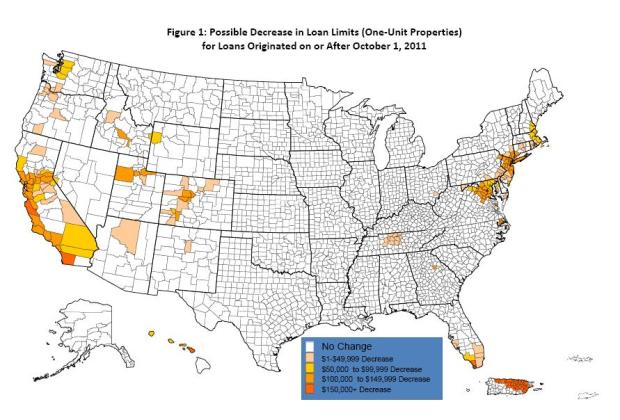
An issue that may have a gigantic impact on the housing market later this year is the lowering of the conforming loan limits. Without an act of Congress, these limits will return to the lower limits that existed prior to 2008. Today, we want to shed light on this issue and what it means to someone thinking about buying either a first home or move-up home valued over $400,000 in certain markets in the country.

What is the ‘Conforming Loan Limit’?

The ‘conforming loan limit’ sets the maximum loan amount, which either Fannie Mae or Freddie Mac are allowed to purchase individual loans. If a loan is larger than this limit, it is considered a ‘jumbo’ loan and is automatically disqualified from being sponsored by Fannie and Freddie. It would have to be handled by the private market.

A Little History

Prior to 2008, the loan limit was $417,000. When prices started to rapidly escalate in certain regions of the country, the limit was increased. In some counties, that limit jumped to over $700,000. These new limits are scheduled to expire this October. If this happens, Fannie Mae and Freddie Mac may no longer be involved in these loans.

What Impact Will This Have on a Buyer?

It will cost more in mortgage payments if buyers are purchasing a home over the limit in a region where the limit changed. The Mortgage Market Note explains:

For the affected borrowers, because mortgage rates for jumbo mortgages tend to be higher than rates for conforming loans, financing costs may be higher… Over the latest year, the difference between mortgage rates for jumbo loans and jumbo-conforming mortgages has varied between about ½ and ¾ of a percentage point.

Just a ½ point increase in mortgage rate on a $500,000 mortgage means an additional $154.84 in your monthly mortgage payment; a difference greater than $55,000 over the life of a 30 year mortgage.

Which Counties are Impacted and to What Degree?

Below is a map of the regions affected from the Mortgage Market Note. You can get a breakdown of each impacted county in this report also.

Bottom Line

If you are thinking about buying a home in the near future, you should know how this issue may impact you. Sit down with a real estate professional familiar with your area for further advice.


Realtors® Go Green with New and Improved Designation

The National Association of Realtors® is modifying its popular Green Designation program to focus on residential real estate practice.

“NAR research has consistently shown that there is a considerable and growing market for green buildings, and many of today’s consumers want homes and communities that are more resource efficient and sensitive to the larger environment,” said NAR President Ron Phipps, broker-president of Phipps Realty in Warwick, R.I. “NAR’s Green Designation helps Realtors® meet that consumer demand for green building practices. These revisions will help Realtors® continue to bring value to buyers and sellers who value eco-friendly and energy-efficient homes.”

Because of high member demand for the residential aspect of the curriculum, the commercial and property management electives will no longer count as credit toward the designation but will be made available to members interested in those areas of study. The changes will include replacing the two-day core course and one-day elective courses with three one-day courses: Green 100: Real Estate for a Sustainable Future (day 1); Green 200: The Science of Green Building (day 2); and Green 300: Greening Your Real Estate Business (day 3).

Students will need to complete all three days to earn NAR’s Green Designation. The updated program will be launched in late summer 2011. Until then, NAR’s Green Resource Council has reduced the prices of the existing online core and elective courses. The core course was $295 and is now $230; the residential elective was $125 and is now $99; and total cost for the full designation was $420 and is now $329.

NAR’s Green Designation was peer-reviewed by the Environmental Protection Agency and the U.S. Green Buildings Council, and received the 2009 Award of Excellence from the American Society of Association Executives. The Green Resource Council has forged strategic relationships within the green industry to create awareness of the designation, advance its mission, and provide continued education to the designee base. Other green industry initiatives include the creation of the Green MLS Toolkit, online at www.GreentheMLS.org.


New FTC Rule Impacts Realtors®’ Short Sale Business

A new rule from the Federal Trade Commission that aims to protect home owners from mortgage relief scams may impact real estate professionals who represent clients involved in short sale transactions. Several hundred Realtors® learned more about the new rule and its impact on their business at the “Risk Management and License Law Forum” during the Realtors® 2011 Midyear Legislative Meetings & Trade Expo in Washington, D.C. today.

National Association of Realtors® General Counsel Laurie Janik overviewed the FTC’s Mortgage Assistance Relief Services rule, which took effect on January 31, 2011. The goal of the rule is to protect distressed home owners from mortgage relief scams and ensure that people who provide counseling, advice and other services to troubled home owners are indeed providing a benefit for the fees they charge. The rule bans all upfront fees for renegotiating mortgage terms and mandates that certain disclosures are made to consumers if a short sale is negotiated with a lender on their behalf or when advertising short sales experience.

“As the leading advocate for home ownership, NAR supports efforts to ensure that mortgage assistance relief services truly benefit consumers,” said Janik. “Nevertheless, NAR has some concerns about the rule and its application to real estate professionals involved in short sales transactions. We are working closely with the FTC to clarify several aspects of the rule in relation to real estate professionals when they are performing traditional real estate functions in a short sale transaction.”

The rule is primarily directed at companies that offer loan modification services to consumers, but it also may impact real estate professionals who represent clients involved in a short sale transaction, especially when advertising short sale negotiation services or other short sale expertise; communicating with a consumer about a possible short sale before the listing agreement is executed; negotiating a short sale on behalf of a consumer; or arranging a short sale negotiation for a consumer. The rule only applies to residential real estate transactions.

In the meantime, Realtors® must already be complying with the rule by not taking any upfront fees and using specific disclosure language. The rule necessitates when and how the disclosures must be presented to consumers and that they are made clearly.

Currently, there are three types of disclosures that a real estate professional may need to make to consumers. First, a real estate professional now needs to include a clear and prominent disclosure in all commercial messages that advertise their short sale services.

Second and third disclosures are required by real estate professionals before they begin mortgage assistance services on their client’s behalf and at the time they present their client with the lender’s short sale approval letter.

“NAR is discussing with the FTC some language in the second and third disclosures and well as some other requirements found in the MARS rule. The FTC is considering possible options to help make the rule more applicable to a real estate brokerage,” said Janik.


 The Impact of Dodd-Frank on Real Estate

Although the 2,314-page Dodd-Frank Wall Street Reform and Consumer Protection Act signed into law last year doesn’t affect real estate brokers and agents as much as, say, mortgage originators, it does have some significant implications for the industry, said Phillip Schulman, a partner at the Washington, D.C. law firm K&L Gates LLP.

In his remarks at the Real Estate Services Forum Thursday during the REALTORS® Midyear Legislative Meetings, Schulman told attendees that the mortgage lending sector was targeted by many of the bill’s provisions.

“[Dodd-Frank] came down hard on loan officers and mortgage brokers. Why? Because they were the ones working with the borrowers,” said Schulman, adding that in the future all originators will be qualified, licensed, and registered, as well as issued a unique identifier.

“Anytime there’s a violation committed by a loan officer, it’s going to be reported in a nationwide system,” he said.

The bill also affects the financial sector, particularly in terms of the structure of securities, which are debts or equities that are packaged for investment. To avoid the financial fraud of the previous decade, Dodd-Frank requires financial companies that create securities to hold a minimum 5 percent stake in them – the exception being securities that are composed of qualified residential mortgages (QRM).

Current QRM requirements for borrowers include no option adjustable-rate mortgages (ARMs), no bankruptcy in the past three years, no prior short sale or foreclosure, and points and fees charged by the lender totaling less than 3 percent of the loan’s value. Furthermore, lenders and regulators have recently recommended implementing a higher minimum down payment.

The increasingly stringent requirements pose a serious challenge to a viable housing market, Schulman noted.

“The eligible loan is shrinking and shrinking, and it’s going to be harder for someone who has any dents or scratches in their credit to get a loan,” he said. “It’s all well and good to get the riff-raff out of the business and get rid of these exotic, fly-by-night financial products, but let’s not throw the baby out with the bath water.

“We just came through a decade of this laissez-faire attitude. The atmosphere was one of easy money. We put millions of Americans in homes who probably should not have been there. Today, Washington is all about risk management. Congress and regulators stepped in and were asked to regulate. So they did what they always do. They overregulated. I think until we earn back the trust of the Congress and the regulators and even the American people, we’re going to continue to be scrutinized like never before.”

Here are a few other important, real estate-related changes brought about by the bill:

Bureau of Consumer Financial Protection:, this new behemoth regulatory agency – which Jay N. Varon, Schulman’s fellow speaker and a litigation partner with law firm Foley & Lardner LLP, characterized as the “centerpiece” of Dodd-Frank – will officially launch on July 21. This organization will encompass a half-dozen current regulatory agencies and 18 consumer statutes, including RESPA. It will also have what Varon called “nuclear” penalties, meaning punishments for violations will be much more stringent than they are now.

Prohibitions on steering and loan-officer compensation:

Dodd-Frank changed the compensation model for loan officers to prevent them from steering consumers into loans that may not be right for them, yet profitable for the lending company. According to Schulman, loan officers will collect the same sum per loan, whether it’s a 30-year fixed mortgage or an option ARM. Still, he said this new arrangement isn’t entirely fool-proof. “Businessmen figure out a way to make every system work. Sure, they’ll pay them 50 basis points for loans of all kinds. But they can also pay them bonuses based on total volume,” he explained.

Appraisals and AMCs:

New regulations in Dodd-Frank are designed to protect appraiser independence, Schulman said. These rules also sunset the Home Valuation Code of Conduct (HVCC), which caused a great deal of consternation among real estate professionals who say it contributed to the collapse of deals after it was enacted in 2009.

TEAM EMPOWERMENT MORTGAGE CHATTER: May 12; News & Headlines; How Much Money Would You Deposit In This Investment; Google Wants Your House To Be As Smart As Your Phone; Global Open House; Banks Less Likely To Budge On Home Prices; The Dollar and Impact

“If you don’t like something, change it. If you can’t change it, change your attitude. Don’t complain.” – by Maya Angelou


NEWS & HEADLINES

HUD announced a conference call for today. FHA Office of Lender Activities and Program Compliance Conference Call/Live Meeting from 2-3 EST. “Topics of Discussion: Audited Financial Statements, Investing Mortgagee Requirements, Third Party Originations.” E-mail your questions both in advance of and during the call to OLAPC@HUD.GOV and to join use the conference dial-in number: (800) 260-0718; Confirmation/Participant Number: 201997.

In Northern California, Walnut Creek to be exact, FHA will conduct a 1-day class on June 7 on “recent changes, highlights of underwriting the FHA appraisal, recap of underwriting & documentation requirements. This training is for Underwriters, Processors, & Loan Officers. It is free but registration required at FHAClass.

HUD also reminded FHA/VA producers that “claim-related payments to HUD must be made through the ‘Claim Remittance’ feature in the FHA Connection. This feature can be accessed through the FHA Connection by selecting Single Family Servicing, Claims Processing, and Claim Remittance. Banking information can be entered securely using one of two methods: (1) the one-time cash flow account setup process, using the Cash Flow Account Setup module in FHA Connection, establishes a banking account that can be used for frequent and recurring remittances, and (2) banking account information can be entered at the time of each remittance. By request to allow a longer transition period, the closing date for the Single Family Claims Lockbox has been extended to May 31, 2011. There will be no further extensions. Any checks received after May 31, 2011, will be returned to the sender and mortgagees may incur interest and – or penalty amounts on delinquent debts. Guidance on this can be found at: HUD.

Wednesday the volatility in our markets continued to pick up slightly. Treasuries and other fixed-income securities opened lower but buyers came into the market and prices gained steadily through the day. Equities sold off sharply on lower commodity prices and increased economic worries. When all was said and done the new 10-year note rallied about .250 in price and down to a yield of 3.16%. Mortgage banker selling was in the mid-to-upper end of its range of $1 to $1.5 billion, and agency MBS prices finished better by .125-.250, resulting in some intra-day price improvements.

Sales increases in building materials, gasoline stations, and restaurants, Retail Sales rose .4% in March. Today we learned that Retail Sales for April were +.5%, due in part to my purchase of SkyMall’s “Teach Your Cat to Use Your Toilet” Program. We also learned that last week’s Jobless Claims dropped from 478k to 434k, with continuing claims about unchanged but the 4-week moving average heading higher, and that the Producer Price Index was +.8% with the core rate +.3%. For the year producer prices are +6.8%.


HOW MUCH MONEY WOULD YOU DEPOSIT IN THIS INVESTMENT?

Conventional wisdom does not always apply. Consider this investment:

  • You determine the length of time and monthly amount you want to contribute.
  • You can always contribute more, but never less. If you do contribute less, all previous contributions will be forfeited.
  • The monies you deposit are not safe from a loss of principal.
  • The monies in the account are not liquid.
  • Your income tax liability actually increases with every contribution.
  • Your money earns a 0% rate of return.
  • When the investment is fully funded, there is NO income paid out.

On these terms, I have yet to have a customer be eager to put money into this investment. As a matter of fact, most are shocked to find out that they have been encouraged to put a large portion of their income in this exact investment! You see, the investment described above is Home Equity – whether it be through a larger than necessary down payment or through pre-payment strategies or even the regular amortization created by taking a shorter term.

Let’s look at the terms of the stated investment one more time:

  • Take a 15, 20 or 30 year loan
  • You can always pay additional money towards your outstanding balance, but if you pay less, and get foreclosed upon, you lose all your payments to reduce the principal.
  • As home values have declined, the monies invested (either from your down payment or other equity reducing strategies) have declined, and your cash has been lost.
  • Home equity is not liquid. You cannot just go get it when you need it. As a matter of fact, usually when you need to access it most (a job loss, disability, or worse) you can’t get it at all, as you won’t qualify for a loan.
  • With each payment on an amortizing fixed rate loan, you are paying more principal than you did in the previous payment. That means you are paying less interest. Since interest is the deductible portion of your payment, with each payment you pay less interest; therefore, less tax deductibility.
  • Home Equity has 0% rate of return. Ask yourself, “What interest rate will the bank give you on your down payment?” The answer is “Zero”. The same holds true for any reduction in principal. Any money used to increase equity (defined as the difference between the home’s value and its outstanding debt) will have a 0% rate of return.
  • When your home is paid off, there is no money paid to you. You are left with a large equity investment, gaining no rate of return.

Bottom Line

There are many factors to consider when deciding what mortgage fits your personal situation. You need to completely understand your individual, short and long-term goals. The “conventional wisdom” is not always the wisest solution. You should seek out the counsel of a good loan officer who understands your goals.


GOOGLE WANTS YOUR HOUSE TO BE AS SMART AS YOUR PHONE

Google kicked off its annual two-day conference for software developers by launching headline-grabbing movie and music services.

But it also announced a more futuristic project at Google I/O called Android@Home. The idea: To make your home as smart as your phone.

So far Google has used Android as an operating system for phones and tablets. Now it apparently has an ambitious plan to turn the home into one giant connected device.

Google wants consumers to be able to control devices and appliances in their homes with their Android devices, which would basically function like a universal remote.

Want to turn off the lights? Use your Android phone. That’s what Google did during an on-stage demonstration on Tuesday. Lighting Science Group is building wireless lighting products — bulbs and switches that can communicate with Android — that should be available in stores by the end of the year.

Making Google’s vision of an Android-automated home a reality will depend on the 5,000 software developers who are attending Google I/O. Google said it wants them to begin building applications to automate houses.

To get the creative juices flowing, it showed off a new home theater system called “Project Tungsten,” which allows users to stream music from Google’s new service to speakers connected to the Android home network. A user can upload music by tapping a CD case equipped with a near field communication device on a Tungsten device. Tap it again and the music plays.


ARE YOU PART OF THE GLOBAL OPEN HOUSE 59 COUNTRIES, 1 WEEKEND ?

The 2011 REALTOR® Nationwide Open House will be held on the weekend of, June 4-5, 2011. This event, which began on a local level a few years ago, is a weekend when REALTORS® across the country – and across the globe – are invited to hold open houses in their area. It is designed to drive buyers’ attention and interest to homes for sale and offers opportunities to educate the public about the benefits of home ownership.

Ask your local association for details and information on how you can participate in this year’s REALTOR® Nationwide Open House.


BANKS LESS LIKELY TO BUDGE ON HOME PRICES

An analysis by Redfin.com shows that bank-owned homes and short sales consistently sell for closer to their list prices than do non-distressed homes.

Redfin trend watcher Tim Ellis writes:

“This held true across every price band, although the volume of distressed sales is certainly weighted toward the low end – we were originally only going to discuss [bank-owned homes] in this post, but the sale-to-list ratios for short sales were so similar that we decided to include them in our analysis as well.”

The study includes homes in 16 markets, including Irvine, where distressed sales were at 42% of total home sales. You can see the sale-to-list ratio in the chart above.

At one point, Ellis cites a Redfin agent in Phoenix, Marcus Fleming, who says:

“Banks are very careful about getting a number of BPOs [broker price opinions] before listing a home. When it goes on the market they are so confident the price is right that for the first 2 weeks they will accept nothing but offers at 100% of list price.”

Fleming says even when the home has been on the market for several months, banks won’t consider offers for less than about 95% of the list price.

Ellis says:

“In general, the more distressed a market is, the bigger the difference between the two sale-to-list ratios. In other words, in a highly distressed market like San Diego, buyers are a lot less likely to get a bank to negotiate on price than they are in a less-distressed market like Denver. Admittedly, the correlation isn’t incredibly strong, but there is definitely a clear trend in that direction.

“In some markets, banks are being especially aggressive with their listings, putting homes up for sale at well below the market value, leading to multiple bids and average sale prices that are higher than the list price. Across the entire data set we analyzed, distressed listings were more than twice as likely to sell for over list price than non-distressed listings.”


THE FALLING DOLLAR AND THE IMPACT ON REAL ESTATE

The U.S. dollar has been weakening for the past two years and the depreciation could continue for the remainder of the year. The dollar is weaker not only against the major foreign currencies of the Euro, Pound, and the Yen, but also against the Russian Ruble, Polish Zloty, South Korean Won, Thai Baht, South African Rand, Brazilian Real, and Mexican Peso.

Why? One key reason is just an unwinding of the strength of the dollar that grew during the 2008/09 financial crisis. Global financial panic always forces the dollar up as investors search for a safe, reliable haven. Now with the financial market recovering quite strongly, the “panic” impact on the dollar is no longer in play. Another reason for the decline in the dollar is a result of the falling confidence that global investors are placing in the U.S. economy. If you had cash to invest, where would you invest – in a country with strong growth prospects or in a country that could be losing competiveness with the rest of the world?

A final important reason for the dollar decline is that the U.S. has been running up a sizeable trade deficit for quite some time. Americans buy far more imported foreign products in relation to exporting U.S.-made products abroad. To help rebalance this persistent trade deficit, the weakening U.S. dollar – in theory – is supposed to help Americans buy fewer foreign products and help sell more American products abroad. John Deere, as an example, has better prospects to sell tractors to Brazil. Also, many Americans may reconsider traveling abroad since the dollar doesn’t go as far in other countries (such as forking over $10 for a Big Mac meal in Rome, for instance, with ketchup costing extra).

However, the weakening dollar could actually worsen the trade deficit if Americans keep buying foreign products, but now at a higher price. Imported oil is one example where Americans are buying out of necessity even at higher prices.

Whichever way one’s take on the desirability or undesirability of the falling dollar goes, one thing is clear as related to the dollar’s impact on real estate. Right now U.S. real estate is cheap, from the perspective of a foreign buyer, which may mean more international purchases this year. Below is a graph of U.S. property prices in different currencies over time.

TEAM EMPOWERMENT MORTGAGE CHATTER: May 11; News & Headlines; Homeownership: Building Family Wealth; Listing Data Not From MLS Has More Errors; 1 in 4 Homes Underwater; Realtors & Techonology; Special Fund Would Help Homeowners Stay In Homes

“To be successful, all you have to do is give up everything you know.” — Asara Lovejoy:  Human potential author and coach

NEWS & HEADLINES

A quick note for anyone interested in FHA lending’s pitfalls, the recent filed lawsuit against Deutsche Bank, and the enforcement tools regulators are using – there is a webinar today on those subjects. The webinar’s discussion will review the charges in the case and potential implications for FHA lending, and participants will be able to submit questions to be answered during the hour-long session from 3-4 EST, 12-1 PST. Webinar Presented by BuckleySandler LLP: “The False Claims Act and FHA Lending: What Does U.S. v. Deutsche Bank Mean for You?” Webinar topics include a summary and analysis of legal theory and corresponding charges in U.S. v. Deutsche Bank AG, et al., pitfalls in FHA Lending, avoiding False Claims Act liability, and beyond, how and when are False Claims Act violations triggered, what other enforcement tools are regulators using, what you can do now to position and protect your company, and insights on where the government and private plaintiff’s bar will go from here.  Clickheretoregister. After registering you will receive a confirmation email containing information about joining the webinar.

Lawsuits seem to be omnipresent in mortgage lending and banking. Here is the latest list of “Professional Liability Lawsuits” from the FDIC – another list you probably don’t want you or your company on: FDICSuits.

Yesterday the commentary mentioned one attribute of Fannie’s portfolio (a large number of Countrywide loans) which contributed to the difference in earnings between Fannie & Freddie. I received some notes, summed up by one Secondary exec in New York. “Fannie’s grappling with Countrywide loans, but remember that Freddie also has a glut of Taylor Bean Whitaker loans. And although both FNMA & FHLMC purchased mortgages down the credit curve several years ago, including subprime mortgages, it was primarily because HUD mandated that they do so. And regarding your Cato Institute quote about abolishing those agencies, readers should know that some people at Cato also support an end to HUD.”

“Freddie’s portfolio isn’t quite as awful as Fannie’s, according to Anthony Sanders, Mercatus Center scholar and a real estate finance professor at George Mason University. He says that Fannie had a larger share of subprime mortgage-backed securities and Alt-A mortgages. Consequently, its losses were more severe last quarter than Freddie’s losses.”

Yesterday’s fixed-income markets saw some volatility yesterday, but unfortunately for lenders the direction was toward lower MBS prices and higher rates. The news primarily consisted of a higher-than-expected print on import prices, the IMF’s preparations for another bailout to Greece (to replace the last one), and the Treasury’s $32 billion 3-yr note auction. Current coupon MBS prices worsened between .125-.250 on average volume while the 10-yr Note dropped nearly .5 and closed at a yield of 3.20%. Traders are definitely seeing the MBS production mix shift from 4.5’s and 5’s down to primarily 4’s (which include 4.25%-4.625% conventional mortgages) although origination is extremely light (barely making $1 billion per day over the past few weeks).

Today we’ve already had mortgage applications for last week, which the MBA said increased 8.2%. The refi number was +9%, hitting its highest level since mid-March, and purchases were up nearly 7%. The 4-week moving average is up nearly 3%, and refi’s account for over 63% of all applications. We also had the March Trade Deficit clock in at $48.18 billion, up from $45.44 billion in February. At 11AM MST the Treasury auctions $24 billion in 10-year notes, which currently is sitting around 3.22% and MBS prices are worse by about .125.


HOMEOWNERSHIP: BUILDING FAMILY WEALTH

The question facing many families making a move today is whether it makes more sense to rent or buy. We have been very upfront in discussing our unwavering belief in homeownership. It is for that reason that today we want to quote from a study issued by an institution with no ties to the real estate business or mortgaging.

The Joint Center for Housing Studies at Harvard University just released a study, America’s Rental Housing: Meeting Challenges, Building on Opportunities. The study discusses the need for a greater supply of quality rental units in America. We agree. However, there were a few nuggets of information found in the study we want everyone to know.

American’s Belief in Homeownership Has NOT Fundamentally Changed

There seems to be some feeling that homeownership has lost it’s luster and perhaps is no longer a component of the American Dream. Harvard explains:

To date, attitudes about owning have become only slightly more negative while attitudes about whether now is a good time to buy are little different than before the housing boom. In the latest Fannie Mae housing survey from October – December 2010, the vast majority of respondents – including renters – continued to believe that homeownership makes more financial sense than renting. In addition, nearly two-thirds of all renters surveyed reported their intention to buy homes in the future.

Homeownership Creates Wealth

Because prices have fallen dramatically in many parts of the country in the last five years, some are too easily dismissing homeownership’s role in building family wealth over the last century. The study explains:

In addition, renters have only a fraction of the net wealth of owners. Near the peak of the housing bubble in 2007, the median net wealth of homeowners was $234,600 – about 46 times the $5,100 median for renters. Even if homeowner wealth fell back to 1995 levels, it would still be 27.5 times the median for renters.

The recent fall in prices can’t wipe out the 100 year history housing has as a good long-term investment.

Bottom Line

The study was promoting the need for the construction of more rental housing for the average American family. However, when it came to a discussion on building wealth, Harvard offered:

“And for individuals as well as businesses, owning rental properties is an avenue for wealth creation.”

And how do these individuals and businesses create that wealth. Owning the real estate and collecting rent from their tenants to offset the mortgage payments. Build your family’s wealth – not your landlord’s. We believe OWNERSHIP almost always makes the most sense.


LISTING DATA NOT FROM MLS HAS MORE ERRORS

Listing data that doesn’t come directly from a multiple listing service data is more likely to have inaccurate price and status information, according to research by Trulia.

Trulia found that third-party syndicators of listing data that did not come from an MLS posted a 21.3 percent error rate regarding the listing’s price or status. Trulia says the problem is that real estate professionals submit the data to these syndication sites but often fail to return to the site to update the listing when information changes, which causes a “significant increase of disparate data sources resulting in less accurate data online,” according to Trulia.

Meanwhile, third-party re-syndicators of MLS data had a 10.2 percent error rate, direct feeds from brokers posted a 5.6 percent error rate, and direct feeds from franchises had a 3.9 percent error rate, according to Trulia’s research.

Trulia’s white paper was based on an analysis more than 430,000 listings between Feb. 15 and April 15 to uncover discrepancies in listing data.


1 IN 4 HOMES WITH MORTGAGES ARE UNDERWATER

The number of home owners who owe more on their mortgage than their house is worth continues to increase. About 28 percent of homes with mortgages are now underwater, according to Zillow.com’s latest Home Value Index. That is up from 27 percent reported during the last three months of 2010.

A flood of foreclosures continues to weigh on many markets and is putting downward pressure on home prices.

Zillow’s latest index, which covers 132 markets, showed that 97 percent of home owners saw a decrease in home values.

However, three real estate market bright spots were uncovered: Fort Myers, Fla., Champaign-Urbana, Ill., and Honolulu, which all posted quarterly increases. Home values in those cities increased 2.4 percent, 0.8 percent, and 0.3 percent, respectively.


REALTORS® and Technology

Technology has changed dramatically over the last 10 years and had a strong impact on the REALTOR® business. New forms of technology have enhanced mobility and improved efficiency, but they have also eliminated a level of control from the average real estate agent.

Consumers and Technology

Consumers have fully embraced the internet. According to the Bureau of the Census, in 1997 only 18.0 percent of Americans had internet at home; by 2009, that figure had jumped to 68.7 percent. The internet is no longer just a source of information and e-commerce, but a means of creating and expanding relationships, both personal and professional. Friendster gave way to MySpace, which gave way to the social media giant Facebook. The number of active members on Facebook jumped from just one million users in December of 2004 to more than 500 million by the end of 2010. Today blogs are common and for those for whom the speed and frequency of interaction on these sites are not enough, registered users on Twitter now total 175 million with an average of 95 million tweets per day.

According to NAR’s 2010 Profile of Home Buyers and Sellers, the share of buyers who searched “frequently” on the internet for their home rose from 71 percent in 2003 to 89 percent in 2010. The share of homebuyers who found their home on the internet jumped from 8 percent in 2001 to 37 percent in 2010. Among buyers who used the internet, the features most often used were photos and detailed information about the property. Buyers were less interested in information on “days on market” and comparables. This pattern suggests that consumers use online information about listings to better educate themselves for the purchase decision, but they are less interested in information that would help them with pricing or strategies of the purchase process. Consumers want to better understand the particulars of the property and leave the process to their REALTOR®.

REALTORS® and Technology

The march of technology has also left an imprint on REALTORS®. REALTORS® were quick to adopt both e-mail and mobile phones. As early as 2002, 96.6 percent of REALTORS® had a mobile phone. At that same time, use of other wireless devices, particularly those withe-mail or internet capabilities, was low at only 17.4 percent, and less than a third (31.7%) of REALTORS® used a pager. Desktop computers were used by almost 73 percent of REALTORS® at their place of business and 84 percent had a desktop computer at home.

By 2010, the technology used by REALTORS® was different. Pagers disappeared and only 16 percent of REALTORS® planned to buy a desktop PC – a trend that reflects the demise of the brick-and-mortar office. Technology enhanced mobility and REALTORS® took advantage of that, with 34 percent planning to buy a laptop, 21 percent selecting an iPad and 42 percent opting for a smart phone.

The internet allows REALTORS® to market listings to a much broader audience than before. In 2010, the site most frequently used by REALTORS® to list their properties was REALTOR.com, followed by their broker site, and their personal site. Magazines, national franchises, and local newspapers, traditional sources of listings, had all fallen below a 40 percent share.

Conclusion

Technology has had a substantial impact on the lives of both consumers and REALTORS® over the last decade. Consumers have embraced the internet as a search tool, but also as a social outlet. REALTORS® embraced the internet as well, and property listings now flourish on line. REALTORS® are also increasing their use of social media as a means of expanding their sphere of influence and lead generation. Gadgets have also had an impact, untethering REALTORS® from their offices and enabling them to communicate much easier. But, while technology has been broadly adopted by the REALTOR® community, social media remains the avenue of younger REALTORS®. Real estate is a fast and fluid business and REALTORS® will continue to seek out and adopt those technological that augment their business. The next 10 years are likely to bring dramatic changes in the ways REALTORS® use those technologies.


SPECIAL FUND WOULD HELP OWNERS STAY IN HOMES

State attorneys general are proposing a special fund, that could be as large as $20 billion, to help troubled borrowers stay in their homes.

State attorneys general are meeting this week in Washington, D.C., to continue negotiations with federal regulators and the country’s largest mortgage servicers. The settlement negotiations are expected to include talks about the special fund as state attorneys general continue to seek fines and other punishment of mortgage servicers for bad foreclosure practices.

Proposals from state attorneys general being discussed include using some of the money in the fund to write down the principal balance for some troubled home owners, The Washington Post reports. Banks have strongly argued against such a move, questioning the fairness for other home owners in doing that. Another option state attorneys general may propose is to use the funds to support state-run aid programs, mediation services, and foreclosure hotlines to help struggling home owners.

The ongoing negotiations are one of many taking place among government agencies to reach settlements with banks regarding shoddy foreclosure practices.