Zackry Cooper

TEAM EMPOWERMENT MORTGAGE CHATTER: April 20; News & Headlines; Will Cost of Buying Increase Even If Prices Fall?; Bill To Allow REO Purchases with Retirement funds; Zillow goes public files for $52 Million IPO; Investors drove homes sales up 3.7%

“Any idea, plan, or purpose may be placed in the mind through repetition of thought.” — Napoleon Hill: Was a lecturer and author of books on achieving success

NEWS & HEADLINES

Dodd Frank is indeed the gift that keeps on giving. Earlier this week the Federal Reserve Board (FRB) requested public comment on a proposed rule under Regulation Z that would require creditors to determine a consumer’s ability to repay a mortgage before making the loan and would establish minimum mortgage underwriting standards. (So let’s take away Fannie & Freddie, and have regulators set underwriting guidelines for private mortgage bankers?) The proposal would apply to all consumer mortgages (except home equity lines of credit, timeshare plans, reverse mortgages, or temporary loans). The proposal would also implement the Dodd-Frank Act’s limits on prepayment penalties.

Housing Starts and Building Permits were both a little stronger than expected – good news for the housing biz although they remain low by historical standards. Today at 9AM CST we have Existing Home Sales, which in February fell 9.6% with declines in every region of the country. Distressed transactions accounted for 39% of all transactions for the month and the median price of an existing single-family home down about 4% over the last year. But analysts are calling for a slight improvement in this morning’s number.

The MBA came out with its weekly index, shopping a little pop last week of 5.3%. Refi’s were up almost 3%, and purchases were up 10% (driven by FHA/VA production). The percentage that refi’s constitute of overall business continues to drop, and is now about 58% – the lowest in almost a year. And ARM share increased to 6.5%.

Rate-wise, yesterday was uneventful. The data was limited to Housing Starts, not a big market-moving number. Agency MBS prices closed around unchanged and the Treasury’s 10-yr settled around 3.36%. A trader reported that “mortgage banker supply remained minimal.” This morning rates are a shade higher, with the 10-yr at 3.40% and agency MBS prices worse by about .125.


WILL THE COST OF BUYING INCREASE EVEN IF PRICES FALL?

We have discussed the proposed modifications to the mortgage process several times in this blog already. We want to make sure our readers understand the potential impact to the cost of financing a home these changes will have. The cost of buying a home may increase even if prices continue to soften. The total cost of a home is determined by two factors:

  • the price of the property
  • the expense of financing the purchase (assuming you are not paying all cash)

Check with a local real estate professional to determine where prices are headed in your region for the type of home you are considering. However, even if prices are predicted to soften further in your area, the COST of the home may rise because of increased expenses in financing. These expenses could increase rather dramatically.

Interest Rates

Interest rates have remained at historic lows for over a year. As the economy improves, there will be less need for the government to keep rates low. Many are predicting interest rates will increase from 1/2 point to 3/4 of a point before the end of the year. We may also see an additional increase in rate for loans deemed “less qualified”.

New Mortgage Standards

The government has proposed a new definition for a “qualified residential mortgage”. The new standard would set a bar much higher than we have today. Anyone not meeting these requirements would not be eligible for the “best” rates available. What could be the difference in interest rate? In a white paper released last week by a group that included the Center for Responsible Lending and the National Association of Realtors:

Some private estimates have concluded that 5 percent risk retention could result in a three-percentage point rise in interest rates for loans funded through securitization. In other words, today’s 5 percent market would become an 8 percent interest-rate market.

Even if the rates for these loans are only one percentage point higher than the best rate, the additional cost to a buyer could be dramatic.

Impact of Interest Rates on Mortgage Payment

The interest rate you receive obviously plays a big role in determining your monthly mortgage payment. How big a role? Here is a chart showing how your payment is impacted even if home prices fall:

Bottom Line

You may have delayed your home purchase decision because of concern over where PRICES may be headed. To make the best financial decision for you and your family, also take into consideration where the overall COST of the purchase may be headed.


BILL WOULD ALLOW REO PURCHASES WITH RETIREMENT FUNDS

A bill introduced in the U.S. House of Representatives would waive withdrawal penalties on certain retirement plans if the funds were used to buy a house that has been in foreclosure for a year or more, HousingWire reports.

The bill, introduced recently by congressman and real estate professional Bill Posey, R-Fla, is expected to apply to Roth IRAs, 401(k) plans, and company pension plans.

The legislation’s aim is to promote REO home purchases by owner occupants or second home owners rather than investors just looking to “flip” a foreclosure for fast money. According to the bill, purchasers must agree to hold the property for at least two years to be exempt from early retirement plan withdrawal penalties.

“It’s just another idea to help the housing market,” says press secretary George Cecala.

The bill has been sent to committee for further consideration.


ZILLOW GOES PUBLIC, FILES FOR $52 MILLION IPO

You may soon be able to buy stock in Zillow. The Seattle-based real estate Web site filed on Monday preliminary documents for an initial public offering. The company hopes to raise about $51.75 million for its IPO.

Zillow has not yet disclosed how many shares it intends to sell or the price for each share.

Technology Crossover Ventures and PAR Investment Partners have already agreed to buy a total of $5.5 million of common stock from Zillow, CNNMoney.com reports.

Zillow, founded in 2004 and originally known for its popular “Zestimates” home value estimates on homes across the U.S., has seen its Web traffic quickly grow. In March, it boasted 19.4 million unique users from its Web site and mobile app, a more than 90 percent year-over-year increase in traffic. Its revenue has also increased significantly. In 2010, Zillow’s revenue increased by 74 percent to $30.5 million, according to the Securities and Exchange Commission filing.


INVESTORS DROVE HOME SALES UP 3.7% IN MARCH

Investors drove up U.S. home sales last month, plunking down cash to grab cheap homes at risk of foreclosure. But purchases made by first-time homebuyers, who are crucial to a housing recovery, fell.

Sales of previously occupied homes rose in March to a seasonally adjusted annual rate of 5.1 million, the National Association of Realtors said Wednesday. That’s up 3.7 percent from 4.92 million in February. The pace is far below the 6 million homes a year that economists say represents a healthy market.

Foreclosures or short sales, when the lender agrees to accept less than is owed on the mortgage, rose to 40 percent of all purchases. And deals paid for entirely in cash accounted for 35 percent of all sales. The Realtors group says that’s the biggest percentage since they have been tracking all-cash sales.

Many of those purchases are being made by investors, who are targeting cheap properties in areas hit hardest by foreclosures. The trade group’s data only accounts for individual investors and does not include homes sold in bulk at auction or on courthouse steps. So many of the foreclosure sales are likely being picked up en masse by private equity firms.

Another sign of the investor activity is that sales of homes priced under $100,000 have risen 10 percent from a year ago. In that same period, sales of mid-priced homes, between $100,000 and $500,000, have fallen more than 14 percent.

Fewer first-time homebuyers, the types of people who set down roots and raise families, are entering the market. Sales among that group fell to 33 percent in March. A more healthy percentage of first-time buyers is 40 percent, according to the trade group.

One major obstacle to a housing recovery is the glut of unsold homes on the market. There were 3.55 million unsold homes in March. It would take 8.4 months to clear them off the market at today’s sales pace. Analysts say a six-month supply represents a healthy supply of homes.

“It is unlikely that home prices can recover on a sustained basis until the inventory-to-sales balance improves further and the number of distressed properties is significantly reduced,” said Steven A. Wood, chief economist at Insight Economics.

Foreclosures are also playing a big role in weakening the housing industry. A record 1 million homes were lost to foreclosure last year and foreclosure tracker RealtyTrac Inc. said it expects 1.2 million more will be lost to foreclosures this year.

For March, sales rose 8.2 percent in the South, 3.9 percent in the Northeast and 1 percent in the Midwest. Sales fell 0.8 percent in the West.

Sales of single-family homes rose 4 percent to an annual rate of 4.45 million units. Sales of condominiums rose 1.6 percent to a rate of 650,000 units.

TEAM EMPOWERMENT MORTGAGE CHATTER: April 19; News & Headlines; What Do Homeowners Say About Homeownership? HUD Offers Grants to Remove Home Hazards; NAR Announces Insurance Benefit for Members; 9 Items Homebuyers Desire in 2011

We’ve got grey clouds, but don’t forget about the beauty nature brings.  Stop during your busy day and just soak it in…


“If you put off everything till you’re sure of it, you’ll never get anything done.” — Norman Vincent Peale: Was a minister and author of inspirational books

NEWS & HEADLINES

Auditing has become so bad that many large companies set aside a room, or block of them, for revolving teams of auditors from investors, Fannie, Freddie, the OTS, OTC, the FDIC, FRB, AA. Last week the servicing biz was in the headlines, with the first official “enforcement.” But in addition to those 14 servicing companies, LPS and MERS were both cited for “significant compliance failures” and “unsafe and unsound business practices” related to foreclosures. Regulators are requiring both companies to hire independent consultants, take remedial steps to address past failures and hire additional staff. LPS “faces the possibility of having to reimburse servicers and borrowers if an independent review finds anyone was financially harmed by its failure to properly execute mortgage documents” per an article by Kate Berry of American Banker. MERS said it is “already implementing changes to tighten corporate governance, improve internal controls and address quality-assurance issues identified by federal regulators.”

A few months ago MERS, with its 31 million residential mortgages on its system, told members not to foreclose in its name since borrowers have filed so many suits claiming the company has no standing to foreclose even though MERS has been listed as the lienholder in many foreclosure filings. MERS has 30 days to hire a third party to analyze and assess its directors, officers, management and staffing needs, and 90 days to create a plan to establish adequate internal control, risk management, audit and reporting requirements. But regulators never questioned the underlying business model of MERS, or attempt to answer the question, “Does MERS have the legal right to foreclose on a borrower?” This has led industry watchers to suggest that MERS has, in effect, had its procedures and processes validated.

For the 14 servicers, the implementation of the steps necessary to comply with the consent orders will further weigh in on timelines and increase servicing costs. Companies already have to reallocate resources away from production and into developing and implementing the plans. The order contained more than 25 action items and detailed over 50 sets of new policies, processes, and measures that need to be developed and implemented over the next 120 days. The biggest change will be the establishment of a single point of contact for borrowers. In addition, servicers will need to hire and train additional staff. Longer term, the additional staff should help to work through the backlog of foreclosures in the pipeline. And the state attorneys general are still negotiating with servicers over a potentially more far reaching agreement. The consent orders may give servicers some leverage in their negotiations. However, until an agreement with the AGs is completed, a cloud is expected to remain over the foreclosure process.

These thoughts all went through the market yesterday, as interest rates actually dropped. The Treasury’s10-yr closed better by about .250 and at a yield of 3.37%, and agency MBS prices improved by about .250. Stocks dropped, but Moody’s reaffirmed its positive outlook on the United States. Today, as mentioned, we had Housing Starts at 549k, up from a revised 512k, and Building Permits for March went from a revised 534k to 594k, both higher as expected. And we already had Goldman Sachs’ earnings, stronger than expected pretty much all the way around. The 10-yr is slightly worse at 3.39% and MBS prices are roughly unchanged.


WHAT DO HOMEOWNERS SAY ABOUT HOMEOWNERSHIP?

There is no shortage of experts that want to let us know how Americans feel about owning a home after the collapse of the residential market in the last five years. They MUST be devastated. They MUST feel trapped like prisoners in their own homes. They MUST be sorry they ever bought the house. These assumptions seem logical at times and can occasionally be supported by anecdotal evidence.

However, we want to go to the only people who truly understand how homeowners feel – the homeowners themselves. There have been three major surveys done this year that can shed light on the issue:

The National Housing Survey

This survey conducted by Fannie Mae showed:

96% of all homeowners said homeownership has been a positive experience.

64% consider buying a home as a safe investment. Buying a home was considered safer than buying stocks by over three times the number of people (64% vs 17%).

The top four reasons to buy:

  1. It means having a good place to raise children and provide a good education
  2. You have a physical structure where you and your family feel safe
  3. It allows you to have more space for your family
  4. It gives you control over what you do with your living space (renovations & updates)

American Attitudes About Home Ownership

According to this survey conducted by Harris Interactive for the National Association of Realtors, home owners believe that home ownership benefits individuals and families and strengthens our communities.

The vast majority of home owners say that owning a home is a smart decision over the long term. Even in today’s challenging economy, 95% of owners believe that over a period of several years, it makes more sense to own a home.

Home owners are much more likely to be satisfied with the quality of their family and community life than renters. While more than half of owners (56%) are “very” or “extremely” satisfied with the overall quality of their family life, only about one-third (36%) of renters report the same levels of satisfaction. Also, 43% of home owners are “very” or “extremely” satisfied with their community life, compared with 30% of renters.

An overwhelming majority of home owners are happy with their decision to own a home. A full 93% of owners surveyed would buy again.

Pew Research Center Survey

This recent survey titled “Home Sweet Home. Still” delves into homeowners’ current belief in homeownership as a long term investment:

Homeowners whose home value has fallen only a little are equally enthusiastic about housing as a long-term investment: 85% say buying a home is the best long-term investment a person can make. Among those who say their home has maintained it value or increased in value, 88% agree…

Even those who have seen their home values plummet are still committed to the idea that buying a home is a solid, long-term investment. Among those who say their home has lost a lot of its value, 80% agree that buying a home is the best long-term investment (36% strongly agree, 44% agree somewhat).

Bottom Line

There have been families that have been devastated by the current economy. However, through it all, homeowners have not wavered in their belief in homeownership as the best long-term investment.


HUD OFFERS GRANTS TO REMOVE HOME HAZARDS

The U.S. Department of Housing and Urban Development announced it will offer several grants to help remove housing-related health hazards – such as lead-based paint removal – from low-income homes.

“These grants are critical for states, counties, and cities who are on the front lines of protecting our children from lead hazards and other residential hazards,” says Jon Gant, director of the Office of Healthy Homes and Lead Hazard Control. “We look forward to communities applying for these grants so that they can help make older housing safer and healthier for children.”

The grants available include:

Lead-Based Paint Hazard Control (LHC) and the Lead Hazard Reduction (LHRD) grant programs: These grants will help identify and control lead-based paint hazards in privately owned housing for rental or owner-occupants.

Healthy Homes Production: A grant program that aims to help public and private entities address several housing-related hazards at the same time.

Asthma Interventions in Public and Assisted Multifamily Housing Grant: Grants that will help to evaluate programs for the control of asthma among residents of federally assisted multifamily housing.

HUD is making the grants available through its Lead-Based Paint Hazard Control, Lead Hazard Reduction Demonstration, Healthy Homes Production, and Asthma Interventions in Public and Assisted Multifamily Housing Grant Programs.

The application deadline for all of the grants above is June 9, 2011. For more information, visit www.grants.gov  or www.hud.gov .


NAR ANNOUNCES INSURANCE BENEFIT FOR MEMBERS

REALTORS® now have access to an errors and omissions insurance program from the National Association of REALTORS® newest REALTOR Benefits® Partner, Victor O. Schinnerer & Company Inc.

“REALTORS® help consumers invest in their future through home ownership,” said NAR President Ron Phipps, broker-president of Phipps Realty in Warwick, R.I. “E&O insurance helps REALTORS® protect their own business investment while they’re helping buyers, sellers and investors achieve their real estate goals.”

Coverage is available to members in all 50 states, the District of Columbia, Puerto Rico, and the U.S. Virgin Islands through Continental Casualty (CNA), a top-rated insurance carrier. Rates vary based on the type of coverage needed, area of specialty, and previous claims history.

The program offers a wide range of deductibles and claim limits as well as several premium credits, as allowed by state law. This includes a credit for being a REALTOR®, holding select NAR designations, continuing education, use of standard contracts, use of home warranties, and risk management programs. Schinnerer’s program also supports a broad range of real estate specialties including residential and commercial, property management, appraisal, and more.

Coverage was recently updated to include use of the Internet, such as Web sites, social networking, video hosting, and blogging. In addition, educational pieces and risk management services are available to policyholders. Schinnerer has developed a toolbox that includes a risk management newsletter, blog updates, webinars, and a toll-free hotline to discuss potential claims with a real estate claims specialist.

To sign up for the program and get more information, visit www.realtor.org/realtor_benefits/benefits_partners/eoinsurance .


9 ITEMS HOMEBUYERS DESIRE IN 2011

Today’s homebuyers want it all. Some items on the shopping list: a home in great condition with rooms that can do double duty. Areas that mingle indoor and outdoor living — patios, porches, decks and outdoor rooms — are always a plus. And so are those features that offer a little luxury, like garden tubs, first-rate appliances and high-dollar countertops.

They’re also going back to basics: searching for solid, well-maintained properties that will give them their money’s worth. “I think this year they’re buying properties that are in good mechanical condition that have inherent value,” says Ron Phipps, president of the National Association of Realtors. But more than anything, buyers want to drive a hard bargain. They want “great deals,” says Patricia Szot, president of the MetroTex Association of Realtors. “And no matter where a seller prices their property, they’re looking to negotiate.”

Here are nine items popular with buyers this year:

Homes in Good Condition

Buyers demand homes that are well maintained, Phipps says. “There’s not a lot of flexibility in that.” The attitude is: “I’d rather spend the money getting into the house” and not have to spend more money later, he says. Buyers don’t want an unknown expense hanging over their heads.

Rock-Bottom Bargains

Buyers “are more focused on negotiating, drawing limits in their mind and focusing on the strategy,” says Justin Knoll, president of the Denver Board of Realtors.

Some of it is a point of pride, he says. “They want to tell their friends and family that they really got a smokin’ deal.”

They “want value,” says Alice Walker, president of the Greater Nashville Association of Realtors. “They are very picky. They’re just a lot more critical. They are not going to settle because they know they don’t have to.”

Her advice to sellers: Repair, update, clean and stage. “You have got to remove every obstacle possible for the buyers,” Walker says.

Outdoor Living Areas

“The thing that we’ve seen over the past couple of years is more outdoor living areas,” says Laurie Knudsen, president of the Charlotte Regional Realtor Association. Some popular features: Screen porches, outdoor kitchens, two-way fireplaces.

IncentivesCall it “Rock-bottom deals, part two.”

Along with pricing, “it’s all about incentives,” says Mabel Guzman, president of the Chicago Association of Realtors. To pique buyer interest, sellers offer everything from gift cards for new furniture and paint to financial assistance at closing.

Practical Green Features

Call it “Yankee frugality,” says Phipps. But what he sees on buyer shopping lists is a home that is easy on the planet because it’s easy on the wallet.

Buyers are looking for things like triple-glazed windows, high-efficiency boilers and energy-efficient appliances. “The buyer of today wants to make sure that the ongoing operating costs of the house are as controlled and economical as possible,” he says.

Open Kitchens

“The wall between the kitchen and the family room is evaporating,” Phipps says.

“The kitchen is becoming part of the gathering space,” he says. “And it’s ironic — it’s the way it was 300 years ago. We’ve come full circle.”

Repurposed Materials

Buyers like a material that looks or feels natural, even if it’s not the genuine article, Phipps says. For example, “granite (for counters) is still popular, but it doesn’t have to be granite,” he says. “It can be stone, another natural material or something that looks like stone.”

Smaller, Less-Formal Homes

Buyers are buying smaller homes, but they want to be able to use and reuse every inch of space, Phipps says. “They are being much more strategic and efficient with how they use it.”

Formal spaces that might only be used three or four times per year are disappearing. “The slipcover rooms are gone,” says Phipps.

That’s “led to a repurposing of space,” he says. Formal living rooms have been added to great rooms or converted into home offices or entertainment rooms.

Touches of Luxury

Buyers like luxury. And sometimes the amenities that convey that feeling of living large are relatively simple or inexpensive.

One example: coffee bars in the master bedroom. “It’s like a butler’s pantry in your bedroom,” Pratt says. “An area for your coffee pot and accoutrements and a little fridge.”

TEAM EMPOWERMENT MORTGAGE CHATTER: April 18; Banks get failing grade in foreclosure handling; House Flippers Return, Still Finding Profits; IRS Loses $513M to Tax Credit Cheaters; US Economy to live within its means; QRM: The other side of the arguemen

“One can have no smaller or greater mastery than mastery of oneself.” – Leonardo da Vinci

NEWS & HEADLINES

This Friday is Good Friday. But today is not so “good” for our government, as S&P cut its US debt rating to a “negative outlook” given the debt & debt ceiling debate, pushing markets this morning. Religious sentiment aside, Good Friday falls into one of those “pseudo-holiday” categories, since the markets are closed, but many originators are open. Most are taking locks, but can’t hedge them, or they sell the loans to investors at what could be termed “conservative” prices.

The FDIC recently updated its loss, income, and reserve ratio projections for the Deposit Insurance Fund (DIF) over the next several years. The projected cost of FDIC-insured institution failures for the five-year period from 2011 through 2015 is $21 billion, compared to estimated losses of $24 billion for banks that failed in 2010 alone. The future is never certain, but most believe that the fund should become positive this year (it has increased for four consecutive quarters) and reach 1.15 percent of estimated insured deposits in 2018. The Dodd-Frank Wall Street Reform and Consumer Protection Act requires that the fund reserve ratio reach 1.35 percent by September 30, 2020.

Last October the FHA increased its MIP’s from 55 basis points to 90 basis points, and today is increasing the monthly fee to 115 basis points for higher LTV loans. The FHA insurance premiums are not “grandfathered in,” so a borrower who is currently paying low MIPs will have to pay higher MIPs if he/she were to refinance. This is a pretty clear example of what is bad for one group (originators, borrowers) is good for another (investors in existing Ginne Mae securities).

(Also note that starting today FHA systems will require mortgagees to certify at the time of requesting a case number that they have an active application for the borrower and property, and provide the borrower’s name and social security number for all new construction. And FHA systems will automatically cancel any uninsured case number where there has been no activity for 6 months since the last action except for loans where an appraisal update has been entered and/or loans where the UFMIP has been received.)

“Fannie Mae told mortgage servicers to halt a practice that could help them avoid repurchasing flawed home loans. In a notice to banks today, the company said servicers are prohibited from entering into loss-sharing or indemnification agreements with mortgage insurers. The deals help servicers avoid having their policies revoked.” FannieServicers

Looking back to Friday, agency mortgage-backed securities had a nice little improvement: .5-.625 depending on coupon. Volume picked up a little, which is nice to see in a rally, although for the week volumes were below normal. (We’ll probably see this in Wednesday’s MBA app index.) The 10-yr notes rallied by more than .5 in price, closing around 3.41%. Interestingly, this happened in spite of inflation coming in about as expected, Industrial Production increasing .8% in March and Capacity Utilization hitting 77.4% (the highest since August 2008), and the University of Michigan’s preliminary index of consumer sentiment moving up to 69.6, higher than forecast.

Unlike last week, this week will be shortened by a holiday and will be a light week for economic data. We have some type of housing index data today, unlikely to move rates. But tomorrow we’ll have the excitement of Housing Starts and Building Permits. Existing Home Sales will come out on Wednesday, and the Philly Fed numbers, Leading Economic Indicators, and another house price index are scheduled for Thursday. Mortgage markets will close early on Thursday and will be closed on Friday in observance of Good Friday. The 10-yr is down to 3.38%, and agency MBS prices are better by about .125.


BANKS GET FAILING GRADE IN FORECLOSURE HANDLING

Banks continue to receive backlash for their handling of a flood of foreclosures across the country. A new report released this week by federal regulators finds that banks failed to do a good job in handling foreclosures and sometimes evicted home owners when they clearly should not have.

The problems were “significant and pervasive” and added up to “a pattern of misconduct and negligence,” according to the Federal Reserve. The Fed says it soon plans to announce monetary penalties against mortgage servicers.

The report revealed several cases “in which foreclosures should not have proceeded due to an intervening event or condition,” such as families in bankruptcy or home owners who were eligible for a loan modification or even in the process of doing a loan modification.

The report also noted that banks had inadequate and poorly-trained staffs and improperly submitted paperwork to the courts.

In response to the report, several mortgage servicers signed a consent agreement this week, agreeing to changes that include new oversight procedures of foreclosures and reimbursing home owners who were wrongly foreclosed upon. One of the servicers signing the agreement, JPMorgan Chase, says it would add up to 3,000 employees to meet the new regulatory procedures.

“The banks are going to have to do substantial work, bear substantial expense, to fix the problem,” says John Walsh, the acting comptroller of the currency.

About two million households are in foreclosure, and several million home owners have already lost their home to foreclosure.

More Penalties Coming

The banks still face punishment and settlement talks with other agencies. The state attorneys general are conducting their own probe into shoddy foreclosure procedures and working with the Obama administration to overhaul the foreclosure process to prevent future abuses.


HOUSE FLIPPERS RETURN, STILL FINDING PROFITS

Banks continue to receive backlash for their handling of a flood of foreclosures across the country. A new report released this week by federal regulators finds that banks failed to do a good job in handling foreclosures and sometimes evicted home owners when they clearly should not have.

The problems were “significant and pervasive” and added up to “a pattern of misconduct and negligence,” according to the Federal Reserve. The Fed says it soon plans to announce monetary penalties against mortgage servicers.

The report revealed several cases “in which foreclosures should not have proceeded due to an intervening event or condition,” such as families in bankruptcy or home owners who were eligible for a loan modification or even in the process of doing a loan modification.

The report also noted that banks had inadequate and poorly-trained staffs and improperly submitted paperwork to the courts.

In response to the report, several mortgage servicers signed a consent agreement this week, agreeing to changes that include new oversight procedures of foreclosures and reimbursing home owners who were wrongly foreclosed upon. One of the servicers signing the agreement, JPMorgan Chase, says it would add up to 3,000 employees to meet the new regulatory procedures.

“The banks are going to have to do substantial work, bear substantial expense, to fix the problem,” says John Walsh, the acting comptroller of the currency.

About two million households are in foreclosure, and several million home owners have already lost their home to foreclosure.

More Penalties Coming

The banks still face punishment and settlement talks with other agencies. The state attorneys general are conducting their own probe into shoddy foreclosure procedures and working with the Obama administration to overhaul the foreclosure process to prevent future abuses.


IRS LOSES $513M TO TAX CREDIT CHEATERS

More investors are taking on the risk of flipping homes, despite falling home prices and sluggish real estate markets across the country. But investors say there are still profits to be made in the house flipping business.

Nearly 1 million homes were bought as investment properties in 2010, according to the National Association of REALTORS®, and a record number of buyers purchasing properties with cash currently are flooding the market.

Flipping homes for profit is easier in rising markets, but not many markets are reporting increases in home prices, analysts say. In Washington, D.C., Justin Konz of RestorationCapital says his clients are going through four of five properties a month and are making gross profit margins of 35 percent or higher.

Where to Find the Deals

Flippers mostly are finding their homes through foreclosures auctions, REOs, and short sales. They seek homes at rock-bottom prices that will have low fix-up costs, no more than about 5 percent or 10 percent of the purchase price.

In Florida, where investors are finding it more difficult to flip homes because of the drastic drop in prices and high inventories, flippers are targeting inner-city properties that are being sold at steep discounts. For example, some of houses are selling for $30,000 when they once sold for $200,000.

Perry Henderson, a real estate agent and investor in Austin, Texas, says the biggest opportunities in flipping are the “ugly” houses that have lingered on the market or “old houses that somebody’s grandma lived in for 40 years and didn’t do anything to. Now, she’s passed away and her family wants to sell quickly.”

Real estate investor Brian Fuller, who with partners buys and sells more than 200 properties a year in the San Diego area, says he’s drawn to the “biggest eyesore on the block.” He says they then – turn it into the best looking house there. We’re helping pull up values in the neighborhood.”


TIME FOR THE U.S. ECONOMY TO LIVE WITHIN ITS MEANS

Inflation fears this week abruptly gave way to concern for the economy, with long-term rates and stocks dipping accordingly. Overriding all financial news: The miraculous outbreak of an authentic effort to repair the nation’s finances.

One at a time: By the end of last week, inflation worrywarts had begun to expect Federal Reserve tightening this year. On Monday, Federal Reserve Board Vice Chairman Janet Yellen and New York Federal Reserve President Bill Dudley blew them up altogether. Fed tightening now is inconceivable.

Forecasters have called for 4 percent-plus U.S. Gross Domestic Product growth, but a crowd is elbowing for the exit, revising suddenly as low as 1.5 percent. March retail sales were soggy, a 0.4 percent gain and only 0.1 percent ex-gasoline.

New claims for unemployment insurance spiked 27,000 to 412,000 last week, the highest in two months. The March survey of small business, by the National Federation of Independent Business, retreated from all gains since last October — in sharp contradiction to the Fed’s Beige Book, brimming with happy-talk fairytales from inflation-hawk regional Fed presidents.

Aside from the ideal structures of taxation and spending priority, NCFRR has one crucial insight and discipline: We must settle on the size of government as measured by percent of GDP. We must no longer tolerate in ourselves the right’s perpetual dodge of taxation, starving revenue from necessary spending; nor can we tolerate the left’s perpetual burglary, committing future spending without revenue.

NCFRR suggests 21 percent of GDP, revenue and spending in approximate balance — 21 percent is the baseline for spending ever since WWII. I don’t care, give or take a couple of points. Go much lower and government will become a cold and pinched vision of Calvin Coolidge. Go much higher and we’ll be lost in bureaucratic bloat, inefficiency, and confiscatory redistribution.

Small imbalances are OK: deficits in the 1 to 2 percent range (each percent is about $150 billion). Today’s spending is 24 percent of GDP, in the early stages of unfunded entitlement explosion headed above 30 percent. Tax revenue today is 15 percent of GDP.

It’s a big hole. However, revenue has been suppressed about 3 percent by the Great Recession.

Obama’s proposal is harder to figure because his behavior has been so odd. He ignored the NCFRR report when released, then dismissed it in his State of the Union, then in February brought an as-is budget, and has since refused to engage the matter. Then on Wednesday, he delivered a hurried, no-detail proposal in a peculiarly timed 1:30 p.m. speech.

He had this key line: “If we truly believe in a progressive vision of our society, we have the obligation to prove that we can afford our commitments.”

No, sir. Not that way. That is the old, corrupt way. Henceforth we cannot make commitments until we have agreed on what we can afford.

The most important thing: There is going to be a deal. The electorate is exhausted with living beyond its means. To the consternation of financial hyenas now salivating at the prospect of U.S. default … ain’t gonna happen.

As markets process the news of many fewer new Treasurys ahead, great benefits from sacrifice will accrue.


QRM: THE OTHER SIDE OF THE ARGUEMENT

There is little doubt that the ease in which mortgage money was issued early in the last decade was one of the major reasons for the housing crash. What constitutes a “quality residential mortgage” (QRM) definitely should be redefined. However, several organizations see the newly suggested guidelines going too far.

The newly proposed QRM definition offered by the government addresses four main issues:

  • Type of mortgages that would qualify
  • The ratios between a purchaser’s income and their payment/overall debt
  • The amount of down payment which should be required (20% is being proposed)
  • The minimum FICO score for a borrower

The National Association of Realtors (NAR), the Center for Responsible Lending (CRL), the Mortgage Bankers Association (MBA), the National Association of Home Builders (NAHB), the Community Banking Mortgage Project and the Mortgage Insurance Companies of America (MICA) issued a white paper on the subject titled:Proposed QRM Harms Creditworthy Borrowers and Housing Recovery

The paper only challenges the potential down payment requirement (eventually the organizations will address the remaining three conditions in updates to this original white paper). Let’s look what the report says:

In the midst of a very fragile housing recovery, the government is throwing a devastating, unnecessary and very expensive wrench into the American dream. First time homebuyers will have to choose between higher rates today or a 9-14 year delay while they save up the necessary down payment…

High down payment and equity requirements will not have a meaningful impact on default rates. But they will require millions of consumers, who are at low risk of default, to either put off buying a home or pay unnecessarily high rates. The government is penalizing responsible consumers, making homeownership more expensive or simply out of reach for millions. We urge regulators to develop a final rule that encourages good lending and borrowing without punishing credit-worthy consumers.

Will Higher Down Payments Substantially Decrease Defaults?

The report actually studies the impact a higher down payment would have had on the default rates of loans written from 2002 through 2008. The report states:

They actually break it down:

…moving from a 5 percent to a 10 percent down payment on loans that already meet strong underwriting and product standards reduces the default experience by an average of only two- or three-tenths of one percent…Increasing the minimum down payment even further to 20 percent… (creates) small improvement in default performance of about eight-tenths of one percent on average.

Will Higher Down Payments Impact a Buyer’s Ability to Purchase?

The white paper looks at three separate areas the proposed QRM would impact:

  • The reduction in eligible buyers caused by an increase in down payment
  • The time it would take to save a 20% down payment
  • The cost of financing for a non-qualified mortgage

1.) The reduction in eligible buyers caused by an increase in down payment

As it did when looking at defaults, the paper studies the impact a higher down payment would have had on buyer demand from 2002 through 2008. The breakdown:

…moving from a 5 percent to a 10 percent down payment on loans that already meet strong underwriting and product standards…would eliminate from 7 to 15 percent of borrowers from qualifying for a lower rate QRM loan. Increasing the minimum down payment even further to 20 percent, as proposed in the QRM rule, would amplify this disparity, knocking 17 to 28 percent of borrowers out of QRM eligibility.

2.) The time it would take to save a 20% down payment

This section of the report was eye-opening. Here is the time it would take a family to save for the newly suggested down payment.

Based on 2009 income and home price data, it would take almost 9 years for the typical American family to save enough money for a 10 percent down payment, and fully 14 years to save for a 20 percent down payment. A 20 percent down payment requirement for the QRM means that even the most creditworthy and diligent first-time homebuyer cannot qualify for the lowest rates and safest products in the market. Even 10 percent down payments create significant barriers for borrowers, especially in higher cost markets. This will significantly delay or deter aspirations for home ownership, or require first-time buyers to seek government-guaranteed loan programs or enter the non-QRM market, with higher interest rates and riskier product features.

3.) The cost of financing for a non-qualified mortgage

Remember, the QRM does not set mandatory requirements for ALL loans. What it does is define the loans that are deemed less risky. The less risky loans will not add additional costs to the banks issuing them. Loans that are not eligible for this category will still be written but at a greater expense to the purchaser to cover the increased costs to the banks. How much greater? According to the study:

(T)oday’s 5 percent market would become an 8 percent interest-rate market. While that estimate may be high, even a one-percentage point increase in interest rates could be devastating to a fragile housing market. According to estimates from the National Association of Home Builders, every 1 percentage point increase in mortgage rates (e.g., from 5 percent to 6 percent) means that 4 million households would no longer be able to qualify for the median-priced home. A 3-percentage point increase would price out over 12 million households.

Bottom Line

Loan qualifications needed to become more stringent than they were five years ago. There is no argument about that. However, the QRM seems to set a down payment requirement (20%) that has a minor impact on default rates yet a major impact on a purchaser’s ability to buy. We should look long and hard at this issue before deciding.


TEAM EMPOWERMENT MORTGAGE CHATTER: April 14; Foreclosure Filings at 2-Year Low; 7 Steps to Visualize, Realize Real Estate Success; Newsflash: There is NO Inventory; Fannie Offers Closing Cost Help for REO’s; HomePath Flyer

“You grow up the day you have your first real laugh–at yourself. “ – Ethel Barrymore

NEWS & HEADLINES

Jobless Claims rose 27,000 to 412,000, the highest level in two months and more than expected. The increase in claims that is typical at the end of a quarter was larger than usual this year. The four-week moving average, a less volatile measure, rose to 395,750 from 390,250. Continuing claims declined by 58,000 to 3.68 million in the week ended April 2.

Producer-price index rose 0.7% in March, smaller than forecast as food prices unexpectedly dropped for the first time since August. Core rate, ex-food and energy, rose 0.3%. Core wholesale prices rose 1.9% in the 12 months ended in March, up from a 1.8% increase the prior month and the biggest year-over-year gain since August 2009. In March, fuel costs rose 2.6% as gasoline prices climbed 5.7%. consumer price index will be released tomorrow, and economists expect overall prices to rise a monthly 0.4% in March, including a 0.2% increase in core CPI.

Fed’s beige book: twelve Federal Reserve Districts said that economic activity generally continued to improve since the last report. While many Districts described the improvements as only moderate, most Districts stated that gains were widespread across sectors. Some companies have started raising prices in response to higher costs for raw materials, though their ability to pass on the higher prices to consumer varied.

Treasuries Pare Advance Before U.S. Auctions $13 Billion of 30-Year Bonds and as economic indicators pointed toward a slowing economy, tipping the balance of fear away from inflation.

Fed’s Bullard Says Exit Plan Should Start With Sale of Assets

Commodity Price Swings Seen Threatening World Recovery, Needing Regulation. The leaders of Brazil, Russia, India, China and South Africa said excessively volatile commodity prices pose a threat to the global economy and called for greater regulation of derivatives markets.

Obama Stokes Deficit Fight. Obama asked Congress to adopt a mix of revenue increases and spending cuts to tame the nation’s long-term budget deficits.


FORECLOSURE FILINGS AT 2-YEAR LOW

Continued fallout from the “robo signing” controversy saw loan servicers throttle back foreclosure filings during the first quarter to their lowest level in two years, according to public records gathered by data aggregator RealtyTrac.

RealtyTrac counted 681,153 foreclosure-related filings against U.S. properties during the first three months of the year, down 15 percent from fourth-quarter 2010 and down 27 percent from first-quarter 2010.

Housing markets face a dual threat: looming shadow inventory and the probability that foreclosure filings will pick up as loan servicers put the robo-signing controversy behind them, said RealtyTrac CEO James Saccacio in a statement.

Federal regulators on Wednesday announced a partial settlement with the nation’s largest loan servicers that requires them to hire outside consultants to review foreclosures initiated in 2009 and 2010 and compensate homeowners who should not have been foreclosed on.

The biggest drop in first-quarter foreclosure-related filings was among homes hit with default notices for the first time. Loan servicers filed default notices on 197,112 homes during the first quarter, down 17 percent from the fourth quarter and 35 percent from a year ago.

Auction notices were down 19 percent from the fourth quarter and down 27 percent from a year ago, to 268,995. Bank repossessions, on the other hand, fell just 6 percent from the fourth quarter, to 215,046 — a 17 percent decrease from the first quarter of 2010.

Slowdowns were magnified in judicial foreclosure states like Florida, Massachusetts, and New Jersey, where courts oversee the foreclosure process and the robo-signing controversy has had the greatest impact. Compared to a year ago, foreclosure-related filings were down 62 percent in Florida and Massachusetts, and 44 percent in New Jersey.

Among the 20 metro areas with the highest foreclosure rates, 19 were in nonjudicial foreclosure states. Cape Coral-Fort Myers, Fla. was the lone exception.

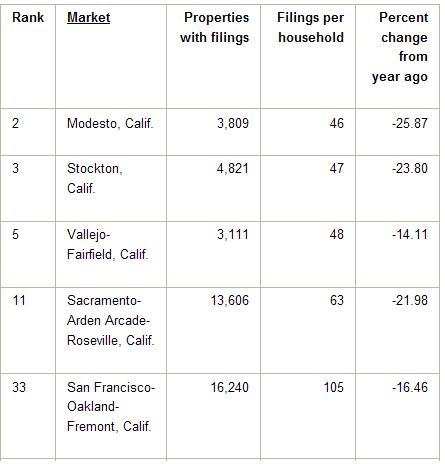
Top 50 metro foreclosure rates

Source: RealtyTrac

Nevada posted the nation’s highest state foreclosure rate: there was a foreclosure filing for one in every 35 housing units in that state. That compares to the U.S. average of one filing for every 191 housing units.

Arizona had the next highest state foreclosure rate (1 in 60 housing units), followed by California (1 in 80 units), Utah (1 in 98 units), Georgia (1 in 108), Michigan (1 in 121), Florida (1 in 152), Colorado (1 in 157) and Illinois (1 in 160).

In terms of raw numbers, California led all states with 168,543 properties receiving some type of foreclosure-related filing, followed by Florida (58,322), Arizona (46,047), Georgia (37,509), Michigan (37,506), Texas (34,646), Illinois (33,092), Nevada (32,066), Ohio (24,697) and Colorado (13,847).


7 STEPS TO VISUALIZE, REALIZE REAL ESTATE SUCCESS

If you were to ask most agents if they would like to double or even triple their income this year, the answer would be a resounding, “Yes!”

What most agents don’t realize is that unless they are brand new, they already have virtually all the tools they need to achieve this goal.

The first segment in this series delineated the difference between training, mentoring and coaching. The following case study illustrates how coaching works to create top production (brought to you by a CEO of a real estate coaching site and work as a real estate trainer).

Several years ago, I worked with 12 experienced agents who were about to be fired if they didn’t improve their production. The “Up or Out” program met once per week for three months. The first two sessions were primarily coaching-based.

Part 1: Create space. In order to do more business, you must first create room in your schedule for that business to appear.

Part 2: Have clarity about who you want to attract. The second week, we worked with the law of attraction. We spent the better part of an hour working on what constituted an ideal client. As part of that exercise, the agents were asked to identify how they attracted their three best clients, and to identify what activity generated their worst client.

Part 3: Visualize success. The next step was for the agents to identify something special they would like to do for themselves if they were closing plenty of transactions. Many of them wanted a new car. For this group, the fieldwork was to visit a dealership and drive their dream car. They were also to have someone take their picture sitting behind the wheel and to post it next to their computer.

Part 4: Accountability. Each week the group shared at least one win for the week, as well as their biggest challenge. In terms of coaching, it’s important that the coach endorses their clients for their wins and makes it safe for them to raise challenges they are facing.

Part 5: Do what generated leads in the past. A common block for virtually all agents is that the moment they become busy, they often stop doing the activities that generated leads for their business.

Part 6: Let the agent do the work. When someone else tells you what to do, most agents push back or refuse to do it. A well-trained coach will brainstorm ideas about what the agent can do, but ultimately will close the session by asking, “What is the one action step that you will take this week to improve your business, and how will I know when you have completed it?”

Part 7: Skills do matter. Coaching works best when agents also work on improving their skills at the same time. Once an agent receives training, coaching is what assists the agent in implementing what they have learned.

The results

One woman chose not to finish the program and left the company. For the remaining 11 agents, they all placed at least $1 million dollars of property under contract.

The top-performing agent sold a whopping $12 million dollars of property during this program. He attributed his success to having “clarity about what he wanted to attract.”


NEWSFLASH: There is NO Inventory!!!

I was in a conversation with one of the most productive agents in our area recently and he told me that there were “no homes for him to sell”. I thought he had a brain cramp. Look at all the “For Sale” signs, all the homes on MLS, all the short sales and foreclosures plus all the shadow inventory on its way. Had this respected agent lost his mind?

As he saw the puzzled expression on my face (which was his intent), he began to explain that every home that is priced correctly is being gobbled up by buyers right away. The only homes that remain on the market for more than 30 days are the ones where the price doesn’t COMPEL a buyer (even multiple buyers) to make an offer.

I pondered his assertion for a while and his premise began to make more and more sense because I am witnessing:

1. Increased attendance at Open Houses. Buyers are coming out to look because they know now is the time to buy(great interest rates with higher rates around the bend, huge inventory available, etc.)

2. Realistic sellers (in terms of asking price) are getting significantly more traffic. This results in an increase in interested buyers; more interested buyers push prices higher. By adjusting prices, many sellers are getting higher offers. By remaining overpriced (and hoping to negotiate down), other sellers are seeing no traffic and no offers.

Why are there record numbers of homes on the market when the properly priced homes are being gobbled up (some at even higher than the listing price)? Because there is a huge difference between a home “being on the market” and a home that is seriously “for sale”. Sellers who are serious about selling are aggressive with pricing because that is how you gain the highest price. A little counter-intuitive maybe; but, it’s very true.

Pricing is the centerpiece of your real estate agents marketing plan (although not the only component). The marketing plan should be designed to drive as many qualified buyers to see your home because THAT is the single most important factor in getting the most money – the number of people bidding. My advice is to give yourself the best chance for highest bids by pricing the home at a compelling number.


FANNIE OFFERS CLOSING COST HELP FOR REO’s

Fannie Mae is trying to lure more buyers to its foreclosure properties by offering to cover 3.5 percent in closing costs for home owners who close by June 30 on its HomePath properties.

Fannie’s HomePath program provides low down payment financing on REO property sales and has no requirements for mortgage insurance or appraisals.

During the fourth quarter of last year, Fannie offered closing cost assistance and was able to recoup 55 percent of unpaid principal balance on defaulted mortgages through the sales.


TEAM EMPOWERMENT MORTGAGE CHATTER: April 13; News & Headlines; Why THe Wealthy Are Buying; CAR Social Media Program To Feature Roost Platform; Survey: Americans Still Optimistic About Housing

Rain, Rain Go Away.  We Were Having Such Lovely Days…. (Stay dry, drive safe & keep warm)


“First comes thought; then organization of that thought, into ideas and plans; then transformation of those plans into reality. The beginning, as you will observe, is in your imagination.” — Napoleon Hill: Was a lecturer and author of books on achieving success

NEWS & HEADLINES

MBA Survey: Mortgage applications Composite Index decreased 6.7% , Refinance Index decreased 7.7% and the Purchase Index decreased 4.7%. The refinance share decreased to 60.3% from 61.2% and the ARM share decreased to 5.9% from 6.1%. The average 30-year rate increased to 4.98% from 4.93%, and the average 15-year rate increased to 4.17% from 4.14%.

Retail Sales increased 0.4% in March increasing for the ninth straight month, adding to speculation the economic recovery is gaining momentum. February retail sales were revised upwards to 1.1% from 1.0%. Purchases excluding autos increased 0.8%, while sales Ex-Autos and service stations climbed 0.6%.

Business Inventories rose 0.5% in February, and business sales rose 0.2%, compared to an increase of 2.0% in January. The inventory-to-sales ratio, an indication of demand, was flat at 1.24 in February.

Beige Book scheduled for release at 2PM today.

Treasuries Drop Before 10-Year Note Auction as U.S. Retail Sales Increase $21 billion in 10-year UST notes will be auctioned at 1PM today. and retail sales increased in March for the ninth straight month, adding to speculation the economic recovery is gaining momentum.

Deficit Speech Will Be Lightning Rod. Obama will outline plans for long-term deficit reduction in a speech tonight that will likely start a debate with Republicans while alienating some members of his own Democratic Party.

Bernanke Urges Republicans to ‘Deal With’ Debt, Lawmaker Says Federal Reserve Chairman Ben S. Bernanke urged Republicans during a dinner meeting yesterday to find a way to “deal with” the rising U.S. national debt without endorsing a specific plan, lawmakers who attended said.


WHY THE WEALTHY ARE BUYING

We have taken the stance that real estate is currently a great investment. There have been MANY that have let us know that they think we are crazy. Today, let’s look at a few prominent people, media sources and one very important group that agree that now is the time to buy.

Fortune Magazine  and The Wall Street Journal

John Paulson, billionaire investor.

Donald Trump, no introduction necessary.

Barbara Corcoran, real estate TV personality.

A pretty impressive list! The question: Is anyone listening to them? The answer: The wealthiest people in the country. According to the most recent Existing Sales Report  from the National Association of Realtors, at a time when sales of all homes have decreased 2.8% compared to last year, homes over $1million dollars are selling at a rate 3.9% higher. Why are the wealthy purchasing real estate right now?

Money is cheap. The 5% interest rate will not be available forever.

The ability to lock in that interest rate for 30 years may soon disappear.

Getting a mortgage may get much more expensive soon.

They want to buy low and sell high. The price of real estate is low.

Bottom Line

We know many will disagree with us about now being the time to buy. But if the wealthiest people in the country are buying, shouldn’t we at least consider the possibility?


CAR SOCIAL MEDIA PROGRAM TO FEATURE ROOST PLATFORM

Social network marketing and technology company Roost has signed an agreement with California Association of Realtors’ subsidiary Real Estate Business Services to feature its platform as the primary tool in CAR’s first social media training program, Roost announced today.

CAR is the country’s largest state Realtor association, with more than 145,000 members at the end of March. REBS’ training division, CAR Education, will use Roost’s social marketing platform as the primary tool of its new Social Network Master Program.

The program is fee-based and geared toward increasing business through social media campaigns. It includes courses on Facebook, Twitter, YouTube, and blogging that members have the option to take individually.

“Social networking has become a useful and necessary tool for Realtors to generate leads and serve their clients. Many of our members are in need of quality training and tools to utilize these new platforms,” said Robert Bailey, chairman of REBS, in a statement.

Training on the Roost platform will begin this Friday, April 15, at CAR’s Social Media Boot Camp, a daylong seminar at the University of Southern California in Los Angeles. Training materials will also be available online.

Roost launched its social marketing platform on March 29. The company simultaneously expanded its business model beyond real estate professionals to other small business owners, such as lawyers, accountants and restaurateurs.

“We’ve been in real estate quite a while and we’ve learned quite a lot. One of things we’ve learned is that, like in real estate, there’s lots of businesses that rely on referral, word-of-mouth business,” said Chris Brubaker, Roost’s vice president of marketing.

Social networks can play a big role in helping small business owners stay “top of mind” to customers offline, he said.

Nevertheless, Roost will continue “to develop and invest in real estate,” Brubaker added.

The platform launch included a more robust version of Roost Publisher, now called Campaign Creator. Whereas the Publisher tool allowed users to schedule a single Facebook post at a time, Campaign Creator allows them to schedule multiple posts simultaneously to both Facebook and Twitter.

The tool also suggests a campaign format, recommending the number of links and status updates a user should schedule per week and times of day to post them.

The idea behind the tool is to allow users to spend as little as 20 minutes a week managing their social marketing campaigns, Brubaker said.

For those worried about what to post, Campaign Creator also suggests content based on the user’s industry type and interests — an article from the real estate section of a local paper, for example.

“By suggesting that content we really hope we’re taking that guesswork out of the equation,” Brubaker said.

Another tool, Roost Circles, has also launched. Roost Circles allows users to share each other’s posts.

“We wanted to create a tool that was actually social. (Users) can band together with colleagues to create a social network for content sharing. I can create a blog post about the market in San Francisco and share it with my mortgage broker and appraiser and encourage them to share,” Brubaker said.

CAR members will also learn to use other Roost tools, including its “Real Estate” Facebook tab; RoostBar, a banner in which a business name, picture, and a “like” button appear at the top of links a user posts via Campaign Creator; and the “Roost Academy” Facebook tab, which includes webinars, how-to videos, and FAQs about how to use social media for real estate marketing.

Roost Listen, which will allow agents to create a list of their most promising leads and see everything they post in one place, and an analytics tool, are in development, the company announced.


SURVEY: AMERICANS STILL OPTIMISTIC ABOUT HOUSING

A sluggish real estate market hasn’t shaken the confidence of the public in how it views home ownership, according to a new study by the Pew Research Center. Eight in 10 adults (or 81 percent) say owning a home is the best long-term investment a person can make, according to the Pew study of about 2,000 adults conducted in March.

“Home owners are not blind to what has happened to home prices, nor are they expecting a speedy recovery,” according to the Pew study. In fact, of the home owners surveyed, about half said their home is worth less now than before the recession, while 31 percent said their home’s value has stayed the same.

Nevertheless, 82 percent of home owners who say their home is worth less now than before the recession either strongly or somewhat agree that home ownership is the best long-term investment a person can make, according to the survey.

The value of home ownership even continues to emerge on top when home owners were surveyed and asked to rate the importance of four long-term financial goals. Home ownership and “being able to live comfortably in retirement” rated the highest–viewed as either extremely or very important by 80 percent of respondents.

Yet, their optimism about home ownership doesn’t mean they’re completely happy with their current home. Nearly a quarter of all home owners surveyed said that if they had it to do all over again, they would not buy their current home. Most of the “buyer’s remorse” complaints were about the home itself or its location. Only 31 percent of those surveyed cited financial factors, such as the home losing value or their own changing financial situation.

TEAM EMPOWERMENT MORTGAGE CHATTER: April 7; News & Headlines; Real Estate & Financing Are Personal; Another Day, Another Call for Real Estate Reform; Revamped Foreclosure Procedures; Plug In TO Gen X, Gen Y Buyers’ Preferences; A Rush To Secure Loans

WE WANT TO WELCOME FELLOW RMA MEMBERS TO OUR SITE. THANK YOU FOR VISITING – MAKE SURE TO SUBSCRIBE TODAY!

TOGETHER WE CAN CONTINUE TO ACHIEVE THE SAME GOAL….


“The secret to productive goal setting is in establishing clearly defined goals,writing them down and then focusing on them several times a day with words,pictures and emotions as if we’ve already achieved them. ” – Denis Waitley

NEWS & HEADLINES

As if the mortgage biz doesn’t have enough other things to worry about, how about a US government shut down? There are dozens of HUD programs that may be impacted, but focusing on FHA loans, there are two important steps in the origination process where FHA lenders have a dependency on FHA: obtaining a case number for a new FHA loan and after it closes being endorsed by FHA so that a mortgage insurance certificate can be issued. The case number for an FHA loan is obtained via FHA Connection. It is possible that FHA Connection may continue to operate even if there is a government shutdown. If that is the case, obtaining case numbers would not be a problem. (During the November 1995 shutdown, case numbers could not be obtained.) The last I checked most believe that it is very likely that loans will not be endorsed and “mortgage insurance certificates will not be issued in the event of a shutdown. Lenders could continue to originate FHA eligible loans but they will need to wait to obtain an endorsement and an MI certificate. It should be noted that lenders with DE authority can potentially obtain MI certificates if FHA Connection continues to operate.” The shutdown in 1995 mainly caused a delay rather than drop in FHA loan origination, but if lenders decide to stop accepting FHA applications, it could be a problem. I have heard nothing about Fannie or Freddie’s operations.

With the comp issue settled, but in no way forgotten, our business turns its attention to the release recently of the set of Proposed Risk Retention Rules, with a comment period ending on June 10, 2011. These rules encompass more than residential mortgages – they also impact ABS & CMBS (asset-backed, like credit card debt, and commercial mortgage) instruments. Industry followers believe that the portions that seem to be generating the most discussions will include the exemption of Fannie Mae and Freddie Mac from risk retention; the narrow definitions of qualified residential mortgage (QRM), commercial real estate (CRE) loan, commercial loan, and auto loan; the creation of a premium capture cash reserve account; and the limited exemption for re-securitizations. If you’d like to comment on the risk retention proposals, go to RiskRetentionComments.

Wednesday was another not-so-good day for rates, with MBS sales volumes picking up a little bit but current-coupon prices losing about .125. Ten year Treasury notes were worse by about .5, closing with a yield of 3.54% given the inflation fears picking up again (oil is nearing $110 per barrel) along with some weakness in the US dollar ahead of an expected interest rate hike from the ECB (which did indeed happen). “REITs, banks and money managers” were better buyers at these rates.

Weekly Jobless Claims dropped from a revised 392k down to 382k, another little bit of good news for our job market (as opposed to going the other way), but more importantly the ECB (European Community Bank) raised their rates. The Jobless Claims number was about as expected, but the ECB move tends to put a little pressure on our own Fed. Regardless, the 10-yr is up to 3.57% and MBS prices are worse by .125-.250.


REAL ESTATE AND FINANCING ARE PERSONAL

Every day we are bombarded with statistics and data. Housing starts are up, housing starts are down; more job losses, unemployment is improving; foreclosures, short sales, housing inventory, interest rate movements and much more. It’s enough to make your head spin.

There’s an old saying that claims: “All real estate is local”. It infers that national numbers are good reference points, but that individual communities (or even pockets within communities) can have strikingly different realities. When prices are falling nationally, there are some places where prices are holding steady or rising as an example.

I believe that even that old saying is too broad. Buying a home or structuring the financing of a home isn’t a local phenomenon….it is a personal one. It’s the same as the economy. Even though we have been suffering through a national downturn, many are having their best years ever. Unemployment, foreclosure, even homelessness are tragic statistics and things to be aware of. But, for those not in those situations, you need to make decisions that will best serve your PERSONAL goals.

To that end, it is a great time to buy a home, for the reasons touted in this space regularly:

  • Low interest rates make more house more affordable
  • Tremendous available inventory
  • Home prices are in line with income levels once again

It is also a terrific time to sell. I heard an agent say just last week that there is NO INVENTORY available. He further explained that properly priced homes are selling almost immediately and the only homes on the market more than 30 days are ones that won’t sell because of unreasonable seller expectations (and agents who aren’t strong enough to deliver the truth to those sellers). A strong statement, yes- but one worth taking into consideration as you ponder your PERSONAL situation. And remember, sellers become buyers. They get the advantages buyers are enjoying as well.

My advice is don’t be a sheep following media hype which analyzes data that reflects the past (and not the present or future) or looks at national numbers or assumes that your job, credit standing or savings are in jeopardy. YOU need to look at your individual life and decide for yourself.


ANOTHER DAY, ANOTHER CALL FOR REAL ESTATE REFORM

Written By A Real Estate Agent To Share With Another

I doubt if a day goes by that I don’t read about how the real estate industry needs reform, how it needs to change, and how real estate agents are incompetent, or dishonest, or both. I am tired of reading it, and bored with it, too. I am open to specific criticisms and suggestions for improvement, but I am not finding any.

People who write about industry reform write in vague generalities, and they seem to miss the fact that our industry is highly regulated on the state level. Legislation is the only answer. It is state law that determines who is eligible for a real estate license and what type of training is required. The bar will be raised when laws are changed.

As an agent, I rarely encounter another agent who is dishonest or incompetent. I have met agents who I did not like, and agents who made the transaction more difficult than it had to be, but that doesn’t make them incompetent or dishonest.

I have met many agents over the years who I have nothing but respect for. They do an amazing job every day but they never make the evening news or the local paper the way the incompetent and dishonest agents do.

When I go to a closing I often thank the other agent — in front of their clients and mine — for doing a great job. I keep thinking that maybe word will get out that real estate agents are amazing people, not to mention hardworking and honest. Does anyone ever mention hardworking and honest?

Those of us who are in the field every day are feeling a backlash because of the mortgage and foreclosure crisis, but both had far more to do with government deregulation than with dishonest or incompetent agents.

I recently read an article about how the real estate industry needs to be scrapped and rebuilt. I had a good laugh because no specific suggestions were made on how to improve anything.

People like to read about real estate reform as long as it is hypothetical, theoretical, is written with drama, and is entertaining. Some of the industry thought leaders offer more entertainment than practical advice.

Trashing real estate salespeople and the industry in general is fashionable, but anyone who wants to make a difference is going to have to start talking specifics and probably start talking to their state legislators.

Real estate salespeople are market-driven. If we make a profit we stay the course. If something stops working for us we stop doing it.

From my world view I think we are doing a fine job. It is the rest of the economy and the housing market that are messed up, and experts need someone to blame.


REVAMPED FORECLOSURE PROCEDURES COMING SOON

The country’s top mortgage servicers have reportedly reached an agreement on changes to their foreclosure procedures.

The consent agreement has not yet been made public, but The New York Times was able to get a preview of what the agreement contains from individuals who spoke on the condition of anonymity.

Among the proposed changes include:

Greater oversight of foreclosures. The oversight will happen from third party groups that include law firms, who mostly will be charged with doing the actual work of eviction, The New York Times reports.

Improved training of foreclosure staff.

A single point of contact for every defaulting home owner with the servicers. Mortgage servicers will no longer be able to foreclose while borrowers are pursuing loan modifications.

Servicers will hire independent consultants to review foreclosures that have been completed in the past two years. Mortgage servicers have agreed to compensate any owner who is found to have been improperly foreclosed on or made to pay excessive fees.

Analysts say that in order for mortgage servicers to meet these revamped rules they’ll need to hire more employees so they can be thoroughly review the cases of home owners in default or servicers will need to slow the pace of foreclosures even more (The average household in foreclosure has been delinquent for more than 500 days/)


REAL ESTATE AGENTS: PLUG IN TO GEN X, GEN Y BUYERS’ PREFERENCES

Are you still marketing your business with personal brochures, glamour shots of yourself taken more than a decade ago, and other agent-centric approaches? If so, it’s time to shift gears to fit the demands of the next generation of buyers and sellers.

Real estate has evolved over the last several decades from being broker-centric to being agent centric, and then to being client-centric. In the client-centric model, the agent was seen as a “trusted adviser” who guided clients through the buying or selling process. The question is: What model is best suited for today’s clients?

Different generations require different approaches

Today, agents must modify their marketing and negotiation strategies to adapt to four different generations. For those born before 1965 (boomers and their ilk), the trusted adviser model is still important since they value expertise.

They expect their Realtor to know more than they do. This includes having a strong knowledge of the inventory, strong negotiation skills, and a mastery of the best technology.

In contrast, those in Gen X and Gen Y (born after 1964), don’t value expertise in the same way. A major source of friction between older agents and younger clients has to do with how older agents approach this important issue.

The older agents understand the value of their knowledge and how it can help younger clients achieve their real estate goals, and it can be particularly frustrating for them when younger clients seem to ignore what they have to say.

The model for 2011: The Trusted Resource Model

The new model for 2011 is what I call “The Trusted Resource Model.” Most agents would agree that the deals that go the most smoothly are those in which everyone works together. This team approach creates a win-win environment for virtually everyone involved. This model is neither agent-centric nor client-centric.

In the more traditional Trusted Adviser Model, the agent often tells the client what to do. The challenge is that most people want to be in charge of their own decision-making.

The Trusted Resource Model establishes the agent as a conduit of information. The agent’s role is to provide the best information possible so that the buyer or seller can make the best decision possible.

To illustrate, it’s common for agents to recommend list prices on a listing appointment. The strongest agents will also outline a 90-day marketing plan that they will use to sell the property. This approach falls into the The rusted adviser model.

In the Trusted Resource Model, the agent outlines a 90-day marketing plan and then asks the seller for input about which services the seller would like to use in marketing the property. The agent also provides the comparable sales information. The key point of differentiation here, however, is how this is handled.

In the Trusted Resource Model, instead of telling the seller, “You should list your property at $244,500,” the agent would say the following: “As you can see from comparable sales, the properties in this area are selling from $120 to $150 per square foot. The properties that have sold for $140 to $150 per square foot were all built in the last five years.

“Properties with amenities similar to yours that were built in the 1960s, are well-maintained, and have not been updated, have been selling for $120 to $135 per square foot. Based upon these numbers, where would you like to position your house in the marketplace?”

The power of this trusted resource approach is that it works with all generations. While the boomers may appreciate the fact that an agent has searched out and compiled the information they need, Gen Xers may appreciate being directed to where they can find the information. Those from Gen Y may prefer to do their own research, but they tend to check with their friends rather than searching exclusively on their own.

The Trusted Resource Model puts the agent in the position to provide access to the information and knowledge needed to close the deal. The client determines what and how to use that information.

In fact, the most important thing for real estate agents to keep in mind in almost any aspect of the real estate transaction is: “It’s not your house, it’s not your mortgage, and it’s not your decision.”

The script that illustrates this and that is a great way to end almost any close is this:

“It’s your house. It’s your decision. What would you like to do?”

If you’re looking for a way to work with all generations that really works, make yourself into your clients’ most trusted resource.


BORROWERS RUSH TO SECURE GOV’T-BACKED LOANS

Purchase applications for mortgages increased 6.7 percent last week, reaching its highest level of the year, according to the Mortgage Bankers Association.

The MBA reports that government loan applications reached their highest level since May 2010, increasing 10.3 percent last week compared to the week prior.

Michael Fratantoni, MBA vice president of research and economics, attributes the surge to borrowers who were likely motivated to apply for government loans before a scheduled increase in FHA insurance premiums, which became effective last Friday.

Despite the sharp rise, however, purchase volume in mortgage applications still remains relatively low by historical standards, at levels last seen in 1997, Fratantoni adds.

Also, while purchase applications soared last week, applications for refinancing declined 6.2 percent last week, the lowest level since February.

TEAM EMPOWERMENT MORTGAGE CHATTER: April 6; News & Headlines; Where Have Foreclosures Gone?; California Expands ‘Hardest Hit’; Don’t Just Walk Away, Survey Says; Open House Flyer Example

“The mass of men lead lives of quiet desperation and go to the grave with the song still in them.” — Henry David Thoreau: Was an author, poet, naturalist, and philosopher

 NEWS & HEADLINES

Word spread quickly yesterday that the Appeals Court has dissolved the administrative stay of the rule and denied the motion of the NAMB and the NAIHP for emergency relief from the change in Reg. Z. The word on the street is that this action is not likely to be appealable, which means that the rule is effective immediately (today), and that companies should not accept any applications unless and until they are able to do so in compliance with the rule. Companies that already rolled the new comp structure out have little to do; companies that did not will be rolling it out today.

Yesterday the commentary discussed REIT’s raising money to buy MBS’s, and then a story broke about PIMCO doing exactly that! There is, of course, little correlation, and granted, the $600 million that Pacific Investment Management Co. is raising is less than the average daily volume of MBS’s traded in the market, but it is a good sign. PIMCO recently made financial headlines by divesting itself of all Treasury debt, claiming that debt levels were unsustainable given the budget problems facing the US. The REIT money will go toward commercial and residential mortgage-backed securities, real estate-related assets and other financial assets. “Significant increases in regulation and public policy are influencing which investors will have the financial ability to hold real estate-related assets. We believe that private non- bank capital will represent an increasing share of these assets in the years to come.”

Is servicing worth the hassle? Probably – it seems that many, many mortgage companies are starting servicing operations. But the government is not making it any easier.  ForeclosureProcedureSettlement?.

Yesterday I wrote that, “Mark Ryan, the first Risk Manager of the FHA and a Freddie vet, will become FHA’s Acting Commissioner when Dave Stevens departs.” It is Bob Ryan, not Mark Ryan, and my apologies to Bob. But speaking of FHA loans, the share of borrowers using FHA loans fell to its lowest level in 27 months in February, according to DataQuick, with “only” 33.3% of purchase money mortgages originated being FHA loans.

And along those lines, clarifications continue to come out regarding “net tangible benefit” and FHA refinancing. BNP Paribas put out a research piece noting that “Lenders will no longer have to certify a borrower’s employment and income. Note however that the borrower will have to be current according to requirements already in place. HUD stressed however that the borrower will have to be current both in the prior month and the month of refinancing. We think that these requirements are likely to blunt the effect of the income doc relaxation. The 5% reduction in payments that allows mortgagors to qualify for streamline refi’s shall be based on P&I + MIP rather than PITI (Principal, Interest, Taxes, Insurance) + MIP. Closing costs and other financing costs now cannot be added to the new loan balance, (which actually) would be a tightening rather than a relaxation of standards, and could negatively impact refinancing considerably.”

Remember when there was training on non-compensation issues? HUD will be offering webinar training on the HOPE LoanPort for counselors. “Last year, HOPE NOW announced the launch of a new web portal that allows HUD-approved housing counseling agencies the ability to efficiently transmit a borrower’s application to partner mortgage servicers and submit completed Home Affordable Modification (HAMP) applications for borrowers at-risk of foreclosure…HUD encourages all HUD-approved housing counseling agencies providing foreclosure prevention services to participate in the HOPE LoanPort…” There is a “Live Meeting” webinar demonstration of the HOPE LoanPort next Tuesday, April 12, from 2-4PM EST, followed by an interactive Q&A session for all participants. Reserve a seat by going to  HOPETraining.

The mortgage market saw some volatility yesterday, but unfortunately for those waiting to lock it pushed rates higher. MBS volumes picked up a little, generally not a good thing on a down day, with current-coupon prices worse by about .250 and the yield on the 10-yr closing at 3.49% (worse by .5 in price). This was despite a larger than expected decline in the ISM Non-Manufacturing index for March. The market was more focused on comments from PIMCO’s Bill Gross, who said he thought current yield levels were unattractive, as well as hints from the last FOMC meeting’s minutes that they’re seeing the recovery pick up a little.

There is no scheduled news today, aside from the MBA releasing its weekly application numbers for last week. Apps didn’t do much, dropping 2%, but refi’s dropped over 6% while purchase apps were up over 6%. The percent of applications made up of refi’s is now down to 61%, a word of warning to anyone basing their business on refinancing their rolodex clients. And ARM share rose above 6%, a warning to anyone who has forgotten what a “margin” is. Rates are a tad worse with the 10-yr at 3.50% and MBS prices down a few ticks.


WHERE HAVE ALL THE FORECLOSURES GONE?

The inventory of foreclosed homes for sale has been dwindling for almost six months. Everyone is wondering if the worst of our challenges with distressed properties are behind us. We are sorry to report that isn’t the case. We must realize that the problems banks have experienced with their paperwork on these properties has done nothing but delay them from coming onto the market.

The robo-signing blunders and then the MERS mess have caused the banks to slow down the foreclosure process dramatically. Just last week, the Office of Thrift Supervision released theirMortgage Metrics Report covering the 4th Quarter of 2010. In that report, they showed how foreclosure completions fell sharply because of these paperwork complications.

Foreclosures are not disappearing. They are just being delayed.

Bottom Line

If you think that waiting to sell your home makes sense, you may not be correct. Check with a local real estate professional to see how this will impact your market.


CALIFORNIA EXPANDS “HARDEST HIT” ELIGIBILITY FOR DISTRESSED HOMEOWNERS

California has expanded the pool of borrowers who could qualify for three programs aimed at helping families at risk of losing their homes, by making those who tapped their home equity or who took out loans after Jan. 1, 2009, eligible for assistance.

The California Housing Finance Agency (CalHFA) is administering nearly $2 billion in federal “Hardest Hit” funds, a $4.1 billion program targeted at states with high foreclosure rates or unemployment.

CalHFA is using the Hardest Hit fund to provide four “Keep Your Home California” programs.  More than 2,000 homeowners are in the process of receiving help since the programs launched in February, CalHFA said in announcing expanded eligibility requirements  for three of those programs.

With the U.S. Treasury signing off on the changes, CalHFA said eligibility requirements are being expanded for:

  • The Unemployment Mortgage Assistance Program (UMA), which provides a mortgage payment subsidy of up to $3,000 a month for six months for unemployed homeowners in imminent danger of foreclosure.
  • The Mortgage Reinstatement Assistance Program (MRAP), which provides up to $15,000 per household for homeowners who have fallen behind on their mortgage payments due to a temporary change in household circumstance.
  • The Transition Assistance Program, which provides relocation assistance in conjunction with a short sale or deed-in-lieu of foreclosure.

Borrowers who took out loans after Jan. 1, 2009, or who tapped into their home’s equity by refinancing or opening a home equity line of credit, were previously excluded from those programs.

Homeowners who were previously disqualified for one of these reasons are being contacted and offered an opportunity to reapply, CalHFA said. They are also being invited to contact the Keep Your Home California call center at (888) 954-5337.

A fourth “Keep Your Home California” initiative, the Principal Reduction Program (PRP), provides funding to reduce outstanding principal balances for qualifying borrowers with negative equity, often in conjunction with a loan modification.

To qualify for any of the four programs, borrowers must own and occupy the home as their primary residence, meet income limits, and face a documented financial hardship.

Loan servicers participating in all four programs are GMAC, Guild Mortgage, CalHFA and California Department of Veterans Affairs. Other servicers, including Bank of America, JPMorgan Chase, CitiMortgage and Wells Fargo are participating in some, but not all of the programs.


DON’T JUST WALK AWAY FROM MORTGAGE, SURVEY SAYS

Some Americans who owe more than what their house is currently worth are opting to walk away from their mortgage. But a new survey finds Americans don’t agree with home owners who make that choice.

Sixty-percent of Americans say it is “never OK” for home owners to stop making payments on their mortgage, according to a new survey of 1,000 American adults by FindLaw.com, a legal information Web site. However, 34 percent say it’s OK for home owners to walk away from their mortgage if they are no longer able to make their monthly payments.

Only 3 percent of those surveyed said home owners should be able to walk away from their mortgage anytime they want.

“Many home owners are currently facing very difficult and complicated situations involving their home mortgage, in some cases even including the threat of foreclosure,” says Stephanie Rahlfs, an attorney and editor for FindLaw.com. “But before making any major decisions, home owners should consult with financial and legal professionals, including accountants, real estate attorneys and financial advisers. Any major change to a mortgage situation could lead to serious and unanticipated consequences involving taxes, contract law, credit scores, ability to borrow in the future, potential for lawsuits, and much more.”