Real Estate

TEAM EMPOWERMENT MORTGAGE CHATTER: August 30; Short Sales: Has Their Time Finally Arrived; How to Reach Out To Global Buyers; REO, Pre-Foreclosure Props Selling At A Larger Discount; Short Sale Success: Key Is to Change Our Mindset; HUD Extends Relief

“The only thing that stands between a man and what he wants from life is often merely the will to try it and the faith to believe that it is possible.”

-Richard M. DeVos


SHORT SALES: HAS THEIR TIME FINALLY ARRIVED?

Last week, RealtyTrac released its Q2 2011 U.S. Foreclosure Sales Report. The report confirmed what we are hearing in the marketplace – banks are beginning to look more favorably on short sales as option to foreclosure.

The report dissected the sales of distressed properties in the second quarter of 2011. Here are several of their findings:

  • Sales of homes that were in some stage of foreclosure or bank owned accounted for 31 percent of all U.S. residential sales in the second quarter of 2011, down from nearly 36 percent of all sales in the first quarter.
  • A total of 102,407 pre-foreclosure homes (short sales) sold in the second quarter, an increase of 19 percent from the previous quarter.
  • A total of 162,680 REO homes (foreclosures) sold in the second quarter, virtually unchanged from the first quarter.
  • Short sales on average sold for a discount of 21 percent below the average sales price of non-foreclosure homes.
  • REOs on average sold at a discount of nearly 40 percent below the average sales price of non-foreclosure homes.

This could be a great sign that banks are finally realizing the advantages of short sales over foreclosures.

Bloomberg.com quoted Rick Sharga, senior vice president of RealtyTrac, in an article covering the report:

“This is a glimmer of hope that lenders are getting more realistic. It’s a win for borrowers who avoid foreclosure, buyers who get a house in better condition and banks that lose less money, which is also a win for taxpayers.”

Bottom Line

Banks are beginning to do more short sales. It is time for everyone involved to help in this endeavor. Tomorrow, we will have a short sale expert, Christopher Reale, blog on gaining the right mindset to do just that.


HOW TO REACH OUT TO GLOBAL BUYERS IN YOUR MARKET

Large, urban markets aren’t the only places where international opportunities in real estate exist. Your state and region may have plenty of opportunities that you may be missing. A recent article at RISMedia highlights a few tips on how to find this “treasure trove of global business” in your real estate market:

1. Identify the international composition of your market. Check out the National Association of REALTORS’ State-by-State International Business Reports to get population demographics, immigration trends, foreign investment trends in your state, and more.

2. Find the local foreign companies and facilities in your market. Contact the Human Resources departments of these companies to form relationships and start becoming the go-to real estate agent for foreign expats relocating to your area.

3. Create relationships with foreign investment officials. Build relationships with economic development agencies, which are on the leading edge of foreign direct investment. Seek out state, regional, and local development organizations as well as industry groups and the Chambers of Commerce to expand your reach.


REO, PRE-FORECLOSURE PROPERTIES SELLING AT A LARGER DISCOUNT

The share of bank-owned homes and homes in some stage of foreclosure dropped 5 percent from the first quarter to the second quarter, falling from 36 percent to 31 percent, but was up from 24 percent in second-quarter 2010, according to a report released today by foreclosure data provider RealtyTrac.

And distressed properties are selling at a larger discount these days, RealtyTrac reported:

The average sales price of a bank-owned (also known as real estate owned or REO) home was $145,211 in the second quarter, which was about 40 percent below the average sales price of a non-foreclosure home. That compares with a 36 percent discount in first-quarter 2011 and a 34 percent discount in second-quarter 2010.

The average sales price of a pre-foreclosure home (pre-foreclosures, which are homes in default or scheduled for sale at public auction, are often sold in a short-sale process) was $192,129 in the second quarter, which is 21 percent below the average sales price of a non-foreclosure home. That compares with a 17 percent discount in first-quarter 2011 and a 14 percent discount in second-quarter 2010.

There were 162,680 sales of bank-owned homes to third parties in the second quarter, RealtyTrac also reported, roughly flat compared with the 162,900 reported in the first quarter and down 10 percent from second-quarter 2010. REO sales accounted for 19 percent of home sales in the second quarter, compared with 23 percent in the first quarter and 15 percent in second-quarter 2010.

There were 102,407 sales of pre-foreclosure homes to third parties in the second quarter of this year, up 19 percent from the first quarter but down 12 percent compared to second-quarter 2010. These sales accounted for 12 percent of sales in the second quarter of this year, flat with the first quarter and up 10 percent compared to second-quarter 2010.

“The jump in pre-foreclosure sales volume, coupled with bigger discounts on pre-foreclosures and a shorter average time to sell pre-foreclosures, all point to a housing market that is starting to focus on more efficiently clearing distressed inventory through more streamlined short sales — at least in some areas,” said James Saccacio, RealtyTrac CEO, in a statement.

“This gives distressed homeowners who do not qualify for loan modification or refinancing — or who are not interested in those options and want to sell — a better chance of completing a short sale to avoid foreclosure.” Expedited short sales, he added, “also give lenders the opportunity to more pre-emptively purge nonperforming loans from their portfolios,” and avoid a lengthy foreclosure and REO process.

Among those metro areas with at least 100 foreclosure-related sales in the second quarter, Louisville, Ky., had the largest average foreclosure discount — 54 percent below the average sales price of nonforeclosure homes. Florida’s Sebastian-Vero Beach metro area was second on the list with an average foreclosure discount of 53 percent, followed by Milwaukee (51 percent), Pittsburgh (51 percent), and Kalamazoo, Mich. (50 percent), RealtyTrac reported.

Top 10 States with Largest Volume of Foreclosure Sales in Q2 2011

California 69,897 Florida 34,558 Arizona 25,756 Nevada 15,685 Michigan 11,668 Texas 11,517 Georgia 10,485 Illinois 9,355 Colorado 8,044 Ohio 6,868

Top 10 States with Highest Average REO Discount

New Jersey 53.53% New York 52.99% Kentucky 51.58% Illinois 49.89% California 49.64% Ohio 49.04% Maryland 48.48% Wisconsin 46.69% Michigan 45.95% Virginia 45.38%

Top 10 States With Highest Average Preforeclosure Discount

Missouri 43.19% Tennessee 39.24% Mississippi 39.22% Indiana 36.93% Maryland 36.11% California 35.95% Texas 35.03% Delaware 33.84% Georgia 33.03% Kentucky 32.76%


SHORT SALE SUCCESS: KEY IS TO CHANGE OUR MINDSET!

In any business discipline, having the proper mindset is the key to a successful business venture. This holds true in the Real Estate industry. Now more than ever, having the proper “Short Sale Mindset” is a key ingredient to a successful short sale transaction. In order to have the proper “Short Sale Mindset” we need to ask ourselves:

What are the parties involved thinking?

During our nationwide educational seminars regarding the short sale process, we have found the following mindsets to permeate the industry:

Listing Agents – The short sale process is too lengthy. It is impossible to deal with the short selling banks.

Buyers – The short sale process takes too long. We want an answer from the short selling bank ASAP. Why should I wait to purchase a short sale when I can purchase a non- distressed asset?

Sellers – What is the point? I am just going to let the bank foreclose.

Banks – Their mindset changes all the time!

The Key to Success

The following comments, though general in nature, are the keys to changing these mindsets.

1.) Listing Agents – Though the short sale process does take longer than the traditional non distressed property sale, the short sale process on average is taking 72 days from start to finish. If the agents are properly positioned to negotiate with the bank, preferably through a law firm who has experience in the short sale process, their mindset will change. Taking the negotiation burden off the agent will allow them to properly market the property and help the distressed seller.

2.) Buyers – Understandably the short sale process is lengthy and not every buyer is a “short sale buyer” depending on their individual circumstances. However, according to the Realty Trac Foreclosure Report dated 8/23/2011, a buyer who engages in the purchase of a short sale will typically purchase the property at a 21% reduction to the current market value. That means INSTANT EQUITY for the potential buyer. In most cases this will change the mindset of the buyer.

3.) Sellers – In nearly every instance, a short sale is more advantageous to the seller than a foreclosure. We will cover this in detail in a later post.

4.) Banks – It is apparent the bank’s mindset changes on a day to day basis. However, through successfully negotiating over 1000 short sale transactions, we have found one common thread to be true. Banks are becoming more and more open to a discussion regarding short selling a property. We will again reference the RealtyTrac Foreclosure Report to explain our point. If a bank approves a short sale, on average, they will be approving a sales price that is at 79% of current market value. The other most common loss mitigation option is for the bank to foreclose on the property. When sold, the bank will sell the REO asset for 60% of current market value. Their mindsets are changing!

We certainly understand that a short sale transaction is not one without its complexities. That being said, if we change our mindset when dealing with them, we will be truly doing a service to our communities and the entire Real Estate market.


HUD EXTENDS UNEMPLOYED MORTGAGE RELIEF PROGRAM

The Department of Housing and Urban Development has once again extended its deadline for a program that provides up to $50,000 in interest-free loans to unemployed or medically ill home owners who are struggling to make their mortgage payments.

The new deadline is now Sept. 15. HUD resumed taking applications for the program on Monday.

The $1 billion Emergency Homeowners Loan Program, which launched in June, was originally slated to end on July 22, but HUD first extended the deadline to July 27 to give home owners more time to apply.

Home owners eligible for the program will be able to qualify for up to $50,000 in interest-free loans for up to two years. Home owners who have had a drop in income of at least 15 percent from involuntary unemployment or underemployment due to economic conditions or a medical emergency are eligible for the program. Home owners must still be able to contribute $150 per month toward their mortgage. (Learn more about eligibility requirements and the participating states at http://findehlp.com.)
TEAM EMPOWERMENT MORTGAGE CHATTER: August 25; Shadow Inventory: Luckily, Here it Comes; Foreclosures Sell For Up To 40% Less; Economists Say Recession Is Not Likely; U.S. May Back Refinance Plan For Mortgages

“I’ve failed over and over and over again in my life and that is why I succeed.” 

– Michael Jordan: is a former professional basketball player


SHADOW INVENTORY: LUCKILY, HERE IT COMES

One of the biggest challenges to the housing industry throughout the rest of the year will be the increase in discounted properties coming unto the market. There is a glut of foreclosures that have been delayed by the court systems in many states while paperwork was corrected. The banks are rectifying their paperwork and processes. Now, more and more states are clearing the way for the banks to resume repossessing these properties.

As these properties find their way to the market, the prices of non-distressed properties in the region will be adversely impacted for two reasons.


There are a finite number of homebuyers in any market. A portion of these buyers will purchase the distressed properties new to the market because they can get them at discounted prices.

As these distressed properties sell, they will become comparable sales used by appraisers to establish value on all homes (both distressed and non-distressed) sold in the future. Since these properties are sold at a discount, they will have a negative impact on other valuations.

A Perfect Example: New Jersey

As an example, let’s look at New Jersey. According to the National Association of Realtors, New Jersey’s percentage of distressed properties to overall home sales (20%) has been less than that of many other states (30-70%). However, the reason for this is the New Jersey court system has prevented banks from foreclosing on many homes for over a year. During that time, the months’ supply of ‘shadow inventory’ of distressed properties waiting to come to market in New Jersey has climbed to over 50 months, the largest number in the country.


Last week, New Jersey Superior Court Judge Mary Jacobson cleared the way for the top-four banks to resume foreclosures in the state. The impact this will have on the number of distressed properties can be clearly seen in these statistics reported by Housing Wire:

In October, New Jersey had the 24th highest foreclosure rate in the country, with servicers filing roughly 5,200 foreclosures that month, according to RealtyTrac. By July, the Garden State’s foreclosure rate dropped to 42nd with just 1,112 filings last month.

New Jersey serves as an example for many states that will see a dramatic increase in the number of distressed properties coming to the market in the fourth quarter of 2011 and the first quarter of 2012.

The Good News

The housing market will not recover until we clear this shadow inventory. The speed at which these properties come to market and are sold will determine the speed at which the housing market recovers. The latest S&P Shadow Inventory Report shows that the months of shadow inventory already is decreasing. The report explains that the number of families falling 90 days behind on their mortgages has decreased dramatically. That means that as we clear these distressed properties there will be much less of a backfill. The end to the housing crisis is finally within sight.

Bottom Line

If you are thinking of selling your home in the next twelve months, selling sooner rather than later will probably get you the higher price. However, in 18-24 months, the market will return to historic appreciation norms.


FORECLOSURES SELL FOR UP TO 40% LESS


Foreclosures made up about one-third of all home sales during the spring quarter (April to June), and sales were about six times the percentage of foreclosures in a healthy housing market, RealtyTrac Inc. reports.


Foreclosure sales likely would have been much higher too if so many banks hadn’t slowed their foreclosure processes while state and federal officials continued to investigate possible faulty practices. Foreclosure sales — which include homes purchased after they receive a notice of default or that were repossessed by lenders — peaked two years ago at 37.4 percent of sales, compared to 31 percent in the April to June quarter.

During the second quarter, 265,087 homes sold were in some stage of foreclosure or owned by banks — but that’s down 11 percent from the same period a year ago, RealtyTrac reports.

The state with the highest number of foreclosure sales was Nevada, where foreclosure sales accounted for 65 percent of all sales. Arizona followed with foreclosure sales accounting for 57 percent of all home sales for the quarter.

Foreclosures Continue to Weigh on Home Prices

Foreclosed homes continue to sell for less than other homes. During the spring, bank-owned homes sold for 40 percent less than the average price of other homes. Sales of homes in the foreclosure process or short sales sold for 21 percent less than the average home sold.

The average sales price of a foreclosed property was $164,217, a drop of less than 1 percent from the January-March quarter and a nearly 5 percent drop from the April-June quarter in 2010.


ECONOMISTS SAY RECESSION IS NOT LIKELY

Many home buyers have been sitting on the sidelines due to economic fears and concerns that the U.S. could be heading for a double-dip recession. But a new poll from the Associated Press shows that most economists say a recession is not likely within the next 12 months, yet the economy will continue to be weak into 2012.

The 43 private, corporate, and academic economists surveyed this month by the Associated Press reported the likelihood of a recession within the next 12 months is 26 percent. They cited high unemployment and weak consumer spending as two leading culprits that will hold back the economy into 2012.


In June, American households trimmed their spending for the first time in nearly two years, and with consumer spending fueling about 70 percent of the economy, it poses a “major risk” to the economy, the economists reported.

The economists surveyed said they are optimistic that economic growth, job creation, consumer spending, and home prices will all rise over the next year — but the gains are expected to be so slight that many won’t notice, the Associated Press reported.

“We need to see the housing market stabilize,” says Sean Snaith, director of the University of Central Florida’s Institute for Economic Competitiveness. “We need to see some job creation. Until then, consumers are trying to put nest eggs that turned into Humpty Dumpty back together again … It’s just going to take time.”

Meanwhile, the markets will be anxiously awaiting Federal Reserve Chairman Ben Bernanke’s speech on Friday at a conference for the Federal Reserve Bank of Kansas City to see if he unveils any new steps to help revive the economy.


U.S. MAY BACK REFINANCE PLAN FOR MORTGAGES

The White House is considering a housing proposal that would allow millions of home owners with government-backed mortgages to refinance into lower interest rates, The New York Times reports.


“A wave of refinancing could be a strong stimulus to the economy, because it would lower consumers’ mortgage bills right away and allow them to spend elsewhere,” an article in The New York Times notes.

Many home owners have been unable to take advantage of today’s low interest rates — which are averaging around 4 percent — because they don’t qualify for refinancing at the best rates since they owe more on their home than it is currently worth or because of poor credit. The refinancing plan is still under discussion of how it would work, The New York Times said.

“This is the best stimulus out there because it doesn’t increase the deficit, it accomplishes monetary policy, and it reduces defaults in housing,” Christopher J. Mayer, an economist at the Columbia Business School, told The New York Times.

The White House is also considering other options to try to stimulate the housing market or save home owners from foreclosure. Such options include more changes to its refinancing programs so more home owners can participate or a home rental program to that would rent out foreclosures instead of putting them for sale so foreclosures would stop weighing down overall home prices.


TEAM EMPOWERMENT MORTGAGE CHATTER: August 23; 5 Quick Tips for September 2011; Distressed Property: The Impact on House Values; Foreclosures Down, Delinquencies Back Up; Short Sale Fraud Rising, Freddie Mac Wants Your Help; Fixing Housing Crisis: Jobs

“Be fully aware. Be engaged. Remind yourself to live in he present moment, The Zone.” – Jim Fannin: Nightingale-Conant Author


 5 QUICK TIPS FOR SEPTEMBER 2011

 1. Build Trust In Order To Remove Fear

In times of uncertainty, fear will manifest itself. You cannot sell a person through their fear. You must talk them through their fear. Take the time to explain what is happening and how it impacts the market. Explain to your clients which options are available and then allow them to pick the option which is best for themselves and their family.

2. Snap Back To Work After Labor Day

We hope everyone enjoys the holiday weekend. However, be ready to ‘snap’ back to work immediately. The month of September will be crucial in deciding your income for the last quarter of 2011. Your success in 2012 will be determined by your fourth quarter in 2011.

3. Price Adjustments Are Crucial

More and more states are clearing the way for banks to resume their foreclosures. As this distressed property inventory comes to market, there will be increased downward pressure on home prices. Make sure each of your listings has a compelling price to guarantee it sells before being confronted with this discounted inventory.

4. Take a Class on How to Write an Effective Business Plan

For most real estate professionals, anything they put into contract after October 15th probably won’t close until 2012. That means that a ‘new year’ starts on that day. What are your goals for next year? What is your plan? Have you committed your goals to a formal business plan? Treat your real estate business like you would any other business. Take a class on how to structure a business plan and see your income skyrocket.

5. Be Passionate and Determined, Yet Humble

Real estate professionals are working hard to turn the housing sector of our economy around. And we are succeeding. We must stay the course and not let the current uncertainty in the financial sector deter us from our goals. Our success is entirely in our own hands…


DISTRESSED PROPERTY: THE IMPACT ON HOUSE VALUES

Chip Wagner, an icon appraiser in the industry and our good friend will discuss the impact distressed properties have on housing values.

Contrary to the alarming nature being used in reporting that appraisers are killing deals, I would bet that most of my peer appraisers are not seeking the lowest possible sales to use in their appraisals. They are searching the data available in the real estate market for the best comparables out there. But the reality is that good comparables are hard to find.

Just last week, I was finishing up an appraisal in a condominium in a Chicago suburb. It is a 246-unit development that has 24 listings available. In the past 12 months, there were 5 sales, of which 4 were distressed (short sales and foreclosures). The one arm’s-length transaction sold pretty low too, and when confirming with the listing agent, we found that the owner needed to sell (but not under duress) and understood the oversupply in their marketplace and didn’t want to sit on the market for a year or more competing with the overpriced competition. In this same condo development, in the previous year (13 to 24 months ago), there were 15 sales of which 6 were distressed (still 40%, but not 80% of the market). As a result, the average sales price has dropped over 15% in the past year.

First of all, with 24 competing on the market and only 5 sales in the past year, which is a 2.5 year supply of inventory. A balanced market is 4 to 6 months, so a 2.5 year supply of inventory is going to place significant downward pressure on prices.

What does this mean to overall values?

According to RealtyTrac.com, foreclosures, on average, sell for a 35% discount and short sales sell for a 10% discount. These distressed properties might not be in the same physical condition as the non-distressed properties. However, at sizable discounts, many purchasers are more than willing to absorb the risk of purchasing a property “as-is” and doing the necessary repairs as well as playing the waiting game with lenders in purchasing short sales.

There comes a point where distressed market competition becomes the marketplace. The appraiser may consider making an adjustment for the “terms of sale.” For example, if using a short sale or a bank-owned foreclosure comparable in an appraisal, an adjustment could be made to reflect the discounted value of that comparable. I have done this in many of my appraisals, without underwriter or appraisal reviewer concerns. The appraiser must support this adjustment and thoroughly explain why it was made.

There are other scenarios where distressed competition is a very small portion of the market, and these sub-markets appear to be doing better. But even if there are not distressed sales flooding the marketplace, we are still often challenged with finding decent comparables – and that is the volume of sales taking place.

In the entire Chicago area, according to local MLS data, in January 2006 we had over 83,000 detached homes to sell in the previous 12-month period. In July 2011 it has fallen to 38,300 detached homes to have sold in the past year. What this tells us is that on average, neighborhoods that once had 20 comps to select from for consideration in our appraisal reports, now have 8 comps to select from. And you can bet with the typical market having 30% distressed competition, this is down to 4 or 5 arm’s-length transactions. This is making the appraiser’s job more difficult than ever. Comparables are limited, and the motivations and terms of the sale are complicated.


FORECLOSURES DOWN, BUT DELINQUENCIES BACK UP

The number of delinquent mortgages more than 90 days late–those that are closest to bank repossession–declined during the second quarter, the Mortgage Bankers Association reported on Monday. The country is back to 2007 levels in foreclosures–with fewer borrowers losing their homes to bank repossessions, MBA reported.

Also, MBA found that loans originated after 2007 are performing better than those issued earlier. Mortgages issued from 2005 through 2007 represent 30 percent of all mortgages. Yet, they account for 65 percent of defaults.

MBA’s report over improvements in foreclosures were masked by a slight rise in the number of troubled mortgages–borrowers who have missed at least one payment–during the second quarter. While delinquencies only increased 0.12 percentage points to 8.44 percent, experts say after two years of improvement in delinquencies, the increase was worrisome.

“Delinquencies are mirroring what’s taking place in the employment market,” Jay Brinkmann, the MBA’s chief economist, told CNNMoney.


SHORT SALE FRAUD RISING, FREDDIE MAC WANTS YOUR HELP

Freddie Mac is reporting an increase in short sale fraud and is reaching out to the real estate community to educate them about the signs of short sale fraud and ask for their help in reporting it when they see it. Freddie’s investigation unit is reaching out to REALTOR® associations through seminars and articles in educating real estate professionals to better detect short sale fraud.

The mortgage giant is reporting cases of some real estate professionals’ hiding better offers from Freddie Mac and the distressed home owner or even rigging sales at a low price so that the property can later be flipped for a higher profit. Also, Freddie Mac reports a growing number of “flopping” schemes, in which a scammer buys a short sale from Freddie or banks by using a fake title or loan document and then sells the property to a legitimate buyer at a higher price.

“There are many conscientious real estate professionals who want to do the right thing,” writes Shelley Poland, a vice president at Freddie, and Robert Hagberg, the associate director of fraud investigations, in a blog post. “We often receive calls in our servicing, quality control, fraud investigation, outreach, and HomeSteps divisions from real estate agents who know they’ve seen something inappropriate and won’t look the other way. They understand that real estate fraud turns a shortsighted profit at the cost of the public’s long-term confidence in home ownership and the housing industry.”


REPORT: “FIXING HOUSING CRISIS WILL CREATE 1 MILLION JOBS’

A new report argues that if banks wrote down the mortgage principal of underwater borrowers it could pump $71 billion per year into the economy and create more than 1 million jobs annually. The report — “The Win/Win Solution: How Fixing the Housing Crisis Will Create One Million Jobs–comes from The New Bottom Line, a campaign that represents about 1,000 nationwide faith-based and community organizations.

The campaign argues in the report that by lowering home owners’ mortgage payments by an average of more than $500 per month–or $6,500 per year–that it would free up about $6 billion dollars per month that home owners could then spend on such items as buying groceries, household necessities, school supplies, etc.

“Home owners across the nation are struggling to pay their boom-era mortgages with their recession-era salaries and the economy is suffering for it,” according to the report. “Writing down the principals and interest rates on all underwater mortgages to market value would serve as the second stimulus that America so desperately needs, only without added costs to taxpayers.”

The group is pressing State Attorneys General, who are currently in settlement talks with the nation’s largest banks over allegations of foreclosure abuses, to stand firm on its request for principal reductions for underwater borrowers.

TEAM EMPOWERMENT MORTGAGE CHATTER: August 22; Buying Real Estate, Better Than Renting; Foreclosure Talks Snag on Bank Liability; Housing Affordability At Highest; Mortgage Rates All-Time Lows; News & Headlines

“People with goals succeed because they know where they are going…It’s as simple as that.” 

– Earl Nightingale


BUYING REAL ESTATE A BETTER DEAL THAN RENTING IN 74% OF MAJOR US CITIES

 Buying real estate continues to be cheaper than renting in the vast majority of major U.S. cities, according to a quarterly rent vs. buy index from real estate search and marketing site Trulia.

The index compared the median list price and the median annualized rent on a two-bedroom apartment, condominium or townhouse in the country’s 50 most populous cities. According to the index, the cost of buying was less than renting in 37 of the 50 cities (74 percent) as of July 1, 2011. About the same share, 78 percent, favored buying over renting in Trulia’s last index report, released in April.

Trulia defines total costs of homeownership to include “mortgage principal and interest, property taxes, hazard insurance, closing costs at time of purchase and ongoing (homeowners association) dues and private mortgage insurance, where applicable. It also includes an offset for the tax advantages of homeownership, including mortgage interest, property tax and closing cost deductions.”

“Many aspiring homeowners are on the fence about renting and buying in today’s market. Should they take advantage of falling home prices and low borrowing costs, or should they continue to rent until the economy stabilizes?” said Ken Shuman, spokesman for Trulia, in a statement.

“Price alone should never be the sole factor in deciding to purchase a home. Instead, buyers should first ask themselves if they plan to live in the home for at least seven to 10 years, could make monthly payments on the house, and have enough cash in the bank for a down payment and an additional six to eight months worth of mortgage payments.

“If you can answer ‘yes’ to each of these questions, then the cost of buying a home definitely outweighs renting in most cities.”

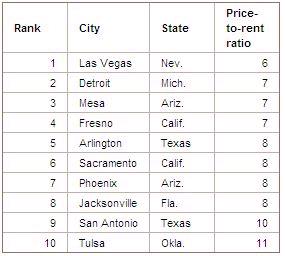
A price-to-rent ratio of 1 to 15 means that it’s much cheaper to buy than to rent in a particular city. Las Vegas, Detroit, and Mesa, Ariz., most favored buying among major cities.

Top 10 cities to buy vs. rent:

Source: Trulia

A ratio between 16 and 20 means that it’s more expensive to rent than to buy, but buying may be better than renting “depending on personal circumstances, such as one’s tax bracket,” Trulia said. Any ratio above 20 indicates that owning is much more costly than renting in a city.

According to the index, renting was much cheaper than buying in six cities: New York; Fort Worth, Texas; Omaha, Neb.; Seattle; San Francisco; and Kansas City.

Top 10 cities to rent vs. buy:

Source: Trulia

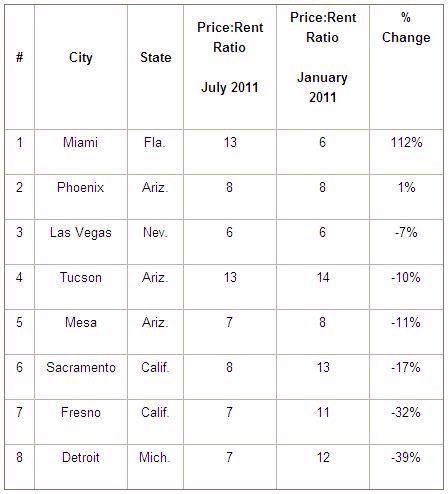
Most foreclosure hot spots saw their price-to-rent ratios drop in the first half of this year, with Detroit seeing the biggest decline, at 39 percent. Miami, however, was an exception. “A mini buying boom created by foreign investors and foreclosure freezes have caused (Miami’s) price-to-rent ratio to jump by 112 percent: from 6 in January to 13 in July,” Trulia said.

Here’s an interactive graph from Trulia that illustrates how cities compare on the rent vs. buy index over the last six months and includes foreclosure and job market data.


FORECLOSURE TALKS SNAG ON BANK LIABILITY

Observers say federal and state officials continue to work on a settlement with the nation’s biggest banks with regard to their foreclosure practices, but the process has been delayed as banks seek broad legal immunity for mortgage-related claims.

The banks reportedly are seeking legal protection with regard to loan origination, securitization, and servicing and fair-lending practices, as well as for claims tied to their use of the Mortgage Electronic Registration Systems (MERS), but federal and state officials countered with an offer to cover only robo-signing and other servicer-related practices.

Federal officials hope to forge a settlement by Labor Day, and observers say banks may agree to a settlement approved by 80 percent of states.


HOUSING AFFORDABILITY AT HIGHEST IN 20 YEARS

Housing affordability continued to be near record highs in the second quarter, hovering near its highest level in the 20-plus years it has been recorded, according to the National Association of Home Builders/Wells Fargo Housing Opportunity Index.

About 72 percent of all new and existing-homes sold in the second quarter of the year were affordable to families earning the national median income of $64,200, according to the index. The record high remains 74.6 percent, which was reached last quarter.

“At a time when home ownership is within reach of more households than it has been for more than two decades and interest rates are at historically low levels, the sluggish economy and the extremely tight credit conditions confronting home buyers and builders remain significant obstacles to many potential home sales,” says Bob Nielsen, chairman of the National Association of Home Builders. “That said, however, some housing markets across the country have stabilized and are beginning to show signs of a budding recovery.”

Most Affordable Housing Markets

According to the index, Youngstown-Warren-Boardman, Ohio-Pa., was the most affordable major housing market during the second quarter with 93.7 percent of all homes sold found to be affordable to households earning the area’s median family income of $54,900. Other cities ranking near the top for affordability is: Syracuse, N.Y.; Indianapolis-Carmel, Ind.; Dayton, Ohio; and Lakeland-Winter Haven, Fla.

Least Affordable Markets

The index found the least affordable market in the country–for the 13th consecutive quarter–is New York-White Plains-Wayne, N.Y.-N.J., in which 25.2 percent of all homes sold during the quarter were affordable to those earning the area’s median income of $67,400. The other least affordable major metro areas includes San Francisco-San Mateo-Redwood City, Calif.; Santa Ana-Anaheim-Irvine, Calif.; Los Angeles-Long Beach-Glendale, Calif.; and Honolulu.


MORTGAGE RATES REACH ALL-TIME LOWS AGAIN

Ongoing economic concerns continued to push mortgage rates to new lows, as 30-year and 15-year mortgage rates took another dip, pushing home affordability even higher, Freddie Mac reports in its weekly mortgage market survey.

30-year fixed-rate mortgages: averaged 4.15 percent this week, dropping from last week’s 4.32 percent average. The previous record low for 30-year rates was set on Nov. 11, 2010, when rates reached 4.17 percent. For comparison sake, in 2000, 30-year mortgage rates averaged more than 8 percent and just five years ago they averaged 6.5 percent.

15-year fixed-rate mortgages: averaged 3.36 percent, dropping from last week’s 3.50 percent. Last year at this time, the 15-year fixed rate averaged 3.90 percent.

5-year adjustable-rate mortgages: averaged 3.08 percent, dropping from last week’s 3.13 percent. Last year at this time, the 5-year ARM averaged 3.56 percent.

1-year ARM: averaged 2.86 percent this week, dropping from last week’s 2.89 percent. A year ago, the 1-year ARM averaged 3.53 percent.

“Not surprising, many home owners took advantage of this low mortgage rate environment and have already refinanced their loans,” says Frank Nothaft, chief economist of Freddie Mac. “The refinance share of applications averaged nearly 70 percent of all mortgage activity in the first half of this year, according to our survey. In addition, an increasing share of refinancing borrowers chose to shorten their loan terms during the second quarter.”


NEWS & HEADLINES

The Mortgage Bankers Association raised its forecast for loan production this year to $1.1 trillion in residential mortgage origination, up $100 billion from its last forecast. Low mortgage rates have brought in higher than expected refinance volume, while purchase volume has been less than anticipated. But put those pennies aside: despite lower rates, weaker projected economic growth in 2012 led to a reduction in MBA’s origination forecast for that year to $931 billion, which would be the lowest volume originated since 1997: MBAForecast.

 HUD weighed in last week with its FHA single-family loan limits which are effective on or after October 1, 2011 through December 31, 2011. “For Forward Mortgages, the FHA floors for the period October 1, 2011 through December 31, 2011 are $271,050, $347,000, $419,425 and $521,250 for 1-, 2-, 3- and 4-unit dwellings, respectively. The FHA ceilings are $625,500, $800,775, $967,950 and $1,202,925 for 1-, 2-, 3- and 4-unit dwellings, respectively. For all other areas, i.e., those where 115 percent of the median home price for the area is in between the floor and the ceiling, the limit shall be at 115 percent of the median home price. For areas under Section 214 of the National Housing Act (Alaska, Guam, Hawaii and the Virgin Islands), higher ceilings of $938,250, $1,201,150, $1,451,925 and $1,804,375 for 1-, 2-, 3-, and 4-unit dwellings, respectively, apply. For HECMS, the maximum claim amount will remain at $625,500.”

So the FHA conforming loan limit on forward mortgages is set to drop in October but not so for reverse mortgages. As HUD is not updating median prices at this time, there is no appeal period associated with the change of loan limits on October 1. And “For calendar year 2012, HUD does expect to announce proposed maximum mortgage amounts in November 2011. Once the principles set forth in the Mortgagee Letter announcing the loan limits that take effect on October 1, 2011, there will be no further declines in any loan limits for 2012, absent a change in authorizing legislation.” Complete schedules of FHA mortgage limits for all areas for forward mortgages will be available through the downloadable file links found at LoanLimits with a “frequently asked question site” found at FAQ. Or fire off an e-mail to answers@hud.gov or by visiting Answers. And if that isn’t enough, read the Mortgagee Letter at Letters.

Freddie Mac announced a number of changes in Mortgage Eligibility and Credit Underwriting guidelines last week worth noting. For second homes and investment properties, the borrower will not be allowed to have “any affiliation with or relation to the builder, developer or the property seller for mortgages for newly constructed homes that are purchase transactions.” And for second homes, “each borrower individually and all borrowers collectively must not own and/or be obligated on more than four 1- to 4-unit financed properties, including the subject property. Ownership of commercial or multifamily (five or more units) real estate is not included in this limitation. Rental income from the borrower’s second home or 1-unit primary residence may not be considered as stable monthly income in the credit qualification analysis. The housing expenses related to a borrower’s current primary residence must be used in computing the borrower’s monthly housing expense-to-income ratio.” It is best to view the extensive u/w changes: Freddie.

TEAM EMPOWERMENT MORTGAGE CHATTER: August 18; Market News; Tightening of Credit Still Shuts Many Buyers Out; The Real Estate Book Launches Mobile Property Search Tools; Shadow Inventory Falls, Expected To Continue

“A leader, once convinced that a particular course of action is the right one, must…

be undaunted when the going gets tough.” 

– Ronald Reagan

MARKET NEWS

Federal Reserve Bank of Philadelphia’s general economic index unexpectedly plunged to minus 30.7 this month, the lowest since March 2009, from 3.2 in July , and all indicators show decline. New orders dropped to minus 26.8, the lowest since March 2009, and shipments decreased to minus 13.9, the weakest since May 2009. The index of prices paid fell to 12.8 from 25.1, prices received dropped to minus 9 from 1.1, employment index decreased to minus 5.2, and the average workweek slumped to minus 14.4 in January from minus 5.4.

Jobless claims climbed by 9,000 to 408,000, the highest in a month, and continuing claims by 7,000 to 3.7mm for the week ended Aug. 6. The 4-week moving average was 402,500, a decrease of 3,500 from the previous week’s revised average of 406,000.

Treasury Yields Tumble Amid Concern Worldwide Economic Growth Is Slowing. Bond prices continued their rally reflecting anxiety related to European Bank, Global economic slowing, and a possible “double dip” of US Economic recession. The UST yield curve continues to flatten and could be a precursor to an inverted yield curve, which typically signals a recession is looming. Ten-year note yields dropped 16bp to 2.01% as of 10:09 AM EST.

U.S. Consumers Most Negative Since Recession Consumer confidence in the U.S. economic outlook slumped in August to the lowest level since the recession, raising the risk that spending will dry up.

TIGHTENING OF CREDIT STILL SHUTS MANY BUYERS OUT

The majority of renters – 73 percent – who live in single-family homes say that the challenges of getting a home mortgage is one of the main culprits keeping them from home ownership. About 33 percent point to their credit history as posing the biggest challenge in qualifying for a mortgage, while others are concerned about the tightening of credit that make it too difficult to qualify in general, according to the latest Fannie Mae National Housing Survey.

Concerns about obtaining financing and growing concerns over the economy continue to plague the housing market, the survey finds.

“Consumers are more cautious due to concerns over employment and household finances,” says Doug Duncan, chief economist of Fannie Mae. “As a result, consumer spending, which accounts for about 70 percent of the economy, ground to a halt in the second quarter. Consumers are more hesitant to take on additional financial commitments, and a setback to confidence means a setback to the recovery of the housing market.”

Renters, however, seem to be getting the message that home ownership still makes more financial sense. Only 23 percent of renters living in single family homes said that renting makes more sense than buying a home.

But besides the tightening of credit, concerns over employment is also keeping many out of the market. “Dissatisfaction about the direction of the economy and related employment fears are damping demand to buy homes and slowing the recovery,” Duncan says. “People who believe owning is a better deal than renting are nonetheless planning to rent, at least until things improve.”

THE REAL ESTATE BOOK LAUNCHES MOBILE PROPERTY SEARCH TOOLS

Real estate information publisher The Real Estate Book has launched a mobile version of its property search site, according to parent company Network Communications Inc.

The mobile site is compatible with any smartphone, including those using the Blackberry, Android or iPhone platforms. The Real Estate Book also rolled out a free mobile application specifically for the Apple iPhone.

The Real Estate Book offers millions of listings in about two dozen countries, including the U.S., Canada and the Caribbean, according to its website.

Network Communications Inc. also announced management changes: Fulton Collins was named interim CEO and Gerry Parker was named president after Dan McCarthy, who had been CEO for nine years, resigned. The company will retain an independent search firm to find McCarthy’s permanent replacement, the company announced.

SHADOW INVENTORY FALLS, EXPECTED TO CONTINUE

Standard & Poor;s estimates that it would take nearly four years – or 47 months – for the housing market to work through its shadow inventory at the current rate. While that number is still high, it marks an improvement over S&P’s first quarter report that had estimated 52 months.

Shadow inventory represents homes that are in the foreclosure system but haven’t hit the market yet. S&P defines shadow inventory as foreclosure and REO properties in 90-day delinquency or worse.

“In conjunction with stable liquidation rates, we believe these are positive signs that the amount of time it will take to clear this ‘shadow inventory’ should continue to decline over the next year,” S&P analysts said.

Delays from mortgage servicers in processing foreclosures likely will cause more than 1 million foreclosures to be postponed until next year, RealtyTrac recently reported.

As such, “the shadow inventory will continue to jeopardize the housing market’s recovery until servicers are able to improve liquidation times,” S&P said. “However, if and when that happens, an influx of homes will likely enter the market, increasing supply and driving prices down further.”

Shadow inventories are largest in New York, where S&P estimates it will take 144 months – or 12 years – to work through foreclosure properties at the current rate. That is down slightly from 146 months in the first quarter.

TEAM EMPOWERMENT MORTGAGE CHATTER: August 17; Home Ownership Trumps Renting in 75% Cities, Survey Says; The Economy: Why All The Panic?; Borrowers Opt for Shorter Loan Terms

“I can’t do it” never yet accomplished anything; “I will try” has performed wonders.” – By George P. Burnham


 You have to keep yourself on task, and if we can’t find methods to do so it can ultimately “kill” us.

I’ve empowered my team to help keep me on track, consequences would be 10 push ups for me, and 10 for the team if they forget to remind me.

We make it fun, yet keeping it productive. 🙂


HOME OWNERSHIP TRUMPS RENTING IN 75% OF CITIES, SURVEY SAYS

Low interest rates and falling home values have made home ownership make more financial sense than renting in most major cities, according to Trulia’s Summer Rent vs. Buy Index.

Trulia found that buying a home is cheaper than renting in 74 percent of the country’s 50 largest cities. Trulia compared the cost of buying and renting a two-bedroom apartment, condo, or townhouse in the nation’s 50 largest cities.

Buying a home particularly in cities plagued by foreclosures proves to be much cheaper than renting, according to Trulia. Below are the top five places where buying beats renting by the most, as well as the few cities where renting may make more sense.

Top 5 Cities Where Buying Beats Renting

1. Las Vegas

2. Detroit

3. Mesa, Ariz.

4. Fresno, Calif.

5. Arlington, Texas

Top 5 Cities Where Renting is Cheaper Than Buying

1. New York

2. Fort Worth, Texas

3. Omaha, Neb.

4. Seattle, Wash.

5. San Francisco, Calif.


THE ECONOMY: WHY ALL THE PANIC?

For the last couple of weeks, all we have heard is how bad the current economic situation is. “The markets are going to crash and interest rates are going to skyrocket.” Panic has definitely engulfed the entire country.

Consumer confidence, as measured by the University of Michigan’s Consumer Sentiment Survey, has fallen to a number not seen in thirty years. This panic has actually had a negative impact on the economy.

It was said best by Mark Zandi, chief economist at Moody’s Economy:

“Confidence normally reflects economic conditions; it doesn’t shape them”

Yet at times, particularly during economic turning points, cause and effect can shift. Sentiment can be so harmed that businesses, consumers and investors freeze up, turning a gloomy outlook into a self-fulfilling prophecy. This is one of those times.”

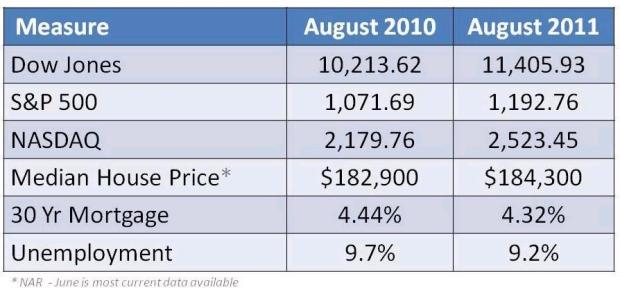
What does the data actually show?

We decided to look at certain economic indicators and compare them to the numbers from a year ago. Here is what we found:

We are not making the argument that the current numbers are worth celebrating. We are only suggesting that the sky is not falling.

Bottom Line

Conditions aren’t as dire as some are professing. Make good sound financial decisions based on your own economic conditions. There is no need to panic.


BORROWERS OPT FOR SHORTER LOAN TERMS

Record-reaching low interest rates have prompted more home owners to shorten the terms of their mortgages. Thirty-four percent of refinancers changed their loan to a 20- or 15-year mortgage during the first quarter — the highest level in seven years, Freddie Mac reports.

Mortgage companies are also reporting a higher demand for shorter-term mortgages. For example, LendingTree reports that 15-year mortgages have increased 30 percent from a year ago.

Quicken Loans recently debuted a product that allows borrowers to select the term of their mortgage. The most popular mortgage term selected is 8 years, followed by 13 years.

“Mortgage-burning parties are back,” Bob Walters, chief economist for Quicken Loans, told USA Today.

Shortening the term of a mortgage can save home owners “tens or even hundreds of thousands of dollars in interest costs,” Keith Gumbinger, vice president of HSH Associates, told USA Today. Some borrowers are finding that refinancing into a shorter term may not even increase their monthly payments, since 15-year rates are so low.

However, some borrowers who want to refinance are finding they’re being shut out, experts say. Home owners who don’t have a credit score of 720 or higher or don’t have at least 20 percent in home equity may not qualify for the lowest rates.


FSBO A NO GO!

This blog prides itself on the quality of real estate information we deliver each and every day. We try to gather empirical evidence to validate the positions we take. We do not use just an anecdotal story to make a point. We also do not get caught up in the sensationalism of the moment. However, today will be different.

We can’t resist commenting on the story which recently appeared in the Wall Street Journal regarding Colby Sambrotto, the founder and former CEO of forsalebyowner.com. It seems the founding father and lifelong evangelist of the concept of selling your home without a real estate agent was forced to hire a broker to sell his home after failing at what he preaches others should do.

After failing to sell his NYC apartment on his own as a For Sale By Owner (FSBO), Sambrotto hired a broker and paid a 6% commission in order to get the job done. His personal experience helps refute some of the myths Sambrotto has been espousing for over a decade. Let’s look at two of those myths:

Myth #1 – You Will Pocket More Money Selling on Your Own

Most FSBO sites say you can save the commission by selling on your own. What happened in Sambrotto’s sale?

From the WSJ article:

“The broker, Jesse Buckler, said he told Mr. Sambrotto the apartment in the Lion’s Head building on West 19th Street near Sixth Avenue was priced too low and wasn’t drawing the right buyers.

By May, it went into contract, he said, after attracting multiple offers. It closed in the last few days for $150,000 more than the original asking price.”

Myth #2 – The Internet Alone Can Sell Your Home

Many have said that, with the introduction of home search on the internet, hiring an agent is no longer a necessity. What happened to the FSBO guru when he attempted to only depend on the internet?

From the WSJ article:

“Looking to move his family to the suburbs, [Mr. Sambrotto] said he carefully staged his apartment for sale himself, and put it on the market. But after using a mix of websites to publicize his apartment, he said he had only “middling success” and switched to a broker because many buyers were so reliant on brokers.”

Bottom Line

There is a reason the real estate industry has been around for centuries: it performs a valuable service.


TEAM EMPOWERMENT MORTGAGE CHATTER: August 16, Freddie Offers Cash Incentives for Buying Condos; Keep Clients By Being A Real Estate Expert; Things To Consider Before Renting a Home You Can’t Sell; Homeownership: Still The American Dream

“Keep away from people who try to belittle your ambitions.

Small people always do that, but the really great make you feel that you, too, can become great.”

– by Mark Twain


I HAD TO SHARE ONE OF THE MANY THINGS I’VE HAD ON MY BUCKET LIST THAT AS OF FRIDAY I CAN CHECK OFF.

I CONQUERED THE HALF DOME HIKE AND IT WAS AN AMAZING EXPERIENCE!


 FREDDIE OFFERS CASH INCENTIVES FOR BUYING CONDOS

Freddie Mac’s HomeSteps unit is offering cash to buyers willing to purchase one of its foreclosed condos that has been lingering on the market. HomeSteps is hoping to unload some of its high inventory of foreclosed condos through the incentive program, known as HomeSteps Condo Cash.

Through the “Condo Cash” program, condo buyers of HomeSteps properties can get up to $1,500 to help pay for standard home owner association dues.

The offer is only valid to owner-occupant buyers and on HomeStep condos that have been on the market for at least 120 days. To participate, buyers must submit offers between Aug. 15 and Nov. 15, and close escrow by Dec. 30.

Some of the homes also come with a two-year Home Protect home warranty to cover electrical, plumbing, air conditioning, heating, and other major appliances and systems. Home Protect also is offering up to 30 percent discounts on the purchase of new appliances (see http://www.homesteps.com/smartbuy/ for more information).


KEEP CLIENTS BY BEING A REAL ESTATE EXPERT

Although 84 percent of home buyers say they would use the same real estate agent for future transactions, the percentage of those who actually do so is lower.

Experts say there are several ways that agents can ensure that they are not forgotten by past clients — such as sending “Just Listed” and “Just Sold” postcards to the whole neighborhood and past clients to broadcast their success.

They should constantly remind people of who they are and what services they offer to ensure they remain visible, and they should use unique marketing to generate attention.

Additionally, agents should reach out to past customers and prospects who might be experiencing financial troubles; and they should act as a consultant to past clients to determine whether they are eligible to claim the federal home buyer tax credit, positioning themselves as a real estate expert.


THINGS TO CONSIDER BEFORE RENTING A HOME YOU CAN’T SELL?

In this difficult housing market, more and more homeowners are considering renting their house instead of adjusting the price. We strongly believe that residential real estate is a great investment and therefore can understand this thinking. However, if you have no desire to actually become an educated investor in this sector, you may be headed for more trouble than you were looking for.

Before renting your home, you should take the following steps to make sure this is the right course of action for you and your family.

Set a consultation appointment with an eviction attorney

People rent out their homes assuming that every tenant will pay the rent every month. We must realize, because of the current economy, there are millions of people not paying their mortgage. There is a chance you may rent to someone who at some point can’t (or simply won’t) pay you the rent. Understand what the legal challenges of eviction could potentially be before deciding to rent your home

Interview property managers

If you are not a full-time investor, hire a professional to handle the property. You need someone to find a qualified tenant, collect the rent and manage the problems. You don’t want to have to make collection calls. What would you say if a tenant told you that they had enough money to either buy food for their children or pay you your rent but not both? You need a person experienced with these situations to help.

You also don’t want to receive calls at all hours of the day and night regarding maintenance issues or challenges a neighbor may be creating for your tenant.

Create an honest budget

Sure, you will receive revenue in the form of rent. However, don’t forget you will also have expenses. Some of the expenses you should consider:

  • Mortgage Payment (unless there is no mortgage on the home you will rent out)
  • Property Taxes
  • Maintenance Expenses such as repairing or replacing: roof, heating/air conditioning unit, appliances, etc.
  • Insurance – Check with your insurance company who may suggest or demand that you increase your liability coverage.

Bottom Line

Again, renting out residential real estate historically is a great investment. However, it is not without its challenges. Make sure you have decided that you want to rent the house because you want to be an investor, not because it looks like an easier way out than selling the house.


HOMEOWNERSHIP: STILL THE AMERICAN DREAM

Yesterday, Fannie Mae released their National Housing Survey for the second quarter of 2011. They survey the American public on a multitude of questions concerning today’s housing market. Each quarter, we like to pull out some of the findings we deem most interesting. Here they are for the most recent report:

Most Important Reasons to Buy a Home

When we talk about homeownership today, it seems that the financial aspects always jump to the front of the discussion. However, the study shows that the four major reasons a person buys a home have nothing to do with money. The top four reasons, in order, are:

  • It means having a good place to raise children and provide them with a good education
  • You have a physical structure where you and your family feel safe
  • It allows you to have more space for your family
  • It gives you control of what you do with your living space (renovations and updates)

The Home as an Investment

Though most people purchase a home for non-financial reasons, everyone realizes there is a money component to homeownership. Here is what they said on this issue:

  • 65% of the general population (and 67% of homeowners) believe that homeownership is a “safe” investment.
  • 56% believe that homeownership has more potential as an investment than any other traditional asset class.
  • 69% think that now is a good time to buy a home (this number has increased in each of the last two quarters)

Rent vs. Buy

We are always interested in the difference people see in renting vs.. owning.

  • 63% of renters have aspirations to someday own their own home
  • 72% of renters think that owning is superior to renting
  • 95% of homeowners see homeownership as a positive experience (4% see it as a negative experience) while 82% of renters see renting as a positive experience (17% see it as a negative experience)
  • 96% of homeowners live in a single family residence while 46% of renters live in a multi-unit building

Bottom Line

Even in difficult times, Americans still realize the value of homeownership.

TEAM EMPOWERMENT MORTGAGE CHATTER: August 15; House Prices: Explaining The Recent Uptick; Are You A Homebuyer On The Fence?; Habitat for Humanity; What If You Could Buy Shoes?; Foreclosures Fall for 10th Straight Month

“People often say that motivation doesn’t last. Well, neither does bathring – that’s why we recommend it daily. ” 

-Zig Ziglar: Motivational author and speaker


HOUSING PRICES: EXPLAINING THE RECENT UPTICK

Several pricing indices have reported that, on a month-over-month basis, home values have ticked up slightly over the last quarter. This has caused some to call the bottom to the housing market – at least from a price standpoint. We must realize that prices are determined by supply and demand.

Demand has indeed shown improvement in many parts of the country. However, the supply side of the formula is being impacted by legal issues. The number of foreclosures coming to market has been slowed dramatically by the courts as the banks still struggle with improperly filed paperwork. This inventory will eventually find its way to the market and again put downward pressure on values.

Here is a chart showing the challenge:

Bottom Line

If you are selling, there currently is a window of opportunity to get your best price before the distressed properties are released.


Is looking for enthusiastic people to donate their time! 100% of net proceeds help rehabilitate and build homes in Solano & Napa counties.

Volunteer Opportunities:

  • Donation Pick-Up
  • Pricing Assistant
  • Warehouse Clerk
  • Customer Service
  • Greeter
  • Warehouse Custodian

Please contact:

Judi Urbanik, ReStore Volunteer Coordinator

Phone: 707-365-3778 Email: judiurbanik@gmail.com

http://www.SolanoNapaHabitat.org


WHAT IF YOU COULD BUY SHOES…?

What if there was a shoe store that had:

An unparalleled selection of shoes of every size, color, and price range

The shoes were discounted 30% or more

You had a credit card that would finance the shoes for 30 years at 4.5%

How many shoes would you buy? My bet is there would be a line around the block. Well, today, real estate is like that shoe store (incredible selection, terrific bargains and excellent financing terms). But there’s more….

Shoes go in and out of style. Homeownership is still the American Dream.

Shoes are worth less once you wear them. Homes will appreciate in value over time.

Shoes get disposed of. Homes are lasting.

And while many can recount memories created in certain shoes, everyone can remember their first home, their first family gathering, the countless holidays shared. There is also the ability to decorate to your tastes, the stability (and lower crime rate) in homeownership neighborhoods and the higher level of education achieved by kids who grow up there.

If you’d stand in line to buy shoes, what’s stopping you from exploring a home? Despite some media perceptions, there is mortgage money available with reasonable down payment requirements at extremely low rates…talk to a loan officer. There are some great deals out there with short sales, foreclosures and regular transactions also!

Happy Shopping!


FORECLOSURES FALL FOR 10TH STRAIGHT MONTH


Foreclosure filings dropped once again in July, hitting their lowest level since November 2007, as processing delaysand foreclosure prevention measures enabled a larger number of delinquent borrowers to remain in their homes.

Filings were down 4% compared to June and were 35% lower than July 2010, marking the tenth straight month of year-over-year declines, according to RealtyTrac, a leading online marketer of foreclosed properties.

RealtyTrac reported that 212,764 U.S. homes received some kind of foreclosure filing — notice of default, notice of auction sale or completed foreclosure — during the month. Bank repossessions totaled 67,829, down 33.6% from the peak month of September, 2010 — when banks took back 102,134 homes, and off 27% from 12 months earlier.

The steep foreclosure drop, according to RealtyTrac CEO James Saccacio, was triggered by a foreclosure processing slowdown that was sparked by the “robo-signing” controversy last fall. As a result of the scandal, in which the banks were accused of mishandling paperwork and failing to follow proper protocols, banks are being much more careful and many filings have been delayed.

“[T]he downward trend in foreclosure activity has now taken on a life of its own,” said Saccacio. “It appears that processing delays, combined with the smorgasbord of national and state-level foreclosure prevention efforts, may be allowing more distressed homeowners to stave off foreclosure.”

There were some small glimmers of hope in RealtyTrac’s report. One promising sign was the steep plunge in initial notices of default, which fell 39% year-over-year to fewer than 60,000.

The decline may indicate that fewer borrowers are falling behind on payments.Or, it could mean lenders are not filing those notices as promptly as they have in the past, according to Rick Sharga, a spokesman for RealtyTrac.

The company analyzed initial default notices in California and discovered that the average sum of missed payments has risen to $78,000 from $17,000 over the past four years. Sharga attributed the jump to delays in filing the initial papers.

Getting rid of repossessed homes

RealtyTrac’s release came a day after the Federal Housing Finance Agency (FHFA), the Treasury Department and the U.S. Department of Housing and Urban Development announced they were seeking suggestions on how to dispose ofthe 92,000 repossessed homes now owned by Fannie Mae, Freddie Mac and the Federal Housing Administration (FHA).

Homeownership reaches lowest level since 1965

FHFA, the agency that supervises Fannie/Freddie, and HUD, which oversees FHA loans, want to be able to reduce that inventory quickly and in a manner that helps stabilize communities that have been hard hit by foreclosures.

They’re seeking proposals from private enterprises, municipalities and non-profits that will result in bulk sales and result in their refurbishment and eventual resale or rental.

Hardest hit markets

Among the markets where these efforts may be most concentrated are those hardest hit by the foreclosure crisis. According to RealtyTrac’s report, Las Vegas continued to record the highest rate of foreclosures in the nation, with a filing for every 99 homes, but the gap between “Sin City” and other metro areas has shrunk.

Foreclosure filings in Stockton, Calif. jumped 57% month-over-month, one for every 124 homes, the second highest rate.

Nevada continued to post the highest foreclosure rate of any state, one filing for every 115 homes. California, one in every 239 homes came in second place, and Arizona, one in every 273 homes, was third.

TEAM EMPOWERMENT MORTGAGE CHATTER: August 9; New Addition To Our Team, Lisa Ricketts; News & Headlines; Are You A Buyer On The Fence?; Feds to Keep Rates At Record Low

“The only thing that stands between a man and what he wants from life is often merely the will to try it and the faith to believe that it is possible.” 

-Richard M. DeVos

JOIN US IN WELCOMING THE NEWEST ADDITION TO TEAM EMPOWERMENT LISA RICKETTS


YOUR CLIENT CARE COORDINATOR

Lisa has joined our team bringing with her a background in both the banking and title industries. We are excited to have her become part of Team Empowerment. As your Client Care Coordinator she will assist you and your buyer(s) once you’ve received an accepted contract. It is her responsibility to maintain target dates, provide you and your buyer(s) with the most up to date information on a weekly basis, also known as our World Class Updates every Wednesday.

Along with her experience she brings to the team a very positive attitude and common goal of all of ours, which is to bring your buyer(s) a pleasant and enjoyable experience within their purchase transaction. Working closely with you and your buyer(s) you will find that she is just as passionate about providing great quality service as it is to put the keys into your buyer(s) hands to their new home.

You’re encouraged to introduce yourself or provide Lisa with a welcoming phone call or email by contacting her directly at:

Phone: 925-295-9361

Email at lricketts@rpm-mtg.com.

Please note that Lisa is also able to assist you should you need immediate assistance for questions on loans in process, or if you have any other questions or concerns.

NEWS & HEADLINES

Productivity of U.S. workers dropped 0.3% in 2Q2011, pushing labor costs up from 2010’s record low and Unit Labor Cost rose 2.2%. Falling efficiency and rising costs hurt profits and mean companies have less incentive to take on staff or increase pay, representing another obstacle to the recovery after growth almost stalled in the first half of the year.

Fed May Boost Stimulus Pledge. Bernanke isn’t scheduled to hold a press briefing following today’s FOMC meeting, as they are only after two day meetings. There is speculation that the 2:15 FOMC statement will indicate a increase in the commitment to monetary stimulus due to a faltering economic recovery and a U.S. credit- rating cut provoked a rout in global stocks. Federal Reserve policy makers are facing mounting pressure to do more to bolster the world’s largest economy as shares plunge. A survey showed 42% of respondents said more bond purchases are very unlikely, and 29% as somewhat unlikely. The statement wording is a delicate balancing act as such a step may backfire because it could panic investors by signaling the economy is in worse shape than the Fed thought.

Treasuries Fall on Speculation Fed Will Offer Increased Economic Stimulus. UST and MBS prices fell and U.S. stocks rose early Tuesday on speculation the Federal Reserve will act to restore confidence in financial markets following S&P’s downgrade to US debt. Yesterday’s global selloff caused the Dow to plunge 634.76 points, its sharpest one-day decline since the financial crisis in 2008 and wiped out $1 trillion from the nation’s market value, After the first-ever downgrade of the U.S.’s sovereign-debt rating, investors world-wide poured their money into-not out of-U.S. Treasurys. Worries about the U.S. economy and the European debt crisis out trumped concerns about the U.S. downgrade as treasurys tend to outperform other assets during times of slow economic growth or recession, as prices usually rise along with pessimism about the economy.

Let me know what I can do to assist you with your buyers!

FED TO KEEP RATES AT RECORD LOWS AT LEAST THROUGH MID 2013

The Federal Reserve pledged for the first time to keep its benchmark interest rate at a record low at least through mid-2013 in a bid to revive the flagging recovery after a worldwide stock rout.

The Federal Open Market Committee discussed a range of policy tools to bolster the economy and said it is “prepared to employ these tools as appropriate,” it said in a statement today in Washington. Three members of the FOMC dissented, preferring to maintain the pledge to keep rates low for an “extended period.”

The decision represents the biggest effort since November to spark the U.S. economy and revive confidence while stopping short of initiating a third round of large-scale asset purchases. Chairman Ben S. Bernanke and his colleagues acted after reports showed the economy was slowing and an unprecedented downgrade to the U.S. credit rating sent stocks tumbling from Sydney to New York.

The Fed offered a dimmer view of the economy than it did in the last statement in late June. “Economic growth so far this year has been considerably slower than the committee had expected,” it said. The Fed also said it expects a “somewhat slower pace of recovery over coming quarters,” adding that “downside risks to the economic outlook have increased.”

The Fed left its target for the federal funds rate in a range of zero to 0.25 percent, where it’s been since December 2008. It said it will maintain its policy of reinvesting maturing securities without saying for how long.

Richard Fisher, president of the Dallas Fed, Charles Plosser of Philadelphia and Narayana Kocherlakota of the Minneapolis Fed all dissented.

Stocks Fall

The Fed’s decision came after Standard & Poor’s unprecedented downgrade of the U.S. credit rating on Aug. 5 sent share prices tumbling on concern a global economic slowdown will deepen. Fitch Ratings and Moody’s Investors Service affirmed their top grades for U.S. debt.

The Standard & Poor’s 500 Index tumbled 6.7 percent yesterday in New York, its biggest decline since December 2008.

The drop has wiped out all the gains in stocks since Nov. 3, 2010, when the Fed announced it would buy $600 billion of government bonds, its second round of asset purchases.

Treasuries surged yesterday as investors sought the safety of government debt. Yields on 10-year notes fell 22 basis points, or 0.22 percentage point, to 2.32 percent, the least since January 2009.

Europe’s debt woes added to the market turmoil. Central bankers and finance ministers from the Group of Seven nations pledged Aug. 7 to “take all necessary measures to support financial stability and growth.”

European Debt

The next day, the European Central Bank began buying Italian and Spanish bonds in its riskiest attempt yet to battle the continent’s sovereign debt crisis.

While U.S. inflation rates have risen, they are still below the Fed’s informal target range of 1.7 to 2 percent. A measure of consumer-price gains, stripping out food and energy, stood at 1.3 percent for the 12 months ending in June. That’s up from 0.9 percent for the 12 months ending December.

Bernanke told Congress on July 13 that the Fed was prepared to buy more Treasury bonds if the economy appeared in danger of stalling or if the threat of deflation looked like it was going to re-emerge, while repeating his forecast for a pickup in growth in the second half of the year.

Recent economic data have cast doubt on his outlook.

Gross domestic product expanded at a 1.3 percent annual pace in the second quarter, less than forecast by economists, a July 29 government report showed. The economy almost stalled in the prior quarter, growing at a 0.4 percent pace, the weakest three-month period since the recovery began in June 2009.

Deeper Recession

The same report showed that the recession was about 25 percent deeper than previously estimated, leaving GDP short of its 2007 peak and the economy more vulnerable to another contraction.

Consumers cut spending in June for the first time in almost two years, the Commerce Department said Aug. 2.

“The consumer environment remains very tough,” Michael Polk, chief executive officer of Atlanta-based Newell Rubbermaid Inc., said on a conference call with analysts on July 29. He said a “difficult” U.S. economy was among the reasons the maker of Rubbermaid containers and Sharpie pens had cut its full-year profit and sales forecasts.

Hiring has slowed as employers lost confidence in the recovery. Average monthly payroll gains fell to 72,000 in the three months through July, from 215,000 in the prior three months. The jobless rate fell to 9.1 percent in July from 9.2 percent in June as Americans gave up looking for work.

“When we have the kind of combination of sub-par growth, stubbornly high unemployment and a big debt overhang, you need low interest rates,” Carmen Reinhart, a senior fellow at the Peterson Institute for International Economics in Washington, said on Aug. 5.

The housing market has also been a drag on growth as sliding home prices cut into consumer confidence and wealth.

Sales of existing homes, the largest portion of the housing market, totaled 4.77 million on an annualized basis in June, a

34 percent drop from their pre-recession peak in September 2005.

The S&P/Case-Shiller index of property values in 20 cities declined 4.5 percent in May from a year earlier, the most in 18 months, and homeownership at 65.9 percent is at its lowest point since 1998, even as affordability is close to a record high.

“We’re still in a market that is clearly bouncing along the bottom on housing and new construction,” Christopher M.

Connor, chief executive officer of Sherwin-Williams Co., said on a July 21 conference call. The Cleveland-based company, the largest U.S. paint maker, also cut its full-year profit forecast because of rising raw material costs.

Manufacturing, which had been one of the few bright spots in the economy, grew in July at its slowest pace in two years, the Institute for Supply Management said on Aug. 1.

The recovery is sputtering just as the existing fiscal stimulus programs expire and the federal government moves toward reducing budget deficits.

The debt deal signed by President Barack Obama on Aug. 2 would cut $2.4 trillion or more off budget deficits over 10 years.

The expiration of current fiscal stimulus programs will slice 1.5 percentage points off economic growth next year, according to economists at JPMorgan Chase & Co. and Deutsche Bank Securities.

TEAM EMPOWERMENT MORTGAGE CHATTER: August 8; News & Headlines; Will the S&P Downgrade Affect Interest Rates?; More Homeowners Get Loan Modification Help; Youth Generation Hit Hard By Recession

“Without a struggle, there can be no progress” -Frederick Douglass

 NEWS & HEADLINES

 S&P: United States of America Long-Term Rating Lowered To ‘AA+’ On Political Risks And Rising Debt Burden; Outlook Negative: Text of S&P press release: ” We have also removed both the short- and long-term ratings from CreditWatch negative. · The downgrade reflects our opinion that the fiscal consolidation plan that Congress and the administration recently agreed to falls short of what, in our view, would be necessary to stabilize the government’s medium-term debt dynamics. More broadly, the downgrade reflects our view that the effectiveness, stability, and predictability of American policymaking and political institutions have weakened at a time of ongoing fiscal and economic challenges to a degree more than we envisioned when we assigned a negative outlook to the rating on April 18, 2011. Since then, we have changed our view of the difficulties in bridging the gulf between the political parties over fiscal policy, which makes us pessimistic about the capacity of Congress and the Administration to be able to leverage their agreement this week into a broader fiscal consolidation plan that stabilizes the government’s debt dynamics any time soon. The outlook on the long-term rating is negative. We could lower the long-term rating to ‘AA’ within the next two years if we see that less reduction in spending than agreed to, higher interest rates, or new fiscal pressures during the period result in a higher general government debt trajectory than we currently assume in our base case.”

Stocks Fall, Treasuries Rally on U.S. Rating. Bonds were higher overnight as equity markets take another bath on reaction to S&P’s downgrade of the U.S. AAA rating late Friday (to AA+). Initially the market did get hit when it first started trading in Tokyo, but the equity losses have been sharp enough to help bonds rally. The benchmark 10-year UST note yield fell to 2.41%, the lowest level since October, and the 2yr UST yield hit a fresh record low of 0.232%. The price move underlines the dilemma confronting investors: there are few alternative safe-haven assets out there that can match the depth and liquidity of the Treasury market, with over $9.3 trillion in debt outstanding. The US Debt downgrade from triple-A to double A-plus by Standard and Poor’s isn’t a big surprise to investors as the rating firm has signaled such a move in recent weeks. Yet the decision late Friday evening came following the biggest weekly selloff in U.S. stocks since the 2008 financial crisis. Fears about the U.S. economy faltering further and the euro-zone debt crisis have spooked investors’ sentiment and increased worries that the downgrade could further undermine confidence by U.S. consumers to spend and businesses to expand, increasing anxiety and outlook for the global economy.

Global Economy Near Tipping Point as Markets Eye FOMC Meeting. Tuesday’s monetary policy meeting by the Federal Reserve may provide further stimulus even though the options are running thin at the moment. One way for the Fed to provide stimulus is to signal that the key policy rate will stay where it is longer than many thought. Interest rate futures indicate the first rate hike will come in the first half of 2012, pushed out from next year.

Fannie Mae, Freddie Mac Ratings Cut by S&P Amid Reliance on U.S. Backing. Standard & Poor’s lowered credit ratings for Fannie Mae, Freddie Mac, and other lenders backed by the federal government.


WILL THE S&P DOWNGRADE AFFECT INTEREST RATES?

Standard & Poor downgraded the U.S.’s credit rating on Friday, despite Congress reaching a deal in the final hours on the debt ceiling crisis last week. And now many of your customers may be asking: What does this mean for interest rates?

“The impact on your wallet of the Standard & Poor’s downgrade of the nation’s credit rating is similar to what would happen if your own credit score declined: The cost of borrowing money is likely to go up,” the Washington Post explained in the aftermath of S&P’s decision.

S&P downgraded the U.S.’s top-notch AAA credit rating for the first time in history, moving it down one notch to AA+; the rating reflects a downgrade in S&P’s confidence in the U.S. government’s ability to repay its debts over time. It’s not clear, however, whether S&P’s downgrade will instantly effect rates, analysts say.

The 10-year Treasury note is considered the basis for all other interest rates. And “the downgrade could increase the yields on those bonds, forcing the government to spend more to borrow the same amount of money,” the Washington Post article notes. “Many consumer loans, such as mortgages, are linked to the yield on Treasurys and therefore would also rise.”

While consumers who have fixed interest rate mortgages will be immune to any changes in borrowing costs, home buyers shopping for a loan or those with mortgages that fluctuate may see a rise in rates later on, some analysts say.

Mark Vitner, senior economist at Wells Fargo Securities, told the Associated Press that he doesn’t expect the downgrade to drive up interest rates instantly since the economy is still weak and borrowers aren’t competing for money and driving rates higher. However, he expects in three to five years, loan demand will be much higher and then the downgraded credit rating might cause rates to rise.

Analysts are still waiting to see if the other rating agencies, Moody’s and Fitch, follows S&P’s lead in its downgrade of the U.S. credit rating. If so, the aftermath could be much worse, analysts say.

The debt deal reached by Congress last week was expected to save the U.S. from any credit rating downgrade. However, S&P said lawmakers fell short in its deal. Congress’ deal called for $2 trillion in U.S. deficit reduction over the next 10 years; S&P had called for $4 trillion.

VIDEO: NAR Chief Economist Lawrence Yun on U.S. Debt Downgrade: Impact on Real Estate


MORE HOME OWNERS GET LOAN MODIFICATION HELP

In June, the Home Affordable Modification Program helped 657,044 home owners avoid foreclosure through permanent loan modifications – that’s up from 633,459 in May, according to Treasury Department statistics released Friday.

However, while the number has grown, the numbers still fall short of the initial goal to help 3 million to 4 million borrowers through HAMP, which since 2009 has reduced mortgage payments to help borrowers avoid foreclosure. (Home owners in the program must make a few trial payments before the loan modification becomes permanent.)

For underwater home owners – those who owe more on their mortgages than their home is currently worth – about 6,941 have participated in a principal-reduction program, up from 4,911 last month, the Treasury Department reported late last week. For borrowers who qualified to have their loan balances reduced, they’ve seen median principal reductions of $67,751, or 30.7 percent.

“We’re continuing to see a slight improvement in home prices and a decline in mortgage defaults as our foreclosure prevention programs reach more borrowers upstream in the process,” says Raphael Bostic, Housing and Urban Development assistant secretary. “But we have much more work to do to help the market recover and to reach the many households there and across the nation who still face trouble.”


YOUNG GENERATION HIT HARD BY RECESSION

The recession has hit the younger generation hard and is forcing them to delay many major life changes and purchases, according to a new survey. About 44 percent of Millennials – people aged 18 to 29 – say they will have to delay buying a home due to economic factors, according to a survey conducted by The Polling Co. Inc./WomanTrend.

About 75 percent say they have or will delay a major life change or purchase due to economic factors, and 30 percent say the bad economy has prompted them to delay changing jobs or cities. What’s more, nearly 25 percent say they will delay starting a family, and 18 percent say they will delay getting married.

Such delays by the younger generation has started to affect household formation. Many young professionals are moving back in with their parents to curb costs, which has caused household to grow in recent years after facing decades of declines.

“The impact of the poor economy, in human terms, has been devastating. This is especially true for young Americans, whose lives have been interrupted and dreams put on hold due to the lack of economic opportunity,” says Paul T. Conway, president of Generation Opportunity.