Real Estate

TEAM EMPOWERMENT MORTGAGE CHATTER: July 5; Celebrating America’s History of Home Ownership; Top 5 Real Estate Headlines in the 1st Half of 2011; Banks Face Foreclosure Practice Deadline

“The best way to predict the future is to create it.”  – Peter F. Drucker: Was a political economist and author


CELEBRATING AMERICA’S HISTORY OF HOME OWNERSHIP

The ability to buy, sell and own property has defined our nation throughout its history, and as the U.S. prepares to celebrate its 235 birthday, Americans continue to reaffirm their support of and aspirations toward home ownership.

“For over 100 years, REALTORS® have helped bring families home,” said NAR President Ron Phipps, broker-president of Phipps Realty in Warwick, R.I. “There’s a reason why home ownership is called the American Dream – it’s part of our collective history and an essential part of building our nation’s future, as well.”

Numerous studies have shown the value Americans place in home ownership. According to the 2010 NAR Profile of Home Buyers and Sellers, first-time buyers most often cite the desire to own a home as the primary reason for their recent home purchase. Eighty-five percent of all recent home buyers consider a home purchase a solid investment, and 76 percent of them believe owning a home is as good as or better than an investment in stocks.

Earlier this week, a New York Times/CBS News poll reported that nearly nine in 10 Americans say home ownership is an important part of the American Dream. In a recent National Association of Home Builders survey , 73 percent of respondents said they believe the federal government should provide tax incentives to promote home ownership.

“Owning a home has long-standing government support in this country,” said Phipps. “Historically, lawmakers have understood the value of homeownership in fostering communities, creating social stability, and building wealth over the long term. In fact, Franklin Delano Roosevelt said, ‘A nation of home owners is unconquerable.’

“The mortgage interest deduction was introduced as part of the federal tax code nearly a century ago, and the Federal Housing Administration, Federal Home Loan Banks, and Fannie Mae were all created during the worst economic crisis our country ever faced in the Great Depression.”

Studies also demonstrate tangible social benefits to home ownership. The NAR report, Social Benefits of Homeownership and Stable Housing, showed that home owners are more active in their communities, benefit from improved education opportunities, and report higher levels of self-esteem and happiness when compared to renters. The U.S. Census Bureau.

reports that owners do not move as frequently as renters, providing more neighborhood stability. In turn, involvement in community quality-of-life issues helps prevent crime, improve childhood education and support neighborhood upkeep.

“As families across the country gather this weekend to celebrate our nation’s birthday,

REALTORS® will continue to work to insure that this and future generations have the opportunity to pursue their dreams of owning a home,” said Phipps.


TOP 5 REAL ESTATE HEADLINES IN THE 1ST HALF OF 2011

We have reached the midway point of the year. Today, we want to look back over the first six months and give you what we believe were the five items that have had the biggest impact on the real estate industry so far this year.

The Government Wants Out of the Mortgage Business

From the original outline of the Dodd-Frank regulations to the talk of closing Fannie Mae and Freddie Mac to the proposed Quality Residential Mortgage (QRM) guidelines, the government has made it very clear that they want to dramatically limit their involvement in the mortgage industry. What will come of this? Will private industry step up and fill the void created? What will be the increased cost to the consumer? Only time will tell.

Despite Early Headlines, Sales are Increasing

Headlines earlier in the year announced the total collapse of the housing market. To those in the know, it was obvious that comparing sales numbers in the first four months of this year to the same period last year made absolutely no sense. The largest tax credit ever given to home buyers expired on April 30, 2010. Large numbers of transactions were dragged forward last year so buyers could take advantage of the credit. Pending home sales (transactions going into contract) on the other hand have done quite nicely and many institutions (ex. Fannie Mae, Freddie Mac, NAR and Moody’s Analytics) are projecting good sales numbers throughout the rest of the year.

Amid Warnings of a ‘Double-Dip’, Prices Began to Stabilize

Prices continued to retreat for the first few months of the year and brought the bears out. Some called for another major fall in prices (15-20%) and almost all recalculated their projections to show continued depreciation. Just as these new projections were made available, some pricing indices announced that values actually increased (though by a rather minimal percentage). Again, those with the best understanding of the market were quick to explain…

Foreclosures Were Delayed Longer Than Originally Projected

Distressed properties (foreclosures and short sales) have a major impact on the values of all properties in an area. Because of paperwork challenges, the flow of these properties to the market was virtually shut off. At the beginning of the year, most experts believed the banks would correct these challenges by the end of the first quarter. That didn’t happen and therefore many of these properties were delayed coming to the market. This is a major reason why prices seemed to recover: there were fewer discounted properties available for sale. Most now believe that the banks are within 60-90 days of releasing this inventory and that prices will again begin to soften.

Main Stream Media Begins to Announce “Now Is the Time to Buy!”

With prices and interest rates at historic lows and the chance that mortgages will become more costly as the private sector steps in, many in the main stream media are announcing that buying a home now makes sense. In the last 45 days, the Wall Street Journal, Forbes Magazine, National Public Radio (NPR) and CBS Money Watch have all ran articles calling for the readership to consider buying now!


BANKS FACE FORECLOSURE PRACTICE DEADLINE

The Office of the Comptroller of the Currency has given all banks until Sept. 30 to conduct a self-assessment of its foreclosure practices.

The “self-assessment” request first came in consent orders given to 14 of the nation’s largest banks in April over a settlement into questionable foreclosure practices that had surfaced last fall. The consent orders called for mortgage servicers to hire a third party to review its foreclosure files to determine if home owners were harmed directly from any errors, sloppy, or incomplete paperwork.

The mortgage servicers include banking giants Bank of America, JPMorgan Chase, Wells Fargo, Citigroup, among others. But the OCC now says that any bank that falls under its supervision, even those that did not sign the consent orders, must complete the self-assessment by Sept. 30, too.

“Banks that identify weaknesses in their foreclosure processes through the self-assessment should take immediate corrective action,” the OCC said. “Banks should determine if the weaknesses resulted in any financial harm to borrowers and provide remediation where appropriate.” The OCC says it will review the self-assessments and the corrective actions taken, as well as also make any determinations of financial harm to home owners.
TEAM EMPOWERMENT MORTGAGE CHATTER: June 30; NOW HIRING: Loan Processor, Have We Forgotten Something?; California Lawmakers Pass Budget With Deep Cuts

“The quality of a leader is reflected in the standards they set for themselves”  -Ray Kroc


HAVE WE FORGOTTEN SOMETHING?

Over the past few weeks and months, the media, so-called experts and most of our friends and relatives seemed to have almost soured on buying a home at this time. With fear of a fragile economy and high unemployment rates, who can argue with caution?

When the pervasive sentiment among even real estate and mortgage professionals is that home prices will continue to move downward and that mortgage interest rates don’t appear to be jumping significantly any time soon, the question remains… “Why would anyone that doesn’t have to buy now, buy now?”

One commenter to a previous blog post even went so far as to challenge the entire industry for promoting the “hurry up and buy” approach by asserting that buyers who listened to that advice six months ago are bemoaning taking that advice. That made me think: “Are people who bought six, eight, ten months ago kicking themselves because their home is worth less now than when they bought it?”

I had my team call some of our recent buyers and this is the feedback we received:

“Last year at this time, I was cooped up in a small apartment. Today, I am planning our Fourth of July celebration with 25 friends and family in our new home. Regrets? Are you kidding? We couldn’t be happier.”

“We are glad we now have a place of our own. We have a few friends looking to buy and we are helping to get them excited. Five years ago, we couldn’t afford it….now, we have our American Dream.”

“We were crammed into my in-laws’ home with no real privacy or room for the kids to just be kids. Now, they have a backyard to play in and they have settled in to their new school and made new friends. We couldn’t be happier.”

“Yeah, I realize, I might have been able to buy a home for $10,000 less if I waited, but there are two things to remember. One, what memories would we have missed if we weren’t here? And two, I am not selling my home now. Who cares what it is worth until we look to move again in 5-7 years? By then, we believe everything will be back to normal. Right now, we have a payment we can comfortable manage and we have a home to build roots and a foundation. I would urge everyone to do it, if they can.”

A home does remain a good long term investment. However, first and foremost, it really is a place for pride, peace, preference, and pleasure. We need to be reminded that the emotional component to buying a home may be worth more than simply the financial benefits. And from a financial perspective…who in your life is a better financial mentor? Donald Trump or Uncle Joe? Warren Buffet or your local newspaper writer who makes $30,000 a year? Remember, conventional wisdom breeds mediocre results (at best).


CALIFORNIA LAWMAKERS PASS BUDGET WITH DEEP CUTS

California lawmakers approved an $86 billion budget late Tuesday that imposes deep spending cuts but does not extend tax hikes.

The budget is a disappointment for Governor Jerry Brown, a Democrat who spent months trying to convince Republican legislators to put an extension of personal income and sales tax increases before the voters.

Unable to do so, Brown and Democratic legislative leaders cobbled together a plan that calls for a total of $14.6 billion in cuts. Much of the bloodletting was agreed to in March, but this week’s deal would add at least $2.5 billion in additional reductions.

“Putting our state on a sound and sustainable fiscal footing still requires much work, but we have now taken a huge step forward,” Brown said.

Overall the Department of Health and Human Services would be slashed by $5 billion, while the Department of Corrections and Rehabilitation would see a cut of $1 billion. The state’s two university systems would each lose $650 million in funding.

The budget hinges on the state bringing in $4 billion in more in tax revenues in the coming year than was initially expected. The improving economy has pushed the state’s tax collections billions of dollars above estimates in recent months. Brown expects the windfall to continue into fiscal 2012, which starts Friday.

The new American dream home: Prices in 11 cities

If tax revenue comes in lower than expected, the budget also would impose an additional $2.6 billion in cuts to higher education, corrections and in-home support services for the elderly and disabled.

The proposal would slash billions in spending for children, the sick, and the elderly, said Senate President pro Tem Darrell Steinberg. And it would hurt the state’s economy, he said.

“This budget is the most austere fiscal blueprint California has seen in a generation,” Steinberg said.

Since the budget does not call for tax increases, it requires only a majority of the Democratic-led legislature to approve it.

However, Governor Brown and his fellow Democrats said they plan to put a tax measure on the ballot in November 2012 through a voter initiative — bypassing the requirement for Republican consent. That’s the only way California can afford to pay for the services it provides, they said.

“It is clear that there is no realistic long-term solution to California’s structural deficit that doesn’t involve new revenues,” said Assembly Speaker John Perez.

Though they fended off Brown’s tax extensions, Republicans immediately attacked the proposal, saying California needs a budget that will revitalize the economy and create jobs.

“This is a ‘Hope without Change’ budget,” said Senate Republican Leader Bob Dutton. “It relies on the hope for billions of phantom dollars and does nothing, absolutely nothing, to change government as usual. Even worse, it does nothing to put people back to work.”

The proposal is a major shift for Brown, who has said for months that the state’s $26 billion budget gap should be addressed with a mix of spending cuts and tax extensions. He also was determined to fulfill his pledge to put the extension of personal income and sales taxes before the voters.

However, he could not convince four Republicans to join him so he could get the measure on the ballot. A budget containing a tax hike needs the support of two-thirds of lawmakers.

Republicans have refused to go along unless the budget also contained a spending cap, as well as pension and regulatory reform.

The latest proposal was put together less than two weeks after Brown vetoed a budget approved by the legislature, saying it was chock full of gimmicks and contained legally questionable maneuvers.

California lawmakers lose pay until they pass balanced budget

Lawmakers had raced to pass a spending plan by June 15 to meet a voter-imposed deadline that required the legislature to pass a balanced budget or forfeit their pay.

However, state controller John Chiang determined that the budget was actually unbalanced. So lawmakers, who earn $95,291 a year and $142 per diem for each day they are in session, have gone without pay since mid-month.


TEAM EMPOWERMENT MORTGAGE CHATTER: June 29; NOW HIRING: Loan Processor, Fannie to Fine Lenders for Foreclosure Delays; 5 Questions To Ask When Evaluating Short Sales; Pending Home Sales Rise in May; Housing Market Casting a Smaller Shadow

“There is all the difference in the world between having something to say and having to say something.” -John Dewey: Was a psychologist, educator and social critic

FANNIE TO FINE LENDERS FOR FORECLOSURE DELAYS

Mortgage servicers who have delayed the foreclosure process for delinquent borrowers may now get fined. Fannie Mae announced it will retroactively fine mortgage servicers for failing to process severely aged loans in foreclosure, HousingWire reports.

Fannie Mae would not disclose the amount of the fees, but the fees are to be “based on the outstanding principal balance of the mortgage loan, the applicable pass-through rate, the length of the delay, and any additional costs,” HousingWire reports.

The government-sponsored enterprise updated its time frames for mortgage servicers for navigating the foreclosure process last August.

“A compensatory fee not only compensates Fannie Mae for damages but also emphasizes the importance placed on a particular aspect of the servicer’s performance,” according to guidance for Fannie Mae from its regulator, the Federal Housing Finance Agency. “In some cases, a compensatory fee will relate to the action the servicer took, or failed to take, in handling a specific mortgage loan. At other times, the compensatory fee reflects the impact of the servicer’s performance deficiencies on Fannie Mae’s cash flow.”

5 QUESTIONS TO ASK WHEN EVALUATING SHORT SALES

“Mortgage lenders across America are eager to avoid foreclosures, and short sales can be an attractive option for clients and real estate professionals alike,” writes Bill Ervin, the national sales director of real estate relationships for CitiMortgage Inc., in an article at RISMedia. “Ask the right questions and you’ll be well on your way to a successful short sale.”

Here are some questions Ervin points out are important for real estate professionals to consider when evaluating a potential short sale for a client.

1. Who owns the lien according to the servicer?

2. What documents are required? For example, the transaction always requires a Letter of Authorization (which is from the client authorizing the real estate professional to speak on their account); listing agreement; purchase contract; estimated/final HUD Settlement Statement; and 2nd Lien Approval Letter.

3. Do all of the parties agree on the property’s value?

4. Has the seller signed a short sale agreement?

5. What are the major challenges the client may face in this transaction? (For example, are there subordinate lien holders or will the client be able to secure financing in time?)


PENDING HOME SALES RISE IN MAY

After an April dip, pending home sales rose sharply in May, for the first annual increase in over a year, according to a report from the National Association of Realtors.

NAR’s Pending Home Sales Index rose 8.2 percent month-to-month and 13.4 percent year-over-year in May, to 88.8. An index score of 100 is the average level of contract activity in 2001, the first year that index data was collected. May saw the first year-over-year index increase since April 2010, NAR said.

The index, which tracks homes under contract, is a leading indicator, and the latest data suggest home sales will jump in June and July.

“Absorption of inventory is the key to price improvement,” said Lawrence Yun, NAR’s chief economist.

He cautioned, however, that “the job market has sputtered recently, and because variations in local job creation impact housing demand, markets will recover unevenly around the country.”

Pending sales jumped in all regions last month. The Midwest saw the biggest year-over-year increase, 17.2 percent, and the second-biggest month-to-month increase, 10.5 percent, to 82.8.

In the South, the index rose 14.6 percent year-over-year and 4.1 percent month-to-month, to 95.

The West saw the biggest month-to-month increase, 12.9 percent, and a 13.5 percent year-over-year increase, to 100.6.

The Northeast was the only region that did not experience double-digit increases. Pending sales in the region rose 4.4 percent year-over-year and 7.3 percent month-to-month, to 69.2.


HOUSING MARKET CASTING A SMALLER SHADOW

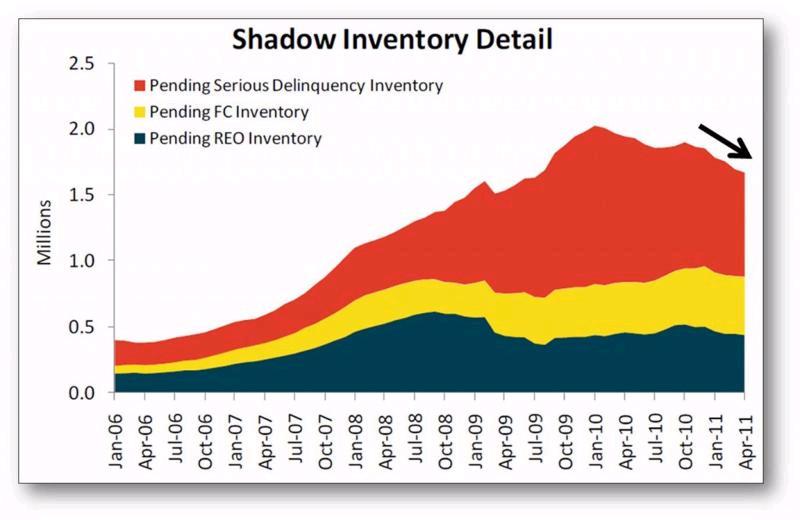
The inventory of future short sales and foreclosures which will be coming to the market is known as ‘shadow inventory’. Future real estate pricing will be determined by the number of these distressed properties which eventually reach the market.

These properties sell at major discounts:

  •  short sales at a 10% discount
  • foreclosures at a 35% discount

CoreLogic just reported this inventory is declining as more Americans are staying current on their mortgage obligations. Here is a graph from their latest report:

 Bottom Line

There still are a substantial number of distressed properties that must be cleared. They will cause prices to soften in many markets. However, it is comforting that this number is finally beginning to decline.

TEAM EMPOWERMENT MORTGAGE CHATTER: June 28;Now Hiring: Loan Processor; The Better Bargain: Foreclosure or Short Sale?; Housing Prices Through 2015; Freddie Mac: Better Days Ahead in Housing; 5 Quick Tips for July 2011

“A primary method for gaining a mind full of peace is to practice emptying the mind.”  

– Napoleon Hill: Was a lecturer and author of books on achieving success

NOW HIRING:   I’m looking to add a loan processor to my team. You can share the information with someone you may know that might be interested. They can apply directly through this link. Thank you for your support and help with finding this great candidate.  LOAN PROCESSOR POSITION

THE BETTER BARGAIN: FORECLOSURE OR SHORT SALE?

Short sales and foreclosures have flooded the housing market in recent years, and buyers are often drawn to the bargain prices but may be hesitant to jump into what usually is a difficult transaction and a long process.

Bankrate.com recently tackled the question of “Which to Buy: Short Sale or Foreclosure?” in an article that helps buyers weigh the pros and cons of a distressed property. Experts note that the question largely depends on buyers’ situations, how quickly they need a home, and their tolerance for fixer-uppers.

Foreclosure Pros and Cons

Buying a foreclosure is often faster than purchasing a short sale. Plus, buyers often can negotiate closing costs and price in foreclosure sales, Elaine Zimmermann, a real estate investor in Memphis, Tenn., told Bankrate.com.

However, abandoned homes in foreclosure can deteriorate very quickly so the buyer may need to weigh the condition of the home and whether they want a fixer upper. Scarred walls and carpets and appliances that were damaged by the former owner are not uncommon in a foreclosure, says David Richardson, an inspector in the Detroit area who’s certified by the American Society of Home Inspectors.

Short Sales Pros and Cons

A short-sale home is still owned by the occupant, so it tends to be in better condition than a foreclosure, experts say.

“The short sale is, in my opinion, far better than buying a foreclosure because the home is generally in better condition because it’s been occupied,” says Gwen Daubenmeyer, a certified distressed property expert with RE/MAX in Detroit. “The utilities have been maintained, usually the lawn is maintained, those kinds of things.”

But short sales often can take a longer time than a foreclosure to close. However, the federal Home Affordable Foreclosure Alternatives program, or HAFA, may be able to help speed up the short-sale process since it has created a timeline to hold mortgage lenders accountable, but still “it’s not perfect by any means,” Daubenmeyer says.

HOUSING PRICES THROUGH 2015

Everyone seems to have an opinion on where home prices are headed. Housing bulls are saying prices may start rebounding as early as later this year. Some housing bears are saying that prices may still drop another 10-15%. What actually is going to happen? No one knows for sure.

However, Macro Markets, a financial technology company, actually surveyed 108 economists, real estate experts, and investment and market strategists for their June 2011 Home Price Expectations Survey. They then averaged all 108 opinions. Here is what the report says about house prices over the next five years:

  • 2011: prices will depreciate 3.52%
  • 2012: prices will appreciate .46%
  • 2013: prices will appreciate 2.18%
  • 2014: prices will appreciate 2.92%
  • 2015: prices will appreciate 3.47%

Accumulative appreciation (including this year’s projected depreciation) will stand at 5.71% in 2015.

Bottom Line

The experts say home prices will begin to see appreciation next year and return to historic levels of annual appreciation by 2015.

FREDDIE MAC: BETTER DAYS AHEAD IN HOUSING

Freddie Mac’s chief economist is optimistic that the housing market and economy will improve in the second half of 2011.

Freddie Mac Chief Economist Frank Nothaft said mortgage rates will likely remain historical lows of between 4.5 percent and 5 percent for the remainder of the year. Also, he expects more buyers to stop waiting on the sidelines as recent price drops in home prices have improved affordability.

Nothaft said consumers’ uncertainty about the economy has caused them to delay home purchases and other “big-ticket items.”

“Some potential buyers who have the means to buy are awaiting clearer signs that home values have firmed,” Nothaft says.

But Nothaft says they should be getting their signs in the second half of the year, with projected job gains, and a growing, improved economy.

“Even though near-term concerns over income and sales growth are restraining consumer spending, business hiring, and new building, a number of positive signs in the economy indicate that growth will continue and is likely to accelerate in the second half of this year,” Nothaft said. “Look for a gradual improvement in housing activity in the coming year.”

5 QUICK TIPS FOR JULY 2011

1. Prepare diligently for EVERY appointment.

Most agents prepare well for a listing appointment. They go in with a complete consultation manual ready to show the seller why they should sell now and at the suggested price. They make sure they have all the tools necessary to have a successful meeting.

What about the buyer consultation appointment?Or the price-break appointment?Or the negotiation of offer appointment? There are four critical appointments in today’s market. We prepare for one of them. We ‘wing’ the other three. We must prepare as thoroughly for the last three as we do for the listing presentation. We must make the most of every opportunity presented from now until the end of the year.

2. Don’t forget the fundamentals; contact listings that expired in June.

History has shown us that the single day of the year that most listings expire is December 31st. The date that comes in second is June 30th. There will be more opportunity in the first week of July 2011 than perhaps in any other July in history. The number of expiring listings will be staggering. That means opportunity for someone. Hone your listing and pricing skills and approach every expired you can. The inventory of listings you accumulate in the first two weeks of July could catapult you to success for the rest of the year.

3. Gain knowledge and then get to work.

Two quotes from the late business guru, Peter Drucker:

“Knowledge has to be improved, challenged and increased constantly, or it vanishes.”

We have to become better at our craft every day. We must continuously improve our skills. We must become an expert at showing our customers what is taking place in the current housing market. They can then make the right choices for themselves and their families.

“Plans are only good intentions unless they immediately degenerate into hard work.”

It is not good enough to be a student of real estate. We must act on our knowledge. We must plan where we wish to be and then get busy making our way there. If I could have only one of all the attributes successful people are known to have, I would chose the ability to work hard. It is the most important and will get you closer to success than any other attribute.

4. Remember that a picture is worth a thousand words.

Whether we are taking a listing, consulting a buyer, doing a price adjustment or presenting an offer-to-purchase, we must be able to effectively communicate our customers’ options in the current real estate environment. The use of strong visuals dramatically enhances the chances that the consumer will truly understand the points we are making. Too many agents are satisfied complaining about the fact that their client just ‘doesn’t get it’ even after they ‘told’ them what is happening.

We must take the time to visually ‘tell a story’ on each point we are making. We must hone that story until it makes our point simple to understand. That is what differentiates talking at a person from truly educating them. We need to be great educators in this market.

5. Stop hoping the market gets better…Make sure YOU get better.

The same question comes up over and over – when do you think the market will get better? It’s a difficult time addressing the person asking the question. I don’t want to be rude but the real question we should be asking is – When are we going to get better?

The best market a true professional can hope for is a market that truly needs the skills of a well-trained expert in the field. Anyone can do the job in a market that doesn’t require competency, skill and insight. To the great real estate professional, a market’s strength has always been determined by how many people needed our help. In my 25 years in the business, I have never experienced a market that had more people who need our help in making the right decisions for themselves and their families.

Are we consistently doing the necessary research to keep abreast of what is happening in today’s rapidly evolving market? Are we taking classes to help us understand why certain things are taking place? Are we taking the time to sit with our clients and simply and effectively inform them of their options?

“Are we prepared to help?” becomes the question that needs to be answered; not “When will the market no longer require a true professional?”

——————————————————————————–

Team Empowerment Mortgage Chatter: June 20; Consumer Confidence: Which Way Is It Headed?; Will Falling Values Lead to More Strategic Deafults?; Scam Cheats Borrowers Out Of Loan Payments;

“Visualize this thing you want. See it, feel it, believe in it. Make your mental blueprint and begin.” – Robert Collier

CONSUMER CONFIDENCE: WHICH WAY IS IT HEADED?

There is no doubt that the housing market and the economy are intertwined. The economy will get better as housing improves. Housing will regain strength as the economy improves. How is the economy actually doing? One measure is the Misery Index which combines the inflation and unemployment numbers. According to their site:

The misery index was initiated by economist Arthur Okun, an adviser to President Lyndon Johnson in the 1960s. It is simply the unemployment rate added to the inflation rate. It is assumed that both a higher rate of unemployment and a worsening of inflation both create economic and social costs for a country. A combination of rising inflation and more people out of work implies a deterioration in economic performance and a rise in the misery index.

How does information like this impact Consumer Confidence?

Obviously, this index reflects on the factors that eat at consumer confidence. Bloomberg News reported on this saying:

Confidence among U.S. consumers dropped more than forecast in June as households contended with higher prices that are eating into incomes amid slowing job growth. The Thomson Reuters/University of Michigan preliminary index of consumer sentiment decreased to 71.8 from 74.3 in May.

Bottom Line

It will be difficult for housing to rebound while consumers are concerned about their financial futures.


WILL FALLING VALUES LEAD TO MORE STRATEGIC DEFAULTS?

As prices continue to soften, more and more homeowners will fall into a position of negative equity on their homes. This means that the balance on their mortgage is greater than the value of their home. The reason this is important is that people are more prone to strategically default on their mortgage when ‘underwater’.

What is a strategic default?

Let’s first define strategic default in simple terms. According to Wikipedia:

A strategic default is the decision by a borrower to stop making payments (i.e. default) on a debt despite having the financial ability to make the payments.

This is particularly associated with residential and commercial mortgages, in which case it usually occurs after a substantial drop in the house’s price such that the debt owed is (considerably) greater than the value of the property – the property negative equity or “underwater” – and is expected to remain so for the foreseeable future, such as following the bursting of a real estate bubble. Such borrowers are called “walkaways.”

This definition itself serves as the explanation as to why people will default.

How do Americans view strategic default?

In Fannie Mae’s recent National Housing Survey, they shed some light on American’s thoughts on strategic default.

  • The number of underwater homeowners who believe it is okay to default on your mortgage if you are under financial distress has almost doubled in the last twelve months (14% to 27%).
  • 47% of people that are underwater and behind on their mortgage have considered strategic default.
  • Those who know a strategic defaulter are more likely to have considered defaulting.
  • 1 in 5 Americans knows a strategic defaulter

Bottom Line

As more people enter into negative equity, more will be tempted to ‘walk away’ from their mortgage obligations. If they do walk, that will increase the number of homes entering foreclosure.


FORECLOSURES SLOW AS BANKS FACE BACKLOGS

Nationwide, new foreclosure cases and repossessions have dropped by a third since last fall as banks, as greater scrutiny over banks’ foreclosure procedures and more home owners fighting back in court has slowed the pace. Banks, already facing huge backlogs of foreclosures they’ve already repossessed, also may be reluctant to add on more to their inventory, experts say.

For example, In New York, experts estimate it would take lenders 62 years at their current pace to repossess the 213,000 houses now in severe default or foreclosure, according to LPS Applied Analytics, a real estate data firm. New York boasted the longest foreclosure backlog in the nation. Following behind, in New Jersey it would take 49 years, and in Florida, Massachusetts, and Illinois it would take 10 years to handle the supply of foreclosures at the current pace.

States where courts must review each foreclosure tend to have the longest delays. But in the 27 states without that requirement, foreclosures are much quicker. For example, as comparison, in California, the foreclosure backlog is three years, and in Nevada and Colorado, it’s two years.

“If you were in foreclosure four years ago, you were biting your nails, asking yourself, ‘When is the sheriff going to show up and put me on the street?'” Herb Blecher, an LPS senior vice president, told The New York Times. “Now you’re probably not losing any sleep.”

However, the banks say they is no strategy in delaying foreclosures. “Any suggestion that we have a strategy to delay foreclosures is baseless,” a spokesman for Bank of America said. Instead, one bank blamed delays in state laws governing foreclosures while others said the decline in foreclosures is the product of an improving economy.


SCAM CHEATS BORROWERS OUT OF LOAN PAYMENTS

Warn your home owner clients to beware of a scam growing in many parts the country that tries to trick home owners out of a month or two of their mortgage payments.

The Chicago Tribune referred to it as the “handoff rip-off” scheme, in which scammers send letters to borrowers informing them that a new company has assumed the management of their loans and to start making mortgage payments to the new company.

Many home owners aren’t familiar with the rules when it comes to the transfer of mortgage-servicing so they follow the letter’s directions in sending their payments to the new company and could possibly lose thousands in mortgage payments.

Inform your home owner clients of mortgage-servicing transfer rules so they won’t be duped. For example, the law requires a company that provides a mortgage on behalf of the loan’s owner to send a “goodbye” letter notifying them that at a specific date their payment should be sent to a new company. Then, a week or so later, the home owner is legally to receive a second letter from the new servicer that provides mortgage payment information (their principal, interest, and escrow). Both letters should include the home owner’s loan number, the Tribune article explains.

When in doubt, contact your original servicer to find out if the letter received is legit or fraud.

The scheme “works for maybe two months” because that is usually how long it takes for borrowers to realize they’ve been tricked, says Becky Walzak, a loan-quality assurance expert. “But if the bad guys are any good, they’ve taken in thousands of payments from thousands of people. They cash them, and they move on to the next batch of borrowers.”

Team Empowerment Mortgage Chatter: June 16; Housing Prices Will Continue To Tumble; Renters Are Next Victims of Housing Market; Is The Economy Worse Than We Think?

“It is literally true that you can succeed best and quickest by helping others to succeed.” – Napoleon Hill


HOUSING PRICES WILL CONTINUE TO TUMBLE

We have written several blogs recently quoting numerous sources saying now is the time to buy a home. We agree that now is definitely the time to buy. This is NOT because we are calling the bottom for real estate PRICES. What we have said is that the COST of purchasing a home is probably near a bottom or has hit the bottom.

The difference is that COST is determined by two components: the price of the home and the expenses associated with mortgaging that home. As we have put forth in several posts, we believe that the expense of obtaining a mortgage will increase as the year goes on.

We also believe strongly that, in most parts of the country, prices will continue to soften. Here are the reasons why:

Existing Months’ Supply of Inventory Is Still Too High

A balanced market (where prices are stable) can handle 5-6 months worth of active inventory. Anything less than 5 months constitutes a seller’s market as there are not enough houses to meet buyer demand. This usually results in price appreciation. Anything more than 6 months constitutes a buyer’s market as there are not enough buyers for the number of houses on the market. This usually results in price depreciation.

Currently, as per the National Association of Realtors (NAR), there is a 9.2 month supply of inventory. This alone would put downward pressure on prices.

Distressed Property Inventory Is About to Enter Market

There are over over 4 million homes that have the potential to become a distressed property sale (foreclosure or short sale) over the next few years. A percentage of these properties are set to enter the market before year’s end. No one knows exactly how many will come to market in each region but the common belief is that the number will be substantial.

These properties will sell at a discount thereby attracting a portion of buyers in the market. After they close, they can also be used in an appraisal to help establish values of other homes which sell in the area. A short sale sells for approximately 90% of it’s non-distressed value. A foreclosure sells for approximately 65% of full value.

Bottom Line

The inventory of homes currently for sale added to the inventory of distressed properties about to come to market will far exceed demand for the next twelve months. When there is less demand for any item then there is supply of that item, prices fall. Check with a local real estate professional to see how this may impact the value of your home over the next year.


RENTERS ARE NEXT VICTIMS OF THE HOUSING MARKET

Stephan Metelica, a 24-year old charter pilot, shares a two-bedroom apartment with a friend in Chicago’s Lincoln Park neighborhood. The duo split the $1,525 monthly rent, but they were surprised this month when their landlord lease came up for renewal and their landlord asked for a 5 percent increase, to $1,600.

“I was pretty upset about it,” Metelica says of what would amount to nearly $40 more per month per person. “I thought a 5 percent increase was ridiculous.”

Renters, long happy to sidestep the drama homeowners have suffered in the roller-coaster housing market, are now facing their downside of the real estate market’s correction. With apartment and rental housing construction halved in recent years and a wave of former homeowners competing for apartment space with “echo boomers” and other renters, conditions have suddenly ripened for landlords to raise the rent.

Last year the rental market quietly shifted from a tenants’ market to what is now decidedly a landlord’s market, said Chris Herbert, research director at Harvard’s Joint Center for Housing Studies. The supply of properties is tightening and vacancy rates are dropping, so landlords have been emboldened to raise the rent.

Nationally, rents are expected to rise 5 percent this year and another 5 percent in 2012, according to Greg Willett, vice president of research and analysis at MPF Research in Carrollton, Texas. The trend is not expected to moderate until 2013, when new multifamily housing construction adds to supply and the housing market stabilizes enough to attract new buyers.

“In California, landlords have to file a 60-day notice if they plan to raise rents by more than 10 percent,” Herbert says. “And in some markets, we’re once again seeing them issue those notices.”

Of course all rental markets are local, and the trend is more pronounced in the San Francisco Bay area, for example, than in Southern California where rents are little changed.

In its annual State of the Nation’s Housing report released last week, the Harvard center said rising rents and the rising cost of owning a home are forcing Americans across all income levels to pay a higher proportion of their income for housing. As of 2009, more than 19 million households paid more than half their incomes for housing, including more than 10 million renters, according to the study. Households in the $45,000 to $60,000 income range have faced a particularly sharp increase in the housing cost burden over the past decade.

Considering that the government-sponsored mortgage buyers Fannie Mae and Freddie Mac are facing potential reforms that could tighten lending standards, and that there’s still a heavy supply of homes for sale, some say renters may not be swayed to move into the ownership market for many years – especially if many new renters tend to be younger.

Most first-time buyers are in their early 30s, according to data from the National Association of Realtors. Metelica, the 24-year old renter, says he’ll probably be at least 29 before he thinks about buying. That means he, and others in his age range, may suffer through a few rent increases before they move to ownership.

To hear landlords discuss the marketplace, the good times have returned.

National apartment operators have adjusted their 2011 forecasts in recent weeks, citing a strong market that is allowing above-average rent increases. Avalonbay Communities, which owns 187 apartment buildings in ten states and Washington, D.C., said this month that rental revenue is expected to increase from 5 to 5.75 percent this year, up from a prior estimate of 4 to 5.5 percent.

“At this point we don’t anticipate a recovery in for-sale housing until at least 2013,” Michael Schall, president and chief executive officer of Essex Property Trust, stated in an earnings conference call last month. “We are now confident that the apartment supply and demand equation is tipping toward housing shortage and thus both rents and occupancies are improving.”

Tammy Kotula, spokeswoman for Apartments.com, an online guide to apartments, urges renters to negotiate with landlords, or if they know they’re staying awhile, get a multiyear lease that allows tenants to lock in a low rent.

“You can definitely talk to your landlord and ask to negotiate,” she says. “A two-year lease is a pretty popular option.”

Just don’t expect keeping your rent down to be the cake walk it once was.


 IS THE ECONOMY WORSE THAN WE THINK?

We are presented with conflicting data almost daily about the “health” of the economy. And I am no economist, but I believe that I do possess some common sense.

So, here’s what I have been thinking. It is obvious that millions of people are NOT paying their mortgage, rightly or wrongly, for their own reasons:

  • They can’t because of a job loss, death, disability or something outside of their control.
  • They won’t because it makes poor financial sense as their house is underwater.

My question is that with so many people NOT paying their mortgage, how can there be an economic recovery of any fashion? And then it hits me, people who used to spend thousands of dollars every month on their housing are spending that money now on food, clothing, vacations, gasoline, cars and alike. With the lag time between the moment of not making a mortgage payment to eviction being as long as two years, it seems logical to me that the reported economic numbers have to be inflated.

As foreclosures and short sales continue and people transition from non-paying homeowners to renters, millions of consumers will start having a housing expense again which will leave them less cash every month to buy other things. The result will be a slowing economy.

If you are a home seller, I think it means continued lower sales prices for at least the next 18 months. Price aggressively and get top dollar now!

If you are a home buyer, most of the recent data points to higher prices of everyday goods (largely because of higher energy prices), and that leads to inflation. Inflation is combated by the Federal Reserve with higher interest rates. So buy now, while the monthly carrying COST of a home is at near all time lows. Lower home prices sound good, but higher interest rates will nullify that benefit.

I have learned that “Common Sense Is Not Common Practice”. Today, I wanted to share some common sense conclusions, to push you to make it part of your practice.


Team Empowerment Mortgage Chatter: June 14; News & Headlines; QRM: The Potential Cost To A Purchaser; Why They Are Saying To Buy A Home Now; 7 Highest-Performing Major Housing Markets

“To be successful, all you have to do is give up everything you know.” – Asara Lovejoy: Motivational author and coach


NEWS & HEADLINES

World economies are struggling, debt in the US is mounting, mortgage bankers are grappling with disclosure, buyback, and volume issues, banks are holding huge amounts of cash reserves in case the “worst case scenario” hits, and…NMLS is reminding everyone that “the NMLS Approved Course Provider logo will no longer be authorized for use after July 1, 2011. Providers who are currently using the logo on their web site and/or are using it in marketing materials should begin the process to remove it. We are currently finalizing the new approved course logo and anticipate starting to send the updated logo to providers the first week of July. To deter unauthorized use, the new logo design incorporates the unique course ID number and a digital watermark.”

Life is tough when even the agency set up to regulate you seems to not only take the credit for your improved performance, but then indicates it would rather you went away: FHFA.

Yesterday the commentary mentioned a report stating that broker business was down to about 7% of total originations. Say what you will about how mortgage production statistics are tabulated, broker business is down. What is the “investor chatter” out there with regard to broker business? Barclays released a piece reminding us that for brokers, “The new loan compensation guidelines, which went into effect on April 1, have several key provisions that limit the types of compensation that they can receive. Yield spread premiums are prohibited. Compensation based on loan characteristics or terms is prohibited, other than the loan balance. Only the borrower or the lender, but not both, may compensate the loan originator for making a loan. A broker can no longer receive fees from both parties. Overall, these changes seek to eliminate the incentives for originators’ steering borrowers into riskier loans for financial gain. While correspondents, and retail lenders are somewhat affected by these rules, they substantially restrict the previously existing business model for brokers.”

Turning to the markets, yesterday MBS prices were unchanged although traders reported higher-than-average volumes. “J.P. Morgan anticipates that buying from banks and REITs will more than offset the dealer positions, while a new quarter and month will bring in some balance sheet space.” The 10-yr ended at 2.99% with no substantive news.

But today we’ve had Retail Sales for May at -.2%, ex-auto +.3%. RS was close to expectations but still a negative number. May PPI was +.2%, ex-food & energy +.2%, a little stronger than expected. The inflation gauges Producer and Consumer Price Indexes are expected to confirm the Fed’s belief that inflation is not a threat at this time and is expected to remain a nonevent for some time given the economic growth slowdown. Later this morning we have Business Inventories – hardly a market mover but is seen +0.9%. After the early numbers stocks are pointing higher, the 10-yr is at 3.06% and agency mortgage prices are worse by .250.


QRM: THE POTENTIAL COST TO A PURCHASER

The Quality Residential Mortgage (QRM), a proposal by the government to tighten lending standards, has initiated quite a debate. The government feels strongly that standards must be raised while others have debated that the new guidelines are an example of the pendulum swinging back much too far. For the government’s position on QRM, click here. For the other side of the debate, click here.

We do not want to enter this debate today. Instead, we just want to shed some light on the increased cost a buyer should expect under the new guidelines. The fact that it will cost a purchaser more is not argued by either side. The only question is the extent of the increase.

The most complete study we could find on this issue was JP Morgan’s 55 page report on Securitized Products. According to their research, in order to entice lending institutions to replace government lending, mortgage interest rates could increase 3%.

“…in this new world of higher capital requirements, mortgage rates would need to rise by more than 300 basis points (3%) from current levels…”

That’s assuming the banks would be looking for the same returns they normally receive. The report went on to say that perhaps the banks would be satisfied with a smaller return.

“This is not to say that the new capital requirements will necessarily drive interest rates 3% higher…the mortgage rate impact could be anywhere from 1% to 3% higher.”

Let’s assume the eventual increase in mortgage rate is 2% (the middle of that 1% – 3% window). What impact would that have on a purchaser?

Today, interest rates are approximately 4.5%. A two percent increase would bring them to 6.5% which happens to be about where they were prior to government intervention. On a $200,000 mortgage, a buyer’s monthly mortgage payment (principle and interest) would go from $1,013.37/month to $1,264.14/month.

That is an additional $3,009 each year and a total of $90,277 over 30 years.

Bottom Line

It doesn’t matter which side of the QRM debate you are on. If you are considering the purchase of a home, waiting could be expensive if lending costs do increase.


WHY THEY ARE SAYING TO BUY A HOME NOW

Despite what appears to be a non-stop wave of tough news regarding real estate, four major media players have come out this month with the same advice: It Is Time to Buy a Home! Here are the four articles and a breakdown as to why the advice makes sense.

The Wall Street Journal: Why It’s Time to Buy

CBS Money Watch:Why the Time to Buy is Now

Forbes Magazine: 9 Reasons to Buy a House Now

National Public Radio: For Many, It’s Still a Good Time to Buy a Home

With prices continuing to depreciate in most regions of the country, some may wonder why these four entities are suggesting to their readership that now is the time to buy. Each organization realizes that PRICE is not as important as COST. The cost of a home can go up even if prices continue to fall. Unless you are an all cash buyer, you must take into consideration the expense of mortgaging when calculating the full cost of a home. Here is some information to consider.

Interest Rates

Currently, interest rates sit at historic lows. However, Fannie Mae, Freddie Mac, PMI and the National Association of Realtors are all projecting approximately a 1% increase in mortgage rates over the next year. A one percent increase in rate negates a ten percent fall in prices.

Lending Standards

The government has proposed a tightening of lending standards called Quality Residential Mortgage (QRM). If accepted as proposed two things will happen:

The qualification process for loans will become more difficult

The cost of a loan will increase

Bottom Line

There is a reason more and more financial organizations are suggesting to their followers that now is the time to buy a home: because the cost of purchasing a home is about to increase (even if prices continue to fall).


7 HIGHEST-PERFORMING MAJOR HOUSING MARKETS

Several real estate markets are starting to show signs of improvement with home prices in the last quarter as the industry demonstrates more signs of stabilizing, according to Clear Capital’s latest monthly Home Data Index Market Report.

REO saturation rates have improved in the majority of the country’s largest markets. However, many areas are still battling year-over-year price declines. Clear Capital’s index reports that quarter-over-quarter home price declines were 2.3 percent in the latest quarter, which is less than half compared to the previous month.

“The latest market report results through May suggest that home prices are starting to ease back from the heavy declines seen over the winter,” says Alex Villacorta, director of research and analytics at Clear Capital. “We are still far away from the strong demand needed to fully turn things around for the housing market. However, it is clear from the initial spring sales data that prices are softening, suggesting stabilization in the market.”

The High Performers

Seven of the top 15 markets posted quarter-over-quarter property price gains in this month’s report, compared to none in last month’s, according to Clear Capital. Here are the seven highest-performing major real estate markets, according to the report.

1. Washington, D.C.-Arlington, Va.-Alexandria, Va. Quarter-to-quarter home price change: 4.5% Year-to-year price changes (May 2010-May 2011): 4.9% REO saturation: 17.5%

2. St. Louis, Mo. Quarter-to-quarter home price change: 2.2% Year-to-year price changes: -11.4% REO saturation: 35.3%

3. Pittsburgh, Pa. Quarter-to-quarter home price change: 1.6% Year-to-year price changes: 0.3% REO saturation: 10.9%

4. New York, N.Y.-Long Island, N.Y.-No. New Jersey, N.J. Quarter-to-quarter home price change: 1.5% Year-to-year price changes: 1.4% REO saturation: 9.6%

5. Virginia Beach, Va.-Norfolk, Va.-Newport News, Va. Quarter-to-quarter home price change: 1.4% Year-to-year price changes: -13.2% REO saturation: 22.4%

6. Miami-Ft. Lauderdale-Miami Beach, Fla. Quarter-to-quarter home price  change: 0.6% Year-to-year price changes: -5.2% REO saturation: 39.6%

7. San Jose-Sunnyvale-Santa Clara, Calif.  Quarter-to-quarter home price change: 0.5% Year-to-year price changes: -5% REO saturation: 25%

Tthe lowest-performing market for the fifth straight month was Detroit-Warren-Livonia, Mich., with a 13.2 percent decrease in quarter-over-quarter home price change and a 58 percent REO saturation rate.


Team Empowerment Mortgage Chatter: June 13; News & Headlines; Homes Prices: Even More Confusion; 40% of Underwater Borrowers Took Out Cash; Too Many Errors Found in Listing Information?; 3 Banks Penalized for Loan Mod Failings; Falling Home Prices Ch

“This one step, choosing a goal and sticking to it, changes everything” – Scott Reed


NEWS & HEADLINES

Here is a NMLS “heads-up” for folks: on June 16 a license deficiency will be placed on companies who have not submitted their Q1 Mortgage Call Report. Over 11,000 companies have successfully completed their Q1 MCR in NMLS. If you haven’t yet, get started: NMLSQ1CallReport.

Last week the commentary discussed REIT’s impact on the residential mortgage market. The total market capitalization, or the aggregate value, of real estate investment trusts could be as high as $42 billion and growing, according to an estimate from investment bank Keefe, Bruyette & Woods (versus $500 million in 1971 and $30 billion by the end of 2010). Real Estate Investment Trusts have special tax exemptions and an ability to hold more capital under upcoming risk-retention rules. So why are REIT’s buying? This is a key reason that spreads remain range-bound despite the news of the Treasury unwinding its MBS portfolio, and the leverage opportunities are very attractive.

Analysts believe that more growth could come as the mortgage market becomes dependent on more capital. Currently, $1.5 trillion in mortgages and MBS sit on Fannie Mae and Freddie Mac balance sheets with another $1 trillion in MBS at the Federal Reserve. Assuming a run-off rate of 10% per year replaced by private capital, the mortgage market could need roughly $110 billion in private capital in the next decade which could double the current $42 billion that REIT’s control. For more information visit REITPrimerAnalysis. And David Akre with Whole Loan Capital has written a presentation for lenders considering a REIT structure.

Yes, there is some inter-day volatility, but with the 10-yr sitting around 3% and 30-yr fixed rates around 4.375%, rates are not the issue. Last week rates closed lower, with the 10-yr at 2.97% and MBS prices slightly better than the previous Friday’s. We have zilch for scheduled economic news today, but tomorrow the pace increases with Retail Sales, the Producer Price Index, and Business Inventories. Wednesday is the Consumer Price Index, Empire Manufacturing, and Industrial Production & Capacity Utilization. Thursday is Jobless Claims, Housing Starts & Building Permits, and the Philly Fed. Friday is a University of Michigan number, and Leading Economic Indicators. Quite a bit! Rates are slightly higher with the 10-yr at 3.01% and MBS prices worse about .125-.250.


HOME PRICES: EVEN MORE CONFUSION

We attempt to keep you abreast of the housing market. When will demand for housing return to historic averages? What impact will foreclosures continue to have? Where are interest rates headed? There are no simple answers to any of these questions. However, the most difficult question to answer seems to be: Where are home prices headed? Yesterday, we read two vastly different opinions on this issue.

Clear Capital claims prices seem to be stabilizing in their most recent Home Data Index Market Report.

“The latest Market Report results through May suggest that home prices are starting to ease back from the heavy declines seen over the winter. We are still far away from the strong demand needed to fully turn things around for the housing market; however, it is clear from the initial spring sales data that prices are softening, suggesting stabilization in the market.”

At the same time, Housing Wire reported that Robert Shiller, the Yale University professor and co-founder of the S&P Case-Shiller Home Price Indices, believes home prices still have a major correction ahead.

“While other people expect home prices to bounce along the bottom for a while without going up much, Robert Shiller is inclined to be more pessimistic.

There is room for home prices to decline another 10% to 25% in real terms over the next five years, according to Shiller.”


40% OF UNDERWATER BORROWERS TOOK CASH OUT OF HOMES

Homeowners with home equity loans are more than twice as likely to be “underwater” as those who didn’t take cash out of their homes, according to statistics compiled by real estate and loan data aggregator CoreLogic.

CoreLogic estimates that at the end of March, 22.7 percent of homeowners with mortgages — about 10.9 million borrowers — owed more on their mortgage than their home was worth. That’s down slightly from an estimated 11.1 million underwater borrowers at the end of December.

Falling home prices can put borrowers who have little equity in their homes underwater. By allowing homeowners to convert equity they have in their homes into cash, home equity loans reduce the cushion borrowers have against price declines.

CoreLogic said that 38 percent of borrowers with home equity loans were underwater at the end of March, compared with 18 percent of homeowners who had no home equity loan. More than 40 percent of all underwater homeowners (4.5 million) have home equity loans, CoreLogic said.


TOO MANY ERRORS FOUND IN LISTING INFORMATION?

Some real estate professionals say they are finding too many errors in property information online and that agents need to do a better job of making sure listing details are accurate and up-to-date.

For example, Troy Deierling, a real estate professional in Sedona, Ariz., recalls a client recently asking him to set up appointments for three homes he viewed online for-sale. However, Deierling discovered all three of the properties had been sold and had been off the market for three months, despite the postings online that indicated otherwise.

While more buyers are turning to online home searches, the information they find may not always have the latest information, such as failing to indicate the latest price cut or even whether the home is still on the market.

Nearly a quarter of the data that real estate professionals individually submit for posting on real estate Web sites is never updated when changes are made to the price or when the property is sold, according to a recent report by Trulia.

While real estate listing Web sites say they try to keep a lookout for errors, many of these sites rely on MLS feeds. As such, real estate professionals need to make sure to keep their listings on the MLS current and listing details accurate, industry experts say.


3 BANKS PENALIZED FOR LOAN MOD FAILINGS

Three major banks have lost federal mortgage modification incentives in delivering a foreclosure relief program until they make big changes to improve their practices.

Obama administration officials have told Bank of America, JPMorgan Chase & Co., and Wells Fargo & Co. that they must make “substantial improvements” to the way they administer the Home Affordable Modification Program, and they will not receive any more federal money from the program until they do so. For example, officials noted that banks need substantial improvement in correctly evaluating borrowers’ incomes, which is a critical component for determining eligibility for the program.

Some of the banks also need to improve how they identify and contact borrowers for the program.

Last month, the banks received $24 million in payments through HAMP, but no more payments will be made until servicers improve their performance, officials warned.

While Bank of America agreed that it needed to improve its practices in the program, JPMorgan Chase and Wells Fargo say they disagree with the poor evaluation. Wells Fargo, in fact, says they plan to contest the administration’s evaluation of how well it’s done with administering HAMP. The review, which examined all 10 servicers who administer the program, found that all 10 were performing below its benchmarks.

This marks the first time the Obama administration has taken major punitive action against banks in the HAMP program, which has been under attack in recent months from some lawmakers and critics who say the program has not done enough to help save home owners from foreclosure.

Republicans in the House of Representatives voted to end the program earlier this year. However, the measure has yet to pass the Senate and the White House already has threatened a veto.


FALLING HOME PRICES CHIPPING AWAY AT EQUITY

On average, home owners now hold about 38 percent equity in their homes, down from 61 percent a decade ago, the Federal Reserve says in citing data from the first quarter of this year.

Despite outstanding balances on loans getting smaller, home owners are losing equity due to drastically falling home prices, which have inched down in many markets since prices peaked in 2006, the Fed reports.

Home equity is an important indicator to the overall health of the economy because the more home equity people have, the more wealthy they tend to feel. Plus, home equity also tends to serve as collateral for other loans.

However, sinking home prices in many markets has caused more home owners to owe more on their home than it is currently worth. About 23 percent of people who have mortgages are underwater and another 5 percent are near that stage, according to CoreLogic.

The average household owes about $119,000 on mortgages, auto loans, credit cards, and other debt, according to the Fed’s report.


Team Empowerment Mortgage Chatter: June 7; News & Headlines; Why It’s Time To Buy; Are Home Prices Headed Up or Down?

“No matter how much pressure you feel at work, if you could find ways to relax for at least five minutes every hour, you’d be more productive” – Dr. Joyce Brothers: Psychologist and advice columnist


NEWS & HEADLINES

Over in the agency side of the world, Fannie and Freddie have both been busy in recent weeks. Fannie Mae announced it has approved Genworth Residential Mortgage Assurance Corporation (GRMAC) as an insurer of conventional mortgage loans in a limited number of states. The insurer is responsible for compliance with its state limitations and which entity is used: Genworth. Fannie has spread the word regarding policy changes regarding deferred student loans, documentation requirements for retirement accounts, prohibition of certain mortgage insurance agreements, DU resubmission policies, MERS updates, and two other miscellaneous items. Fannie Mae is “requiring servicers, in determining whether a borrower faces imminent default, to apply the evaluation methods now used only for HAMP modifications to non-HAMP modifications secured by owner-occupied properties. In addition, Fannie Mae is requiring servicers to use Fannie Mae Network Providers to obtain broker price opinions or appraisals to complete the evaluation of preforeclosure sales and deeds-in-lieu of foreclosure.” In addition, Fannie will be conducting a reapplication process for the Retained Attorney Network in 16 states, is updating the maximum number of allowable days in which routine foreclosure proceedings are to be completed in each jurisdiction, announcing new servicer requirements to streamline and simplify servicing processes related to delinquency management, updating the Servicing Guide to simplify the existing servicing fee structure for mortgage loan modifications while making the servicing fee comparable to that of other secondary market investors, and reminded clients that if a mortgage loan is registered with the MERS and “is originated naming MERS as the original mortgagee of record, MERS must not be named as the loss payee on property insurance policies.” All of these can be viewed at Fannie.

Across the agency aisle and down the road a ways, Freddie Mac has made changes to its selling requirements to improve the quality of appraisal data and introduce additional borrower qualification sources. FreddieQualification. Freddie has also revised its credit requirements to “Provide an avenue for borrowers with unrestricted access to eligible assets to utilize those assets to qualify for a mortgage” for manually underwritten loans as long as the borrower “must not currently be using the eligible assets as a source of income.” Freddie also announced that an increase in the limit for “credit card charges, or the use of a cash advance or an unsecured line of credit to pay mortgage application fees. We are increasing the maximum amount a borrower may charge to a credit card, or receive from a cash advance or unsecured line of credit to pay fees associated with the mortgage application process from 1 percent of the mortgage amount to the greater of 2 percent of the mortgage amount or $1,500. Additionally, we are removing the provision regarding the maximum allowable amount of $500 for appraisals and credit reports.”

In September Freddie is amending property eligibility and appraisal requirements related to property underwriting and review of appraisals and taking another step in the implementation of UAD (Uniform Appraisal Dataset). Freddie also announced revised eligibility requirements for manufactured homes, incomplete improvements including energy conservation improvements (effective September 1), appraisal photographs (effective March 19, 2012), transmitting appraisal reports (effective March 19, 2012), and seller warranties for Established Condominium Projects and New Condominium Projects. As always, for these and everything Freddie, go to the source at FreddieBulletins.

On the FHA/VA side, GNMA speeds will likely remain depressed as originators brace for increased put-back risks by the FHA. Late last year, HUD proposed new rules to streamline the process of indemnifications related to underwriting defects and more recently “the proposed Biggert FHA bill seeks to expand HUD’s authority to pursue indemnification to more lenders (currently, HUD’s right is limited to 29% of all FHA lenders, or 70% of total FHA origination).”

Yesterday was pretty quiet, market-wise, and don’t look for much more today. Tradeweb’s MBS volume registered at 52% of the 30-day average with all sectors below normal. On no news the 10-year Treasury note closed at a yield of 3.00%, nearly unchanged, and MBS prices were also flat to Friday’s close. Today we do, however, have yet another auction starting up – this time $66 billion for the week with $32 billion in 3-yr notes. And we have a speech by Chairman Bernanke on “The U.S. Economic Outlook” at the International Monetary Conference in Atlanta, GA at 3:45 EST.


WHY IT’S TIME TO BUY

Back in June 2006, when the housing market peaked, the prospect of a five-year national housing bust seemed unimaginable to most people. And yet here we are, with the latest Standard & Poor’s Case-Shiller index showing that prices hit new bear-market lows, falling back to 2002levels nationally and to 1990s levels in some battered regions.

Despite all the gloom, however, there are growing indications that it is a good time to buy. Mortgage rates, which fell to 4.55% for the week ending June 2, according to Freddie Mac, are near 50-year lows. Homes have become more affordable than they have been in years: According to Moody’s Analytics, the ratio of home prices to income is now 20.9% lower than the 15-year average through 2010, and 12.5% lower than the 1989-2004 average. A historic glut of homes, meanwhile, has created a buyer’s market: There were about 15 million vacant homes in the U.S. last year, according to John Burns Real Estate ConsultingInc.-some 3.1 million more than normal.

Such conditions might not last long. Moody’s Analytics predicts that the number of distressed sales will begin to fall in 2013, and that prices will begin to edge upward then. Home building is at a virtual standstill, so the supply overhang isn’t likely to get much worse. Meanwhile, demographic indicators such as “household formation”-the number of new households each year-are on the rise, and promise to take a bite out of the glut in coming years.

The upshot: “While we might not see rapid growth in the next couple of years, there are a tremendous number of positive signs that could lead to a rebound,” says Anthony Sanders, a real-estate finance professor at George Mason University.

The short-term outlook isn’t encouraging. Job growth remains weak, foreclosure sales are making up more of the market, and economists are predicting that home prices will fall more in the coming months.

But the long-term benefits of homeownership remain very much intact. For now, at least, you can deduct the mortgage interest on your taxes-a big perk for people in higher tax brackets. You get to paint your walls any color you wish, without having to clear it with a landlord. And assuming you can buy a home for about the same price as you can rent one, buying will give you the ability one day to live rent-free. Come retirement time, a paid-off mortgage means your monthly expenses are significantly reduced, and you have a chunk of equity to play with.

So what might the next five years look like? Once the foreclosure mess begins to clear up, say housing economists, the traditional drivers of the housing market-demographics, affordability, loan availability, employment and psychology-should take over.

Here is a glimmer of what the future may hold: While overall home prices fell by 7.5% in April over the same period a year earlier, according to CoreLogic, a Santa Ana, Calif., provider of real-estate data and analytics, if you exclude distressed sales, prices were off just 0.5%. So if you are in a market that isn’t battered by foreclosures, you may be close to a bottom already.


ARE HOME PRICES HEADED UP OR DOWN?

Here are two headlines that appeared in print last week:

LA Times: Case-Shiller Home Price Index Hits New Low

Forex: CoreLogic: Home Price Index Increased 0.7%

In the Los Angeles Times story, David Blitzer, chairman of the S&P index committee, was quoted as saying:

“This month’s report is marked by the confirmation of a double-dip in home prices across much of the nation. Home prices continue on their downward spiral with no relief in sight.”

In the second article, Forex quotes Mark Fleming, chief economist for CoreLogic:

“While the economic recovery is still fragile and one data point is not a trend, the month-over-month increase based on April sales activity is a positive sign.”

The Case Shiller and the CoreLogic price indices are both very well respected. How can they come to seemingly opposite conclusions? There are two reasons for this.

1. Each Index Has a Different Lag Time

Each report is actually looking at data from different periods of time. Therefore, they are not technically comparing apples to apples.

The Case Shiller Index Methodology:

The CSI is reported with a two-month lag and is based on three months of data. For example, data released in January 2011 was for the three months ended November 2010 (November, October, September 2010).

The CoreLogic Index Methodology:

The CoreLogic HPI is published on approximately a 5 week lag from the end of the data collection period. For example, the CoreLogic January HPI will be published in mid-March.

2. The REO Saturation Level Has Changed

The Case Shiller report covered data several months old. This data would contain transactions where prices were negatively impacted by the large number of distressed properties on the market

However, inventories of distressed properties have decreased recently because the process of foreclosure has slowed. The CoreLogic data, being more current, would have fewer homes impacted by distressed properties. Therefore, prices would be higher.

The difference in time table helps explain some of the conflict in the conclusions of the reports. Once the banks again start to introduce more distressed properties to the market, prices will again be negatively impacted.

Bottom Line

Prices of properties in your region will not be determined by the different price indices. Prices will be determined by the supply of homes available in ratio to the demand for those homes in your area. Whether you are buying or selling, check with a local real estate professional to help you analyze these numbers.


TEAM EMPOWERMENT MORTGAGE CHATTER: June 2; News & Headlines; 10 Reasons to Attend Real Estate Connect SF; Home Price Bargains Coming This Summer

“If we do not learn to live together as friends, we will die apart as fools” – Martin Luther King


NEWS & HEADLINES

In a recent article, Caroline Baum pointed out that the yield curve “says” that there will be no recession. “With the Federal Reserve’s benchmark rate at zero to 0.25 percent and the 10-year Treasury note yielding 3.06 percent, the spread between the two interest rates is among the widest in history. It’s the reverse configuration (an inverted yield curve with short rates above long rates) that augurs recession… When the yield curve is steep, as it is now, it’s an inducement for banks to expand their balance sheets — borrow short, lend long — and increase the money supply. That bank credit isn’t growing now owes more to the hangover from a period of excess leverage and new-found religion on lending standards than any restrictive policy on the part of the Fed…A $15 trillion economy doesn’t turn on a dime. Listening to the media, you’d think that one day inflation is ready to take off and the next the economy is struggling to stay afloat.”

The ADP Private Sector Employment number only increased by 38,000 in May, far less than the 175k that was expected. But remember that the ADP number, while it grabs headlines, is of dubious predictive ability for tomorrow’s government-produced employment number. Over the last 6 months alone ADP’s initial figure has ranged from understating the gain in jobs by 5k to overestimating it by 184k!

But the ADP only started the market moving yesterday, making everyone who locked in a loan earlier in the week wish that they hadn’t. The ISM Purchasing Managers’ index fell in May, and was much lower than expected. In fact, it was the lowest reading in a year. Construction Spending increased 0.4% in April although during the first 4 months of 2011, construction spending is 8.4% below the same period in 2010. These components, pointing to a slow economy, moved stocks lower but pushed 10-year UST note yields below 3% for the first time in 2011. Generally speaking, a slow economy helps keep rates low – but is that what the mortgage industry really needs? Low rates help, but be careful what you wish for.


10 REASONS TO ATTEND REAL ESTATE CONNECT SF

The industry event of the year, Real Estate Connect®San Francisco is fast approaching – so what are you waiting for? Here are 10 reasons to lock down your spot at this summer’s hottest ticket.Register online now!

10. Fabulous 15: It’s our 15th anniversary! Help us celebrate in style. It’s a milestone achievement and we’ll mark the occasion with an unparalleled event.

9. Sparkling San Francisco: Spend your free time (or an extra day) enjoying our host city’s famous cuisine, phenomenal scenery, and fantastic attractions.

8. Killer Keynotes: Want big names? We got’em! Our featured speakers include David Pogue of the New York Times, author and social-web expert Brian Solis, Virgin America CMO Porter Gale, and HootSuite CEO Ryan Holmes.

7. Top-Notch Workshops:Choose from four can’t-miss options: the Broker Summit, our Internet Marketing workshop, Connect Tech, The Paperless Agent.

6. Four Intense Tracks:High-profile speakers and panelists tackle the hottest topics in Broker Summit, our Internet Marketing workshop, Connect Tech, The Paperless Agent.

5. Trailblazing Brokers: Meet the brokerages of the future – five groundbreaking companies that’ll change the way we think about the real estate business.

4. New Kids on the Block: We’ll unveil the coolest companies you’ve never heard of in this annual panel, always a Connect must-see.

3. Generation Next: Learn strategies and tactics to attract and target the growing and increasingly critical under-44 demographic.

2. The Innovator Awards: We’ll hand out top honors in seven categories, including Most Innovative Brokerage or Franchise and Most Innovative Website or Web Service. Which of your peers will win?

1. All-Star Attendees: All the top names in the industry will be here – it’s the ideal place to meet, greet, and exchange ideas.


HOME PRICE BARGAINS COMING THIS SUMMER

Home prices are already a third off their highs, but this summer could bring the real discounts.

Buyers are still cautious, and anxious sellers will have to price aggressively to get them off the fence.

That could result in a “summer clearance sale,” predicts Pete Flint, CEO of Trulia, the real estate web site.

“We don’t imagine a stampede of buyers, like outside of Macy’s on Black Friday,” he said. “We see this more akin to January sales where retailers are trying to get rid of stock before it gets stale.”

Several factors, he said, will lead to blow-out prices: Accelerating price drops: Home prices have already reached their lowest level since the housing bubble burst, and are now at 2002 levels. Sellers will feel the pressure to make deals before their homes lose even more value. Bloated inventory: There are boatloads of homes on the market, more than eight months worth at the current rate of sales. Many are distressed properties — short sales and bank repossessions. Such homes are selling at discounts up to 50%. Tight credit: Some homebuyers still can’t obtain mortgages, limiting demand. Unemployment: While the job picture has brightened, unemployment is still around 9%. People without jobs don’t buy homes, obviously, but high unemployment also rattles working people. Lacking the confidence that their jobs are secure, they may not look to buy.

These forces could all come to a head this summer, according to Flint, because of the cyclical nature of homebuying. Buying takes off in spring as many young families hope to make their moves before the new school year.

“By the end of the homebuying season, sellers will become increasingly desperate,” said Flint.

Adding to already swollen inventories will be a flood of new distressed properties poised to hit the market.

“By the summer, most of the ‘robo-signing’ delays will be over and more distressed properties will be on the market,” said Celia Chen of Moody’s analytics.

Many banks had slowed foreclosure proceedings until they made sure that paperwork was in order. That put hundreds of thousands of homes into foreclosure limbo: Borrowers were no longer making payments in many cases, but were allowed to remain living in the homes.

There’s little urgency for buyers to act in this stagnant market because no one expects prices to turnaround, according to Ken Johnson, a real estate professor at Florida International University and co-author of a new study on whether it’s better to buy or rent. Realizing that home prices will likely get even better, buyers can wait for even better deals.

“If people think we’re at the bottom of the market, they’ll act,” he said.

All the experts, however, are telling buyers that prices will continue to erode all through 2011. Even after that, no one is predicting outsized price gains.

“There will be a lousy housing market for another year or two,” said Michael Larson, a housing analyst for Weiss Research.

Even if we’re at or near the bottom, buyers are unlikely to see prices rise much if they wait.

“I myself continue to rent,” said Johnson. “I know that even if I don’t buy for a year, it’s no big deal. Who cares if I miss the bottom if prices only go up a couple of points or so?”