RPM Mortgage

TEAM EMPOWERMENT MORTGAGE CHATTER: July 19; REALTORS: You’re Invited To A FREE Exclusive Event; Call To Action For Buyers: FHA Loan Limits 2011; Selling Your House? Waiting May Not Make Sense; Why Do People Actually Buy A Home?

“Whatever you can do, or dream you can, begin it. Boldness has genius, power and magic in it. Begin it now.” -Johann Wolfgang Von Goethe: Was a German poet, playwright, novelist

REALTORS:FREE EXCLUSIVE SPEAKING EVENT ON JULY 25, 2011

SPEAKER: Rick Ruby of The CORE Training, Inc.

(Also Zack’s personal coach for the last 2 years)

TOPIC: “How To Turn Buyers Into Closed Transactions And Exceed Your Goals for 2011”

Click on image for more information and to RSVP TODAY!

(Due To Limited Seating You MUST RSVP)


Zackry Cooper Website

Rick Ruby Website

The CORE Training, Inc. Website

CALL TO ACTION FOR BUYERS!!! FHA 2011 LOAN LIMITS

Federal Housing Finance Agency (FHFA) has announced Temporary High Balance Loan Limits, scheduled to expires on December 31, 2010, were extended to September 30, 2011.

This is not dictated by case number order date! You will need to have all FHA loans with current high balance loan limits FUNDED BY AUGUST 15th, 2011 to ensure enough time to get the loan insured. RPM will have additional resources dedicated to the loans that are impacted and make them a priority in insuring. We will relay any additional information provided to us.

For mortgage loans originated after September 30, 2011, revised limits will apply. The maximum limit is $625,000 for a 1-unit property in the continental United States, established under the Housing and Economic Recovery Act, and referred to by Fannie Mae as “permanent.”

Informational Material Links Below:

Loan Limits Expiration FAQs

Confirmation of Conventional Loan Limits for 2011

FHA Maximum Conforming Loan Limits

Potential to FHA Single-Family Loan Limits beginning October 1, 2011

SELLING YOUR HOUSE? WAITING MAY NOT MAKE SENSE

There have been some bright spots in the residential real estate market over the last couple of months. Several price indices have reported a stabilization of prices and some regions have even shown small levels of appreciation. This has led some to believe that we may have reached a bottom for home values. We must realize that what we are actually experiencing is a ‘window of opportunity’ as the banks are delayed in bringing certain inventories of distressed properties to the market. Let’s look at what others are reporting:

Bloomberg Businessweek:

“The crux of Simon’s analysis is that the loose lending practices seen during the housing bubble allowed 5 million renters to become homeowners, and that the market is in the protracted process of evicting this group. He believes housing prices will decline 6 percent to 8 percent nationally, with 6 million to 7 million more foreclosures yet to come.”

Yahoo Finance:

“The problem with the real estate market remains excess inventory. Based on Shilling’s research, there are 2 million to 2.5 million excess homes in the country – a supply that will take 4-5 years to work-off. The result: Housing prices will fall another 20% and underwater mortgages will balloon from 23% to 40%, he says.”

Housing Wire:

“Both warmer weather and the drop in distressed sales percentage have contributed to recent home price improvements. However, given the disappointing pace in housing demand recovery, both factors may turn against us in the coming winter and push home prices lower again…

This supply-demand imbalance affirmed JPMorgan analysts’ estimate of a further 4% drop in home prices from the first quarter of 2011 to a new bottom next year.”

DS News:

“Home prices have gotten a little bit of a boost in recent months thanks to a seasonal uptick in market activity. Most analysts, however, expect further declines to characterize the later part of the year and possibly extend into next year, largely because of the huge supply of foreclosures on the market.”

Bottom Line

If you are thinking of selling in the next twelve months, you would probably do much better if you sold your house sooner rather than later.

WHY DO PEOPLE ACTUALLY BUY A HOME?

It seems that every time we talk about real estate today the conversation immediately goes to the financial aspects of buying a home. Where are prices headed? Where are interest rates headed? Should I wait to try and get a ‘better buy’? Should I wait until I can get a ‘steal’?

The odd thing about all these questions is that survey after survey keeps telling us that price is not the reason families actually buy a home. When money is considered at all, it is in light of not paying rent to a landlord. Let’s look at two recent surveys as examples:

National Housing Survey

The top five reasons given in the survey for buying a home, in order, are:

  • It means having a good place to raise children and provide them with a good education
  • You have a physical structure where you and your family feel safe
  • It allows you to have more space for your family
  • It gives you control of what you do with your living space (renovations and updates)
  • Paying rent is not a good investment

The Myers Research and Strategic Services Survey

The top five reasons given in the survey for buying a home, in order, are:

  • Home ownership provides a stable and safe environment for children and other family members
  • Home ownership means the money you spend on housing goes towards building equity, rather than to a landlord
  • Home ownership creates the opportunity to pay off a mortgage and own your home by the time you retire
  • Home ownership creates the opportunity to live in a neighborhood that you enjoy
  • Home ownership allows you the right to decorate, modify and renovate your home as you see fit

Bottom Line

Price dominates conversation when we talk about buying a home. However, when it comes down to it, we actually buy for the same reasons our parents and grandparents did – we want a better lifestyle for ourselves and our families.

TEAM EMPOWERMENT MORTGAGE CHATTER: July 15; FHA 2011 Loan Limits – A Call for Action for Buyers

CALL TO ACTION FOR BUYERS!!! 

FHA 2011 LOAN LIMITS


Federal Housing Finance Agency (FHFA) has announced Temporary High Balance Loan Limits, scheduled to expires on December 31, 2010, were extended to September 30, 2011.

This is not dictated by case number order date! You will need to have all FHA loans with current high balance loan limits FUNDED BY AUGUST 15th, 2011 to ensure enough time to get the loan insured. RPM will have additional resources dedicated to the loans that are impacted and make them a priority in insuring. We will relay any additional information provided to us.

For mortgage loans originated after September 30, 2011, revised limits will apply. The maximum limit is $625,000 for a 1-unit property in the continental United States, established under the Housing and Economic Recovery Act, and referred to by Fannie Mae as “permanent.”

Informational Material Links Below:

Loan Limits Expiration FAQs

Confirmation of Conventional Loan Limits for 2011

FHA Maximum Conforming Loan Limits

Potential to FHA Single-Family Loan Limits beginning October 1, 2011


TEAM EMPOWERMENT MORTGAGE CHATTER: July 12; News & Headlines; The Devil Is In The Details; Some HOAs Foreclosing on Residents; 10-Best Performing Housing Markets

“As we increasingly master our perceptions, beliefs, and thought/feeling patterns, we magnetically attract that which we most desire.” 

-Luanne Oakes: Was a holistic doctor, author and composer


NEWS HEADLINES & MORE

A report in the Wall Street Journal said two Representatives plan to introduce legislation to merge Freddie & Fannie and restructure the company into a government-held corporation. Most doubt that anything will happen until after the 2012 elections. It is one idea out of many competing plans for housing finance, and there is certainly no consensus on whether or not the government should offer a guarantee. But the plan has some genetics that we may see in future proposals. “Frannie” would be a utility-like entity and phase out government-controlled Fannie Mae and Freddie Mac, would purchase mortgages and repackage them as government-backed securities, and have no shareholder investors.

Fannie Mae released news for servicers. Specifically, it addressed HUD’s Emergency Homeowners’ Loan Program (the EHLP is designed to provide mortgage payment relief to eligible borrowers experiencing a reduction in income resulting from involuntary unemployment or underemployment due to adverse economic conditions or a medical emergency.) For details go to FannieEHLP.

This morning we start off with the 10-yr note yield at 2.90% after closing around 2.92% Monday. MBS prices improved by roughly .250 on current coupon products. Rates are being helped by uncertainty over the European debt crisis, what the US will do with its debt ceiling (does it really matter, and isn’t this debt ceiling jabbering taking our eyes off the real problem – the debt?), when Congress will get down to the business of really cutting the budget and what will be cut, and how we will grow our economy moving forward. Most believe that eventually rates will go up because of inflation, or in order to attract investment dollars, but for now we have the “flight to safety” bid.

Today starts yet another Treasury auction with $32 billion 3yrs, $21 billion 10yrs, and $13 billion 30yrs. We’ve already had the International Trade numbers for May – usually not a big market mover, and the deficit went up to $50.2 billion – and later we’ll see the minutes from the last FOMC meeting at 2PM EST. The yield on the 10-yr is down to 2.90% and MBS prices are a shade better.


THE DEVIL IS IN THE DETAILS


DISTRESSED PROPERTY INFOGRAPHIC

Info on Shadow Information: CoreLogic

Info on inventory/sales ratio: LPS

Info on discounts on short sales and foreclosures: RealtyTrac


SOME HOAs FORCLOSING ON RESIDENTS

While banks are usually the ones who go after delinquent home owners, more homeowners’ associations (HOAs) around the country are deciding to take on that power too in fighting against home owners who have stopped paying their HOA fees.

For communities governed by a homeowners’ association, which one in five communities are, more HOAs are discovering they have a power they have ever rarely acted upon until now – the right to foreclose on residents who stop paying fees.

For example, a condo complex in Fort Pierce, Fla., for 55-and-older residents was once a desirable area with condos once fetching nearly $80,000 four years ago but now sell for as little as $3,000. The HOA levied $6,000 assessments on its residents for much-needed repairs in the complex and when some residents didn’t pay, the HOA foreclosed on them, even if they didn’t owe the bank anything.

“The treacherous part is that homeowners’ associations are acting like a local government without restraints, and they have this extraordinary power,” Marjorie Murray, a lawyer and founder of the Center for California Homeowner Association Law, told the Associated Press.

If HOAs need to do major repairs, the board can levy a “special assessment” on top of its regular dues. When a home owner fails to pay, all of the home owners then have to step up to pick the costs.

“What many people didn’t realize when they bought their homes was that the fine print gave the association the right to foreclose – even over a few hundred dollars in unpaid dues,” according to an article by the Associated Press. “All the association board has to do is alert its attorney to place a lien on the property to start the process. The home can then be auctioned by the board until the bank eventually takes ownership. Home owners typically have no right to a hearing.”

About 65 percent of HOAs have reported delinquency rates higher than 5 percent, according to a September survey by the Community Association Institute.


10 BEST-PERFORMING MAJOR HOUSING MARKETS

Ten of the highest performing major market metros are expected to improve their performance over the first half of the year, with five of the top 10 even expected to see modest gains, reports Clear Capital in its latest monthly Home Data Index.

While housing prices in the first half of the year were mostly negative among the metro areas, Clear Capital says the market is showing signs of stabilizing.

Top Performers

The following are the highest performing major markets based on first half 2011 data (January through June) and second half forecast, according to Clear Capital.

1. Washington, D.C.-Arlington, Va.

2. New York-Long Island, N.Y.-No. New Jersey, N.J.

3. Orlando

4. Dallas-Fort Worth-Arlington, Texas

5. San Francisco-Oakland-Fremont, Calif.

6. Boston-Cambridge-Quincy, Mass.

7. Honolulu

8. San Diego-Carlsbad-San Marcos, Calif.

9. Rochester, N.Y.

10. Memphis, Tenn.

Yet, only five of these markets are expected to boast home price gains in the second half of 2011: Washington, D.C., New York, Orlando, Dallas, and San Francisco, according to Clear Capital.

Worst-Performing Markets

Meanwhile, the lowest performing markets were Virginia Beach-Norfolk-Newport News, Va.; Cleveland-Elyria-Mentor, Ohio; and Minneapolis-St. Paul-Bloomington, Minn., according to Clear Capital.

“While most individual markets are also projected to post losses for the year, it is clear prices have begun to level off and are not exhibiting as much volatility as we’ve seen since the downturn began,” says Alex Villacorta, director of research and analytics at Clear Capital.


Team Empowerment Mortgage Chatter: July 8; Open House Flyer; Today’s Rates; 7 Out of 10 Renters Say Owning A Home Is Top Priority; Seller Credit and How It’s Applied; Latest Bill Calls For Fannie, Freddie Merger; 10 Steps To A Safe Open House; Which Banks Are Pursuing the Most Short Sales?

“As a man grows older it is harder and harder to frighten him.” -Jean Paul Richter

DO YOU NEED AN OPEN HOUSE FLYER?

Coming into the weekend, we’d like to create an open house flyer for you. Simply send an email to my assistant Sherrell at sayers@rpm-mtg.com. Provide your property address and list price and we’ll create an open house flyer for you. Please provide this request before 4:00 pm today. See an example below.



7 OUT OF 10 RENTERS SAY OWNING A HOME IS A TOP PRIORITY

Most Americans still believe that owning a home is a solid financial decision, and a majority of renters aspire to home ownership as a long-term goal. According to the 2011 National Housing Pulse Survey released today by the National Association of REALTORS®, 72 percent of renters surveyed said owning a home is a top priority for their future, up from 63 percent in 2010.

Seven in 10 Americans also agreed that buying a home is a good financial decision while almost two-thirds said now is a good time to purchase a home. The annual survey, which measures how affordable housing issues affect consumers, also found that more than three quarters of renters (77 percent) said they would be less likely to buy a home if they were required to put down a 20 percent down payment on the home, and a strong majority (71 percent) believe a 20 percent down payment requirement could have a negative impact on the housing market.

“Despite the economic setbacks Americans have experienced in today’s current climate, it is clear that a strong majority still believe in home ownership and aspire to own a home,” said NAR President Ron Phipps. “However, achieving the dream of home ownership will become increasingly difficult for buyers if they are required to make a 20 percent down payment, which may be a reality for many of tomorrow’s buyers if a proposed

Qualified Residential Mortgage rule is adopted. That is why REALTORS® are strongly urging regulators to go back to the drawing board on the proposed rule.”

Defining the QRM rule is important because it will determine the types of mortgages that will generally be available to borrowers in the future. As currently proposed, borrowers with less than 20 percent down will have to choose between higher fees and rates today – up to 3 percentage points more – or a delay of between nine and 14 years while they save up the necessary down payment.

More than half – 51 percent – of self-described “working class” home owners as well as younger non-college graduates (51 percent), African Americans (57 percent), and Hispanic Americans (50 percent) who currently own their homes reported that a 20 percent down payment would have prevented them from becoming home owners.

Pulse surveys for the past eight years have consistently reported that having enough money for a down payment and closing costs are top obstacles that make housing unaffordable for Americans. Eighty-two percent of respondents cited these as the top obstacle, followed by having confidence in one’s job security.

The survey also found respondents were adamantly against eliminating the mortgage interest deduction (MID). Two-thirds of Americans oppose eliminating the tax benefit, while 73 percent believe eliminating the MID will have a negative impact on the housing market as well as the overall economy.

“The MID facilitates home ownership by reducing the carrying costs of owning a home, and it makes a real difference to hard-working American families,” Phipps said. “Home ownership offers not only social benefits, but also long-term value for families, communities and the nation’s economy. We need to make sure that any changes to current programs or incentives don’t jeopardize our collective futures.”

When asked why home ownership matters to them, respondents cited stability and safety as the top reason. Long-term economic reasons such as building equity followed closely behind. On a local level, respondents said neighbors falling behind on their mortgages and the drop in home values were top concerns. Foreclosures also continue to remain a large concern, with almost half of those surveyed citing the issue as a problem in their area.


LATEST BILL CALLS FOR FANNIE, FREDDIE MERGER

A bill is expected to be introduced today in the House of Representatives that calls for a merger between government-sponsored enterprises Fannie Mae and Freddie Mac, The Wall Street Journal reports.

Rep. Gary Miller, R-Calif., who is introducing the bill and who is also a real estate developer and former home builder, proposes that the newly merged firm also be restructured in how it operates. It would purchase mortgages and sell them to investors as securities that are backed by the government.

Unlike other bills that have called for winding down of the GSEs and privatizing them, Miller’s bill would not seek private owners for the new entity. However, the new firm would be privately capitalized.

Banks would pay a ‘guarantee’ fee on loans that would fund the firm’s operations and maintain adequate capital. Investors would pay an additional fee to finance an insurance fund that would cover catastrophic losses,” The Wall Street Journal explains.

The new firm would be regulated by the Federal Housing Finance Agency. The FHFA would ensure the firm’s market share never exceeds 50 percent of the mortgage market.

Lawmakers continue to wrestle over the fate of the GSEs, which have cost taxpayers $138 billion since the government took them over in 2008. Earlier this year, the White House called for winding them down. A series of bills currently in Congress are attempting to shrink Fannie and Freddie’s role and privatize them.

Miller’s bill is expected to garner bipartisan support.


10 STEPS TO A SAFE OPEN HOUSE

In February, a real estate agent in Ottumwa, Iowa was assaulted and tied up when she arrived at a home for a scheduled showing appointment. Her attackers robbed the home, according to news reports. In response to the attacks, the Iowa Association of Realtors invited safety instructor Andrew Wooten to conduct safety seminars throughout the state earlier this month.

Wooten is a certified crime prevention practitioner and president of workplace safety firm Safety Awareness Firearms Education (SAFE). He has worked with real estate professionals for 25 years and has partnered with the National Association of Realtors as a safety trainer.

These tips are presented in a safety video offered in a Realtor Safety section of the Realtor.org website:

1. Park where you cannot get blocked in. Agents are most afraid when they are walking back to their car after an open house, Wooten said. Therefore, take a few minutes to make sure you have a clear line of sight to your vehicle.

“Before you exit your car, look around. Can you see the front door? Are there trees or shrubbery within 10 feet that can serve as a hiding place? When getting out of the car, keep looking around. When you get to the front door, turn around and walk back — are there places where someone could surprise you?” Wooten said.

2. Meet the neighbors. There’s safety in numbers. Introduce yourself, point out your car, and invite the neighbors over to the open house.

“Meeting the neighbors will drive people to the home and is a great source of referrals,” Wooten said.

3. Advise clients about valuables. Thefts often result in lawsuits against agents, Wooten said. To forestall this, develop a list of valuables clients should put away before an open house, including mail, jewelry, prescription drugs, extra sets of keys, and financial statements, among others.

Then, because clients likely “won’t listen” otherwise, get to the property an hour before the open house is scheduled to start and do a walk-through with the clients to point out what they need to secure, Wooten said.

4. Be aware and work in teams. The No. 1 place where agents are attacked during an open house is the front door, partly because lockboxes take time to open, Wooten said. If you are alone, turn your back against a wall to avoid being attacked from behind.

Company is better, however. Sign up your affiliates, such as a home inspector or title officer, to sit the open house with you.

“Not only will they jump at the opportunity, they will bring goodies and giveaways,” Wooten said.

5. Establish your escape routes. Walk around the house and notice how to get in and out of rooms. If there is a fence in the backyard with a gate, unlock the gate for easy exit. As another escape route, open the garage door but lock the door leading to the inside from the garage. Direct clients to the front door with signs.

6. Set up for safety. Hang decorative bells behind every outside door that you have unlocked. These will alert you whenever someone enters the house. Do not bring your laptop to an open house. Not only can it be easily stolen, but signing on to someone’s unsecured wireless network can open you up to identity theft.

Carry only what you need — purses go in the trunk of your car before you leave your house, not when you arrive at the open house. Finally, when picking a room to wait in during the open house, pick the one with the most cell service and with escape routes.

7. Check out your guests as they arrive. As soon as someone comes in, jump up, introduce yourself, and direct guests to a sign-in sheet.

“This is your time to do a ‘checkup from the neck up,’ ” Wooten said.

“Ask yourself, ‘Is this someone I’m comfortable with? Do I want to be alone with this person?’ If not, enlist your support team. Make sure there are others around you as you work with this person.”

8. Never, ever turn your back on a prospect. Let prospects walk in front of you. If a man says, “Ladies first,” to a female agent, the agent should say something like, “You are such a gentleman, thank you. But I really want you to see this home, and if I can direct you where to go, I think you’ll gain a further appreciation for this home.”

Both men and women can be violent, so this advice applies regardless of the visitor’s gender, Wooten said.

9. Never go into certain rooms. When showing visitors around, never go into rooms with no escape routes. These include walk-in closets, bathrooms and laundry rooms, among others. Instead, direct visitors to those rooms.

10. Close up in teams. Openings and closings are the most dangerous times during an open house, Wooten said. Often, there is another agent down the street also doing an open house. If you’re alone, lock up your house, go over to the other agent, and offer to walk through his or her house and close it up with him or her and then both of you can go over to your house to do the same.

Working in teams applies to both men and women, Wooten said.

Wooten said that inmates who have attacked agents have said, “Regardless if they’re male or female, if there’s one agent in the open house working (alone) I know I’ve got (that agent). But if there are two or more, I’m out of there.”

Crimes happen to men as much as they happen to women, Wooten said, though there are some differences. Women are more often stalked than men are, and stalkers tend to get violent at the intended victim’s home. Therefore, Wooten advises agents to heed his “three L’s for home safety”: locks, lighting and landscaping.

1. Locks: Install anti-bumping deadbolt locks on all doors. (Lock bumping is a lock-picking technique.)

2. Lighting: Install motion-detector lighting outside all four sides of the home, and install timers for interior lights so that the home appears occupied even when it is not.

3. Landscaping: To prevent criminals from using them as hiding places, trim shrubs to a maximum height of 3 feet and cut trees so they hang no lower than 10 feet from the ground.


WHICH BANKS ARE PURSUING THE MOST SHORT SALES?

JPMorgan Chase and Wells Fargo accounted for 60 percent of the some 17,781 short sale and deed-in-lieu agreements loan servicers completed through May under the Home Affordable Foreclosure Alternatives program, reports Inman News in its analysis of the latest figures provided by the Treasury Department.

The two banks emerged as the front-runners in completing short sales and deed-in-lieu of foreclosure agreements when compared up against other loan servicers, all participating in the HAFA program.

On the other hand, Bank of America entered into less than half as many HAFA short sales or deed-in-lieu of foreclosure agreements than either JPMorgan Chase or Wells Fargo.

The government’s HAFA program provides incentives for completing short sales. For example, home owners participating in a HAFA short sale receive $3,000 in relocation assistance.

TEAM EMPOWERMENT MORTGAGE CHATTER: July 6; 5 Real Estate Headlines You’ll See In The Next Six Months; Down Payment Plan May Price Buyers Out Of Market; National Rental Prices Climb in June; Can a New HUD Program Save Home Owners?

“The loudest and most influential voice you hear is your own inner voice, your self critic. It can work for you or against you, depending on the messages you allow.” -Keith Harrell: Was a motivational speaker, trainer, and coach

5 REAL ESTATE HEADLINES YOU’LL SEE IN THE NEXT SIX MONTHS

Making predictions can be the ‘kiss-of-death’ for a blog. Even if we get four out of five correct (80%), there are those in the industry who will kill us on the one we got wrong. We believe strongly that when making a real estate decision for you and your family you must look forward and take into consideration how the housing market may change.

For this reason, we are willing to take on the possible wrath of our counterparts by sticking out our necks and predicting these will be the major real estate news stories from now until the end of the year.

Interest Rates Rise

Many, including us, have been surprised that rates have not risen already. However, the next several months are going to see three distinct changes that will propel rates upward.

  1. As the government starts to leave the mortgage market, private industry will step in. Private industry demands a higher rate of return on their investments. Mortgages will be no different. Studies have shown that 30 year mortgage rates could increase by 1 to 3% over the current rate.
  2. In many higher priced markets, rolling back Conforming Loan Limits means that rates for the mortgages on these properties will resort back to the rates on private jumbo loans. The FHFA informed us that last year, the difference between mortgage rates for jumbo loans and jumbo-conforming mortgages has varied between about ½ and ¾ of a percentage point.
  3. As the economy gets better (and we believe it will), the pressure to keep rates low to stimulate growth will abate.

Some Loan Requirements Tighten but More Can Now Get a Loan

Lending institutions have already started to introduce stricter mortgage guidelines. Whether the Quality Residential Mortgage (QRM) requirements are instituted as originally proposed or eased somewhat, there is no doubt that guidelines will continue to tighten as we work through the year. However, we believe the private sector will again start introducing alternative mortgage financing but at a greater expense to the consumer. You WILL be able to get a mortgage. It will just cost you more.

Housing Sales Increase

Contracted sales have shown consistent improvement over the last six months and we feel this will continue and actually begin gaining even greater momentum. We believe there is a ‘pent-up’ buying demand caused by the volatility of the market over the last several years. When interest rates start to move upward and alternative financing becomes more available, these buyers will start to jump off the fence. We believe there will be a major upswing in sales over the next six months.

Distressed Properties Increase Markedly

More people are paying their mortgage on time and that is great news for housing in the long term. However, the numbers of distressed properties currently in the foreclosure process is still very swollen. These properties will begin coming to the market in the second half of the year as short sales and foreclosures. The numbers will be staggering in some areas.

Prices Continue to Soften in Most Markets

The current housing inventory for sale and the distressed properties about to come on the market will vastly outnumber the increased supply of purchasers we will see over the next six months. There will be more houses for sale then there will be buyers purchasing them. That oversupply will continue to put downward pressure on prices through the rest of this year and into 2012.


DOWN PAYMENT PLAN MAY PRICE BUYERS OUT OF MARKET

How much a home buyer should have a for a down payment on a home has been up for dispute among policymakers. Some recent federal regulators and lawmakers calling for a 20 percent or 10 percent down payment in order for mortgages to be considered a “qualified residential mortgage” and not subjected to extra fees.

However, such stringent down payment requirements could price many home owners out of the housing market, argues a growing number of consumer housing advocates. (Read more about the National Association of REALTORS®’ stance).

In fact, for many creditworthy home buyers in occupations that don’t boast high median salaries, they might have to wait a decade or even longer to meet the down payment rule.

The Center for Responsible Lending, which has argued that 10 percent or 20 percent down payment requirements are too high, has a chart on its Web site boasting the length of time it would take borrowers of different occupations to save enough for a 10 percent down payment on a 2010 median-priced $172,900 home.

▪U.S. Army Staff Sergeant: 16 years (median salary: $30,176)

▪Public school teacher: Nearly 15 years (median salary: $33,530)

▪Firefighter: 10 years (median salary: $47,730)

▪Police officer: Nearly 9 years (median salary: $55,620)

“We’re not advocating for zero percent down,” Kathleen Day, spokesperson for the Center for Responsible Lending, told The New York Times. “We think down payments are good. But we think the market should set them, based on the underwriting.” (That is, based on the borrower’s credit history and income and debt levels.)

The down payment proposal comes as part of new rules for mortgage lenders in the Dodd-Frank law. Federal agencies are trying to set criteria for what should be considered a reasonably safe mortgage or QRM. Lenders issuing a QRM will be able to sell the loan to an investor and avoid retaining any of the risk. However, lenders will consider non-QRMs more risky since they’ll have to retain a 5 percent ownership. (Loans insured by the Federal Housing Agency would be exempt.) For borrowers who are unable to meet QRM, they would have to pay more for their loans because lenders would have to boost interest rates on their loans to cover the extra costs.

What You Can Do

Lawmakers have extended the public comment on the new down payment rules to Aug. 1. The REALTOR® Action Center has issued a call for real estate professionals to help ensure their clients have access to affordable mortgages. To send a letter to your state lawmakers, visit REALTOR.org


NATIONAL RENTAL PRICES CLIMB IN JUNE

Rental listing prices nationwide rose 6.7 percent year-over-year in June, according to a report from real estate search site HotPads.

The report was based on the median listing prices of 500,000 rentals on HotPads.com across major U.S. metro areas between June 2010 and June 2011.

When broken down by number of bedrooms, the data showed studios and five-bedroom homes experienced the biggest rental price hikes. Monthly rent prices for studios rose 14.3 percent, to a median $833. For five-bedroom homes, rents rose 12.1 percent to a median $2,727.

“This is a telling trend (that) may indicate a growing demand for rental housing among first-time renters and larger families,” the report said.

Monthly rents for one-bedroom homes rose a more modest 2.3 percent to a median $851. Rents for two-bedroom homes rose 2 percent to $1,020; for three-bedroom homes, up 4.2 percent to $1,295; and for four-bedroom homes, up 5.3 percent to $1,832.

As in a previous report, HotPads said “built-up demand for low-risk housing may be due to financial uncertainty and a growing national sentiment questioning the future value of a home purchase.”

CAN A NEW HUD PROGRAM SAVE HOME OWNERS?

In June, the Department of Housing and Urban Development launched a new grant program to help home owners who have fallen behind on their mortgage payments due to unemployment or unexpected medical bills.

The program offers eligible home owners $50,000 in interest-free loans for up to two years.

HUD has until the end of the government’s fiscal year, Sept. 30, to spend all of its $1 billion for the Emergency Homeowners’ Loan Program (or EHLP), which will provide 27 states with aid for the program. Home owners in eligible states have until July 22 to complete their applications.

HUD hopes that 30,000 home owners can be helped through the program.

However, while some are seeing the program as a last chance to help unemployed home owners stay in their homes, others aren’t as convinced the program will do much good in ultimately lessening foreclosures in the country.

“The best foreclosure mitigation program in America is a job,” argues Rep. Jeb Hensarling, R-Texas. “It’s not a government check, it’s a paycheck.” Earlier this year, Hensarling sponsored a bill to end EHLP, which was supported by the House. The Senate has yet to take up the bill, however.

For a full list of states and eligibility requirements for EHLP, visit the HUD Web site.


TEAM EMPOWERMENT MORTGAGE CHATTER: July 5; Celebrating America’s History of Home Ownership; Top 5 Real Estate Headlines in the 1st Half of 2011; Banks Face Foreclosure Practice Deadline

“The best way to predict the future is to create it.”  – Peter F. Drucker: Was a political economist and author


CELEBRATING AMERICA’S HISTORY OF HOME OWNERSHIP

The ability to buy, sell and own property has defined our nation throughout its history, and as the U.S. prepares to celebrate its 235 birthday, Americans continue to reaffirm their support of and aspirations toward home ownership.

“For over 100 years, REALTORS® have helped bring families home,” said NAR President Ron Phipps, broker-president of Phipps Realty in Warwick, R.I. “There’s a reason why home ownership is called the American Dream – it’s part of our collective history and an essential part of building our nation’s future, as well.”

Numerous studies have shown the value Americans place in home ownership. According to the 2010 NAR Profile of Home Buyers and Sellers, first-time buyers most often cite the desire to own a home as the primary reason for their recent home purchase. Eighty-five percent of all recent home buyers consider a home purchase a solid investment, and 76 percent of them believe owning a home is as good as or better than an investment in stocks.

Earlier this week, a New York Times/CBS News poll reported that nearly nine in 10 Americans say home ownership is an important part of the American Dream. In a recent National Association of Home Builders survey , 73 percent of respondents said they believe the federal government should provide tax incentives to promote home ownership.

“Owning a home has long-standing government support in this country,” said Phipps. “Historically, lawmakers have understood the value of homeownership in fostering communities, creating social stability, and building wealth over the long term. In fact, Franklin Delano Roosevelt said, ‘A nation of home owners is unconquerable.’

“The mortgage interest deduction was introduced as part of the federal tax code nearly a century ago, and the Federal Housing Administration, Federal Home Loan Banks, and Fannie Mae were all created during the worst economic crisis our country ever faced in the Great Depression.”

Studies also demonstrate tangible social benefits to home ownership. The NAR report, Social Benefits of Homeownership and Stable Housing, showed that home owners are more active in their communities, benefit from improved education opportunities, and report higher levels of self-esteem and happiness when compared to renters. The U.S. Census Bureau.

reports that owners do not move as frequently as renters, providing more neighborhood stability. In turn, involvement in community quality-of-life issues helps prevent crime, improve childhood education and support neighborhood upkeep.

“As families across the country gather this weekend to celebrate our nation’s birthday,

REALTORS® will continue to work to insure that this and future generations have the opportunity to pursue their dreams of owning a home,” said Phipps.


TOP 5 REAL ESTATE HEADLINES IN THE 1ST HALF OF 2011

We have reached the midway point of the year. Today, we want to look back over the first six months and give you what we believe were the five items that have had the biggest impact on the real estate industry so far this year.

The Government Wants Out of the Mortgage Business

From the original outline of the Dodd-Frank regulations to the talk of closing Fannie Mae and Freddie Mac to the proposed Quality Residential Mortgage (QRM) guidelines, the government has made it very clear that they want to dramatically limit their involvement in the mortgage industry. What will come of this? Will private industry step up and fill the void created? What will be the increased cost to the consumer? Only time will tell.

Despite Early Headlines, Sales are Increasing

Headlines earlier in the year announced the total collapse of the housing market. To those in the know, it was obvious that comparing sales numbers in the first four months of this year to the same period last year made absolutely no sense. The largest tax credit ever given to home buyers expired on April 30, 2010. Large numbers of transactions were dragged forward last year so buyers could take advantage of the credit. Pending home sales (transactions going into contract) on the other hand have done quite nicely and many institutions (ex. Fannie Mae, Freddie Mac, NAR and Moody’s Analytics) are projecting good sales numbers throughout the rest of the year.

Amid Warnings of a ‘Double-Dip’, Prices Began to Stabilize

Prices continued to retreat for the first few months of the year and brought the bears out. Some called for another major fall in prices (15-20%) and almost all recalculated their projections to show continued depreciation. Just as these new projections were made available, some pricing indices announced that values actually increased (though by a rather minimal percentage). Again, those with the best understanding of the market were quick to explain…

Foreclosures Were Delayed Longer Than Originally Projected

Distressed properties (foreclosures and short sales) have a major impact on the values of all properties in an area. Because of paperwork challenges, the flow of these properties to the market was virtually shut off. At the beginning of the year, most experts believed the banks would correct these challenges by the end of the first quarter. That didn’t happen and therefore many of these properties were delayed coming to the market. This is a major reason why prices seemed to recover: there were fewer discounted properties available for sale. Most now believe that the banks are within 60-90 days of releasing this inventory and that prices will again begin to soften.

Main Stream Media Begins to Announce “Now Is the Time to Buy!”

With prices and interest rates at historic lows and the chance that mortgages will become more costly as the private sector steps in, many in the main stream media are announcing that buying a home now makes sense. In the last 45 days, the Wall Street Journal, Forbes Magazine, National Public Radio (NPR) and CBS Money Watch have all ran articles calling for the readership to consider buying now!


BANKS FACE FORECLOSURE PRACTICE DEADLINE

The Office of the Comptroller of the Currency has given all banks until Sept. 30 to conduct a self-assessment of its foreclosure practices.

The “self-assessment” request first came in consent orders given to 14 of the nation’s largest banks in April over a settlement into questionable foreclosure practices that had surfaced last fall. The consent orders called for mortgage servicers to hire a third party to review its foreclosure files to determine if home owners were harmed directly from any errors, sloppy, or incomplete paperwork.

The mortgage servicers include banking giants Bank of America, JPMorgan Chase, Wells Fargo, Citigroup, among others. But the OCC now says that any bank that falls under its supervision, even those that did not sign the consent orders, must complete the self-assessment by Sept. 30, too.

“Banks that identify weaknesses in their foreclosure processes through the self-assessment should take immediate corrective action,” the OCC said. “Banks should determine if the weaknesses resulted in any financial harm to borrowers and provide remediation where appropriate.” The OCC says it will review the self-assessments and the corrective actions taken, as well as also make any determinations of financial harm to home owners.

TEAM EMPOWERMENT MORTGAGE CHATTER: June 30; NOW HIRING: Loan Processor, Have We Forgotten Something?; California Lawmakers Pass Budget With Deep Cuts

“The quality of a leader is reflected in the standards they set for themselves”  -Ray Kroc


HAVE WE FORGOTTEN SOMETHING?

Over the past few weeks and months, the media, so-called experts and most of our friends and relatives seemed to have almost soured on buying a home at this time. With fear of a fragile economy and high unemployment rates, who can argue with caution?

When the pervasive sentiment among even real estate and mortgage professionals is that home prices will continue to move downward and that mortgage interest rates don’t appear to be jumping significantly any time soon, the question remains… “Why would anyone that doesn’t have to buy now, buy now?”

One commenter to a previous blog post even went so far as to challenge the entire industry for promoting the “hurry up and buy” approach by asserting that buyers who listened to that advice six months ago are bemoaning taking that advice. That made me think: “Are people who bought six, eight, ten months ago kicking themselves because their home is worth less now than when they bought it?”

I had my team call some of our recent buyers and this is the feedback we received:

“Last year at this time, I was cooped up in a small apartment. Today, I am planning our Fourth of July celebration with 25 friends and family in our new home. Regrets? Are you kidding? We couldn’t be happier.”

“We are glad we now have a place of our own. We have a few friends looking to buy and we are helping to get them excited. Five years ago, we couldn’t afford it….now, we have our American Dream.”

“We were crammed into my in-laws’ home with no real privacy or room for the kids to just be kids. Now, they have a backyard to play in and they have settled in to their new school and made new friends. We couldn’t be happier.”

“Yeah, I realize, I might have been able to buy a home for $10,000 less if I waited, but there are two things to remember. One, what memories would we have missed if we weren’t here? And two, I am not selling my home now. Who cares what it is worth until we look to move again in 5-7 years? By then, we believe everything will be back to normal. Right now, we have a payment we can comfortable manage and we have a home to build roots and a foundation. I would urge everyone to do it, if they can.”

A home does remain a good long term investment. However, first and foremost, it really is a place for pride, peace, preference, and pleasure. We need to be reminded that the emotional component to buying a home may be worth more than simply the financial benefits. And from a financial perspective…who in your life is a better financial mentor? Donald Trump or Uncle Joe? Warren Buffet or your local newspaper writer who makes $30,000 a year? Remember, conventional wisdom breeds mediocre results (at best).


CALIFORNIA LAWMAKERS PASS BUDGET WITH DEEP CUTS

California lawmakers approved an $86 billion budget late Tuesday that imposes deep spending cuts but does not extend tax hikes.

The budget is a disappointment for Governor Jerry Brown, a Democrat who spent months trying to convince Republican legislators to put an extension of personal income and sales tax increases before the voters.

Unable to do so, Brown and Democratic legislative leaders cobbled together a plan that calls for a total of $14.6 billion in cuts. Much of the bloodletting was agreed to in March, but this week’s deal would add at least $2.5 billion in additional reductions.

“Putting our state on a sound and sustainable fiscal footing still requires much work, but we have now taken a huge step forward,” Brown said.

Overall the Department of Health and Human Services would be slashed by $5 billion, while the Department of Corrections and Rehabilitation would see a cut of $1 billion. The state’s two university systems would each lose $650 million in funding.

The budget hinges on the state bringing in $4 billion in more in tax revenues in the coming year than was initially expected. The improving economy has pushed the state’s tax collections billions of dollars above estimates in recent months. Brown expects the windfall to continue into fiscal 2012, which starts Friday.

The new American dream home: Prices in 11 cities

If tax revenue comes in lower than expected, the budget also would impose an additional $2.6 billion in cuts to higher education, corrections and in-home support services for the elderly and disabled.

The proposal would slash billions in spending for children, the sick, and the elderly, said Senate President pro Tem Darrell Steinberg. And it would hurt the state’s economy, he said.

“This budget is the most austere fiscal blueprint California has seen in a generation,” Steinberg said.

Since the budget does not call for tax increases, it requires only a majority of the Democratic-led legislature to approve it.

However, Governor Brown and his fellow Democrats said they plan to put a tax measure on the ballot in November 2012 through a voter initiative — bypassing the requirement for Republican consent. That’s the only way California can afford to pay for the services it provides, they said.

“It is clear that there is no realistic long-term solution to California’s structural deficit that doesn’t involve new revenues,” said Assembly Speaker John Perez.

Though they fended off Brown’s tax extensions, Republicans immediately attacked the proposal, saying California needs a budget that will revitalize the economy and create jobs.

“This is a ‘Hope without Change’ budget,” said Senate Republican Leader Bob Dutton. “It relies on the hope for billions of phantom dollars and does nothing, absolutely nothing, to change government as usual. Even worse, it does nothing to put people back to work.”

The proposal is a major shift for Brown, who has said for months that the state’s $26 billion budget gap should be addressed with a mix of spending cuts and tax extensions. He also was determined to fulfill his pledge to put the extension of personal income and sales taxes before the voters.

However, he could not convince four Republicans to join him so he could get the measure on the ballot. A budget containing a tax hike needs the support of two-thirds of lawmakers.

Republicans have refused to go along unless the budget also contained a spending cap, as well as pension and regulatory reform.

The latest proposal was put together less than two weeks after Brown vetoed a budget approved by the legislature, saying it was chock full of gimmicks and contained legally questionable maneuvers.

California lawmakers lose pay until they pass balanced budget

Lawmakers had raced to pass a spending plan by June 15 to meet a voter-imposed deadline that required the legislature to pass a balanced budget or forfeit their pay.

However, state controller John Chiang determined that the budget was actually unbalanced. So lawmakers, who earn $95,291 a year and $142 per diem for each day they are in session, have gone without pay since mid-month.


TEAM EMPOWERMENT MORTGAGE CHATTER: June 29; NOW HIRING: Loan Processor, Fannie to Fine Lenders for Foreclosure Delays; 5 Questions To Ask When Evaluating Short Sales; Pending Home Sales Rise in May; Housing Market Casting a Smaller Shadow

“There is all the difference in the world between having something to say and having to say something.” -John Dewey: Was a psychologist, educator and social critic

FANNIE TO FINE LENDERS FOR FORECLOSURE DELAYS

Mortgage servicers who have delayed the foreclosure process for delinquent borrowers may now get fined. Fannie Mae announced it will retroactively fine mortgage servicers for failing to process severely aged loans in foreclosure, HousingWire reports.

Fannie Mae would not disclose the amount of the fees, but the fees are to be “based on the outstanding principal balance of the mortgage loan, the applicable pass-through rate, the length of the delay, and any additional costs,” HousingWire reports.

The government-sponsored enterprise updated its time frames for mortgage servicers for navigating the foreclosure process last August.

“A compensatory fee not only compensates Fannie Mae for damages but also emphasizes the importance placed on a particular aspect of the servicer’s performance,” according to guidance for Fannie Mae from its regulator, the Federal Housing Finance Agency. “In some cases, a compensatory fee will relate to the action the servicer took, or failed to take, in handling a specific mortgage loan. At other times, the compensatory fee reflects the impact of the servicer’s performance deficiencies on Fannie Mae’s cash flow.”

5 QUESTIONS TO ASK WHEN EVALUATING SHORT SALES

“Mortgage lenders across America are eager to avoid foreclosures, and short sales can be an attractive option for clients and real estate professionals alike,” writes Bill Ervin, the national sales director of real estate relationships for CitiMortgage Inc., in an article at RISMedia. “Ask the right questions and you’ll be well on your way to a successful short sale.”

Here are some questions Ervin points out are important for real estate professionals to consider when evaluating a potential short sale for a client.

1. Who owns the lien according to the servicer?

2. What documents are required? For example, the transaction always requires a Letter of Authorization (which is from the client authorizing the real estate professional to speak on their account); listing agreement; purchase contract; estimated/final HUD Settlement Statement; and 2nd Lien Approval Letter.

3. Do all of the parties agree on the property’s value?

4. Has the seller signed a short sale agreement?

5. What are the major challenges the client may face in this transaction? (For example, are there subordinate lien holders or will the client be able to secure financing in time?)


PENDING HOME SALES RISE IN MAY

After an April dip, pending home sales rose sharply in May, for the first annual increase in over a year, according to a report from the National Association of Realtors.

NAR’s Pending Home Sales Index rose 8.2 percent month-to-month and 13.4 percent year-over-year in May, to 88.8. An index score of 100 is the average level of contract activity in 2001, the first year that index data was collected. May saw the first year-over-year index increase since April 2010, NAR said.

The index, which tracks homes under contract, is a leading indicator, and the latest data suggest home sales will jump in June and July.

“Absorption of inventory is the key to price improvement,” said Lawrence Yun, NAR’s chief economist.

He cautioned, however, that “the job market has sputtered recently, and because variations in local job creation impact housing demand, markets will recover unevenly around the country.”

Pending sales jumped in all regions last month. The Midwest saw the biggest year-over-year increase, 17.2 percent, and the second-biggest month-to-month increase, 10.5 percent, to 82.8.

In the South, the index rose 14.6 percent year-over-year and 4.1 percent month-to-month, to 95.

The West saw the biggest month-to-month increase, 12.9 percent, and a 13.5 percent year-over-year increase, to 100.6.

The Northeast was the only region that did not experience double-digit increases. Pending sales in the region rose 4.4 percent year-over-year and 7.3 percent month-to-month, to 69.2.


HOUSING MARKET CASTING A SMALLER SHADOW

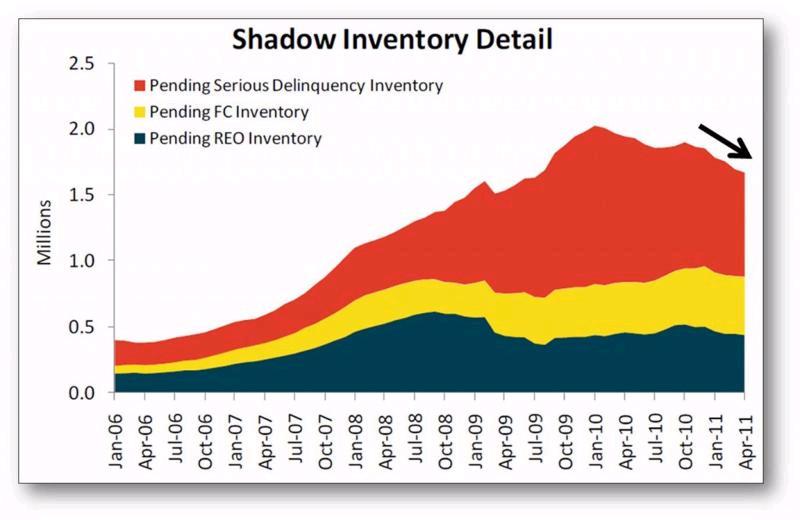
The inventory of future short sales and foreclosures which will be coming to the market is known as ‘shadow inventory’. Future real estate pricing will be determined by the number of these distressed properties which eventually reach the market.

These properties sell at major discounts:

  •  short sales at a 10% discount
  • foreclosures at a 35% discount

CoreLogic just reported this inventory is declining as more Americans are staying current on their mortgage obligations. Here is a graph from their latest report:

 Bottom Line

There still are a substantial number of distressed properties that must be cleared. They will cause prices to soften in many markets. However, it is comforting that this number is finally beginning to decline.

TEAM EMPOWERMENT MORTGAGE CHATTER: June 28;Now Hiring: Loan Processor; The Better Bargain: Foreclosure or Short Sale?; Housing Prices Through 2015; Freddie Mac: Better Days Ahead in Housing; 5 Quick Tips for July 2011

“A primary method for gaining a mind full of peace is to practice emptying the mind.”  

– Napoleon Hill: Was a lecturer and author of books on achieving success

NOW HIRING:   I’m looking to add a loan processor to my team. You can share the information with someone you may know that might be interested. They can apply directly through this link. Thank you for your support and help with finding this great candidate.  LOAN PROCESSOR POSITION

THE BETTER BARGAIN: FORECLOSURE OR SHORT SALE?

Short sales and foreclosures have flooded the housing market in recent years, and buyers are often drawn to the bargain prices but may be hesitant to jump into what usually is a difficult transaction and a long process.

Bankrate.com recently tackled the question of “Which to Buy: Short Sale or Foreclosure?” in an article that helps buyers weigh the pros and cons of a distressed property. Experts note that the question largely depends on buyers’ situations, how quickly they need a home, and their tolerance for fixer-uppers.

Foreclosure Pros and Cons

Buying a foreclosure is often faster than purchasing a short sale. Plus, buyers often can negotiate closing costs and price in foreclosure sales, Elaine Zimmermann, a real estate investor in Memphis, Tenn., told Bankrate.com.

However, abandoned homes in foreclosure can deteriorate very quickly so the buyer may need to weigh the condition of the home and whether they want a fixer upper. Scarred walls and carpets and appliances that were damaged by the former owner are not uncommon in a foreclosure, says David Richardson, an inspector in the Detroit area who’s certified by the American Society of Home Inspectors.

Short Sales Pros and Cons

A short-sale home is still owned by the occupant, so it tends to be in better condition than a foreclosure, experts say.

“The short sale is, in my opinion, far better than buying a foreclosure because the home is generally in better condition because it’s been occupied,” says Gwen Daubenmeyer, a certified distressed property expert with RE/MAX in Detroit. “The utilities have been maintained, usually the lawn is maintained, those kinds of things.”

But short sales often can take a longer time than a foreclosure to close. However, the federal Home Affordable Foreclosure Alternatives program, or HAFA, may be able to help speed up the short-sale process since it has created a timeline to hold mortgage lenders accountable, but still “it’s not perfect by any means,” Daubenmeyer says.

HOUSING PRICES THROUGH 2015

Everyone seems to have an opinion on where home prices are headed. Housing bulls are saying prices may start rebounding as early as later this year. Some housing bears are saying that prices may still drop another 10-15%. What actually is going to happen? No one knows for sure.

However, Macro Markets, a financial technology company, actually surveyed 108 economists, real estate experts, and investment and market strategists for their June 2011 Home Price Expectations Survey. They then averaged all 108 opinions. Here is what the report says about house prices over the next five years:

  • 2011: prices will depreciate 3.52%
  • 2012: prices will appreciate .46%
  • 2013: prices will appreciate 2.18%
  • 2014: prices will appreciate 2.92%
  • 2015: prices will appreciate 3.47%

Accumulative appreciation (including this year’s projected depreciation) will stand at 5.71% in 2015.

Bottom Line

The experts say home prices will begin to see appreciation next year and return to historic levels of annual appreciation by 2015.

FREDDIE MAC: BETTER DAYS AHEAD IN HOUSING

Freddie Mac’s chief economist is optimistic that the housing market and economy will improve in the second half of 2011.

Freddie Mac Chief Economist Frank Nothaft said mortgage rates will likely remain historical lows of between 4.5 percent and 5 percent for the remainder of the year. Also, he expects more buyers to stop waiting on the sidelines as recent price drops in home prices have improved affordability.

Nothaft said consumers’ uncertainty about the economy has caused them to delay home purchases and other “big-ticket items.”

“Some potential buyers who have the means to buy are awaiting clearer signs that home values have firmed,” Nothaft says.

But Nothaft says they should be getting their signs in the second half of the year, with projected job gains, and a growing, improved economy.

“Even though near-term concerns over income and sales growth are restraining consumer spending, business hiring, and new building, a number of positive signs in the economy indicate that growth will continue and is likely to accelerate in the second half of this year,” Nothaft said. “Look for a gradual improvement in housing activity in the coming year.”

5 QUICK TIPS FOR JULY 2011

1. Prepare diligently for EVERY appointment.

Most agents prepare well for a listing appointment. They go in with a complete consultation manual ready to show the seller why they should sell now and at the suggested price. They make sure they have all the tools necessary to have a successful meeting.

What about the buyer consultation appointment?Or the price-break appointment?Or the negotiation of offer appointment? There are four critical appointments in today’s market. We prepare for one of them. We ‘wing’ the other three. We must prepare as thoroughly for the last three as we do for the listing presentation. We must make the most of every opportunity presented from now until the end of the year.

2. Don’t forget the fundamentals; contact listings that expired in June.

History has shown us that the single day of the year that most listings expire is December 31st. The date that comes in second is June 30th. There will be more opportunity in the first week of July 2011 than perhaps in any other July in history. The number of expiring listings will be staggering. That means opportunity for someone. Hone your listing and pricing skills and approach every expired you can. The inventory of listings you accumulate in the first two weeks of July could catapult you to success for the rest of the year.

3. Gain knowledge and then get to work.

Two quotes from the late business guru, Peter Drucker:

“Knowledge has to be improved, challenged and increased constantly, or it vanishes.”

We have to become better at our craft every day. We must continuously improve our skills. We must become an expert at showing our customers what is taking place in the current housing market. They can then make the right choices for themselves and their families.

“Plans are only good intentions unless they immediately degenerate into hard work.”

It is not good enough to be a student of real estate. We must act on our knowledge. We must plan where we wish to be and then get busy making our way there. If I could have only one of all the attributes successful people are known to have, I would chose the ability to work hard. It is the most important and will get you closer to success than any other attribute.

4. Remember that a picture is worth a thousand words.

Whether we are taking a listing, consulting a buyer, doing a price adjustment or presenting an offer-to-purchase, we must be able to effectively communicate our customers’ options in the current real estate environment. The use of strong visuals dramatically enhances the chances that the consumer will truly understand the points we are making. Too many agents are satisfied complaining about the fact that their client just ‘doesn’t get it’ even after they ‘told’ them what is happening.

We must take the time to visually ‘tell a story’ on each point we are making. We must hone that story until it makes our point simple to understand. That is what differentiates talking at a person from truly educating them. We need to be great educators in this market.

5. Stop hoping the market gets better…Make sure YOU get better.

The same question comes up over and over – when do you think the market will get better? It’s a difficult time addressing the person asking the question. I don’t want to be rude but the real question we should be asking is – When are we going to get better?

The best market a true professional can hope for is a market that truly needs the skills of a well-trained expert in the field. Anyone can do the job in a market that doesn’t require competency, skill and insight. To the great real estate professional, a market’s strength has always been determined by how many people needed our help. In my 25 years in the business, I have never experienced a market that had more people who need our help in making the right decisions for themselves and their families.

Are we consistently doing the necessary research to keep abreast of what is happening in today’s rapidly evolving market? Are we taking classes to help us understand why certain things are taking place? Are we taking the time to sit with our clients and simply and effectively inform them of their options?

“Are we prepared to help?” becomes the question that needs to be answered; not “When will the market no longer require a true professional?”

——————————————————————————–

Team Empowerment Mortgage Chatter: June 20; Consumer Confidence: Which Way Is It Headed?; Will Falling Values Lead to More Strategic Deafults?; Scam Cheats Borrowers Out Of Loan Payments;

“Visualize this thing you want. See it, feel it, believe in it. Make your mental blueprint and begin.” – Robert Collier

CONSUMER CONFIDENCE: WHICH WAY IS IT HEADED?

There is no doubt that the housing market and the economy are intertwined. The economy will get better as housing improves. Housing will regain strength as the economy improves. How is the economy actually doing? One measure is the Misery Index which combines the inflation and unemployment numbers. According to their site:

The misery index was initiated by economist Arthur Okun, an adviser to President Lyndon Johnson in the 1960s. It is simply the unemployment rate added to the inflation rate. It is assumed that both a higher rate of unemployment and a worsening of inflation both create economic and social costs for a country. A combination of rising inflation and more people out of work implies a deterioration in economic performance and a rise in the misery index.

How does information like this impact Consumer Confidence?

Obviously, this index reflects on the factors that eat at consumer confidence. Bloomberg News reported on this saying:

Confidence among U.S. consumers dropped more than forecast in June as households contended with higher prices that are eating into incomes amid slowing job growth. The Thomson Reuters/University of Michigan preliminary index of consumer sentiment decreased to 71.8 from 74.3 in May.

Bottom Line

It will be difficult for housing to rebound while consumers are concerned about their financial futures.


WILL FALLING VALUES LEAD TO MORE STRATEGIC DEFAULTS?

As prices continue to soften, more and more homeowners will fall into a position of negative equity on their homes. This means that the balance on their mortgage is greater than the value of their home. The reason this is important is that people are more prone to strategically default on their mortgage when ‘underwater’.

What is a strategic default?

Let’s first define strategic default in simple terms. According to Wikipedia:

A strategic default is the decision by a borrower to stop making payments (i.e. default) on a debt despite having the financial ability to make the payments.

This is particularly associated with residential and commercial mortgages, in which case it usually occurs after a substantial drop in the house’s price such that the debt owed is (considerably) greater than the value of the property – the property negative equity or “underwater” – and is expected to remain so for the foreseeable future, such as following the bursting of a real estate bubble. Such borrowers are called “walkaways.”

This definition itself serves as the explanation as to why people will default.

How do Americans view strategic default?

In Fannie Mae’s recent National Housing Survey, they shed some light on American’s thoughts on strategic default.

  • The number of underwater homeowners who believe it is okay to default on your mortgage if you are under financial distress has almost doubled in the last twelve months (14% to 27%).
  • 47% of people that are underwater and behind on their mortgage have considered strategic default.
  • Those who know a strategic defaulter are more likely to have considered defaulting.
  • 1 in 5 Americans knows a strategic defaulter

Bottom Line

As more people enter into negative equity, more will be tempted to ‘walk away’ from their mortgage obligations. If they do walk, that will increase the number of homes entering foreclosure.


FORECLOSURES SLOW AS BANKS FACE BACKLOGS

Nationwide, new foreclosure cases and repossessions have dropped by a third since last fall as banks, as greater scrutiny over banks’ foreclosure procedures and more home owners fighting back in court has slowed the pace. Banks, already facing huge backlogs of foreclosures they’ve already repossessed, also may be reluctant to add on more to their inventory, experts say.

For example, In New York, experts estimate it would take lenders 62 years at their current pace to repossess the 213,000 houses now in severe default or foreclosure, according to LPS Applied Analytics, a real estate data firm. New York boasted the longest foreclosure backlog in the nation. Following behind, in New Jersey it would take 49 years, and in Florida, Massachusetts, and Illinois it would take 10 years to handle the supply of foreclosures at the current pace.

States where courts must review each foreclosure tend to have the longest delays. But in the 27 states without that requirement, foreclosures are much quicker. For example, as comparison, in California, the foreclosure backlog is three years, and in Nevada and Colorado, it’s two years.

“If you were in foreclosure four years ago, you were biting your nails, asking yourself, ‘When is the sheriff going to show up and put me on the street?'” Herb Blecher, an LPS senior vice president, told The New York Times. “Now you’re probably not losing any sleep.”

However, the banks say they is no strategy in delaying foreclosures. “Any suggestion that we have a strategy to delay foreclosures is baseless,” a spokesman for Bank of America said. Instead, one bank blamed delays in state laws governing foreclosures while others said the decline in foreclosures is the product of an improving economy.


SCAM CHEATS BORROWERS OUT OF LOAN PAYMENTS

Warn your home owner clients to beware of a scam growing in many parts the country that tries to trick home owners out of a month or two of their mortgage payments.

The Chicago Tribune referred to it as the “handoff rip-off” scheme, in which scammers send letters to borrowers informing them that a new company has assumed the management of their loans and to start making mortgage payments to the new company.

Many home owners aren’t familiar with the rules when it comes to the transfer of mortgage-servicing so they follow the letter’s directions in sending their payments to the new company and could possibly lose thousands in mortgage payments.

Inform your home owner clients of mortgage-servicing transfer rules so they won’t be duped. For example, the law requires a company that provides a mortgage on behalf of the loan’s owner to send a “goodbye” letter notifying them that at a specific date their payment should be sent to a new company. Then, a week or so later, the home owner is legally to receive a second letter from the new servicer that provides mortgage payment information (their principal, interest, and escrow). Both letters should include the home owner’s loan number, the Tribune article explains.

When in doubt, contact your original servicer to find out if the letter received is legit or fraud.

The scheme “works for maybe two months” because that is usually how long it takes for borrowers to realize they’ve been tricked, says Becky Walzak, a loan-quality assurance expert. “But if the bad guys are any good, they’ve taken in thousands of payments from thousands of people. They cash them, and they move on to the next batch of borrowers.”