Uncategorized

TEAM EMPOWERMENT MORTGAGE CHATTER: April 11; News & Headlines; Pricing Always Local…Most Of The Time; Coach, Mentor, Trainer; Pick The Right Path For Growth; RPM Co-Branded Mortgage Statement Example

Remote Area Medical (RAM) is at the Oakland Coliseum today! (April 9-12) Click Here for More InformationMaintain a healthy heart


“Patience and perseverance have a magical effect before which difficulties disappear and obstacles vanish.” – John Quincy Adams

NEWS & HEADLINES

Any company originating FHA & VA loans, and either securitizing them or selling the loans to a company that does, should be aware of HUD’s new data elements to Ginnie Mae pool issuance. Commencing 9/1, Ginnie Mae will require Issuers to provide up to eight additional new data elements on single-family forward mortgages in an effort to provide greater transparency for investors, which in turn should help prices and therefore rates. For complete details go to GinnieData

Here is one trend that Realtors and mortgage originators should pay attention to, and that is household formation. Yes, as a nation the population in the US is steadily increasing, which in the past led to an increase in the number of households. But at present, household formation has been slowed by the recession. There are a large number of adults who have either moved back in with their parents because they can no longer maintain the expense of their own household, or are not even moving out due to economic uncertainty. A loan agent wrote to me, “In the recent past many kids got down payment gifts from their parents, but now the parent’s wealth has gone down, and a portion of my clients don’t feel comfortable giving their kids any money to move them out of the house.”

Owning a home is a subset of forming a household (which includes rentals), and most analysts believe that several years ago home was driven up artificially high by political mandates, bad mortgage lending, artificially low rates, or any number of other factors. The homeownership rate has been inching back down for a variety of reasons, but the number of households is not showing the same dramatic decline since people do, indeed, need a place to live. And many in the business believe that encouraging more investor loans would be an improvement rather than the government concentrating on keeping people in homes with mortgage modifications. Clearing the existing inventory, and the inventory of about-to-be foreclosures, is a necessary condition to improve the housing market.

Many originators are hoping that this week is an improvement over last week, when we saw the price on the 10-yr Treasury Note worsen by nearly 1.25 (3.45% up to 3.57%) and current coupon mortgage-backed securities worsen by roughly .5 in price. What’s been driving interest rates higher for three weeks in a row? The markets seem focused on the trend in rates moving higher, commodity price pressures (seen every time one drives by the gas station), the job market improving, persistent stock market gains, European Central Bank tightening, increasing Treasury supply (this week we have 3’s, 10’s, and 30’s), our Fed tightening going from “if” to “when”, and so forth. In early February the 10-yr yield hit 3.74%, but most don’t expect us to see that high of a yield in the near future.

Last week we had very little scheduled economic news to chew on but this week we have “a ton.” We don’t have anything today, but tomorrow we have the trade balance figures and import & export prices. Wednesday is the MBA application index, Retail Sales, Business Inventories, and the Fed’s Beige Book monitoring economic activity in the various Fed districts. Thursday brings us Jobless Claims and the Producer Price Index. Tax Day we’ll see the Consumer Price Index, so we can see how much of the change in the PPI is passed on the consumers, Empire Manufacturing, Industrial Production and Capacity Utilization, and a University of Michigan sentiment number. Ahead of that our 10-yr Treasury is sitting around 3.59% and MBS prices are roughly unchanged.


PRICING IS ALWAYS LOCAL…MOST OF THE TIME

We understand that real estate is intensely local. Whether you are thinking of buying or selling a home, you should sit with a real estate professional familiar with your local area. However, that does not mean that what is happening nationally doesn’t apply to your market. What is taking place with home values is a perfect example of this. Prices are softening in many parts of the country. We all hope that our region is the exception to this trend. Before we buy or sell we should make sure. Just how widespread are these price declines? Let’s take a look at what the current pricing indices have found.

S&P/Case Shiller

Their Home Price Index shows that 18 of the 20 cities they monitor had year-over-year depreciation. San Diego and Washington D.C. were the only two markets to record appreciation. However, San Diego was up a “scant 0.1%”, while Washington DC posted a healthier +3.6% annual growth rate.

CoreLogic

Their Home Price Index states:

“Of the top 100 Core Based Statistical Areas measured by population, 86 are showing year-over-year declines.”

National Association of Realtors (NAR)

Their Existing Sales Report showed that 13 of 17 metros they report on had median sales prices decline in the last year. Only Dallas/Fort Worth, Houston, San Diego and St. Louis saw their median price increase.

Federal Housing Finance Agency (FHFA)

Their website has a visual that shows how widespread the price situation has become:

Bottom Line

Pricing is a major challenge in the vast majority of regions right now. Definitely sit with a local agent. However, make sure they tell you what you need to know not just what they think you may want to hear.


COACH, MENTOR, TRAINER: PICK THE RIGHT PATH FOR YOUR REAL ESTATE GROWTH

Are you ready to double or triple your real estate income? Who is the best person to get you there: A coach, a trainer or a mentor?

First, most real estate professionals who want “coaching” are really looking for real estate sales training. Second, there is tremendous confusion about what constitutes coaching, training, and mentoring.

Depending on what you want to achieve, each of these approaches is a viable way to increase your income. Here’s how to tell whether training, coaching, or mentoring is the best choice to help you achieve your goals.

1. Real estate sales training

Training teaches you a skill or a strategy for your business. This can include how to conduct a listing presentation, scripts for working with buyers, or how to use Web tools or mobile apps. In each of these examples, the trainer is the expert who is showing you what to do and how to do it.

No matter how long you have been in the business, attending regular training can help you improve your business and your income. Today’s technology innovations are occurring at such a rapid pace that it takes a concerted effort to stay up to date.

In fact, when I do a major speaking gig for a company, the management almost always makes the same observation: “My top producers were all sitting in the first three rows. The people who really needed this aren’t here.”

When I ask the top producers about why they are such avid consumers of training books, seminars, and webinars, they pretty much agree on this one point: “If I learn just one thing that can help my business, it was worth my time.”

2. Real estate sales mentoring

Mentoring refers to learning from someone who is an expert. An excellent example includes working with a top producer and shadowing that person to learn how the individual conducts business. A mentor draws upon professional experience and can provide you with practical and proven success strategies.

3. Real estate coaching

Many agents have discovered the benefits of working with a coach both in terms of increased production and having a better life. While training and mentoring can help you achieve your goals, coaching is usually the best tool for helping you to double or triple your commission income.

Unfortunately, because of the confusion about what constitutes real estate coaching vs. training and mentoring, agents often end up with a solution that won’t work for them.

Here are some examples of real estate “coaching” that may or may not be a great solution for your business. Use this list to determine what will work for you:

1. The granddaddy of them all

Mike Ferry was a pioneer in launching a national coaching program. Ferry’s programs have a proven track record for success that date back over two decades. His programs are well suited to those who have a strong drive to succeed, handle rejection well, and are numbers-focused.

Coaching consists of staying on target with your numbers, mastery of scripts and dialogues, and access to video, online, and live training to support your success. The core emphasis is on cold-calling, door-knocking, and calling on owners of expired listings and for-sale-by-owner homes.

2. Oh, by the way

Brian Buffini and Joe Stumpf focus on helping agents build their businesses “by referral.” Their programs provide a turnkey solution that sends snail-mail letters to your database each month. Your coach works with you on using their systems and strategies to generate referrals.

3. Words of wisdom from Gary Keller

Gary Keller, who consults and coaches the top agents in his company, made an interesting observation about how well his agents did with each of these two different approaches.

According to Keller, the people who rely exclusively on door-knocking and calling on owners of expired and FSBO listings must place up to five times as much effort into their lead generation activities vs. those using the by-referral model.

On the other hand, because the referral approach requires someone else to generate the lead for you, agents who rely exclusively on this approach often see their business decrease by as much as 80 percent during market downturns. This occurs because someone else is controlling their lead generation.

The agents who have consistent top performance are those who actively prospect daily and maintain strong relationships with their referral database.

4. You know what to do … what’s keeping you from doing it?

Coaching is about removing the blocks that keep you from achieving success, and building on your strengths. It’s not about trying to force yourself to do something that you hate doing.

As Joeann Fossland says, “No one ever got to the top by developing their weaknesses.”

The challenge with training and mentoring is that they address the “what to do,” but don’t provide the coaching necessary for you to personally implement these skills in your business.

If you want to double or triple your business, implementation is the key. See Part 2 for specific steps on methods that could help you to multiply your real estate income.


TEAM EMPOWERMENT MORTGAGE CHATTER: April 8; News & Headlines; Rental Costs Are About To Takeoff; Greater Stability – Nondistressed Real Estate Prices; Budget Impasse and FHA; Today’s Rates; EEM Program; Open House Flyer Example

PLAY BALL!  San Francisco Giants Home Opener Today!  Enjoy Giants Fans!


“In the long run, men hit only what they aim at. Therefore… they had better aim at something high.” — Henry David Thoreau: Was an author, poet, naturalist, and philosopher


NEWS & HEADLINES

Rain or shine, whether or not the US government is closed or open, the US Treasury will be open next week to auction off $32 billion in 3-yr notes, $21 billion in 10-yr’s, and $13 billion in 30-yr’s.

Word has it that since it doesn’t rely on Congressional funds, the Federal Reserve (central bank) would remain open for business as usual, with normal staffing levels. The Fed would therefore be able to continue with its day-to-day operations. The SEC is expected to continue operations as well. But lenders and vendors were out warning originators about possibilities. CoreLogic told clients that, “If the government does a shutdown, the last date of service for 4506-T and SSA-89 orders would be this Friday April 8…We will make every effort to transmit orders to the IRS and SSA as quickly as possible once received. All SSN orders will be processed during standard business hours and may not be affected by the shutdown. In the event of a shutdown, we will still continue to submit all 4506-T Direct and SSN orders but service time is expected to be affected due to the IRS and SSA being unavailable to respond.”

For licensing, “Since CSBS is the nationwide organization representing state banking regulators, a shutdown of federal government agencies will not have an immediate impact on day-to-day operations. NMLS offices will remain open during any government shutdown and NMLS staff will continue to report to work…Test candidates should not expect their appointments to be cancelled or be affected by a shutdown of federal government agencies.”

Wednesday HUD issued a memorandum (APM 11-04) that is not a surprise, but turned some investor heads. Ginnie Mae will change its policy with regards to the delinquency status of loans being pooled into their MBS. “Effective for single-family securities with an issue date of June 1, 2011 and later, all loans pooled into Ginnie Mae single-family securities may not be delinquent by more than the monthly installment of principal and interest that is due on the issue date.” In other words, the loan being pooled would need to be current till the month prior to the issuance of the MBS pool – no more allowing new up-to-60-day delinquent loans to be pooled into Ginnie securities. Ginnie Mae was already requiring “re-performing” loans to be current at the time of the issuance. The impact on the market and investors is not huge, as analysts estimate that at most 0.5% to 1% of loans being securitized into Ginnie Mae MBS were delinquent at issuance.

In the markets on Thursday, MBS volumes were anemic, as opposed to Wednesday when they were decent. 10-year notes were worse by a smidge and closed with a yield of 3.55% while current coupon MBS prices were slightly better than Wednesday’s close. Rates were pushed around a little by the .25% rate hike by the ECB, another strong earthquake in Japan, more hawkish comments from a Fed official, and the potential for a government shutdown as Republicans and Democrats are unable to reach an agreement on the budget.

The week closes out with gold marching toward $1,500 per ounce, oil at $111 per barrel, and another day of no substantive scheduled economic news (unless one counts Wholesale Trade for February later today). Even though the markets assume a shutdown will be averted, these factors have served to push rates higher, and the 10-yr yield is up to 3.61% and MBS prices worse by .250.


RENTAL COSTS ARE ABOUT TO TAKEOFF

We are often asked whether it is better to rent or buy in the current housing market. The answer to that question is: “It all depends”. There are certain situations where renting short term probably makes sense. It may make sense if you are retiring to a different region of the country and are not yet sure where you want to set down roots for the next 25 years. It may make sense if you have a one year employment contract which will probably require a move to another place upon termination.

However, in most other cases, renting right now makes little sense for several reasons.

Even though prices may still soften, waiting to buy makes no sense as the cost of owning a home may still increase.

Mortgages may soon become much more expensive than they are right now.

Owning a home is less expensive than renting a home in 72% of major U.S. cities.

Rental costs are about to explode.

Let’s take a closer look at the last reason. We have often said that the cost of anything is based on supply and demand. The number of widgets for sale and the number of widget buyers together create the price for widgets. That will also apply to rents. There is a much larger demand for rentals right now. The economy has forced many to leave their foreclosed homes and other buyers are afraid to plunge into homeownership.

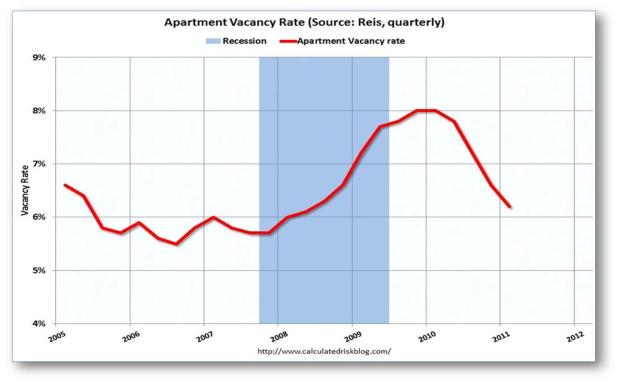
At the same time, the supply of rentals is rapidly decreasing. Here is a graph from Calculated Risk showing the apartment vacancy rate in the United States:

When supply is rapidly decreasing and demand is quickly increasing, prices have only one place to go – and that is UP! That is exactly where rental prices are headed.

Bottom Line

Is now a good time to rent? We think not. You can buy a home today at a discounted price and get a 30 year mortgage at a historically low interest rate. You can set your housing expense for the next thirty years. On the other hand, rental costs are poised to increase for years to come.


GREATER STABILITY IN NONDISTRESSED REAL ESTATE PRICES

U.S. home prices fell for the seventh month in a row during February, although price declines are increasingly concentrated in sales of distressed properties such as bank-owned homes, data aggregator CoreLogic said in releasing its home price index.

The CoreLogic home price index showed U.S. home prices down 6.7 percent from a year ago during February, a sharper decline than the 5.5 percent year-over-year drop registered in January.

Excluding distressed sales, the index was essentially flat, declining by 0.1 percent from a year ago compared to 1.4 percent in January. Distressed sales include short sales and real-estate owned, or “REO,” properties.

“When you remove distressed properties from the equation, we’re seeing a significantly reduced pace of depreciation and greater stability in many markets,” said CoreLogic Chief Economist Mark Fleming in a statement. “Price declines are increasingly isolated to the distressed segment of the market, mostly in the form of REO sales, as the stock of foreclosures is slowly cleared.”

The index showed national home prices down 34.5 percent from their April 2006 peak, or 21.7 percent if distressed transactions were excluded.

Prices were down from a year ago in 86 of the top 100 markets tracked by CoreLogic, down from 88 in January.

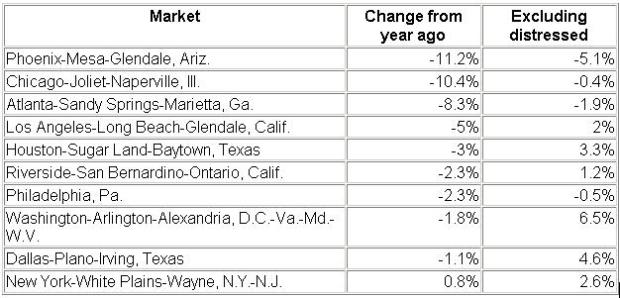
February 2011 single-family home prices: Top 10 biggest U.S. markets


Source: CoreLogic

Nine out of 10 of the nation’s biggest markets saw prices decline from a year ago, although six out of 10 of those markets experienced price appreciation among non-distressed properties, CoreLogic said.

The five states with the greatest year-over-year depreciation were Idaho (-14.6 percent), Arizona (-12 percent), Florida (-11.2 percent), Michigan (-11.1 percent) and Illinois (-11.1 percent). When distressed sales are excluded, the five states with the greatest depreciation were Idaho (-9.3 percent), Montana (-8.6 percent), Maine (-6.2 percent), Arizona (-5.4 percent) and Rhode Island (-5.4 percent).


BUDGET IMPASSE THREATENS FHA LENDING

The budget deadlock and looming shutdown of the federal government wouldn’t affect Fannie Mae and Freddie Mac, but it could put the brakes on FHA and other government-backed loan guarantee programs.

The Obama administration has proposed $33 billion in spending cuts, while Republicans are reportedly pushing for $40 billion or more. House Republicans Thursday passed a bill to push back a shutdown by one week. But that bill includes spending cuts opposed by Democrats, and President Obama has threatened a veto if it’s approved by the Senate.

In the event of a government shutdown, the Federal Housing Administration “will not be able to endorse any single-family loans, and staff will not be available to underwrite and approve new loans,” a HUD spokeswoman told Inman News.

Although so-called “full eagle” lenders vetted by FHA have direct endorsement authority, in the event of a government shutdown FHA would power down its automated systems for processing those loans, in effect suspending all lender insurance approvals.

“Technically, the banks can close on a loan that’s been FHA-approved if they want to, but they will be taking the risk on their own books,” the HUD spokeswoman said. “Some may choose to do so, but (in the event of a government shutdown), they will not receive FHA insurance until FHA is up and running.”

FHA insured mortgages on about 19 percent of home sales in the fiscal year ending Sept. 30, 2010, and just under 16 percent of sales in October, according to the latest figures from HUD.

USDA and VA loan guarantee programs, although smaller, could be affected in similar ways. Those agencies did not immediately respond to requests for comment.

According to a bulletin issued by the National Association of Realtors, lenders may continue to process and guaranty mortgages through the VA Loan Guaranty program.

For U.S. Department of Agriculture rural housing programs, staff who typically issue conditional commitments, loan note guarantees, and modification approvals are not classified as “essential personnel,” and lenders would not receive approvals in the event of a shutdown, NAR said. Lenders who have received conditional commitments may close those loans.

As the Obama administration and Republican lawmakers continue negotiations over proposed budget cuts, the President has pointed to the potential impacts to FHA lending as one example of how a shutdown “could have real effects on everyday Americans.”

“It may turn out that somebody who was trying to get a mortgage can’t have their paperwork processed by the FHA and now the person who was going to sell the house — what they were counting on, they can’t get it,” President Obama said Wednesday, speaking at a town hall discussion in Pennsylvania on energy policy.

Testifying before Senate lawmakers today, U.S. Housing and Urban Development Secretary Shaun Donovan said he is “very concerned that a significant number of lenders would not choose to close” on pending FHA loans, Dow Jones reported.

Fannie Mae and Freddie Mac, which the government placed under conservatorship in 2008, would not be affected by a shutdown because the Treasury Department’s preferred stock purchase agreements with the companies are not subject to the annual appropriations process, said a spokeswoman for their regulator, the Federal Housing Finance Agency (FHFA).

FHFA itself is not subject to a shutdown because it is funded by assessments on Fannie, Freddie and the Federal Home Loan Banks.


TEAM EMPOWERMENT MORTGAGE CHATTER: April 4; News & Headlines; QRM: Is the Pendulum Swinging Back Too Hard?; 6 Ways to rev up your real estate productivity engine; Bargain-Seeking Buyers; GOP Senators Join Efforts -Ending Fannie/Freddie; Red Flags = Audits

Had a great time contributing…we bowled for “The American Dream” (CCAR Fundraiser)

Thanks to Shea Matthews, Joe Cuttone and Valerie Vincente


“When you get right down to the root of the meaning of the word ‘succeed,’ you find that it simply means to follow through.” – F. W. Nichol


NEWS & HEADLINES

“Congressional Republicans are moving aggressively to wind down mortgage giants Fannie Mae and Freddie Mac, but they face resistance not only from Democrats, but members of their own party who fear rapid elimination of the two entities would destabilize the fragile housing market.” And many in the business would agree. Read more at the Washington Examiner: F&FtoStickAround?

Yes, the US Court of Appeals has granted a stay on Fed’s LO Compensation rule. This order does not permanently stay or otherwise modify the enforceability of the rule. Instead, it is a temporary measure to give the Court an opportunity to review the case and make a final determination. The Federal Reserve has until 12PM EST today to file a response to NAMB and NAIHP’s (the plaintiffs) motions, and then the plaintiffs will be given the opportunity to file a response to the government’s response no later than 10AM EST tomorrow. After that filing takes place the Appeals court can order a hearing or make a decision on the basis of the filed briefs. If the court decides in favor of the NAMB and NAIHP then the most likely course of action would be that the case would move back to the District Court. The stay would probably be extended to cover the period of time the case is in the District Court and could be extended further if there is another appeal. If the Appeals Court decides in favor of the Federal Reserve the stay will be dissolved upon the issuance of the decision.

The latest survey shows that three out of four people make up 75% of the population. Statistics and numbers are interesting like that. But here is more good news: commercial and multifamily mortgage originations grew 88% in the fourth quarter of 2010 when compared to 4Q 2009 and hit $6 billion, the Mortgage Bankers Association said in its Fourth Quarter Commercial Real Estate-Multifamily Finance Quarterly Report. Much of this gain was due to a pick up by insurance companies in the CMBS segment – up 170%. Loans for conduits for CMBS saw a 60-fold increase compared to last year’s fourth quarter, and GSE’s saw a 65% increase. Multi-Family.

Jobs and housing, housing and jobs. After a decent Pending Home Sales number earlier in the week, on Friday the focus was on jobs after we learned that March non-farm payrolls rose 216k, with private payrolls up 230k. The overall payroll data was stronger than the market expected, and in the Household Survey (those pesky phone calls), the unemployment rate ticked down to 8.8% from 8.9%. A trader at Jefferies wrote, “Both the household survey and the establishment surveys are very encouraging and very clearly reflect improved labor market conditions. The only significant flies in the ointment are the lack of growth in earnings, which will translate into a continuation of very moderate income growth, and the continued substantial job losses at the local government level.”

The strong employment numbers, combined with some “bullish Fed-speak” recently would normally push bond prices lower and yields higher, but perhaps the market focused on the big drop in Consumer Confidence. On Friday somehow the 10-yr clawed its way back from being down .625 and closed basically flat at 3.45%. MBS prices were also roughly unchanged Friday, and in some cases better by .125.

This is a decidedly light week for scheduled economic news, which gives originators one less thing to worry about. Zip today, tomorrow is a 9AM CST ISM services number, zip on Wednesday, Thursday holds the usual Jobless Claims number, and zip on Friday. Ahead of a lot of zips, the 10-yr is sitting around 3.43% and MBS prices are a shade better.

CLICK ON LINKS TO VIEW MORE (VIDEOS)

BARRY HABIB ON FOX BUSINESS (VIEW VIDEO OF OUR NEWEST ADDITION TO RPM MORTGAGE, INC 


QRM (Qualified Residential Mortgage): IS THE PENDULUM SWINGING BACK TOO HARD?

There is no doubt that one of the main reasons for the housing collapse was that mortgage underwriting became too lenient. It seemed anyone who wanted to purchase a home found someone to give them a mortgage; whether they actually qualified for it or not. These buyers eventually couldn’t make their monthly mortgage payment and many went into foreclosure.

This started the downward spiral in home values which crashed our economy.The government is now calling for adjustments to the definition of a “Qualified Residential Mortgage” (QRM) in order to guarantee this never happens again. Like many adjustments that follow a disaster, some are claiming the pendulum is swinging back much too hard. Let’s look at the requirements being considered.

The FHFA issued a Mortgage Market Note 11-02 last week which discusses QRM. Here are the highlights:

Types of mortgages that will qualify

A Product-Type qualified residential mortgage is a first-lien mortgage that is for an owner-occupant with fully documented income, fully amortizing with a maturity that does not exceed 30 years and, in the case of adjustable rate mortgages (ARMs), has an interest rate reset limit of 2 percent annually and a limit of 6 percent over the life of the loan.

Therefore, the following loans WILL NOT qualify:

  • Alt-A (most of which are low or no document) mortgages
  • Interest-only mortgages
  • Negatively amortizing mortgages such as payment option-ARMs
  • Balloon mortgages

Acceptable debt ratios

A PTI/DTI qualified residential mortgage has a borrower’s ratio of monthly housing debt to monthly gross income that does not exceed 28 percent and a borrower’s total monthly debt to monthly gross income that does not exceed 36 percent.

Payment-to-income ratio, otherwise known as front-end DTI, is the sum of the borrowers’ monthly payment for principal, interest, taxes, and insurance divided by the total gross monthly income of all borrowers as determined at the time of origination. Debt-to-Income ratio, or back-end DTI, is similar to payment-to-income but adds all other fixed debts into the numerator of the ratio.Down payment requirement

An LTV ratio qualified residential mortgage must meet a minimum LTV ratio that varies according to the purpose for which the mortgage was originated.

For home purchase mortgages, the LTV ratio will be 80% which means a buyer would need a 20% down payment.Necessary FICO scoreA FICO qualified residential mortgage has a borrower’s FICO score greater than or equal to 690 at the origination of the loan. The HLP dataset does not record delinquency history, prior bankruptcy of foreclosure, etc. of borrowers in the loans analyzed. For this reason, using a threshold of 690 for the FICO of the borrower at origination is a proxy for the absent detailed credit bureau data.

How many existing loans would pass QRM?

According to the FHFA report, less than half the loans originated over the last 12 years would have qualified. Here are the percentages that would have qualified based on the year the loan was originated:

  • 1997 – 20.4%
  • 1998 – 23.3%
  • 1999 – 19.5%
  • 2000 – 16.4%
  • 2001 – 19.4%
  • 2002 – 22.4%
  • 2003 – 24.6%
  • 2004 – 17%
  • 2005 – 14.4%
  • 2006 – 11.5%
  • 2007 – 10.7%
  • 2008 – 17.4%
  • 2009 – 30.5%

We understand that the loans written during the years building up to the bubble were not scrutinized appropriately. However, it seems strange that only 20.4% of the loans issued in 1997 would meet the new criteria.

When will this take place?

We want to make two things very clear right now:

These are proposed adjustments which are currently up for debate.

Whatever is approved will only apply to government backed mortgages. The private sector will still be allowed to lend their money based on their own criteria (ex. 10% down payments).

However, there will be increased costs to lending institutions which do not use the QRM. Those costs will be transferred on to the purchaser.

What might these increased costs amount to?

Cameron Findlay, chief economist for LendingTree, in an article on the ramifications of QRM explained:

Homeowners who do not qualify for a loan that meets the new definition (mortgage insurance doesn’t appear to be part of the equation) would be forced to pay substantially higher rates. Early market estimates place that number as much as 3.00% higher than the QRM equivalent rate (on a $200,000 loan, that’s almost $400 more a month).

Others like housing economist Tom Lawler do not see the impact being as severe.

Bottom Line

Loan qualifications will continue to get tougher and the costs of a mortgage will increase. Perhaps now is the time to buy that house of your dreams.


 6 Ways To Rev Up Your Real Estate Productivity Engine

What would it take for you to achieve maximum productivity for your business? Surprisingly, it’s easier than you may think.

While everyone experiences both high and low levels of productivity, the steps outlined below will help you keep your productivity engine purring with minimal amounts of effort.

1. Don’t starve the engine

Many real estate professionals jack themselves up with caffeine and sugar to get through their day. It’s common for us to skip meals as well. If you’re getting that 4 p.m. low or need a double espresso to get started in the morning, here’s how to put your body into high gear without sugar and caffeine.

Begin by getting in the habit of eating five or six times per day. Instead of having three large meals, eat three smaller meals with 100- to 200-calorie snacks between meals. Nutritionists recommend this approach for people who are diabetic since it keeps their blood sugar and energy levels constant.

2. Synchronize your brain

Research on peak performance indicates that humans perform best when both sides of their brain are working in concert. There are a number of ways to achieve brain synchronization — an easy way is to listen to music you love.

The way you can tell if both hemispheres of your brain are in synchrony is that you feel like dancing or snapping your fingers to the beat. There’s also a smile on your face. If you’re having an off day, as little as five minutes of the right music can put your brain back into top performance mode.

3. Take advantage of peak productivity times

Each day, your body has high and low cycles. For example, most people wake up or become hungry at about the same time each day. Your body temperature and other functions rise and fall throughout the day.

To take full advantage of these cycles, pay attention to when you are the most productive. The way to determine your peak energy time of day is to keep a log for several days. Note your energy level each hour and how easy or difficult it is to accomplish work-related tasks.

In most cases, you probably already know whether you are a morning person or a night owl. Whatever is the case for you personally, schedule your day so that you do your most important and difficult tasks at your personal peak time periods.

4. Can the negative self-talk

Most of us are our own worst critics. If you catch yourself complaining about a transaction, the traffic, or your weight, the best way to eliminate this negative self-talk is to shift gears and ask, “What are five things that are going right today?”

It could be something as simple as the sun is shining, my car is running perfectly, or my technology is working with no glitches. By immediately focusing on what is going right in your life, you increase your optimism and your energy. This, in turn, leads to increased performance.

5. Narrow your focus

To keep your focus strong, use time blocking. For example, if you are prospecting by phone, don’t allow any interruptions during your scheduled prospecting time. Devote 45 to 50 minutes per hour for the scheduled activity as well as 10-15 minutes per hour to check in for emergencies or to handle other urgent issues.

Also, while it’s tempting to respond to text messages or phone calls as they come in, remember that it takes almost 30 minutes after you return to your original task to reach the same level of concentration that you had before the interruption.

6. Allocate only 20 percent of your time to handle the bottom 80 percent of your activities

A common way we overwork our high performance engine is by trying to have it carry a bigger load than it was designed to carry. The 80-20 rule says that 80 percent of the benefit for our businesses comes from the top 20 percent of our activities.

Many agents beat themselves up because they didn’t accomplish the 53 things that were on their to-do list for the day. A better approach is to identify the three most important activities that you must complete each day. These are in your top 20 percent.

Allocate only 20 percent of your day to the other 80 percent. The reason? The bottom 50 percent of your activities may yield a far smaller share of benefit for your business. Consequently, you’re better off focusing primarily on the top 20 percent, doing what you can to complete the next 20-30 percent, and delegating or dumping the rest.

If you’re ready to make your productivity engine purr, then follow the simple tips above. You may be pleasantly surprised at how much better you feel as well as how much more you accomplish.


BARGAIN-SEEKING HOME BUYERS ON THE HUNT

Housing prices across the country are at multi-year lows and mixed with low interest rates bargain hunters are targeting real estate.

More investors are heading to the market looking to make cash buys for real estate, investing in second or even a third home, Reuters News reports.

“We’re starting to get a lot more inquiries and assisting in transactions,” says Rocco Papandrea, a senior vice president and wealth management adviser at Merill Lynch in New York. Papandrea says he’s seeing more interest in properties along the West Coast and in Colorado, as well as Florida.

Canadian buyers in particular are expected to be looking to purchase U.S. homes. The Bank of Montreal estimates that one-in-five Canadians is considering buying U.S. property.

With dropping home prices, more cities are looking to be attractive buys, such as the increasing affordability in popular vacation-home designations along the U.S. Sunbelt. For example, home prices have fallen 44 percent in Tampa, 54 percent in Phoenix, 57 percent in Las Vegas, and 49 percent in Miami, the Bank of Montreal reports.

“If the economy keeps clicking along and jobs keep growing, housing will be fine,” says Dean Frankel, a portfolio manager at Urdang Capital Markets in Plymouth Meeting, Pennsylvania, who oversees around $1.7 billion in real estate equity investments.

The economy–and ultimately housing–may then get a boost from the latest unemployment report released Friday. The unemployment rate reached a two-year low of 8.8 percent in March as companies began a brisk wave of hiring, adding employees at the fastest two-month pace since before the recession even started, the Labor Department reports.

The unemployment rate has fallen a full percentage point in the last four months, which marks the sharpest drop since 1983.


GOP SENATORS JOIN EFFORTS TO END FANNIE, FREDDIE

Sens. John McCain, R-Ariz., and Orrin Hatch, R-Utah, proposed a bill Thursday that would phase out government-sponsored enterprises Fannie Mae and Freddie Mac in five years or privatize them.

The bill comes on the heels of several similar Republican bills that have been proposed in the House.

While the proposed bill calls for Fannie and Freddie to be dismantled, the senate bill also calls for the GSEs to take steps such as charging higher fees and decreasing the size of their mortgage portfolios so that private banks can step up to take on a bigger piece of the mortgage market.

Fannie and Freddie, as well as other federal agencies, backed about nine in 10 mortgages in the past year.

“Never again can we allow the taxpayer to be responsible for poorly managed financial entities who gambled away billions of dollars,” McCain says.

McCain’s bill is similar to the one proposed in the House by Rep. Jeb Hensarling, R-Texas. Earlier this week, House Republicans also introduced eight smaller bills that take a “bite-sized approach” to winding down the GSEs.

The National Association of REALTORS® urged Congress this week to not move too fast in reforming Fannie Mae and Freddie Mac.

“NAR strongly agrees that the existing system failed and that reforms are needed. However, redesigning a viable secondary mortgage model that will protect taxpayer dollars and serve the country’s home owners today, and in the future, can only be achieved through a methodical, measured effort,” 2011 NAR President Ron Phipps said in testimony before the House Subcommittee on Capital Markets this week.

“REALTORS® agree that increasing private capital in the mortgage finance market is necessary for a healthy market and for reducing the government’s involvement. However, proposed legislation that relies only on private capital to operate the secondary mortgage market will slow, if not stop, the housing and economic recovery.”


WATCH FOR RED FLAGS THAT MAY GET YOU AUDITED

With a growing federal deficit and pressure from Congress, the number of audits from the IRS are increasing–could your tax return be at risk?

The IRS says that individual income tax returns that report higher adjusted gross incomes were likely to get closely examined and small business owners, either as a partnership or a Schedule C filer reporting self-employment income, are always prime targets, Bankrate.com reports.

So how does the IRS select the returns to audit? One way is its use of a computer-scoring system known as the Discriminant Information Function, which it uses to evaluate tax returns based on IRS formulas. DIF is based on tax deductions, credits, and exemptions with standards for taxpayers in each of the income brackets, Bankrate.com reports. The actual scoring formula the IRS uses is top secret, however.

But here are some possible red flags that may alarm the IRS’ DIF, according to Bankrate.com:

– Home-based businesses, especially when in addition to salary income, and home-office deductions.

– Income other than basic wages (for example, contract payments).

– Unreported income, such as investment returns.

– Large business meal and entertainment deductions.

– Excessive use of a car for business.

– Losses from an activity that may be considered more as a hobby than a business.

TEAM EMPOWERMENT MORTGAGE CHATTER: April 1; News & Headlines; Don’t Believe Everything You Read; ‘Long Way To Go’ New Foreclosure Rules; Housing Shortage On Horizon?

“The one piece of advice I can give you is, do what turns you on. Do something that if you had all the money in the world, you’d still be doing it. You’ve got to have a reason to jump out of bed in the morning.” — Warren Buffett: American investor and philanthropist


NEWS & HEADLINES

The U.S. Court of Appeals in Washington granted emergency motions from NAMB and NAIHP which argue the rule unfairly penalize brokers, who won’t be able to pay loan officers from consumer-paid fees. “The purpose of this administrative stay is to give the court sufficient opportunity to consider the merits of the motions for emergency relief and should not be construed in any as a ruling on the merits of those motions,” the court said in its order yesterday. The Appellate Court stay was granted, and a date of appeal was set for Tuesday, April 5. What lenders actually do with this information remains to be seen, however – you’ll have to figure that one out on your own. For example, Stearns Lending told its clients that it will be conducting “BUSINESS AS USUAL” until the Federal Courts issue additional rulings. One can view NAMB or what the press is reporting: CompRuling.

On the eve of being enacted, in a surprise move, Senator Dodd called on Congress to rescind the Dodd-Frank legislation, saying the rules and regulations not only has ground residential lending to a halt, but has, and will, also cost the consumer billions of dollars. Without the Dodd-Frank regulations to rally against, many groups are now left searching for a new objective. In a move that was expected by many, the Mortgage Bankers Association of America is requiring that newspapers and magazines use capitals when describing their members. Brett Benjamin, with the MBA, exclaimed, “Look, if ‘Realtors’ is capitalized, and even has a little fancy trademark thing after it, then Mortgage Bankers deserve the same treatment. Especially if they have to do all that licensing stuff.” Rumors are swirling about making commissions identical to whatever loan agents earn from processing and funding a loan. Teams of expensive attorneys have been brought in by each side in the matter.

With the future of HAMP uncertain, the state of California, in conjunction with the federal program, today is expected to roll out HEMP (Helping Everyone Make Payments), a pilot program that would allow a group of distressed, but very relaxed, homeowners to make mortgage payments through profits from the legalized sale of marijuana. Fortunately the underwriting guidelines includes Foreign Nationals, self-employed borrowers, agricultural and rural land owners, etc. “We feel that this is a neglected segment of our potential borrower population,” noted Chrissie Sollay, with HEMP. Teams of expensive attorneys have been brought in by each side in the matter.

“Handshakes for Homeowners” launched its program to reward on-time mortgage payments. A long-rumored federal Handshakes for Homeowners program is expected to be unveiled today as an incentive for underwater homeowners who avoid mortgage default. The program is expected to extend a hand, quite literally, to as many as 200,000 homeowners within the next 12-18 months. According to insiders, Handshakes for Homeowners will involve the creation of regional centers with a staff of “Handshake Helpers” who will be deployed to area neighborhoods based on need. Staff will reportedly be trained to offer greetings, a certificate, and a sturdy handshake to select homeowners who continue to pay their mortgage on time. Those homeowners who have not missed a payment for the past five years will also allegedly be eligible for an “I pay my mortgage – back off” T-shirt or a name-brand wristwatch etched with the slogan, “I pay on time.” Lenders will reportedly be incentivized to participate in the program with free offers of tickets to sporting events and casino concerts, though participation will be entirely voluntary. “For too long we’ve been hearing from diligent homeowners who’ve asked, ‘Where’s my bailout?’ Well, now it’s time to give them a hand,” said Scott Smurthwrite, the newly appointed administrator for the Treasury Department’s Division of Economic Recovery and Prevention of Future Downturns.

While foreclosure is a national problem, it has not been evenly distributed across the country. Four states (AZ, CA, FL, and NV) have suffered the highest foreclosure rate and account for 42% of the foreclosure inventory today. If one adds in the next tier, adding Illinois, New York, and New Jersey, that represents 60% of all foreclosures.

Until this morning Wall Street traders were noticing a significant lack of volatility in MBS prices, and in turn, mortgage rates. Volatility is the lowest it has been all year, which, when combined with higher yields/rates, light origination, and continued demand for agency product, mortgages have done very well relative to Treasury rates. (And very few originators would be unhappy with stable rates.) REITS and banks continue to be the big buyers of MBS’s. Yesterday Factory Orders fell .1% in February, as did the Chicago Purchasing Manager’s Survey results. At the end of the day MBS prices had improved, and the 10-yr yield closed at 3.45%.

Well, volatility picked up today after the unemployment data, and unfortunately for anyone waiting to lock a loan it moved rates in the wrong direction. Non-farm Payroll came out better/higher than expected, at 216,000, with 230,000 private jobs being created and the government losing 14,000 jobs. The headline Unemployment Rate dropped to 8.8% (the lowest in 2 years) but this is primarily due to the labor force not growing. Hourly earnings and hours worked were pretty stable. After the number we find that rates have crept up: early on the 10-yr is at 3.51% and MBS prices are worse by .250 or more, depending on coupon.


 DON’T BELIEVE EVERYTHING YOU READ

Many headlines in the media right now are proclaiming the total collapse of the housing market. What makes it seem very believable is the headlines are based on two reports from the National Association of Realtors (NAR): the Existing Home Sales Report and the Pending Home Sales Report. However, all is not what it seems.

Both reports look at two different sets of data:

  • A year-over-year comparison of transactions (Y-O-Y)
  • A month-over-month comparison of transactions (M-O-M)

The negative headlines you have been reading are based on the Y-O-Y statistics. They are horrific. There is a logical explanation for this however. Last year, at this time, we were headed toward the expiration of the Homebuyer Tax Credit, one of the greatest buyer tax incentives in American history. There were people rushing to get their home into contract and/or to a closing. This dragged demand forward. People who would have normally closed later in the year moved their closing up in order to take advantage of the tax credit. Comparing sales in the first four months of this year to the same time last year wouldn’t be comparing similar situations. That wouldn’t make sense.

Sales dropped dramatically after the expiration of the tax credit in April 2010. Then sales began to slowly rebuild and are now increasing nicely.

Bottom Line

The market is gaining momentum not losing ground. Headlines sell papers. Actually knowing what is truly happening in the real estate market is what’s important.


 LONG WAY TO GO’ IN NEW FORECLOSURE RULES

The nation’s five largest banks met with government officials and state attorneys general on Wednesday to resolve allegations of wrongdoing in mortgage lending and lay the framework for new foreclosure rules. Both the banks and state attorneys general have come up with proposals in changes to mortgage servicing to help improve the system but now they must hash out a settlement.

The five banks participating in Wednesday’s talks were Bank of America, Wells Fargo, Citibank, Chase, and GMAC.

Scant details were released about what the talks on Wednesday centered on during the meeting, but one thing officials did say was that the settlement was going to take a long time.

“Obviously this is a very large set of issues, and it’s going to take some time to work through,” said Thomas J. Perrelli, associate U.S. attorney general.

Government officials and regulators have been seeking solutions to prevent future lending abuses after the “robo-signing” scandal set off last fall, which led to reports of foreclosures that were done without proper reviews of paperwork.

In proposals submitted prior to the meeting, regulators and state attorneys general have called for banks to include mortgage principal writedowns as part of the proposed settlement.

However, banks have argued that cutting the mortgage debt of foreclosed home owners would create a moral hazard and prompt more home owners to default in order to get a better deal.

“Principal writedown for people who could pay their mortgages? Yeah, that’s off the table,” JPMorgan Chase CEO Jamie Dimon told reporters after the meeting.

Analysts say lengthy negotiations could work in the banks’ favor.

“The banks” strategy is to run the clock,” speculates Adam Levitin, a Georgetown University law professor. “The chances of a settlement that meaningfully reforms mortgage servicing and makes the banks pay an appropriate price for illegal conduct are rapidly slipping away.”

About two million households in the U.S. are in foreclosure.

Banks are expected to face fines and penalties following the upcoming release of a report by the Federal Reserve, the Office of the Comptroller of the Currency, and other banking regulators that is to further outline lending abuses. Any fines and penalties imposed would be separate from any monetary settlement that results the state attorneys general meetings.


HOUSING SHORTAGE ON THE HORIZON?

Mike Castleman, founder and CEO of Metrostudy, which tracks real-time data of the county’s inventory of new homes, says a housing shortage is looming that will soon will create a huge surge in demand for new homes. As such, now is the time to buy, he says.

In the 41 cities Metrostudy covers, 78,000 houses are either vacant and for sale, or under construction – that is less than a quarter of the new homes that fell in that category during the housing boom in 2006 and way below the level of a decade ago.

“If we had anything like normal levels of buying, those houses would sell in 2½ months,” says Castleman. “We’d see an incredible shortage. And that’s where we’re heading.”

The historic drop in new construction mixed with the decline in housing prices is laying the foundation for a dramatic recovery in residential real estate, Castleman told CNN. Castleman expects home owners soon will start returning, which will drive up prices in many markets later this year.

While demand remains low for new construction, he expects that to change. He foresees the recovery following a similar path as previous ones: A severe housing shortage will drive a big increase in demand.

“We’ll get a big surge in demand and the drywall companies will take a long time to ramp up, and it will take years to get new lots approved,” he predicts. “Buyers will show up looking for a house in a subdivision, and all the houses will be sold. The builders will tell them it will take six months to deliver a house.” But they’ll want the house so bad that they’ll “bid the prices up.”

IT’S TIME TO BUY AGAIN

TEAM EMPOWERMENT MORTGAGE CHATTER: March 31; News & Headlines; Trulia on iPad & Android; Mortgages: Is What You Believe Actually True?; NAR Opposes High Down Payment Requirement; House Votes to End HAMP

It’s about that time, fresh cut grass, hot dogs, garlic fries, and more!  Enjoy Baseball fans!…


“No matter what you’ve done for yourself or for humanity, if you can’t look back on having given love and attention to your own family, what have you really accomplished?” – by Lee Iacocca


NEWS & HEADLINES:

The U.S. District Court denied NAIHP and NAMB’s motions for a temporary restraining order and preliminary injunction against the Federal Reserve’s loan officer compensation rule. Call me uninformed, but I could almost hear a collective sigh of relief from all those companies that paid out thousands and an industry that spent millions of dollars in manpower and attorney fees in setting up plans geared for tomorrow. DelayDenied

 HAMP. Tens of billions of dollars remain unspent and hundreds of thousands of homeowners have been rejected. Tuesday the Republican-controlled House voted to kill the foreclosure relief program. But the Senate, which the Democrats control, will probably pursue a rescue. But, the program is grappling with, as American Banker points out, “weak oversight, conflicts of interest, mind-numbing complexity and poor performance by many participating banks.”

But by one measure TARP appears to have worked. TARP (Troubled Asset Relief Program) received some good news yesterday when three banks repaid $7.4 billion in TARP funds. Including these three, taxpayers have now recouped $251 billion from the TARP program in the form of repayments, dividends, interest and other income. “That exceeds the original investment Treasury made through those programs ($245 billion) by nearly $6 billion,” the federal agency said. “Treasury currently estimates that bank programs within TARP will ultimately provide a lifetime profit of approximately $20 billion to taxpayers.”

Fannie Mae released news on its latest updates for mortgage insurance companies, including a list that any personnel charged with sending MI Disclosure Instructions and Released forms to each MI company probably already has printed and stapled on to their cubicle wall. It is the MI contact information: FannieMI

Over at Freddie, it provided an update for the effective dates and scope of the Uniform Loan Delivery Dataset (ULDD) requirements for Phase I, along with some additional details on key implementation dates to “support your transition from our existing loan delivery data requirements to the ULDD requirements.” Although much of this doesn’t happen until next autumn or winter, and setting specific dates nearly a year away may appear “iffy”, look for investors to be making changes soon. And if you’re asking yourself, “What the heck is ULDD?” you may want to visit ULDD

Jobs and housing, housing and jobs… Yesterday the ADP jobs report, always of questionable predictive ability for Non-farm Payroll, came in about as expected. In recent months ADP has outpaced the NFP growth of late – it generally does a better job of capturing new business growth. Later in the day we had the third poor auction of the week, a 7-yr Treasury-note sale that came in around 2.90%. But despite the poor auction, fixed-income securities’ prices were higher with the 10-yr down to 3.45%. There is a definite lack of mortgages hitting the market, and the demand is decent. So even though the 10-yr was up about .250 in price, MBS prices were up that and even more, which is unusual. Traders saw “heavy real money buying from domestic banks, insurance companies, REITS and Index accounts.”

Today we already had Initial Jobless Claims. Expected to drop, Claims fell 6k to 388k, with its 4-week moving average coming in at 394k. Later we will have the Chicago PMI at 9:45AM, and at 10AM are Factory Orders for February. Rates are a little better, with the 10-yr down to 3.42% and MBS prices a shade higher.


 TRULIA ROLLS OUT iPAD AND ANDRIOD APPS

Property search site Trulia has launched two mobile applications, one for the Apple iPad and one for smartphones that run on Google’s Android platform.

Trulia also has an iPhone app, which it launched in September 2008. That app is ranked fourth in popularity among real estate-related apps, according to a keyword search for “real estate” at ranking site TopAppCharts.com.

Traffic from mobile phones accounts for 12 percent of the site’s overall traffic. In February, more than 2 million users accessed Trulia from their phones — a 300 percent year-over-year jump, the company said. Meanwhile, website traffic overall rose 80 percent year-over-year.

Trulia’s iPad app, which already ranks ninth in popularity among real estate-related iPad apps, according to TopAppCharts.com, allows users to search for-sale, for-rent, or sold homes nearby or at a user-specified location.

Users can filter their search by price range, number of bedrooms or bathrooms, square feet, and property type. Users can also decide to see properties that are foreclosures, have an open house, and/or have experienced a price reduction.

With Trulia’s Android app, users can also search for-sale, for-rent, and sold properties using the same filters as in the iPad app. Homes appear in list or map view and users can sort results by best match, newest listing, price, bedrooms, bathrooms, or square footage.

Listings include similar property details as those noted in the iPad app, as well as a description, public records and tax information, and a price history.

Users can save searches and listings, e-mail listings, contact the listing agent, and get directions from the app.

In contrast to the iPad app, users of the Android app are able to voice search, add open houses to their built-in calendars with the touch of a button, and read QR (“Quick Response”) codes directly from the app.


MORTGAGES: IS WHAT YOU BELIEVE ACTUALLY TRUE?

What if everything you believed to be true about mortgages, wasn’t actually true after all? Would you rather know now or later? In my experience, I have come to understand that many, if not most, clients come “pre-conditioned” by what has long been termed “conventional wisdom”. For generations, people have been told that when buying a home, they should:

Make a big down payment

Obtain a fixed-rate-mortgage; 15 years if you can afford it

Make additional principal payments whenever possible

Pay off your loan as quickly as you can

People see a mortgage as a “necessary evil”- one that they should be afraid of and try to eliminate as soon as they can. And while the concept of being mortgage-free may seem attractive on the surface (and may have been an acceptable strategy in the past), we no longer live in the same world that our parents and grandparents did. Unlike previous generations:

We will not have the same job for life. Most people will have five to six different careers. That simple fact will preclude most people from a company pension as part of a retirement strategy.

We cannot realistically count on Social Security to exist in its current form. Either your benefits will have to be reduced or pushed off to later years to enable the fund to remain solvent.

We won’t have “Mortgage Burning Parties”. People live in their homes on average just seven years now and, because of refinancing, their mortgages will only last 5 years.

Ultimately, we have to appreciate that we live in a very different world and that the tactics and solutions of the past no longer fit the challenges of the present or future. I believe we have an obligation to custom design our clients’ mortgage in a way to enhance cash flow, minimize income taxes and help implement alternative strategies to protect their assets and create wealth.

I know clients can make better choices if they are armed with the understanding that every dollar applied to the principal of their mortgage (through down payments, regular mortgage payments, and even pre-payment strategies) is NOT the strongest fiscal strategy. When you pay down your mortgage, the BANK is in a less risky position. Whose risk is increasing? YOURS!

I have seen clients apply money towards their principal balance of their 5% tax-deductible mortgage, while carrying 18% non-deductible credit cards. Why not get rid of the revolving debt? I know you need discipline to actually save the money you would normally apply to lower your mortgage balance. However, I promise you that good mortgage professionals can show you the power of separating the equity from the home; the increased liquidity, the phenomenon of compounding interest and why the actual rate of return on home equity is 0%.

I imagine many will dispute my contentions here, but they are mathematically proven. If you have discipline, there IS a better way to manage your finances. Explore them and decide for yourself.


 NAR OPPOSES HIGH DOWN PAYMENT REQUIREMENT

High down payment requirements being proposed by federal regulatory agencies as part of the upcoming rule-making under the Dodd-Frank Wall Street Reform and Consumer Protection Act will unnecessarily burden home buyers and significantly impede the economic and housing recovery, according to the National Association of REALTORS®.

Six agencies (including the Department of Housing and Urban Development, Federal Deposit Insurance Corp., Federal Housing Finance Agency, Federal Reserve, Office of the Comptroller of the Currency, and the U.S. Securities and Exchange Commission) are developing a proposed risk retention regulation under the Dodd-Frank Act that requires lenders that securitize mortgage loans to retain 5 percent of the credit risk unless the mortgage is a qualified residential mortgage (QRM); FHA and VA mortgages would also be exempted. The purpose is to create strong incentives for responsible lending and borrowing.

“As the leading advocate for home ownership, NAR supports a reasonable and affordable cash investment requirement coupled with quality credit standards, strong documentation and sound underwriting,” said NAR President Ron Phipps, broker-president of Phipps Realty in Warwick, R.I. “A narrow definition of QRM, with an unnecessarily high down payment requirement, will increase the cost and reduce the availability of mortgage credit, significantly delaying a housing recovery.”

NAR believes that Congress intended to create a broad QRM exemption from the 5 percent risk retention requirement to include a wide variety of traditionally safe, well-underwritten products. Congress chose not to include a high down payment among the criteria it specified in the Dodd-Frank Act to guide the regulators in defining a QRM. Strong evidence shows that responsible lending standards and ensuring a borrower’s ability to repay have the greatest impact on reducing lender risk.

“We need to strike a balance between reducing investor risk and providing affordable mortgage credit. Better underwriting and credit quality standards have greatly reduced risk. Adding unnecessarily high minimum down payment requirements will only exclude hundreds of thousands of buyers from home ownership, despite their creditworthiness and proven ability to afford the monthly payment, because of the dramatic increase in the wealth required to purchase a home,” said Phipps.

The definition of QRM is important because it will determine the types of mortgages that will generally be available to borrowers in the future. Borrowers with less than 20 percent down could be forced to pay higher fees and interest rates, up to 3 percentage points more, for safe loans that otherwise do not meet too narrow QRM criteria.

NAR is concerned that a narrowly defined QRM will also require severe tightening of FHA eligibility requirements and higher FHA premiums to prevent huge increases in its already robust share of the market, adding additional roadblocks to sustainable home ownership.

“Saving the necessary down payment has always been the principal obstacle to buyers seeking to purchase their first home. Proposals requiring high down payments will only drive more borrowers to FHA, increase costs for borrowers by raising interest rates and fees, and effectively price many eligible borrowers out of the housing market,” said Phipps. “We strongly urge the regulators to consider the negative consequences of setting onerous limits on the availability of credit.”


HOUSE VOTES TO END HAMP

The House voted Tuesday to end the Home Affordable Modification Program (HAMP), the Obama administration’s flagship program for foreclosure aid.

HAMP provides federal money to help banks modify mortgages for borrowers who are behind on their payments.

“To many struggling Americans seeking permanent mortgage relief, HAMP offered little more than false hope,” Rep. Darrell Issa (R-Calif.), who chairs the House Oversight Committee, said in a statement. “More home owners have been kicked out of the program than have received permanent relief.”

The program has faced criticism that it hasn’t done enough to help struggling borrowers and is costly to taxpayers.

The House voted 252 to 170 to end any new funding for HAMP. The bill will now go before the Senate.

In recent weeks, President Obama has threatened to veto any bill that tries to end the administration’s foreclosure aid programs. House Republicans already have passed three other bills to stop funding of smaller programs, which are aimed at helping families, those who have lost their jobs, and neighborhoods dealing with foreclosure.

Despite being a mostly Republican led fight to end HAMP, Democrats have also urged government officials that HAMP needs to help more home owners.

“Yes, the HAMP program has a lot of problems,” says Rep. Barney Frank (D-Mass.) on the House floor. “But, the absence of any program leaves home owners worse off.”

TEAM EMPOWERMENT MORTGAGE CHATTER: March 30; News & Headlines; GOLDen Opportunity; 8 Bills To Chip Away At Fannie, Freddie; Web Logs & Evolution of Marketing

Have you seen the sun today?  Don’t miss out!  Homebuyers perfect weather to find your home!!  It’s beautiful, enjoy the weather while looking for your home…


“Great things are done by a series of small things brought together.” — Vincent van Gogh: Was a Dutch post-Impressionist artist

NEWS & HEADLINES

NAMB/NAIHP motion for a temporary restraining order to prevent the rules from becoming effective this Friday. The judge’s last words, reportedly, were that they should expect her ruling shortly. If the judge rules in favor of granting a temporary restraining order, she will probably also grant a preliminary injunction, which would prevent the rule from becoming effective until after July 21st, when the new Consumer Protection Bureau comes into effect.

Markets don’t like uncertainty. So, on the plus side, at least yesterday’s QRM-related proposals by the Federal Deposit Insurance Corp. (FDIC) and the Federal Reserve (the Fed) removed some of it. And it would certainly seem to help the argument of many in the industry that we’re better off with government sponsored agencies (GSE’s) than without them. Qualified mortgages are defined as those that will not require any form of risk retention by any entity. The proposal limits qualified mortgages to below 80% LTV for purchase loans, below 75% CLTV for refinanced loans, and below 70% CLTV for cash out refinance transactions. Negam loans, IO loans, and loans with significant rate increases are excluded. Front end/back end DTI is capped at 28% and 36%, respectively, and for ARMs, these ratios are calculated at the maximum interest rate attainable in the first five years after origination of the loan. There is also a restriction on the timing of prior delinquencies. In particular, mortgages made to borrowers who have been 60 days or more delinquent on a prior mortgage at any time in the preceding 24 months do not qualify. Any pools with an explicit government guarantee or backed by the GSEs, as long as they are under conservatorship or receivership, is exempt from risk retention requirements.

In the short run, most experts see no significant effect on the mortgage origination and funding universe if what was proposed goes through. This is because more than 90% of current originations are done through the GSEs and FHA which are not really affected by this proposal. The remaining origination volume is being funded through bank balance sheets, so is not affected by risk retention.

Monday’s 2-yr auction was poor, and yesterday’s $35 billion was bit “sloppy” but not as bad as the 2-yr. (Today we have $29 billion 7-yr. sale.) Stocks rose in spite of the economic outlook being whacked yesterday by a couple pieces of minor news. The S&P/Case-Shiller Home Price Index, which I don’t think has ever gone up, showed its 20-city index down 1% in January, and down over 3% for the last 12 months. (11 cities saw prices sink to new lows – Atlanta, Charlotte, N.C., Chicago, Detroit, Las Vegas, Miami, New York, Phoenix, Portland, Ore., Seattle and Tampa.) And the Conference Board’s Consumer Confidence Index dropped to 63.4 in March, down from 72.0 in February.

Yesterday, for the day 10-year notes lost about .375 and closed at 3.49%. Current coupon mortgage prices were worse by about .250. This morning we have already learned that the ADP employment number showed an increase of 201k jobs, with service sector jobs +164k, and small business gains positive for 13 straight months. The MBA reported that apps dropped last week by 7.5%, with refi’s down about 10% and now accounting for about 64% of all apps. Currently the 10-yr is yielding 3.47% and MBS prices are roughly unchanged.


 REAL ESTATE: GOLDEN OPPORTUNITY OF THIS DECADE

Everyone wants to comment on the current real estate market. They want to talk about how now is not the time to buy a home. Some even argue owning a house has never been a great investment. Most say it will be a long time before real estate again begins to appreciate. It all sounds so familiar to me. It was just a decade ago that many made the same arguments about gold as an investment.

Gold had dropped from over $400 an ounce to $250 an ounce (a 40% decline) from February 1996 to August 1999. People ran from gold as though it was a plague.

Lord William Rees-Mogg, the current Chairman of The Zurich Club, in 1997 said:

“No investment has been so thoroughly exploded as gold; most people think that there will no more be another gold boom than there will be another boom in tulip futures in The Netherlands.”

Two years later in 1999, Don Wolanchuk author of the Wolanchuk Report explained:

“Everybody hates gold. You can’t have a bottom until everybody is out. And everybody is out of the gold sector.”

Everyone knows what happened next. The proclamation of gold’s death was rather premature. Gold rose from $250 an ounce to over $1,400 an ounce in the next twelve years. I see the same situation with real estate today. I am not predicting that real estate will see the same levels of appreciation. I do believe however that the market will rebound strongly.

Those who continued to believe in gold as an investment were rewarded. Those who continue to believe in real estate as a sound investment will also be rewarded.

Here is what Adam Hamilton wrote in October 2000 in an essay titled Is Gold Dead?

The road for gold investors has been long and parched in the last five years. They have wandered through a seemingly endless desert, occasionally tempted by what proves to be an illusory mirage. Many have fallen beside the sun-cracked path, their white bones picked clean by buzzards and gleaming in the sun. Nevertheless, a brave contrarian core continues to march forward. They have studied history, currency, gold, investments, economics, and finance. They understand the timeless value of gold, the cyclical nature of the markets, and the vagaries of human psychology. They realize it is darkest before the dawn, and the journey most difficult right before the homestretch is reached. Gold is in an INCREDIBLE position, and it will have its day. Nothing goes up in price forever, and nothing goes down in price forever. Investments are cyclical. Gold is NOT dead, it is simply biding its time, waiting for its next earth-shattering mega-rally. The spoils that go to the few remaining gold investors when that day inevitably arrives will be fantastic. The stunning victory will quickly blot out the painful memories of the long struggle…

You could replace the word “gold” with the words “real estate” throughout this essay and it would apply today.


8 BILLS TO CHIP AWAY AT FANNIE, FREDDIE

House Republicans plan to introduce eight bills on Tuesday in what some are calling a “bite-sized approach” to phasing out government-sponsored enterprises Fannie Mae and Freddie Mac, the Associated Press reports.

Fannie and Freddie, along with other federal agencies, have backed about 9 in 10 new mortgages over the past year. The federal takeover of the GSEs in 2008 following the housing market collapse has cost taxpayers $150 billion, which has prompted many in Congress and even the White House to call for the GSEs to be phased out gradually over a five-year timeline.

Earlier this month, Rep. Jeb Hensarling, R-Texas, a member of the House GOP leadership, took the first shot by introducing a wide-ranging bill to end the government’s ownership of Fannie and Freddie in two years, either phasing them out completely or making them fully private companies within five years. However, experts say that the bill has little chance of surviving the Democratic-run Senate.

The eight smaller bills would include many of Hensarling’s proposals but by taking a “bite-sized approach” may have a better shot at weaving its way through Congress, aides and lobbyists told The Associated Press. The proposals are also expected to include a gradual increase in Fannie’s and Freddie’s fees as well as reduce the size of loans they’ll be able to back.


 WEB LOGS AND THE EVOLUTION OF REAL ESTATE MARKETING

The question becomes: Which customer are you trying to woo? And if you can’t answer that question, you can’t possibly make thoughtful and ultimately profitable business decisions.

There is no right approach, but understanding who it is you are targeting is paramount in understanding how to go about the whole new-business-capture thing. With my little blog lacking initial purpose, I admittedly lucked out, but hoping to get lucky is a pretty bad business strategy in the long-term and not one I would recommend.

Instead of intentionally packing each post with so many search-happy keywords that one might suspect I suffered from Tourette syndrome (“If you are searching for San Francisco homes or San Francisco real estate in San Francisco and haven’t found the best San Francisco real estate agent in San Francisco …”), I just wrote stuff. Crazier yet, it worked.

I learned over time and quite by accident that the right words tend to find their way into the post all by themselves if you stay on topic.

For me, these include words like “San Francisco” and “Sunset District,” and in the case of a more recent post, “Gisele Bundchen” and “Weebles.” In any event, my blog magically started to rank well beyond the pages of anonymity for many popular search terms and a larger number of the more obscure ones.

The goal is to write something someone, like, say, a potential client, might want to read without having a gun pointed at his head.

In other words, my approach is backwards; use traditional media to drive Internet traffic and let the Internet presence put the icing on the relationship — not the other way around. I guarantee that, whatever your market, sticks in the ground — those all-important yard signs — will trump any online lead generator you can find or manufacture. Every time.

For the average agent, however, the job is to connect with committed and qualified buyers and sellers and earn their business. For the average agent, the goal is to build an impressive following of happy past clients who will do repeat business and refer prospective clients.

Your approach may be different. But whatever your approach, just remember whom it is you are targeting and be sure to allocate your most valuable resource — your time — accordingly.

Oh, and it’s not a bad idea to give each page on your site a unique name, something other than “New Page.”

TEAM EMPOWERMENT MORTGAGE CHATTER: March 29; News & Headlines; 13% of Homes are Empty – Census Says; Month’s Shadow Inventory; Where Did All The 1st Time Homebuyers Go? Mortgage Delinquencies Decline

Catch me on 910 AM Fox News Radio from 6-7 PM every Sunday…

As an effort to help relief efforts in Japan, my assistant created these wristbands.  Proceeds go to the American Red Cross…email Sherrell at sayers@rpm-mtg.com for more information.  $5.00 each. Thank you for your interest in helping Japan…


“The great secret of success in life is for a man to be ready when his opportunity comes.” — Benjamin Disraeli: Was England’s prime minister


NEWS & HEADLINES

Today the FDIC Board will vote on a credit risk-retention proposal that is required under the Dodd-Frank bill. A joint release yesterday from the Federal Reserve, HUD, FDIC, FHA, OCC and SEC said all the agencies this week “are considering for approval a notice of proposed rulemaking that addresses section 941 of the Dodd-Frank Wall Street Reform and Consumer Protection Act.” If all the agencies approve, the proposal will be published in the Federal Register for public comment. Look for the proposed thresholds on banks retaining 5% of mortgages unless excluded by being “Qualified”: purchase with at least 20% down, no cash out refi with 25% down, cash out refi with 30% down, with minimum income standards and no borrower who fell two months behind within the previous two years could get a qualified mortgage.

How is the jumbo market doing out there? In the 4th quarter of 2010 roughly $33 billion of jumbo mortgages were funded. This is higher than 2009’s fourth quarter by 57% according to survey figures compiled by National Mortgage News’ Quarterly Data Report. **Ask Me About RPM’s Jumbo Program**

NAR came out with its Pending Home Sales Index yesterday, viewed by some as a leading indicator for the housing sector since it measures sales activity based on sales of units where contracts have been signed but the transactions have not closed. Nationwide the number was +2.1% month over month, but down over 8% versus a year ago. We also learned that Personal consumer spending rose by 0.7% in February, and Personal Income increased 0.3%. Inflation is increasing as the overall PCE price index went up 1.6% from February 2010, compared with a 1.2% gain in the 12 months ended in January. The Fed’s preferred price measure is core PCE, which excludes food and fuel, rose 0.2% for a second month, and was up 0.9% from a year earlier.

But the recent improvement in US Treasury prices, and the corresponding drop in rates, has been erased as we are now at March 10 levels – the same as prior to the Japanese earthquake. The 10-yr closed at 3.45%, and MBS prices closed flat to 3 ticks higher, respectively, on 5s down through 3.5s, while 5.5s and 6s were a plus to a tick lower on relatively light trading volume. REITs are steadily emerging as a key source of levered demand for agency MBS, which is helping to keep mortgage rates low relative to Treasury rates (spread).

The Treasury auctioned $35 billion of 2-yr notes (a weak auction), will do $35 billion of 5-yr notes today and $29 billion of 7-yr notes on Wednesday. Today is another report on housing – S&P Case-Shiller HPI for February at 6AM PST. We also will have Consumer Confidence for March 9AM CST, along with the $35 billion 5-yr auction. So far the 10-yr is roughly unchanged at 3.45% and MBS prices are also roughly unchanged.


13% OF HOMES ARE EMPTY, CENSUS SAYS

Of all U.S. homes, 13 percent stand vacant, according to U.S. Census Bureau statistics.

“More vacant homes equal more downward pressure on home prices,” says Brad Hunter, chief economist for Metrostudy, a real estate information provider.

But there are a few surprises on the census’ list of most empty states. Here are the states with the highest proportion of empty housing, according to census data:

1. Maine: 22.8 percent

2. Vermont: 20.5 percent

3. Florida: 17.5 percent

4. Arizona: 16.3 percent

5. Alaska: 15.9 percent

The U.S. Census includes empty properties such as ski lodges, beach houses, and pied-Ã -terres when configuring its vacancy rate – properties that most other real estate statisticians would not include in their data.

While these are often summer homes or second homes, the census groups them with homes that have been sold but not occupied, empty homes for sale or rent, and homes used by migrant workers.

“You can only live in one home,” William Chapin of the Census Bureau’s Housing Statistics Branch told CNNMoney. “If you own five homes that you occasionally live in, four of them will be counted as vacant.”

Paul Bishop, the vice president for research for the National Association of REALTORS®, told CNNMoney that these properties aren’t vacant in the usual sense.

“A vacation home is hardly the same situation as a foreclosed home that has been taken back by the bank,” he says.

In Maine, for example, more than two-thirds of the 160,000 vacancies were vacation homes in 2009. Vermont had a similar number.


 MONTH’S SHADOW INVENTORY: STATE BY STATE:

Last week, it was reported on the National Association of Realtors’ (NAR) Economists’ Outlook and gave cx you a map showing the percentage of overall sales that distressed properties represented in each state. Today we want to show you another map from the same NAR outlook. This one shows the number of months shadow inventory by state:

NAR explained their methodology:

The map shows the number of months it would take to clear the shadow inventory by state. The months’ supply is estimated by dividing the shadow inventory and the monthly number of distressed sales. The numbers range broadly from 51 months in New Jersey to 7 months in Nevada. When looking at months’ supply it is important to keep in mind that this estimate highly depends on saturation of distressed sales. Given that New Jersey over the past year on average reported about 20 percent of existing home sales to be distressed sales, it will take a longer period for the shadow inventory to clear. In contrast, Nevada’s distressed sales averaged a considerable 70 percent share of the existing sales and at that rate the current shadow inventory would clear in 7 months.

Bottom Line

Appreciation of residential real estate will not take place until a region works their way through the shadow inventory that exists. This map gives you an indication of when that will occur in your state.


WHERE DID ALL THE FIRST TIME HOMEBUYERS GO?

In January, first-time home buyers made up 29 percent of the market, the lowest since the National Association of REALTORS® started tracking first-time buyers on a monthly basis in 2008.

In a healthy market, first-time buyers generally make up 40 percent to 45 percent of all purchasers. So with low interest rates and falling housing prices, why are first-time home buyers sitting on the sidelines?

A USA Today article highlighted some of the factors that have first-time home buyers skittish about the market:

Tougher lending standards: Some first-timer buyers can’t meet credit or employment history requirements, Guy Cecala, publisher of Inside Mortgage Finance, told USA Today. Lenders also are requiring higher credit scores and some want higher down payments that are shutting out more first-timers. The best loan terms usually require 20 percent down payment or more, says Greg McBride, senior analyst at Bankrate.com.

Expired tax credits: Federal incentives that included lures for first-time buyers gave a big boost to home sales in 2009 and 2010. But with those tax credits now expired, first-time buyers aren’t as eager to jump in to the housing market.

Competition from cash buyers: NAR reports that cash buyers accounted for a record-reaching 33 percent of existing-home sales in February. Sellers like cash deals because those transactions are more likely to close, says Jerry Abbott of Grupe Real Estate in Stockton, Calif. As such, competing against these cash buyers has left some first-time home buyers out.


 MORTGAGE DELINQUENCIES CONTINUE TO DECLINE

Mortgages for single-family homes that are 90 days or more delinquent declined for the third consecutive month in February, Freddie Mac reports.

Delinquencies on single-family homes dropped to 3.78 percent in February from 3.82 percent in January. What’s more, delinquencies were lower than the 4.2% rate reported one year ago.

Freddie Mac also reported that it has completed 23,017 loan modifications for the first two months of the year. Loan modifications in February totaled 11,885 and totaled 11,153 in January.

TEAM EMPOWERMENT MORTGAGE CHATTER: March 28, News & Headlines; 5 Social Media Tips (Pt. 11); Double Dip or Double Your Money?; Real Estate or Customer Service?

Enjoy the sunshine….a little break from the rain is always nice


“There is one thing stronger than all the armies in the world, and that is an idea whose time has come.” – by Victor Hugo

NEWS & HEADLINES

HUD has some free training classes coming up that might be of interest to some. At 1PM EST on the 30th it is presenting a Webinar “Important Changes to HudHome Sales” for HUD registered real estate brokers nationwide. “FHA staff will provide information on recent changes & how they will affect the real estate community.” Register at http://www.visualwebcaster.com/FHA/77434/reg.html. HUD is also doing some loss mitigation training in Hollywood, Florida on April 28th for housing counselors. “Please Note: The completion of NSC’s Online EClass Training is a “prerequisite” prior to registering & attending any HUD live classroom training. The NSC EClass training date on your certificate is a required field when registering for live classroom training.” Register at https://eclass.hudtulsa.org/, and additional information regarding EClass requirements can be found in Mortgagee Letter 2009-45 at http://www.hud.gov/offices/adm/hudclips/letters/mortgagee/.

Friday I mentioned a proposal for paying foreclosed-upon borrowers to help them start anew. “Sheila Bair, FDIC chairman, raised the idea but people involved said it was not an official government proposal and was rejected strongly by some of the banks.” I received this note. “Marx, Engels, Lenin, etc. would be proud that their failed ideas on economics live on in Sheila Bair and our benevolent banking/mtg industry ‘regulators’. How many more times do we need to listen to our leaders talk about abandoning free market principles in order to save the free market? ‘Congress recognizes that the country’s debt path is unsustainable. While the economics of the matter is straightforward – cut spending, raise taxes, or both – the politics is not. And if voters cannot insist, or are not going to insist, on fiscal sustainability, and if Congress is not going to control public finances on its own accord, then one must conclude that the fiscal process is lacking a necessary ingredient.’ A wise economist once said, ‘if something is unsustainable, it will not be sustained.’ If our ‘leaders’ don’t get their fiscal house in order, bond vigilantes and our creditors will do it for them. Then Helicopter Ben will start raining more dollars into the economy magic printing press, call it stimulative quantitative easing III, IV, V or whatever, and then we’ll be Weimar Germany. My parents came to this country by literally escaping communist Yugoslavia for economic and political freedom, and it scares me to think that, less than 50 years later, I might have to leave the US for the same reasons my parents fled communist Yugoslavia….in search of economic and political freedom.”

Turning to the markets, the 10-yr closed around 3.44% on Friday, with not much in the way of news aside from GDP from the 4th quarter and a University of Michigan Consumer Sentiment Index survey that showed a drop in sentiment back to November 2009 levels. From the previous Friday’s close, however, 10’s lost 1.375 in price and its yield shot up 17 basis points. For the week MBS prices lost between .5-.75 points on current coupon rates.

For economic news this week today we will have Personal Income and Consumption/Spending, along with PCE (Personal Consumption Expenditures) and Pending Home Sales. Tomorrow is the Case-Shiller 20-city Index, which never seems to bring good news, and Consumer Confidence. On Wednesday the 30th we have the Challenger Job Cuts and ADP Employment Change. Thursday is Jobless Claims, Factory Orders, and the Chicago Purchasing Manager’s Survey. Friday is all the unemployment data, the ISM index data, and Construction Spending.

Last month’s Personal Income was up 1%, and Personal Spending rose .2%, although adjusted for inflation spending fell .1% – the first decline in a year. Later this morning look for a pick-up of about .5%. Bonds are not really trading yet although at this point rates appear to be slightly worse with the 10-yr at perhaps 3.47%.


 5 SOCIAL MEDIA TIPS TO WIN REAL ESTATE CLIENTS

(Part 2 of the 3 Basics of Social Media from Thursday’s Email)

 Are you gaining clients from your social networking activities? If not, it’s time to create a plan that not only builds your friends and followers, but also helps them become your clients as well.

There are literally thousands of ways to use social media to attract clients. The following list contains strategies that are working for top agents in today’s market.

1. Micro-marketing on Facebook business pages

One strategy that has worked well for a number of agents is to set up a fan page or business page for the specific markets they serve. On this page, provide as much information about the subdivision, condo project, or market niche that you are serving. In most cases, the more specific you are in your target, the better your results will be.

2. Market your listings on Facebook Marketplace

As mentioned in Part 1 of this series, the Facebook terms of use prohibits you from marketing your listings on your Facebook profile page. You can market your listings on your Facebook group and fan page.

3. Video testimonials

Video testimonials are one of the most powerful ways to build your online identity using social media. Not only do you help others build their online presence, you build your personal online presence as well.

There are a variety of places that you can post video testimonials. One great place is Yelp.com, which comes up high on most search engines.

Another excellent way to post video testimonials for your friends and followers is on LinkedIn. Do this without expecting the person you recommended to reciprocate. The law of attraction says that this will come back to you in a positive way. It just may not return through the same person you recommended.

4. Communicate with your high-probability contacts

Research suggests that most people can manage no more than 150 relationships. If you have more than 150 people in your database of friends and followers, consider which 150 are most important to your business.

Since most social media platforms allow you to create lists, place these individuals into a separate business list. This allows you to focus on seeing the interactions that matter most to you.

The next step is to make a point of commenting on five posts each day from your list. This means that you will contact each person in your core database of 150 people at least once a month. The research from the National Association of Realtors shows that most people will do business with the Realtor with whom they have had the most recent contact. You want to be that person.

5. Give to get

One of the best ways to convert a friend into a client is to use a “give-to-get” approach. In other words, you take the initiative in helping that friend with something that matters to him.

For example, if one of your high-probability contacts is involved in a walk or run for a charitable cause, offer to volunteer or participate at that event. This gives you valuable face-to-face time that strengthens your connection. Another alternative would be to prepare a snack bag with water and energy snacks that you give to your friend’s friends who are running or walking in the event.

Using social media to build connection is not rocket science. Simply build your online connection with those who share a mutual interest; interact with them regularly online; see them face to face as much as practical; and be involved in giving back to others.


DOUBLE DIP OR DOUBLE YOUR MONEY?

Last week, MacroMarkets LLC announced the results of the March 2011 Home Price Expectations Survey, compiled from 111 responses of a diverse group of economists, real estate experts and investment and market strategists. Many media sources reported on the survey’s comment about a projected “double dip’ in prices. What the media didn’t aggressively cover was the other projection in this same report. Today we want to shed light on both portions.

Double Dip

There is no doubt the survey looked negatively on house prices through the rest of 2011. Robert Shiller, MacroMarkets co-founder and chief economist said:

“Overall, the sentiment among our expert panel regarding the U.S. housing market outlook continues to deteriorate. Now they are expecting only a weak recovery, and even that is not until 2013. This uninspiring view must be influenced by the persistently weak market fundamentals … high unemployment, supply overhang, an unabated foreclosure crisis, and constrained mortgage credit.”

Terry Loebs, MacroMarkets managing director commented on the dreaded “double dip”.

“Many more experts are now projecting a double-dip after witnessing the double-dead cat bounce that came in the wake of expired government stimulus programs. In December, only 15% of our panelists were projecting that a new post-crash low would materialize for national home prices. Now, just three months later, almost 50% foresee a double-dip happening this year, and not a single panelist expects national home prices to recover to the pre-bubble trend in the coming 5 years.”

However, the longer term view of home prices was much more optimistic.

This means, if you purchased a house today with a 10% cash down payment, you could double your cash in five years; even taking the projected double dip into consideration.

Shiller also noted that there continues to be significant dispersion among the panelists regarding their individual home price forecasts:

“A few respondents do see a real recovery, predicting prices up 20% or so by 2015.”

If that happens, you would have TRIPLED your cash.

Bottom Line

If you are thinking of selling in the next 12 months, you should do it before the projected “double dip”. If you are thinking of buying and you plan to live in the home for at least five years, your financial investment will be fine.


ARE WE IN REAL ESTATE SALES OR CUSTOMER SERVICE

There is a lot of talk about real estate agents being in customer service. Certainly those talking don’t mean this to be news. We get paid to provide very important and very difficult services.

Think of a transaction as a management companies and title companies being in customer service, because they build their business on relationships with third-party referrals (from real estate agents, for example). Real estate sellers and buyers need a solution, not a towel. We don’t provide real estate services for tips based on guests’ whims.

I will believe I am in the customer service business when I get paid a fee or hourly rate for services rendered to a real estate homebuyer or seller. We are dealing with large purchases on behalf of families and individuals who need our help. My guess: This is one reason they don’t Google “customer service” when they want to buy or sell real estate.

Allow me present a couple of scenarios, because positioning is so important to any business. What you don’t want to do, of course, is confuse the market — or even worse, yourself — in today’s real estate market as to whether you are in real estate sales or customer service.

Which of these sample ads would best fit your services?

1. “Looking for a service-oriented real estate agent to help you purchase your next home? Look no further. I am a Realtor. I will answer all of your questions by phone, text or e-mail seven days a week. Think of me as your concierge/chauffeur. If you don’t like my services because I was of no real help (you don’t buy), don’t pay me.”

2. “Home shopping can be fun when you give me the great honor of providing more than 100 services to you at no charge. We laugh. We have lunch. We look at as many homes as you wish. You will absolutely love my service, and as always, I work for nothing and pay my own expenses.

Gas prices got you concerned? Not to worry. My car is my office. Let me show you the home of your dreams. I am a no-pressure customer service professional. I am not a door-to-door salesman, but I do provide door-to-door service.”

In closing, we have learned for years that referrals do not come from satisfied customers — they come from enthusiastic ones. We are in the service business, for sure. But we have known that for years. What we have not known, perhaps, is how to sell ourselves on how important our professional services are to many who use them.

TEAM EMPOWERMENT MORTGAGE CHATTER: March 25; News & Headlines; Distressed Properties: Discounts & Difficulties; 8 Can’t-Miss Real Estate Tech Tools; Housing Market – Could Take Years To Correct; Today’s Rates; Open House Flyer Example

Promoting team building with our morning smoothies, great start to a day!  Snap shot of our fruity goodness…Happy Friday!


“Follow your bliss and the universe will open doors where there were only walls.” — Joseph Campbell: Was an American Mythologist, writer and lecturer

NEWS & HEADLINES

U.S. Census Bureau reports that state government tax collections decreased about $14 billion to $705 billion in fiscal year 2010, following a drop of $66 billion in 2009. According to the survey, corporate net income tax revenue was $38 billion, down 6.6%, while tax revenue on individual income was $236 billion, down 4.4%. General sales tax revenue was $224 billion, down 1.8%. For more information about this survey Census.

Anyone needing presentation material on “the shadow inventory” may want to use NAR’s, which has a colorful state map:NARMap.

According to a story in the Financial Times, “The five biggest US mortgage servicers were told this week at a private meeting with regulators to consider paying delinquent borrowers up to $21,000 each as part of a broader settlement of the foreclosure crisis…The industry-wide “cash for keys” program would involve the biggest servicers paying borrowers as an incentive to leave their homes.” “Banks would pay borrowers who are more than 90 days behind on mortgage payments up to $1,000 to seek independent financial advice and up to $20,000 in cash as a “fresh start” payment towards living costs in a new home. They would have to vacate their properties quickly and leave them in good condition.” Sheila Bair, FDIC chairman, raised the idea but people involved said it was not an official government proposal and was rejected strongly by some of the banks.

Why is there so much press against the 30-yr mortgage? The 30-yr mortgage did not cause the credit crisis. This is yet another example of regulators not being able to find one single cause of the credit crisis, and swinging at different parts of our industry like they are some kind of piñata, and they have the blindfolds. If the banks want to better match their assets and liabilities by emphasizing ARM loans, that is fine, or if a borrower wants a loan to match their expected ownership period I understand, but saying that a 30 year term for a mortgage is bad is plain wrong.”

Yesterday MBS prices worse/down by about .250. Dick Lepre (LoanMine) writes, “Low Treasury yields are discouraging the addressing of the massive amount of public debt. Our nation is taking on debt at an unsustainable rate. The MegaMillions Jackpot last weekend was $201,000,000. Is that a lot of money? That is the amount of debt the Treasury Department will add every 70 minutes of every day this year. This week the House voted to cut spending $6 billion. That is 1.5 days’ worth of deficit…Congress recognizes that the country’s debt path is unsustainable. While the economics of the matter is straightforward – cut spending, raise taxes, or both – the politics is not. And if voters cannot insist, or are not going to insist, on fiscal sustainability, and if Congress is not going to control public finances on its own accord, then one must conclude that the fiscal process is lacking a necessary ingredient.

This morning’s 4th quarter GDP number was revised to +3.1% versus +2.8% previously reported. Later on we’ll receive a University of Michigan survey number, not exactly a market-moving volatile number especially given overseas events. But until then the 10-yr is sitting around 3.40% and MBS prices are not doing much.


DISTRESSED PROPERTIES: DISCOUNTS AND DIFFICULTIES

Most buyers want to make sure they get a “good deal” when they purchase something. Purchasers of real estate are no different. That is why many decide to buy a distressed property (a foreclosure or a short sale). The National Association of Realtors (NAR) last week reported foreclosures, on average, sell at a 22% discount and short sales at a 17% discount. It sounds like a pretty good decision to buy a property at those levels of discount.

However, the purchaser must realize that there are added obstacles in these type of transactions. Many foreclosures are left in less than pristine condition by the previous owner and some have title issues that must be corrected before they can change hands. Many short sales have multiple loans that must be negotiated before an offer is accepted by all parties to the transaction. This can take months in many cases. Purchasing a non-distressed property will probably have a lot fewer pitfalls.

Patience Equity

Does that mean that you shouldn’t consider a distressed property? Not necessarily. Just understand that there is an additional cost to purchasing a foreclosure or a short sale: the cost of time. For some, the 17 or 22 percent discount is well worth the extra time they must spend on the transaction. We like to call that savings your “patience equity”. Patience equity will require you to be patient however. Realize going into the deal that there will be obstacles to overcome and make sure you give your real estate professional time to overcome these challenges. Again, patience equity will require your patience.

Bottom Line

Buying a distressed property could make sense for you as long as you realize you will need to be VERY patient with your real estate agent throughout the process. If you are, you will own a home that has considerable equity the day you move in.


8 CAN’T-MISS REAL ESTATE TECH TOOLS

Here are some great free programs and services that I use every day, and most of them have been around for years and have a large user base.

1. Pixlr  is a free photo editor that is a browser extension. You can use it to edit photographs right in your browser. I use it in Google’s Chrome browser, but it is also available for the Firefox browser. Pixlr has the look and feel of Photoshop Elements and similar features. It can even be used to create graphics. Also try Pixler Expressfor quick edits and Pixlr Grabber  for screen prints that can be edited and shared and saved in the browser.

2. Chrome browser: I have recently switched to the Chrome browser by Google, mainly because it is a faster, smaller program and it doesn’t crash. I also use the Chrome Web store, which is full of free time-saving gadgets and Chrome browser extensions. I have found browser extensions and add-ons that replace services that I used to pay for.

3. Open Office: I stopped buying Microsoft Office. I think it is an expensive, bloated software package that takes up a lot of space and is CPU-intensive. Open Office is free, can be downloaded from the Internet, is a much smaller program, and the upgrades are free, too. Open office is compatible with Microsoft Office and cloud-based Google Docs, and is a complete office suite with word processing, spreadsheet, database, presentation tools and even a drawing program.

4. Blogger: Maybe you’ve heard of tumblr, Posterous and wordpress.com— they are popular free blogging platforms. Blogger is also free and is great for mobile blogging or any kind of blogging. It can be used with a custom domain name and it is very easy to customize the look and feel and the functionality by adding free Gadgets and widgets.

I will always recommend running a free blog off of a domain name that you own so that it can be moved, if needed, without loss of traffic. Any of the free blog platforms can be used to create a free agent or brokerage website, or even an individual property website.

5. Google Sites: If you work on a team or maybe in a small office, you can use Google Sites to set up a company or team intranet. Forms and documents can be stored on the site and shared. The site is easy to build and share, and it is free.

6. CutePDF writer:A free and easy way to create PDFs. Install it on your computer and it becomes a PDF printer. Any file can be saved as a PDF file. Also check out the other CutePDF programs that cost far less than the programs they replace.

7.Scribefire: is a browser extension that is available for both Chrome and Firefox. I have used it for many years for writing blog posts. It is a full-featured blog editor. You can grab photographs, links and text from the Internet and compose and post to all of your blogs, all in one place. I like the writing interface, and Scribefire can be used offline and is a handy place to store notes and ideas for future blog posts.

8. Instapaper: My bet is that this tool will quickly become indispensable for you. With Instapaper I can easily save articles that I find on the Internet to read later. The articles can be organized into folders. The “read later” bookmark can be installed into any browser — even the Safari browser on the iPad.

Most brokerages cannot compete with companies like Oracle and Google to provide better free software for their agents, so even if you are getting free software from a brokerage it doesn’t hurt to check to see what the competition might be using.


 HOUSING MARKET – COULD TAKE YEARS TO CORRECT

It was a big, bad and highly disappointing week for housing.

Existing sales fell 9.6% for the month of February to the lowest number seen in almost a decade.

Housing starts posted the biggest decline in almost 30 years in and home builders added the smallest number of new homes since 1967. Builders cut back due to rising foreclosures and high unemployment.

Meanwhile, supply ticked up to 8.9 months worth of new home inventory on the market.

The Daily Ticker gang talks about the overall grim reality of the housing market. Until the excess inventory is taken up — which could take five to ten years — there will be no price support, Dan says. Right now the market outright “sucks.” To Watch Video  CLICK HERE


TEAM EMPOWERMENT MORTGAGE CHATTER: March 24; News & Headlines; 4 Stages of Wealth Building As A Homeowner; 3 Basics Of Social Media Engagement; New-Home Sales Remain Sluggish; Smarter Agent App; Open House Flyer Example

There’s Sunshine after the rain…and rainbows too!  Sharing the great site from my office window we saw yesterday


“The indispensable first step to getting the things you want out of life is this: decide what you want. “ – Ben Stein

NEWS & HEADLINES

Six Federal agencies have to sign off on the QRM provisions, and apparently the first will be early next week. Early next week the FDIC opines on, “What counts as a “Qualified Residential Mortgage (QRM)?” as it scheduled a meeting of its Board of Directors for next Tuesday to vote on the issue. A draft of the proposed rule will be made available to the public at that time. Industry folks believe that the FDIC will move first on the rule, followed by (in random order) the OCC, the Fed, HUD, SEC and the FHFA — will be approving the rule in the days following the FDIC’s notice. Once all six agencies have approved the proposed rule it will be published in the Federal Register, and the comment period will begin. For more information visit CMBP.

Freddie Mac notified its servicers of some changes to its servicing requirements that should be noted. The changes are numerous but include, “Permitting Servicers to postpone foreclosure sales handled by designated counsel as long as the newly scheduled foreclosure sale date is within Freddie Mac’s State foreclosure time lines” and “Eliminating the option to foreclose in the name of Mortgage Electronic Registration Systems Inc. (MERS).” Best to check out the bulletin: Freddie.

Anyone looking for a rebound in the housing market did not find it in yesterday’s release of New Home Sales for February. Anyone in the market for a home is asking, “Why buy a new one when there are so many others around?” And indeed, New Home Sales were down nearly 17%, and are at their lowest level since 1970, and following NAR’s Existing Home Sales drop of 10% announced earlier this week. Most analysts are not looking for any rebound this year. It was the third monthly decline in a row and far below the 700,000-a-year pace that economists view as healthy, with the median sales price dropping to $202k.

In terms of interest rates, Treasuries opened higher (rates lower) on more flight-to-safety (European sovereign debt, Libya and Japan issues continue) but then tailed off during the day. The 10-yr closed nearly unchanged at 3.35%. MBS prices and spreads ended mixed with lower coupons mostly “lower and wider”, while higher coupons were “higher and tighter”.

Today we have seen Jobless Claims and the volatile Durable Goods. Last month Durable Goods orders remained positive, increasing 3.6%, and expectations were running around +1.3% for February. They came out +.9%. Jobless Claims were at 382k, down from 387k – good new. We will also have the Treasury’s announcement for next week’s 2, 5, and 7-yr auctions. Currently the 10-yr is sitting around 3.39% and MBS prices are worse about .125.


4 STAGES OF WEALTH BUILDING AS A HOMEOWNER

One of the primary objectives of owning a home is to let the home appreciate over time and become a pillar of a family’s financial strength.

But before we can discuss “wealth”, we need to identify the stages to get there.

Stage 1

Having “Emergency Cash” is the first stage. It’s having $5-7,000 liquid for life’s inconveniences (the boiler breaking down, the car needing work, etc). When faced with the inevitable challenges that arise, many people are forced to run to their credit cards to make it through. They become stuck with high interest rate, non-tax deductible borrowing.

Stage 2

The second stage is the elimination of “Bad Debt”. We define “Bad Debt” as any debt whose interest is not tax deductible. Obviously, those high interest rate credit cards must be the first to go. But we also want to divest ourselves of the borrowing associated with car loans, boat loans, student loans, and personal loans because it typically can be done cheaper.

Stage 3

Shockingly, when you arrive at stage three, you will be considered in the Top 5% of Americans in terms of financial security. Stage three is accomplished when you have 3-6 months of your total expenses in reserves. The average homeowner (who is logically financially better off than the non-homeowner) has less than one month’s expenses in reserve! When life shows them more than a minor inconvenience (like a job loss, an illness/disability, or worse), most people are in a panic situation. With 3-6 month’s reserves, you will have time to weigh options and make better choices.

Stage 4

True financial security is attained when you become “Debt Free”. But not without debt. We consider our clients “Debt Free” when they have enough liquid assets to pay off whatever mortgage they have outstanding. Wealth building almost requires utilizing the tax benefits of having a mortgage in combination with strategies that utilize The 3 Miracles of Money…

The 3 Miracles of Money

Compound Interest – The impact of money left to grow upon itself can be dramatic. If you had $1 on Monday and you could double it every day ($2 on Tuesday, $4 on Wednesday, etc.), by the end of 20 days, you would have $1,048,576.00!!! Now, you can’t double your cash every day, not even every year, but the concept holds true…..compounding interest is a good thing!

Tax Free Growth – The ability to accumulate assets without giving Uncle Sam a third of it (in the form of Federal and State Income Taxes) is how the $1 became $1 million. If the growth was taxed at 33% ($1 on Monday gave you $1.67 on Tuesday (instead of $2- and so on), your $1 would only grow to $28,466.20 after 20 days!!! THAT IS NOT A TYPO! You would have “lost” over $1 million.

Leverage and Arbitrage – If you can put up minimum of cash and take title to a significant asset (like a down payment on a home…the smaller the down payment the better), you can leverage that cash investment to large returns. At the same time, if you can take the cash that you don’t bury in home equity and effectuate a spread between your “after tax cost of money” (mortgage payment) and your investment options (hopefully, in a tax free environment), you can gain the exponential growth that creates wealth.

Bottom Line

Please take the time to investigate all that is possible, by harnessing the POWER of a mortgage to help you move your family towards wealth. Work with a loan officer who can educate you on the power behind properly leveraged real estate via tax savings and reallocation of equity.


3 BASICS OF SOCIAL MEDIA ENGAGEMENT

(This is Part 1 of 2 part series, check Monday for part 2)

Everyone says that you have to be on Facebook, Twitter and LinkedIn. The question is, “How are you converting your social networking activities into an income stream for your business?”

Eighteen months ago, at a National Association of Realtors conference, I was in the audience for a social media panel composed of five of real estate’s best social media experts. When an agent stood up and said, “I’m on Facebook, Twitter and LinkedIn, but how am I supposed to make money with them?” sadly, there was not a direct answer from the panel.

Establishing connection consists of three basic steps: curiosity, communication and commonality.

Step 1: Curiosity

Are you curious about the people you meet? Do you inquire about what recreational activities they enjoy? What hobbies they have? How about where they like to spend their free time? What is their favorite type of food? Avoid very personal questions until you develop rapport. Do your best to learn what matters to them and what gives their lives meaning.

Step 2: Communication

Communication implies a two-way conversation. Engage your friends and followers by asking questions and commenting on what they post. This is the quickest and easiest way to get to know them. The law of attraction says, “We attract who we are.” The more the people in your database of friends and followers feel that you are like them in some way, the more likely they are to do business with you rather than someone else.

Step 3: Commonality

The moment you say, “I’ve done that” or “I have eaten there,” your shared experience or commonality forms the basis for building connection. People prefer to work with others who share similarities. You can observe this any time you have a party where new people meet. People will group themselves with those who share similar interests. The cooks and the sports enthusiasts always seem to find each other.

To make yourself more attractive to more people, stay up on movies, current events and sports. Take time to read major best sellers or business books. Know where to find the best ethnic food in town as well as the best-kept secret about where to shop. In most cases, a little bit of knowledge goes a long way in building connection.

There’s an old adage that says, “You get what you give.” When you give connection, you get connection. Connection ultimately forms the basis for all great business and personal relationships. Once people connect with you, you are no longer perceived as that “pesky real estate salesperson.” Instead, you become “my friend” who sells real estate.


NEW-HOME SALES REMAIN SLUGISH

New-home sales continued to fall in February as prices took another tumble, the Commerce Department reported Wednesday.

New-home sales dropped 16.9 percent last month–the third consecutive monthly decline. New-home sales were at a seasonally adjusted annual rate of 250,000 homes; economists view a 700,000 a year pace as healthy for the sector.

The median price of new homes dropped nearly 14 percent to $202,100–its lowest level since December 2003.

The new-home market has been pummeled by the sluggish housing market in recent years as it tries to compete against low prices and a huge inventory of foreclosures on the market.

A turnaround in the new-home market may not come for another three years, analysts say.

Residential construction continues to slow nationwide. Builders started on fewer homes last month than in nearly two years as building permits fell to their lowest level in more than 50 years.


SMARTER AGENT OFFERS MLS’ FREE MOBILE APPLICATION

Mobile real estate applications company Smarter Agent will build a free, branded mobile application for any interested multiple listing service, the company announced last week.

The consumer-facing app will be branded with the MLS name and logo, and all leads will be directed to the listing agent. In the last year, the company has built apps for agents and brokers from more than 250 MLSs, and “we’ve had a lot of interest at the MLS level for their own mobile solution,” said Shelly Schwartz, spokesperson for Smarter Agent.

The apps are designed for a variety of phone platforms, including the iPhone, BlackBerry, Android and Palm operating systems; and non-smartphone systems on Sprint, T-Mobile, AT&T and Verizon.

“For the MLS to get this valuable mobile app, it’s a requirement that its members are not charged additional fees. We can do this because we are (a) venture-backed mobile firm and we want the industry to go mobile to meet consumer demand,” Schwartz said.

“By offering our base product for free to an MLS, Smarter Agent hopes to reduce costs and frictions to brokers and agents as MLSs become more familiar with mobile, while at the same time providing a member benefit for MLSs.”

The apps can contain ads from local retailers, Schwartz added, and “if these are revenue-generating, it is shared with the MLS as auxiliary income.”