Uncategorized

TEAM EMPOWERMENT MORTGAGE CHATTER: March 23; News & Headlines; Real Estate & Japan Relief Efforts; Social Media Alive in GMAIL; NAR Dues Hike; Buyers Ready for Bargains This Spring; Open House Flyer Example

Despite our local weather, I thought I’d bring some color from Spring to our day…


“The cave you fear to enter holds the treasure you seek.” — Joseph Campbell: Was an American Mythologist, writer and lecturer

NEWS & HEADLINES

The markets were relatively tame yesterday following some Treasury-induced volatility Monday. The volume of MBS sales went back down below recent averages, per Tradeweb, the yield on the 10-yr was stuck around 3.33%, and MBS prices ended the day worse by about .125. Overall the $10 billion per month is seen as manageable, helped in part by limited mortgage banker supply that is averaging around $1.5 billion per day.

We learned that, per FHFA’s House Price Index, home prices declined 0.3% in January and December’s number was revised downward. Every week we are reminded of the anemic housing market, and the news continues today with the New Home Sales for February (actually projected to increase slightly). Rates are down slightly today, but unfortunately the market is being moved by more bad news from Japan and the Middle East. The 10-yr is down to 3.29% and MBS prices are better by .125.

Mortgage Applications Increase: The Market Composite Index increased 2.7%, the Refinance Index increased 2.7%, and Purchase Index increased 2.7%. The refinance share remained constant at 66.4% and the ARM share increased to 5.9% from 5.6%. The average 30-year rate increased to 4.80% from 4.79% and the average 15-year rate decreased to 4.02% from 4.03%.

New Home Sales were down 16.9% in February an annual rate of 250,000, a record low, and the third monthly decline in a row and far below the 700,000-a-year pace that economists view as healthy. The median sales price drop 14% to was $202,100 as builders struggled to compete with distressed prices of foreclosures. The average sales price was $246,000. New home prices are now 30% higher than existing home sales, which is twice the markup in healthy housing markets.

Treasuries Gain on Global Turmoil, Unexpected U.S. Drop in New Home Sales, with the 10-year UST note 12/32 higher to yield of3.284% as of 10:40 AM. Treasuries increased as the nuclear disaster in Japan worsened, preparation for an attack of ground forces in Libya, and the possibility that Portugal might need to be bailed out. Federal Reserve Bank of Dallas President Richard Fisher said the earthquake and nuclear crisis in Japan presented some “short-term inflationary impetus,” though he cautioned that the pressures were conflicting and complicated and didn’t present a medium-term or long-term risk.

Fed to Send $79 Billion to Treasury as higher earnings from securities the central bank bought during the financial crisis. The record transfer marks a 68% increase from the $47.43 billion the Fed sent to the Treasury in 2009.


 REAL ESTATE GROUPS ORGANIZE JAPAN RELIEF EFFORTS

In the wake of a devastating 9.0 magnitude earthquake and resulting tsunami in Japan, some real estate groups are organizing relief efforts for the country’s short- and long-term needs.

Allen Okamoto, broker-owner of real estate and insurance agency T. Okamoto & Co. in San Francisco and founding chair of the Asian Real Estate Association of America(AREAA) has set up a relief fund through the association to assist people in the country’s Tohuku region rebuild their homes.

“I am currently involved with several relief efforts by different organizations. All of the other organizations are dealing with the immediate needs of the victims such as food, water and clothing. Since the Asian Real Estate Association of America is a real estate-related organization I felt it only proper that we help with the long-term needs (of) rebuilding homes,” Okamoto said.

The association is accepting donations by mail to: AREAA, 5963 La Place Court, Suite 312, Carlsbad, CA 92008-8823. Checks should be made payable to: AREAA Foundation Earthquake Relief Fund.

The death toll in Japan continues to mount, with the lastest figures exceeding 9,000, and with more than 12,000 people still missing since the quake and subsequent tsunami hit on March 11. Whole coastal towns have been destroyed. Electricity access, roads and rail lines have been damaged, stranding more than 1 million people across the country, according to news reports.

Some electronics and auto plants have temporarily shut down due to breaks in their supply chains. A breakdown of reactor cooling systems at the country’s Fukushima nuclear plant triggered a massive evacuation in the area surrounding the plant and is not yet resolved.

The National Association of Realtors has recommended four organizations it believes are “well equipped” to provide disaster relief services. These are AmeriCares, Habitat for Humanity International, UNICEF-USA and World Vision.

NAR reports that some members have received “scam e-mails from organizations, some calling themselves real estate associations, purporting to collect money for Japanese tsunami relief.”

To “make sure their donations reach those in need,” the association recommends potential donors follow tips from Charity Navigator, a nonprofit organization that evaluates charities. These include avoiding newly-formed charities and seeking out a charity’s authorized website.

Major property search site Realtor.com is donating ad space to the Salvation Army to help raise aid funds for Japan and also urges others to donate through text message or through the Salvation Army’s website. To donate by text, donors can type JAPAN to 80888.

“Coupled with higher gas prices already effecting rural real estate, we are likely to see increased pricing pressures on the rural areas surrounding nuclear plants in this country.”

The crisis in Japan, the world’s third-largest economy, will likely have more of an impact on inflation and global stock markets, some experts say.

Much of the cost is expected to fall on the Japanese government, which covers earthquake damage to residential property as well as natural disaster-related damage to nuclear power facilities. That will be a heavy burden to bear for a country with a public debt that is more than twice the size of its $5 trillion economy.

Floods, human misery, loss of life and possessions do not necessarily defeat the will to rebuild. Ecological disasters can only be watched. Nothing is more defeating to the human spirit than the feeling of helplessness.


DISTRESSED SALES: STATE BY STATE

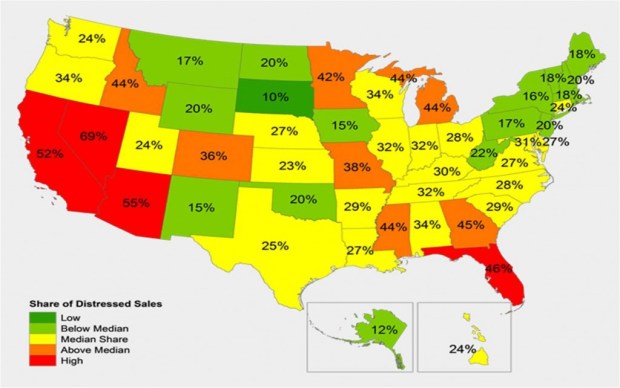
We have often written on the impact foreclosures and short sales have on the value of the house next door. The Center for Responsible Lending has done great reporting on the subject. It seems distressed properties will be a challenge we will need to deal with for some time. The National Association of Realtors (NAR) released their Existing Sales Report. The report said:

Distressed homes – sold at discount – accounted for a 39 percent market share in February, up from 37 percent in January and 35 percent in February 2010.

This week, NAR released an Economic Outlook. In the report, they covered the percentage of overall sales that distressed properties represented in each state. Here is a map that accompanied the report:
Bottom Line

Distressed properties have a major impact on house values in a marketplace. Where there is a large percentage of distressed properties, home prices will continue to soften until we work our way through this inventory.


 RAPPORTIVE BRINGS SOCIAL MEDIA ALIVE IN GMAIL

Rapportive is a free browser add-on developed for Firefox, Chrome and Safari that allows you to view your contacts’ social media profiles and activity right inside Gmail. The add-on works with both Gmail and Google Apps. Give it a try! It’s quick and easy to set up and it truly enhances your traditional mail client.

There are a handful of popular social CRM (customer relationship management) tools available that integrate with your mail client.

Last month, RIM (Research in Motion) announced the acquisition of Gist, one of the more widely used applications that enhance email contacts by displaying profiles that includes blogs, social networks and more. The future of Gist and how BlackBerry users will utilize the product remains to be seen.

The well-established Microsoft Outlook add-on Xobni will finally be releasing the tool for Gmail and are now accepting registration for a private beta preview.

However, since making the transition to Google Apps at Residential Properties Ltd, I have been enjoying Rapportive.

What is Rapportive?

Rapportive was launched in January 2010 by three developers: Rahul Vohra, Martin Kleppman and Sam Stokes. The successful venture capital firm Y Combinator, whose portfolio also includes Dropbox, reddit and Posterous, funds the company. Interestingly enough, it is also funded by Paul Buchheit, the creator of Gmail.

Unlike other similar services, Rapportive streamlines your contacts’ social profiles directly in Gmail without having to leave the mail client and access a separate CRM application. Having one less site or service to log into is always refreshing.

After a quick installation of the extension, connecting social networks is super easy, and all of the major networks including Facebook, Twitter and LinkedIn are supported.

After your networks are added, just open an email and your contacts profile is displayed in the side bar with a wealth of information including a profile picture, Twitter user name with recent tweets, the latest Facebook activity and links to other social networks.

I also found the add-on to be an extremely useful discovery tool as well. You can follow a contact on Twitter or send a Facebook request right from the mail client. Editing your own profile can be accomplished right in Gmail as well. Also, one of my favorite features of Rapportive is the ability to assign a “note” to your contact, which is private and can be viewed only by you.

How does Rapportive obtain its data?

Rapportive states on their site that they “combine information from several sources; at the moment, these are Academia.edu, Bitbucket, CrunchBase, Econsultancy, Facebook, Flickr, GitHub, Google Profiles, Gravatar, LinkedIn, Plancast, Posterous, Rapleaf, Stack Overflow, Tungle.me and Twitter, as well as thousands of organisations’ public websites.” You can learn more about this and their privacy policies here.

Raplets

Another feature that differentiates Rapportive from other services is the ability for vendors to build extensions, which are called Raplets. There are few good extensions that can easily be added, including BatchBook, MailChimp and Klout. Raplets can easily be added or removed right from inside Gmail.

Rapportive is a handy little tool that brings social media right to your inbox. The add-on is lightweight and fast loading — I would love to see a mobile app. Those who spend a fair amount of time in Gmail will appreciate having everything integrated in the mail client without having to access a third-party CRM application.


 NAR FLOATS $40 DUES HIKE FOR POLITICAL CAMPAIGNS

The National Association of Realtors is considering a hike in member dues by $40 a year in 2012 and 2013, with the goal of raising nearly $80 million in “soft money” for political advocacy at the local, state and federal level.

NAR’s board of directors is scheduled to vote on the “Realtor Party Political Survival Initiative” on May 14, at its annual midyear meeting in Washington, D.C.

If the initiative is approved, NAR says it will be spending nearly half of its budget on political advocacy, which the group’s members consistently rate as the most important benefit they receive from NAR, the group said in a “talking points” memo in support of the initiative.

The Political Survival Initiative — prompted in part by last year’s U.S. Supreme Court decision striking down restrictions on independent campaign expenditures by corporations — was unveiled at a meeting of Realtor association executives in Dallas this week.

The National Association of Realtors is considering a hike in member dues by $40 a year in 2012 and 2013, with the goal of raising nearly $80 million in “soft money” for political advocacy at the local, state and federal level.

NAR’s board of directors is scheduled to vote on the “Realtor Party Political Survival Initiative” on May 14, at its annual midyear meeting in Washington, D.C.

If the initiative is approved, NAR says it will be spending nearly half of its budget on political advocacy, which the group’s members consistently rate as the most important benefit they receive from NAR, the group said in a “talking points” memo in support of the initiative.

The Political Survival Initiative — prompted in part by last year’s U.S. Supreme Court decision striking down restrictions on independent campaign expenditures by corporations — was unveiled at a meeting of Realtor association executives in Dallas this week.

Initial online reaction among some NAR members to what would amount to a 50 percent increase in national level dues, from $80 to $120 a year, was mixed.

The Supreme Court ruling on “soft money” restrictions has opened the floodgates for independent campaign expenditures, and NAR must up its spending in order to maintain its voice, association executives were told.

In its last annual report, NAR said it currently collects $80 in national dues, of which $23 is used for legislative regulatory advocacy, $15 for consumer and member relationship building, $15 for state and local association services and support, $10 for economic and technological research, $7 for code of ethics, legal policy, and enforcement; $5 for publications (Realtor Magazine and Realtor.org), and $5 for commercial and international alliance partnerships.

Of that money, $9.77 million would be earmarked for state and local issue campaigns, and $8.95 million for federal issue campaigns. Another $7.02 million a year would go to supporting state and local candidates, and $3.95 million to federal candidates. The dues increase would provide an extra $5.17 million a year for Realtor mobilization, and $4.32 million for unspecified “campaign services.”

NAR last raised dues in 2008, after the group’s board of directors voted to fund a technology incubator, Second Century Ventures, among a series of other initiatives, with a $16 dues increase. Members also pay a $35-a-year special assessment for NAR’s “Home Ownership Matters” public awareness campaign.


 BUYERS READY TO SNATCH BARGAINS THIS SPRING

Bargain prices on housing combined with low interest rates below 5 percent may bring the real estate market its busiest spring season in years, economists say.

Distressed sales continue to put downward pressure on home prices, which may lure more buyers off the fence and ready to snag a deal during the typical prime-time buying season.

Some builders are ramping up discounts on new homes as well as boosting commissions to brokers to try to spark more transactions.

Sellers of existing-homes also are getting more competitive in pricing their homes.

“After three years of the housing downturn, people are becoming much more realistic in terms of valuing their homes,” says Lawrence Yun, chief economist at the National Association of REALTORS®.

An improved job market with better income potential may also motivate more people to buy, says David Berson of the PMI Group.

“Household formations are also very important,” Berson says. “Kids may have moved back in with their parents, or two people may have moved in together, because of job concerns. Now they can move into their own place.”

While interest rates are sitting comfortably below 5 percent for now (30-year fixed rates averaged 4.76 percent last week), economists warn the attractive low rates won’t last long.

“Few think mortgage rates are going lower,” says Mark Zandi, Moody’s Analytics chief economist. “It’s more likely they will be 6 percent than 4 percent next spring. This lights a fire under buyers.”


TEAM EMPOWERMENT MORTGAGE CHATTER: March 22; News & Headlines; Measure What Matters To Your Real Estate Site; We Think We’re Going To Believe Grandpa; California Auctioned Properties Rigged; Jobs Key To Housing Recovery; Don’t Cut Home Insurance

Yes, gas prices are extremely high!

See 6 tips on how to squeeze out better gas mileage below…


“To live is the rarest thing in the world. Most people exist, that is all.” — Oscar Wilde: Was an Irish writer and poet


6 TIPS TO SQUEEZE OUT BETTER GAS MILEAGE

1. Slow down: Most cars get the best gas mileage at 45-55 miles per hour. Driving faster than 60 mph actually can cut gas mileage anywhere from 7 to 23 percent.

2. Don’t idle: If you need to wait longer than 20 seconds, you’re better off turning off your engine than keeping your car running. Restarting the car requires less gas than leaving it idling.

3. Lose the heavy load: Make sure you’re not carrying in your car more than what you need. An extra 100 pounds sitting in the trunk or back seat can reduce fuel economy as much as 2 percent.

4. Tighten the gas cap: Fuel can evaporate through gas caps with broken or weak seals. Loose or broken gas caps can cost you a loss of about 2 percent in your gas mileage.

5. Close the windows and turn off the AC: Driving with the windows open or the air conditioner turned on can be big gas wasters. Instead, the most efficient way to keep the car cool is by using the air that comes in through your flow-through ventilator.

6. Get an oil change: Improve your gas mileage by as much as 2 percent by using energy-conserving or synthetic motor oil, which can reduce engine friction.

NEWS & HEADLINES

Well, it seems that the “markets” had grown a little jaded about watching the turmoil in the Middle East, the European debt crisis, and the Japanese nuclear & tsunami havoc. What to do? The U.S. Treasury announced that it will begin an “orderly wind down” of its $142 billion MBS portfolio over about 1 year by selling roughly $10 billion agency MBS’s per month. (In this case, “agency” means Freddie and Fannie securities, as the Treasury does not have any Ginnie securities in this group, which started at $300 billion but has since been paid down by borrowers.) It is part of continuing wind down of emergency programs put in place in 2008 and 2009, which also include TARP, Citi stock, AIG, etc. The Treasury expects to make about $15 billion in profits. It does not impact the FOMC’s position (they bought $1.25 trillion, which is now down to about $950 billion.) MBS

Suddenly Wall Street firms and investors were scrambling to find out the current holdings of the Treasury. The bulk of its holdings (purchased between 10/08-12/09) are in Freddie & Fannie 5 & 5.5% securities, which contain 5.25-6.125% 30-yr mortgages, but the MBS pass-through rates range from 4%-6.5%, and include 15-yr MBS’s. MBSSaleFAQ

Keep in mind that monthly MBS pay-downs have slowed over the last 6 months (due to higher rates and fees), and, relatedly, daily origination has slowed to about $1.25 billion. Sterne Agee noted that in the context of the overall MBS market, $10 billion is slightly more than 1/3rd of the recent 3 month average net issuance of the total MBS market. Prior to December, net issuance had not totaled over $3.3 billion/month in any single month for 10 consecutive months, dating back to the initiation of GSE delinquency buyouts. There is no indication that the Federal Reserve will begin systematically selling its $950 billion MBS portfolio. However, the Treasury’s announcement makes one wonder…

Just when you thought your head was about to explode from comp “stuff,” HUD weighed in. “(HUD)…issues the following additional guidance on how mortgage loan originators comply with the RESPA, in light of the FRB LO Compensation rule…This guidance seeks to clarify RESPA requirements related to proper disclosure on the GFE and HUD-1 settlement statement. This guidance does not address substantive issues related to restrictions on mortgage loan originator compensation that are within the jurisdiction of the FRB.” HUDRegZ.

Sterne Agee, on the other hand, stratified prepayment speeds by servicer for conventional 30-yr and 15-yr MBS’s. “We conclude that the business practices of any given servicer can have a meaningful impact on the prepayment speeds of MBS. Furthermore, market prices do not fully reflect the differences in speeds among servicers presenting investors with opportunities to enhance prepayment protection.” MBS investors, of course, are particularly interested in rates and their impact on early payoffs (refinancing), but should also note the company servicing the loan.

Sterne Agee suggests that “investors consider pools that are not explicitly prepayment protected pools, but have a relatively high concentration of attributes that can be associated with slower prepayment speeds. In addition to a relatively low WAC (low rate) and a relatively low average loan size, we favor pools that have a relatively high LTV ratio, low FICO score, high % of non-owner occupied property, low % of third-party origination (TPO), high % of purchase loans, low % of refi loans, low % of delinquent loans, favorable ‘geographics’, and favorable servicers.”

Rates began Monday slightly worse than Friday’s close, but by the end of the day were worse by .375-.5, depending on coupon and security. Who cared about the Existing Home Sales number after the Treasury’s announcement (noted at the top) that it would commence selling its holdings of MBS’s at $10 billion per month. 10-yr Treasuries tagged along for the ride somewhat, but finished down about .375 to 3.32%.

Any moves in the market will be driven by “headline news.” Currently the 10-yr is sitting around 3.35% and MBS prices, depending on coupon, are worse by about .125.


MEASURE WHAT MATTERS TO YOUR REAL ESTATE SITE

One thing consistently recommend to clients is that they install and monitor Web analytics. Not everyone does, of course. But it’s definitely the starting point for making websites better, in terms of accomplishing business goals.

There can be lots of different approaches to a Web analytics program. In fact, there might even be as many unique uses for Web analytics as there are different real estate websites that have analytics installed.

One company may be measuring to calculate ROI on paid advertising or search traffic versus social media efforts.

Another company might be using analytics to listen to their customers by reviewing keyword reports and traffic patterns.

A third company might be using analytics to identify conversion rates for different paid advertising headlines.

A fourth might be using analytics to figure out if new visitors behave differently than repeat visitors.

Depending on the goals of each company, all of these approaches are right. There really isn’t a simple “four metrics every Realtor must track day and night or risk joining the career path of the fax boy.”

Here are some examples of metrics that might be aligned with your company values.

Outstanding customer service: Many real estate professionals promote their high commitment to customer service. You can measure your performance in this in several ways.

Number of social media mentions that are expressing positive sentiment after being helped in some way. (Usually these messages include “Thanks!”)

Number of qualitative/voice-of-customer surveys that mention “ease of use” of website as something good about the site.

Number of non-real estate questions answered via social media (answering real estate questions isn’t outstanding if your business is real estate — it’s standard).

Expertise: Like outstanding customer service, many real estate professionals claim to have expertise in a geographic region or property type or type of sale. You can put some measurements in place to track your progress in being the expert. Here are a handful of metrics related to expertise:

Number of questions related to your expertise answered.

Number of new pages related to your expertise created.

Increase in expertise-topic mailing list distribution.

Measuring for values, measuring values

The purpose of metrics and analytics is to help you make better decisions so you can take better actions. If you aren’t sure how your Web analytics can really relate directly to your bottom line, start by measuring things that encourage fulfillment of your brand promises.

Once you do have a solid program in place that can directly relate online activity to your company revenue, continue measuring the company values metrics. Hopefully you will see a direct relation between your values-based metrics and your bottom-line-based metrics.

If you don’t see a relationship between fulfilling your brand promises and an increase in your business, then perhaps your values aren’t matched well with the people in your market. Or perhaps you don’t really believe your company values yourself.

Either way, if you see no relationship between your company values and your bottom line then it’s probably a good time to review your values.

Ultimately, the kinds of things we measure will influence the actions we take each day. If all of your key metrics are strictly focused on the bottom line, you may run the risk of losing your company “soul.” Attaching performance metrics to your values is a way to maintain your vision.


WE THINK WE’RE GOING TO BELIEVE GRANDPA

There are those currently debating the financial advantages of owning a home. Some are looking at studies and reporting that homeownership has never really been a great investment.

One of these people is Jack C. Francis, a former Federal Reserve economist and professor at Baruch College. He said in a recent CNBC article:

“For generations, parents and grandparents have been telling us that the way to get ahead was to buy a house and keep making payments with a fixed interest rate and after 20 or 30 years it would be way up in value and that was your nest egg in old age. You could either live in it rent free or sell it and use the proceeds to rent an apartment.”

The article goes on to explain the rest of Mr. Francis’ comment:

That was good advice until 2006 when home prices collapsed, he says, and it “may become good advice 10 years from now, but right now it’s not.”

Mr. Francis bases his conclusions on a study he completed which covered the years 1978 through 2008. In his study it showed that home prices increased annually by 5.7% and that the S&P 500 increased by 10.8%. Based on this information, Mr. Francis gives the following advice:

To students who come to him for guidance on whether to buy or rent in the near term, however, Francis has one word of advice: wait. “I keep telling them this is not the time to buy,” he says.

Let’s take a closer look at this conclusion.

1. We have our own study.

Mr. Francis did a study over a thirty year period which did not include the last 3 years. If we look at the same categories since January 2000 (covering one of the worst decades in American real estate history), we find that home values GAINED 42% while the S&P LOST 4.7%. It all depends on which set of data you choose to use.

2. The proper comparison is rent vs. buy.

All of these comparisons claim that putting your money into a different investment vehicle other than real estate might make sense. What they are not taking into consideration is that the investor will still have a housing expense. They will still need money for shelter. They cannot just take their money for shelter and buy other assets with it. A person can’t live in their 401k or their IRA. This leads us to…

3. In most markets today, owning is LESS expensive than renting.

Trulia recently came out with their Rent vs. Buy Index. The report shows:

that it is more affordable to buy than to rent a two-bedroom home in 72 percent of America’s 50 largest cities.

For more on this issue including a 50 city breakdown, click here.

4. Current mortgage opportunities may never be available again

The government has driven mortgage interest rates to all time lows. You can still get a 5% rate and guarantee it for 30 years. Both of these opportunities may soon disappear. Mortgage rates will increase as the economy improves and the Fed no longer feels pressure to keep rates low. The 30 year mortgage may soon be a thing of the past if suggested mortgage reforms come to be. You can lock in your housing expense for 30 years if you purchase. Renting is like having an adjustable rate loan with no cap that readjusts EVERY year. Which way do you think a landlord will readjust it?

For more on this, click here.

5. Most Americans see more to homeownership than financial value.

Last week, Fannie Mae released the National Housing Survey. The survey reported:

96% of all homeowners said homeownership has been a positive experience.

84% of Americans still believe that owning a home makes more sense than renting. Even 68% of renters believe owning makes more sense.

2 in 3 Americans believe that lifestyle benefits of homeownership (65%) are superior to the financial benefits (32%).

Bottom Line

There are more and more studies being done on the value of homeownership. We think we will trust in what our parents and grandparents said. Your mortgage payment is money you put into your savings. Your rent payment goes into the garbage.


BIDS RIGGED IN CALIFORNIA PROPERTY AUCTIONS

Six people, including two licensed real estate brokers, have pleaded guilty to conspiring to rig bids at public foreclosure auctions in San Joaquin County, Calif.

Prosecutors said the conspirators would designate one person to bid for them at public auctions in order to keep prices low. After the designated bidder bought a property at a public auction, the group would hold a second, private auction, where each conspirator would bid what they were actually willing to pay.

The highest bidder at the private auction won the property. The difference between the rigged bid at the public auction and the high bid at the private auction was divided among the conspirators — an “illicit profit,” prosecutors said.

The scheme ran from about September 2008 until October 2009, with more than $10 million in homes purchased at artificially low prices. The U.S. Department of Justice, the FBI and the San Joaquin County District Attorney’s Office are conducting an ongoing investigation of “fraud and bidding irregularities” at auctions in the county, prosecutors said.

Stockton, the county seat, has been a hotbed for foreclosures. Stockton real estate executive Anthony B. Ghio was the first to enter a guilty plea in the case last year.

Facing a maximum penalty of 10 years in prison and a $1 million fine, Ghio pleaded guilty to bid rigging in April and agreed to cooperate with investigators in return for a recommendation of a lighter sentence.

On June 24, licensed brokers John R. Vanzetti and Theodore B. Hutz also pleaded guilty to participating in the conspiracy.

Vanzetti agreed to cooperate with investigators and pay $271,000 in restitution and a minimum fine of $20,000. In return, federal prosecutors said they would recommend that he be sentenced to no more than 24 months in prison.

Hutz, who is also a Realtor, agreed to the terms of a plea bargain calling for him to pay $96,500 in restitution and a minimum fine of $20,000. In return, prosecutors said they would recommend the same sentence for Hutz as Vanzetti — 18 to 24 months in prison.

In February, real estate executive Richard W. Northcutt was the fourth person to enter a guilty plea, followed by real estate investors Yama Marifat of Pleasanton and Gregory L. Jackson this month.

The California Department of Real Estate still lists Vanzetti and Huntz as licensed brokers, with no record of disciplinary action.

A California Department of Real Estate spokesman, Tom Pool, said that charges against an agent or broker can’t serve as the sole basis for disciplinary action — licencees are entitled to a hearing before an administrative law judge. Even in cases where a broker has entered a guilty plea or been convicted, they may still have the right to appeal their conviction.

A recent investigation by the Sacramento Bee found dozens of California real estate professionals charged with crimes or sued for allegedly fraudulent dealings in recent years still have their licenses.


JOBS KEY TO HOUSING RECOVERY, MORTGAGE EXPERT SAYS

Get ready for a showdown between the Obama administration and the banking industry over the mortgage market. Described as a “shock and awe” approach, the White House wants the nation’s five largest banks to reduce the principle on mortgages in an effort to reduce monthly payments for struggling homewoners, reports the Huffington Post.

The White House hopes the plan will take effect in the next six months may cover as many as three million distressed homeowners. This new modified mortgage plan could cost Bank of America, JPMorgan Chase, Citigroup, Wells Fargo and Ally Financial as much as $30 billion, according to unnamed sources cited in the Huffington Post report.

“The banks are going to fight this tooth and nail,” says Paul Muolo, executive editor of National Mortgage News and author of “Chain of Blame: How Wall Street Cause the Mortgage and Credit Crisis.

If implemented the plan will lead to a “horrible precedent for the industry,” he tells Aaron and Henry in the accompanying clip.

Muolo raises two key problems with the plan:

Legality “There’s something called rule of law. The mortgage contracts are legal contracts and there’s nothing in those original loan documents that say they should write-down the principle in the event of a default,” he argues.

Not a Solution Like the White house’s first attempt at this – HAMP – Muolo says there’s no reason to believe a principle write-down will prevent foreclosures, just delay them.

Nearing a Bottom?

The key to finding a bottom in the housing market is not government intervention, it’s employment, Muolo argues. “If you want to help someone with their mortgage, help them with their job, get them back to work and they’ll pay their mortgage,” he says.

The good news is, we are getting closer to that bottom. Muolo estimates the balance between supply and demand may tip back to sellers in the next year or so. We’re closer to a healthy equilibrium judging by the February housing starts data released today. Home construction dropped 22.5% last month to a seasonally adjusted 479,000 homes – the lowest level since April 2009 and the second-lowest on the books.


 DON’T CUT HOME INSURANCE, EXPERTS SAY

Many home owners are contemplating reducing their homeowners insurance coverage since their property’s value has dropped. But experts warn that’s not a good idea and could leave home owners with insufficient coverage if a disaster ever strikes.

“The market value of your home and its insurance value can vary widely because they are based on different assumptions and calculations,” according to an article in the Baltimore Sun. The insurance value is based on what it would cost to rebuild the house, not on what you paid for it.

As such, even though housing prices have dropped in many markets, rebuilding costs have not.

For home owners looking for savings, they might instead consider increasing their deductible. For example, increasing a deductible to $1,000 from $500 could lower the premium by 25 percent.

TEAM EMPOWERMENT MORTGAGE CHATTER: March 21; Visit www.CoopsCoffee.com; News & Headlines; Did Modification Programs Work?; Existing-Home Sales Dip in Feb; 7 Tips To Create Real Estate Marketing Buzz; 6 Ways To Squeeze Out Better Gas Mileage

In addition to my visit to the speedway, I was also able to enjoy a Cirque De Soleil show.


“The pessimist borrows trouble; the optimist lends encouragement.” – William Arthur Ward

How many lenders can say that their average close of escrow is 21 DAYS? Well, I’d like to share, that our Team’s average is 21 days right now. This doesn’t only help with those of you with REO’s to impress those asset managers of yours, as we all know time is of the essence. Not to mention that your buyers will have a better chance to get into contract with such an impressive timeline. Did you happen to catch my co-hosted radio show yesterday on 910AM? If not, you can listen to it by visiting http://www.CoopsCoffee.com. If you’d like to call me with any difficult loan scenarios, questions on financing options for your buyers, need a pre-approval or an open house flyer – I’ll be in the office all day today, so please do not hesitate to contact me. Have a great Monday and I’m hoping you have an awesome week! Please let me know if there’s anything my team and I can do to help.


 NEWS & HEADLINES

The National Association of Realtors, community banks, and probably practically everyone in the mortgage business tend to believe that a drastic withdrawal of government, or a dismissal of government insured loans, could slow the recovery and shut out deserving borrowers. In addition, although there have been steps made toward having “private money” re-enter the mortgage market, most would agree that it is in no way ready to step into the private and secondary markets quite yet. In fact, the government continues to be involved, as we all know – the Federal Reserve Board held a teleconference late last week to clarify some outstanding issues/questions about the comp issue.

Hey, how about taxing foreclosures? An assemblyman in California has introduced legislation that would bill banks $20,000 for every home foreclosed. The money collected would supposedly be used to cover foreclosure costs, property tax losses, support school districts, police and fire departments.

Investor updates continue unabated. As always, this commentary tries to point out the trends, rather than go into too many specific details. So for example, three weeks ago Freddie Mac announced the reduction of its maximum LTV, total LTV (TLTV) and Home Equity Line of Credit TLTV (HTLTV) ratio requirements to 95% for all conventional mortgages it purchases. (This doesn’t include Freddie Mac Relief Refinance Mortgages.) One can expect investors that sell loans to Freddie Mac to follow this change.

Friday ended the day with MBS prices where they started: unchanged from Thursday’s close. For the first time since 2000, the G7 intervened in the currency markets when the Fed, Bank of England, ECB and Bank of Canada committed to concerted intervention in response to the recent strengthening of the Yen. Ultimately the market impact should depend on the total size of intervention over the medium term. It is extremely difficult to put an estimate to this question since it depends on the size of repatriation flows and the G7 commitment to maintain the yen, and the news did not roil the rate markets.

For economic news it was pretty quiet over the weekend. This week we have Existing Home Sales today and New Home Sales on Wednesday. Thursday has Durable Goods and Jobless Claims, and then on Friday is GDP & a Michigan Consumer Sentiment number. Existing Home Sales, which will come out at 10AM EST, rose 2.7% last month, the highest level in eight months but due mostly to distressed and all-cash transactions. Look for a big drop this time around. Ahead of that, our 10-yr is up to 3.33% and MBS prices are worse bout about .125.


DID MODIFICATION PROGRAMS WORK?

The government decided early on that the market would not be able to absorb the number of foreclosures that the financial crisis was creating without crushing house values. This was one reason that they funded the Troubled Asset Relief Program (TARP). This past week, the Congressional Oversight Panel (COP) weighed in with their opinion on TARP’s success.

Today we want to concentrate on the parts of the report that pertain to real estate. TARP funds were to be used:

…in a manner that protects home values, college funds, retirement accounts, and life savings; preserves homeownership and promotes jobs and economic growth; maximizes overall returns to the taxpayers of the United States.

Did TARP Accomplish Its Housing Goals?

One way TARP was to accomplish “protecting home values and preserving homeownership” was through the Home Affordable Modification Program (HAMP). According to the COP report:

…when the President announced the Home Affordable Modification Program in early 2009, he asserted that it would prevent three to four million foreclosures. The program now appears on track to help only 700,000 to 800,000 homeowners.

We want to say that, if hundreds of thousands of families averted the devastation foreclosure can bring, we consider the program as worthwhile. Successful? That’s a different story.

Another program initiated to help was HOPE for Homeowners. It was established by Congress in July 2008 to permit the FHA to insure refinanced distressed mortgages. However, as the report explains:

HOPE for Homeowners was initially expected to help 400,000 homeowners, but it managed to refinance only a handful of loans. This was likely due to the program’s poor initial design, lack of flexibility, and its reliance on voluntary principal write-downs, which lenders were very reluctant to make.

The Only Good News?

The only silver lining is that TARP didn’t cost the taxpayer as much as was originally estimated. At what expense to troubled homeowners? In discussing the falling cost of the program COP stated:

…a separate reason for the TARP’s falling cost is that Treasury’s foreclosure prevention programs, which could have cost $50 billion, have largely failed to get off the ground. Viewed from this perspective, the TARP will cost less than expected in part because it will accomplish far less than envisioned for American homeowners.

Bottom Line

TARP was set up to avoid home values being crushed under the weight of foreclosures. To that regard, it seems to have done nothing but delay the inevitable.


 EXISTING-HOME SALES DIP IN FEBRUARY

Existing-home sales fell in February following three straight monthly increases, according to the National Association of REALTORS’.

Existing-home sales dropped 9.6 percent to a seasonally adjusted annual rate of 4.88 million in February from an upwardly revised 5.40 million in January, and are 2.8 percent below the 5.02 million pace in February 2010.

Total housing inventory at the end of February rose 3.5 percent to 3.49 million existing homes available for sale, which represents an 8.6-month supply at the current sales pace, up from a 7.5-month supply in January.

According to Freddie Mac, the national average commitment rate for a 30-year, conventional, fixed-rate mortgage rose to 4.95 percent in February from 4.76 percent in January; the rate was 4.99 percent in February 2010.

Single-family home sales fell 9.6 percent to a seasonally adjusted annual rate of 4.25 million in February from 4.70 million in January, and are 2.7 percent below the 4.37 million pace in February 2010. The median existing single-family home price was $157,000 in February, which is 4.2 percent below a year ago.

Existing condominium and co-op sales dropped 10.0 percent to a seasonally adjusted annual rate of 630,000 in February from 700,000 in January, and are 3.1 percent lower than the 650,000-unit level one year ago. The median existing condo price was $150,400 in February, down 11.1 percent from February 2010.


7 TIPS TO CREATE REAL ESTATE MARKETING BUZZ

Gone are the days where advertising alone does the job. The secret to having a steady stream of clients today is to create a positive buzz about your business.

Word-of-mouth marketing is nothing new. We all want others to say positive things about our businesses. If you would like to get people buzzing about how great you and your services are, here are seven great ways to do it.

1. The best marketing buzz: a new listing sign with a “sold” rider in 72 hours

When a for-sale sign pops up in a neighborhood, the neighbors are always buzzing about the price, the reasons their neighbors are moving, and most important: whether the agent will get the job done.

If you have a reputation for selling homes quickly, you will likely have more sellers seeking out your services. You can also expect that your sellers will tell everyone they know about how their house sold quickly in this tough market.

2. Help someone avoid foreclosure

Many people have the impression that most real estate agents care only about themselves and their commissions. You can get people buzzing about how great you are by helping distressed property owners find a solution to their situation.

For example, if a past client is facing a foreclosure sale, you can tell them about the “ask for the note strategy” to delay or stop the foreclosure. You can also refer them to an organization such as the National Association of Consumer Advocates, which performs forensic loan audits to determine if the lender violated any RESPA or other requirements.

If the lender did so, the owner now has more leverage to work out a loan modification, a short sale, or some other solution.

3. Support your local team

To create a positive buzz about your business, host a special event for people in your referral database. Rent a bus and take your guests to the most important away game for your local high school or college. Provide plenty of food, ice cream, souvenirs and other goodies.

Arrange for a photographer and post the pictures to your website. Send out the link to everyone who attended as well as to any alumni you happen to know. Whether your team wins or loses, everyone will be “buzzing” about the great time they had.

4. Be “You-nique”

Butch Grimes of WeTalkRealEstate.com uses a variety of methods to get people buzzing about his real estate business. In addition to hosting a 24-7 radio show, Grimes emphasizes the importance of being “You-nique.”

For example, Grimes has a 20-foot-tall, inflatable open house sign that he uses to attract visitors to his open houses. To help people find his open houses, he had directional signs made with a life-sized cutout of him attached to the sign. From a distance, it looks as if he is personally standing there directing you to his open house.

The one thing he does that gets the most buzz, however, is sending a chauffeur-driven limousine to pick his clients up at work and take them to the escrow to sign their final closing documents. You can imagine the buzz this creates among his clients, as well as their colleagues, who see them being ushered into a limousine.

5. Take advantage of social media and texting

Rather than being aggravated when you work with a client who is more involved in texting than interacting with you, take advantage of this activity. When you send your buyers information about the listings you will be showing them, include as many pictures of the listings as possible.

Next, ask your buyers to forward the information to their friends via e-mail or on Facebook. Make it a game. Ask their friends to predict which house your buyers will like best. Everyone has fun. You can also probably expect lots of texting going back and forth about which house will be the buyers’ favorite.

6. Help others build their businesses

Do you have a favorite dry cleaner or restaurant? Do any of your clients own their own businesses? If you are a customer, post a video testimonial for them on Yelp.com as well as on their LinkedIn profile if they have one. Normally, when someone posts a testimonial for another person’s business, they will reciprocate with a testimonial for you.

7. Give away a conversation starter

Many agents market their businesses by giving away magnets. In 2005, Inventables began distributing “squishy magnets.” These magnets feel like a piece of foam rubber and can be used to close doors without the doors slamming. Distributing these to your geographical farm or on your open houses will make a great conversation starter and get people buzzing about the agent who gave them this nifty little gift item.

There are literally thousands of ways to get people buzzing about you and your business. All it takes is a little creativity. If you have a great suggestion, we invite you to share your suggestion in the comments.


 6 WAYS TO SQUEEZE OUT BETTER GAS MILEAGE

With gas prices topping $4 a gallon, real estate professionals who use their car frequently for work are looking for ways to get as much as they can out of every gallon.

Here are some tips for getting better mileage out of your car:

1. Slow down: Most cars get the best gas mileage at 45-55 miles per hour. Driving faster than 60 mph actually can cut gas mileage anywhere from 7 to 23 percent.

2. Don’t idle: If you need to wait longer than 20 seconds, you’re better off turning off your engine than keeping your car running. Restarting the car requires less gas than leaving it idling.

3. Lose the heavy load: Make sure you’re not carrying in your car more than what you need. An extra 100 pounds sitting in the trunk or back seat can reduce fuel economy as much as 2 percent.

4. Tighten the gas cap: Fuel can evaporate through gas caps with broken or weak seals. Loose or broken gas caps can cost you a loss of about 2 percent in your gas mileage.

5. Close the windows and turn off the AC: Driving with the windows open or the air conditioner turned on can be big gas wasters. Instead, the most efficient way to keep the car cool is by using the air that comes in through your flow-through ventilator.

6. Get an oil change: Improve your gas mileage by as much as 2 percent by using energy-conserving or synthetic motor oil, which can reduce engine friction.

TEAM EMPOWERMENT MORTGAGE CHATTER: March 18; Radio Segment; Redfin and Agent Comments on Listings; Killing an Elephant with a Bazooka; Once-In-A-Lifetime Opportunity for Buyers

To preserve your happiness & decrease any stress you have, you have to enjoy yourself!  

166 MPH on the NASCAR Racing Experience in North Carolina is a great way to do so…


“Think in the morning. Act in the noon. Eat in the evening. Sleep in the night.” — William Blake: Was an English poet, printmaker, and artist

910AM BAY AREA REAL ESTATE RADIO SEGMENT

Last Friday I announced that I’d be featured as a co-host on the 910AM Bay Rea Real Estate segment on Sunday from 6-7 PM. I will be on there again this coming Sunday – as a regular co-host. You can listen through 910AM or iheartradio.com on your mobile phone. We will also feature links on my website for you as well on Monday morning just incase you’re not able to listen to it on Sunday, check out my website to see the links Monday Morning – www.ZackryCooper.com


 REDFIN TO SERVE UP AGENTS’ COMMENTS ON REAL ESTATE LISTINGS

Registered users of Redfin’s website can now see what the brokerage’s agents thought of listings they’ve toured, whether “the lawn needs to be mowed” or the home “showed well,” CEO Glenn Kelman announced in a blog post.

The comments that Redfin agents make in “Agent Insights” notes will also be e-mailed automatically to listing agents, Kelman said.

Given the sheer number of homes Redfin agents tour, the new feature will be a “game changer,” for consumers, he said. The 13,793 Agent Insights currently available for homes on the market represent 35 percent of active listings in Irvine, Calif., and 31 percent of Seattle listings, Kelman wrote.

Redfin will give the client who requested the tour two days to decide whether they want to suppress Agent Insight comments.

“The reasoning behind this is that if you tour a hot property with Redfin, you shouldn’t have to worry that your agent will tell everyone else about it before you’ve had a chance to make your own move,” Kelman said. “The customer who requested the tour comes first.”

Only registered users of Redin’s virtual office website (VOW) will be able to see Agent Insights.

Under the terms of a November 2008 settlement between the Department of Justice and the National Association of Realtors, Redfin and other VOW operators are allowed to provide registered users of their sites with a broader range of property data from multiple listing services, which Kelman said includes the notes that agents take on home tours.

“This is exactly the kind of communication the Department of Justice’s historic settlement with the National Association of Realtors was designed to protect,” Kelman wrote.

That doesn’t mean that buyers and sellers will be comfortable with this “degree of candor,” Kelman acknowledged.

He said Redfin almost offered access to agents’ notes 18 months ago, after the settlement was finalized, but “couldn’t find a way to make it work for our agents, our buyers, our sellers, our peers in the industry.”

By e-mailing “Agent Insights” to listing agents and giving prospective buyers the power to suppress their public display, the company hopes it has found a way to balance the interests of those groups, Kelman said.

The company plans to pay close attention to the feedback it receives on the new capabilities.

In 2007, Redfin was fined by Northwest MLS for publishing reviews of properties for sale on the company’s Sweet Digs blog. The reviews were authored by writers hired by Redfin to visit the properties in person.

Redfin appealed the fine, but shifted the focus of its blogs to be sources of information about markets it serves, analyzing price trends and recent sales.


KILLING AN ELEPHANT WITH A BAZOOKA

There’s an old saying that talks about “killing a flea with an elephant gun”. I think that may somewhat trivialize the issue at hand and I don’t want to do that. The issue is a big one, a serious one. So, I modified the saying just a bit to establish that I understand the gravity of the situation. What is the issue? Those damn loan officers! What I mean is that regulators, politicians and the media have chosen to blame loan officers (LOs) for the economic meltdown.

Why did people take loans they couldn’t afford? Their loan officer talked them into it! Why did they get approved for those loans? The loan officer pushed loan programs that ignored basic qualification items like income, credit and/or assets! How about those inflated appraisals? It must be because the loan officer had too cushy of a relationship with the appraiser! It goes on and on…

Let me admit some things:

The standards for entering the mortgage industry were pitifully low and many unqualified (and potentially unscrupulous) people started selling mortgages. That has now been addressed with testing and licensing.

Loan programs were too liberal. Those loan programs are virtually gone.

Many consumers got caught up in the home buying frenzy and they began to use their home’s appreciation like an ATM. The correction we are now enduring is fixing that issue.

With all that being said, the regulators have taken steps to corral the cowboys. The results are clear. The number of licensed LOs is down from a high of 450,000 to estimates of about 115,000 today. Those who are left have survived reduced loan products, testing, licensing AND the scorn of a reluctant public who views the LO with a suspicious eye. Those who are left are qualified professionals who are looking to serve their clients with solid financial advice and counsel. There are still some bad apples of course just as there are in any industry. However, the weeding out process has had a dramatic impact already.

But, that wasn’t enough. Bring out the Bazooka – LO Compensation. Effective April 1st (assuming there is no last second change or delay), the way LOs are paid is going to change. Without going into all the nuts-and-bolts, for the most part, the mortgage BROKER (who just a few years ago represented 70% of all loan originations) will become a dying breed with projections of less than 15% of originations in 2011. Individual LOs will now be compensated based on nothing other than the loan amount for a transaction and/or an hourly wage. (Some lenders are working on “bonus monies” tied to some other quantitative and qualitative metrics, but those payments represent a somewhat gray area at the moment.)

The Consequences

It’s too late for whining and there isn’t a likely outcry from a brainwashed public to rise up in defense of the loan officers. But, there does need to be an understanding by every one of the likely consequences:

More Loan Officers are likely to leave the industry as their income is slashed..estimates of 75,000 LOs by 2012 are not uncommon.

Loan Volume will continue to consolidate to the 4 major banks, some regional banks & credit unions and some large mortgage banks with the smaller mortgage banks and mortgage brokers folding into larger companies or folding all together.

The additional cost to cover the additional expenses for accounting and compliance resulting from this regulation (projected to be 20-30 basis points) will increase the costs of borrowing money.

More loan products (like state mortgage programs that are below market interest rate programs) could go away because LOs need to be paid the same on those programs as they are on other programs and companies will not be able to afford to do that.

LOs will need to do more volume to replace their lower commissions and customer service will suffer.

The good LO is now poised to pay an even steeper price for the LO who was part of the problem but has now left the industry. I believe in transparency. I believe LOs who take advantage of customers (in loan product steering or the timing of the locking in of the loan, for example) have been eliminated or can be controlled in other ways besides this vague directive. I do expect some dissenting opinions on this blog post. However, I am hard pressed to find another industry that discloses as much as we are required to do (in terms of costs) to the consumer. And now we are being told by the government how to dissect the revenue. What’s the next weapon to kill the elephant?


ONCE-IN-A-LIFETIME OPPORTUNITY FOR BUYERS?

Business Insider’s Money Game interviewed real estate expert Barbara Corcoran earlier this week. This is what she said about buying in this market:

“We have a regular real estate miracle happening right now. We not only have record low prices, but we also have cheap money.”

A second real estate icon, Donald Trump, just a few weeks ago said:

“This is a great time to go out and buy a house. And if you do, in 10 years you’re going to look back and say, ‘You know, I”m glad I listened to Donald Trump’.”

Maybe it’s time to start listening to the people who have made fortunes buying and selling real estate. They may know best!!


10 TAX DEDUCTIONS: IN TIME FOR THE APRIL 18TH DEADLINE

Your tax return is due by April 18, 2011 (the deadline was extended three days this year because of weekends and holidays). If you haven’t filed yet, make sure you haven’t forgotten the following 10 tax deductions, which are often overlooked by real estate agents and brokers.

1. Business clothing with logos

2. Car expenses if you take standard mileage rate

3. Home telephone expenses

4. Business gifts

5. Continuing-education courses

6. Tax-preparation fees

7. ATM fees, credit card fees, and interest

8. Subscriptions

9. Greeting cards

10. Websites


CALIFORNIA LAWMAKER PROPOSES BILL THAT WOULD CHARGE BANKS $20,000 FEE PER FORECLOSURE

A California state assemblyman is introducing legislation that would bill banks $20,000 for every home foreclosure they execute in the state.

San Fernando Valley-based Assemblyman Bob Blumenfield’s office said in a fact sheet released Wednesday that the bill would help make up for costs associated with foreclosures, such as property tax losses.

The money collected would be used for school districts, police and fire departments, small-business loans and other applications.

Amy Schur, who directs advocacy group Alliance of Californians for Community Empowerment, which is supporting the bill, says its language is currently being vetted by the legislature’s legal staff.

Blumenfield spokesman Anthony Matthews did not return a phone call. A message was left with Mortgage Bankers Association spokesman John Mechem.


 GEN X BUYERS TO LEAD HOUSING RECOVERY

Generation X – adults ages 31 to 45 – are expected to lead the recovery in the housing market, according to real estate experts in a recent webinar produced by the National Association of Home Builders. During the event, speakers highlighted results of a survey of 10,000 buyers in 27 metro areas.

While Generation X isn’t the largest population group – making up 32 percent of the population compared to 41 percent of baby boomers – it’s the most mobile age group, says Mollie Carmichael, principal of John Burns Real Estate Consulting in Irvine, Calif., the company that conducted the survey.

“They are in full force with their careers, and they need to accommodate growing families,” Carmichael says.

This generation is coming with their own set of house preferences that may differ from other generations. Even though home sizes continue to shrink, first-time buyers and younger families are looking for more room to grow, Carmichael says. Nearly 50 percent said they prefer a home with a large lot and in a suburban development. Only 21 percent said they are looking for a traditional or “walkable neighborhood,” according to the survey.

“They want something compelling, from a design or personalization standpoint,” Carmichael says.

And many want “green,” energy-efficient features, too. Regardless of age group, 70 percent of buyers said in the survey they are willing to pay $5,000 more for a home with “green” features.

Most buyers also said they’d be willing to pay a premium for such housing characteristics as dark wood cabinets, a separate tub and shower, and a fireplace in the living room.


TEAM EMPOWERMENT MORTGAGE CHATTER: March 17

 HAPPY SAINT PATRICK’S DAY!


TEAM EMPOWERMENT MORTGAGE CHATTER: March 17; Happy St. Patrick’s Day!; News & Headlines; What Homeownership Truly Means; 5 Real Estate Tech Time-Savers; FHA Chief Stevens Heads to Mortgage Bankers Group; Weighing An Offer: 3 Seller Tips


“If not you, then who? If not now, then when?” – by Hillel


NEWS & HEADLINES

The ability for a borrower to refinance is determined by several factors: current rates, credit quality, and collateral value being primary. Lenders know that higher fees have a negative impact on refinancing volumes going forward as FHLMC, FNMA and the FHA have all recently increased costs for certain borrowers. Loan Level Price Adjustment changes by Fannie & Freddie, and the increase in FHA’s MIP fees, make home purchases more expensive and raise the refinancing bar. But for a very long time mortgage applications show that over 60% of loans are refinances. Who & why are these borrowers refinancing? On the retail side, lower rates can be found for high quality borrowers with pre-existing relationships with the lending institutions. Otherwise, borrower’s with lots of equity, government loans because of LTV, borrowers who paid cash for their home and are now taking money out, and borrowers converting from ARM’s to fixed-rate mortgages are refinancing. In addition, lenders report that there are still borrowers out there with higher note rates that can still refi into a lower rate, those taking advantage in some areas of the $729,750 loan amount while it exists.

Fannie & Freddie were in the subprime business? The SEC is checking into it: FF

Does a decline in foreclosures mean that the improving job market is helping folks make payments, or that the servicers are so backlogged it is holding things up? CNBC

The question about whether or not Freddie or Fannie accepts e-signatures occasionally comes up. For example, Fannie answers the question at FannieE-Sig But this appears to be for the note and e-delivery to Fannie only. But FHA issued a Mortgagee Letter concerning what documents it would accept electronic signatures on (such as initial 1003, disclosures, purchase contracts), but, according to one reader, Fannie has not issued guidance on this. “Our private investors only want to accept e-signatures per FHA’s guidance, and don’t want to extend the policy to conventional loans because Fannie doesn’t make any specifications. Freddie Mac believes that authentic electronic signatures from duly authorized individuals that comply with E-SIGN and UETA are as enforceable as authentic pen and ink signatures from duly authorized individuals that comply with applicable law. In either case, a signature (pen & ink or electronic) must be capable of being legally attributable to the signer. The conventional agencies don’t give much further guidance, as most of their e-Mortgage guidance refers to the mortgage documents not ancillary documents.” If anyone is listening…

In regards to MI, it seems that they may no longer have to worry about being “squeezed out of the market” due to the Dodd-Frank provisions. Nothing is set in stone, but recent reports hint that the requirement that banks retain 5% of the risk of a loan – “skin in the game” – may not apply to agency loans while in conservatorship. Non-agency loans are still a big question mark, as are any loans done that have more than an 80% LTV. Six federal agencies – the Federal Reserve, the FDIC, the OCC, HUD, the SEC, and FHFA – must sign off on the proposal before it is released for comment.

In the markets, Japan, Europe, and the Middle East continue to dominate the news, and this uncertainty has helped the “safety” bid on Treasuries. Yesterday the 10-yr hit a low of 3.15% but closed around 3.21%, its lowest level in months as the markets seemed driven by rumors of rumors. Over in the mortgage camp, as might be expected, the higher prices and lower yields kept many investors near the sidelines or taking profits, particularly in higher coupons. There was servicer buying in the lower coupons to add duration, and by the end of the day current coupon agency MBS prices were better by about .5.

Today we have a slew of economic data. Last month we learned that the previous month’s Consumer Price Index (CPI) rose 0.4% in January, mostly due to gasoline and food costs. But clothing (cotton) and airfare prices were also on the rise. Today’s CPI was expected to also be +.4% and came out at +.5% with the core rate, for those who don’t drive or eat, at +.2%. Initial Jobless Claims were 385k, down 16k from the prior month with the 4-week moving average (smoothing out the volatility) is down 7k. Later we will see Industrial Production and Capacity Utilization, along with Leading Economic Indicators and the Philly Fed Survey. So far rates have drifted higher with the 10-yr yield at 3.26% and MBS prices worse by about .250.


WHAT HOMEOWNERSHIP TRULY MEANS

I thought this blog was perfect to share! Enjoy!…

My Son, His New Home, and What It Means

Every week we try to help you put an accurate value on housing in today’s real estate market. We give you all the charts, report on all the surveys, and quote every housing expert willing to talk on the subject. And we are still not 100% sure what prices should be. At best, we can only tell you what we think.

This week was different. I was able to personally FEEL the true value of a home. My older son closed on his first home yesterday. I have the great fortune to work with him at our company. I get to see him a lot when I am not traveling. This week I was home and got to spend every day with him.

I saw how nervous he was as he got all the last minute paperwork together. I heard the relief in his voice when he found out that he had overestimated his costs and would need to bring a little less money to the closing. I could feel how proud he was when he hugged me as he left the office the night before the closing.

He should be proud. He just purchased his own home. He just took a major step toward accomplishing the American Dream. He now owns a piece of this country. He now has a community he can call his own. He has a place to go “home” to every night, a place where he can work in the yard, a place he can invite friends and showoff his “castle”, a place where he will someday raise his family.

Owning a home makes things different. You can’t necessarily explain it logically. But you can feel it. That feeling is the real value of a home AND IT IS PRICELESS.

My son slept in his own home last night. I am happy for him.


5 REAL ESTATE TECH TIME-SAVERS

Are you looking for some simple new Web tools that will definitely help your business and won’t break the bank? Here are some great suggestions.

Evernote and Dropbox are the two relatively new tools that I use constantly. Evernote allows you to take notes anywhere on my smart phone or iPad. It then syncs those notes so they appear on all my devices, including my laptop.

have complete accessibility to my notes at all times. Best of all, I can quickly search my notes to locate keywords. Evernote aggregates each document containing those keywords as well as highlighting the position of the keywords within the document.

Dropbox saves me tremendous amounts of time by avoiding the hassle of downloading and uploading files. Normally it would take three to five minutes to upload a 6MB video. I recently moved my presentations folder, which occupied 672MB of disk space, using Dropbox.

I dragged and dropped the file in my Dropbox folder. It took three minutes for the entire file to reach my assistant. For agents uploading videos and other large files, this system is terrific time-saver.

Here are five other tools that you may want to add to your toolbox.

1. Join.me

How many times have you wished that there were a simple way to share your screen with someone else? Until recently, the best option was to sign up for a service such as GoToMeeting or WebEx. Both systems take time to load and also require the user to upload the application.

Join.me is fast and simple. The first time you use the system, it will take a few seconds to upload the application to your computer. After that, all you have to do is to click on the icon that says, “Share my screen with others.” The system then generates a code that appears at the top of your screen.

Give the code to the person with whom you would like to share your screen. When they visit Join.me and enter the code in the appropriate box, the system automatically shares your screen.

Another great feature of Join.me is that you can also hand off control to the person with whom you are sharing. For example, assume that you have a new software program and you’re having issues with it. Your assistant has figured out how to use it, but you also need to know. Your assistant can screen-share with you. You can give her control and she could actually install the program and demo it for you. This can be a huge time-saver that eliminates a considerable amount of frustration as well.

2. Zosh.com — sign with your finger

If you own an iPhone, iPod touch or an iPad, you can save yourself and your clients time with a great little tool from Zosh.com. Suppose that your clients forgot to initial one of the pages of a disclosure statement and the lender can’t fund their loan without a signature. If they have Zosh, all you have to do is send them the document. They then initial it using the Zosh application and send it back. You can even sign documents using your finger. This is a great application that can save you a long trip across town to get a signature.

3. Never wait on hold again

Let’s face it. Most agents are busy and don’t have time to sit around on hold. If you have ever called customer service and waited forever to be connected somewhere overseas, LucyPhone.com is a free service that makes the wait disappear. With LucyPhone.com you enter the number you want to call. The company completes the call and rings you back once the other party is off hold.

Best of all, the company that made you wait actually has to wait a few seconds for you to connect, rather than vice versa.

4. Make your website mobile-phone friendly

Even if you own the latest smart phone, website and blog, load times can be extremely slow. If you want to make your blog site load super fast and fit perfectly to the screen size of mobile devices, you need WPtouch Pro. At $29, WPtouch Pro automatically makes your blog fit the small screens of mobile devices and also speeds up the load time by up to 500 percent. This is a great way to keep mobile visitors to your blog happy and coming back.

5. 1Password and Last Pass

Are you tired of trying to remember all those passwords for all the sites you visit? Have you taken to storing them on a sheet of paper or in your address book? If so, 1Password.com provides a great way to manage all your passwords if you’re running an iPhone, iPad, Android or Mac platform. The price is $39.95. 1Password works with file sharing systems such as Dropbox.

If you’re running a PC, another great product is LastPass.com. This stores your passwords on their secure servers. LastPass.com is only $12 per year and has received some rave reviews.

Each of these applications is relatively inexpensive, makes it a lot easier to conduct your business, and will save you plenty of time.


FHA CHIEF STEVENS TO HEAD MORTGAGE BANKERS GROUP

David Stevens, who announced his resignation as FHA commissioner last week, will take over as president and CEO of Washington-based Mortgage Bankers Association, the trade group announced. Stevens, who was appointed to FHA in mid-2009 and helped design the Obama administration’s response to the mortgage crisis, will step down at the end of this month. He will replace John Courson at MBA.

“David Stevens is uniquely qualified to lead the association in its next chapter,” says Michael Berman, MBA chairman. “Most recently he has had a tremendous impact at FHA, as that program faced its own unprecedented challenges. He also brings a wealth of industry experience in mortgage lending that will help him further build MBA’s position as the industry’s leading voice in advocacy, communications, education and research.”

Prior to being confirmed at HUD, Stevens had been president and chief operating officer of real estate firm Long and Foster Companies. He started his professional career at the World Savings Bank, where he began as a loan officer. He later served briefly as executive vice president at Wells Fargo, and spent seven years as senior vice president at Freddie Mac, where he created and ran the small lender channel.

Stevens told news outlets that he wants to remind policy makers that the goal of the organization, whose members have come under “broad brush” criticism for the mortgage crisis, remains fundamental to the country for its role in making home ownership possible. “It’s important to restore balance,” he says in a quote that appears in Wall Street Journal coverage of his announcement.

Stevens has spoken regularly with REALTORS® as FHA chief. His remarks often aimed at challenging lenders to close a “trust gap” that had opened up between them and consumers and lawmakers because of lending practices during the housing boom and the way they’ve handled foreclosures, short sales, loan modifications, and tightened underwriting standards for creditworthy borrowers since the mortgage crisis.


WEIGHING AN OFFER: 3 SELLER TIPS

Sellers can feel pressure when trying to decide whether to accept a buyer offer on their home. While real estate professionals can advise clients on whether to accept an offer, the final decision is up to the seller–and it can be an agonizing one.

In the current buyer’s market, buyers aren’t shy about making lowball offers to sellers either. So when should you accept or decline an offer?

Realty Times recently offered the following questions for sellers to consider.

1. Is the buyer pre-qualified/approved? You may not want to risk a deal falling through because the buyer wasn’t pre-qualified for a loan.

2. Do you need to move quickly? If you need to move quickly–due to a job relocation or to avoid foreclosure–you may need to accept an offer that is less than what you want.

3. Can you accept a loss? Be sure to take closing costs into consideration too as you weigh whether you can even afford to agree to the buyer’s offer.

Realty Times also suggests sellers take into account how long their home has been on the market and the number of showings. Such considerations also can help sellers determine whether getting a better offer soon is realistic and would be worth the wait.


TEAM EMPOWERMENT MORTGAGE CHATTER: March 16; News & Headlines; Impact Foreclosures On Housing Prices; More Banks Fix Up Foreclosures; Launch of Agent Ratings Pilot Program; Freddie Mac’s Former Chief Facing S.E.C. Action; What Buyers Want In Homes Today

During these tough times for Japan, may we remember the beauty aside from the scenes we see today

Visit The American Red Cross  website to learn how you can help with the relief efforts in Japan


“Things are seldom what they seem, skim milk masquerades as cream.” — W.S. Gilbert: Was an English dramatist, poet, and illustrator


NEWS AND HEADLINES

Many areas of the nation have stabilized, but falling home prices in other areas pushed more borrowers into a negative equity position. CoreLogic’s recent study showed that in the 4th quarter of 2010 23% of borrowers nationwide, or 11.1 million, were holding “underwater” mortgages which is a collective $750 billion of negative equity. Negative equity is concentrated in the hardest hit states: Nevada (65%), Arizona (51%), Florida (47%), Michigan (36%), and California (32%).

Are we really better off winding down Freddie and Fannie entirely? Most, if not all, of the mortgage and real estate professionals in the US would suggest that we’re better off with those agencies staying around in one form or another.

Dodd-Frank is not set in stone. There is some small bit of hope that the comp issue will be delayed, although it is not likely. But House Republicans are drafting five bills to repeal or change parts of the Dodd-Frank financial-overhaul law that have been opposed by business groups. A story in the WSJ noted that the bills are to be discussed at House subcommittee hearing today. The group is not trying to reverse the entire bill, but is targeting specific provisions.

FHA Commissioner Dave Stevens, who announced his resignation last week, will be merely having a different morning commute: he will become the MBA’s president and CEO in early May. The MBA “represents more than 2,400 firms in the nation’s real estate finance industry,” although critics claim that the membership has such divergent goals and objectives that it is nearly impossible for the MBA to adequately address them. One story noted that, “An administration official said Stevens signed a pledge when he took office not to lobby any official for the remainder of the Obama administration and not to speak on official matters for two years with anyone from HUD, if he left government.”

Freddie Mac announced a new offering of multifamily mortgage-backed securities – $1 billion of Structured Pass-Through Certificates (“K Certificates”). They are expected to price next week and settle the week after, and are backed by 76 recently originated multifamily mortgages and are guaranteed by Freddie Mac. Check out FreddieMulti

Yesterday rates improved again, although they started off the day much better but then tailed off. The Treasury’s 10-year notes closed up 6+/32s (3.32%) after being better by almost 1 point earlier in the day. After starting off strong (better by about .5), agency MBS’s finished the day only better by about .125 on “below normal” volume. Traders are reporting that the Treasury market volatility is not being mirrored in the agency MBS market – a good thing for hedgers! As expected, the FOMC statement was close to January’s (which was identical to December’s), but with a little more underscoring of inflation concerns. In short, the statement was slightly more bullish. With all that has happened in Japan and the Middle East, the Fed wanted to emphasis stability so did not deviate too much from last statement.

This morning we learned from the MBA that last week’s mortgage applications fell slightly after a 15% jump the week before. The four-week moving average is up 4.9%, while the four-week moving averages for the purchase index and refinance index are up 1.6% and 6.6%, respectively. Refinancing accounts for 66.4% of total applications.

This morning we also had Housing Starts & Building Permits. Recall that initial Housing Starts numbers jumped 14.6% in January to a 596,000 annual rate, but the entire increase came from a 78% surge in multifamily starts following the rush of multifamily permits in December ahead of building code changes. Single family starts, which comprise 70% of the market, fell 1%. Last month Permits were down about 10%. Housing Starts dropped 22.5% and Building Permits dropped 8.2% – painful numbers.

We also had the Producer Price Index, which for last month was +1.6%, with the core rate (ex-food & energy) was+.2%. After this news, and given the continued impact of Japan, Europe, the Middle East, etc., the 10-yr’s yield is down to 3.28% and MBS prices are better by roughly .125.


THE IMPACT FORECLOSURES HAVE ON HOUSE PRICES

Home values are again beginning to fall. What has caused this renewed downward pressure on prices? It can be directly tied to the number of distressed properties in the region which have shredded values in some marketplaces. Foreclosures and short sales impact prices in two major ways.

They are discounted competition to the house next door

When a home buyer decides to purchase, price is a major component in the equation. Every buyer wants to make sure they are getting an excellent deal especially after what has taking place over the last five years. According to RealtyTrac, foreclosures, on average, sell for a 41% discount and short sales sell for a 19% discount.

These distressed properties might not be in the same physical condition as the non-distressed properties. However, at sizable discounts, many purchasers are more than willing to do the necessary repairs. Every buyer who buys a distressed property is one less eligible buyer for the other homes. Less demand in a market with an oversupply of houses for sale means lower prices.

Distressed properties could impact your buyer’s appraisal

We had the honor to speak at the Leading Real Estate Companies of the World Conference and the RELO Direct Corporate Forum last week in Las Vegas. Chip Wagner of A. L. Wagner Appraisal Group, Inc also spoke. He is a third generation appraiser and an industry icon who will be inducted into Worldwide ERC‘s prestigious “Hall of Leaders” in May in recognition of his years of hard work in the field.

At the conference, Mr. Wagner explained:

“Recently appraisers have been accused of prolonging the nation’s real estate downturn by developing value opinions that are below proposed sales prices. Specifically, we have been accused for using distressed properties among the comparable sales used in the valuation process.

If a specific market area has a low amount of distressed listings and comparable sales, it is likely there is little impact on property values, and we may be seeing appreciation taking place. A “low amount” would be under 10% to 15%. In market areas where there is a high amount of distressed market competition, typically greater than 1/3 of the market, this distressed competition has to be analyzed as this is the new “norm” for that market area. Buyers active in that area are looking at all of the competing properties and making their purchase offers and buying decisions based on all of the information available to them. Sometimes the appraisers are using that data, and sometimes they are not. The important thing is that the appraiser properly research and analyze each property, understanding the differences in seller motivations and the condition between the properties.”

These properties sell at substantial discounts. When they are used as comparable sales, they could dramatically impact values.

Bottom Line

The number of distressed properties coming to market is increasing and will create downward pressure on house prices throughout 2011.


MORE BANKS PAY TO FIX UP FORECLOSURES FOR RESALE

More banks are investing thousands of dollars to fix up foreclosures in trying to spur sales and appeal to a broader buying pool. Banks have inherited plenty of foreclosed homes that have everything from water damage, mold, broken windows, and missing plumbing fixtures.

But while banks used to be hesitant to invest much money in fixing up these homes, more real estate pros say that banks are heeding their suggestions for repairs and seeing the benefits of how a little investment can make these properties more sellable. As such, they are paying for new paint and carpet, refinishing damaged floors, replacing old windows, and repairing leaky roofs.

They hope to extend the foreclosed homes’ appeal past traditional investors and professional rehabbers. For example, home buyer would have trouble securing a mortgage on homes that lenders deem “uninhabitable” because of needed repairs.

The banks interest in fixing up these properties also can help the overall real estate market because the foreclosed properties can sell at a higher price.

Real estate agents say they are making more suggestions to banks on how to spruce up the properties. First, they identify the target customer for a property. For example, if the home will likely appeal to owner-occupant, agents may recommend fixes such as paint to $25,000 kitchen remodel.


CALIFORNIA REALTORS LAUNCH AGENT RATINGS PILOT PROGRAM

The California Association of Realtors is getting behind the concept of agent ratings and reviews, sponsoring a pilot program with a multiple listing service in California’s Silicon Valley in which clients of participating agents are sent customer satisfaction surveys from a third-party vendor whenever a transaction closes.

Although it will be up to the agents whether the survey results are displayed to the public, brokerages will be able to use the client reviews to spot problem areas for agents to work on, backers said.

Six brokerages belonging to Sunnyvale-based MLSListings Inc are participating in the pilot program, which CAR says is aimed at developing an industry standard across Northern California for measuring real estate agent performance and customer service.

Brokers from Intero Real Estate Services, Bailey Properties, Alain Pinel Realtors, Sereno Group, Realty World and Legacy Real Estate have volunteered to participate in the pilot program.

Some of the brokerages participating in the pilot are requiring that all of their agents be rated by their clients, said Jim Harrison, president and CEO of the 18,000-member MLS. Others are allowing agents to opt out, he said.

“We just launched this a few weeks ago” with funding from CAR that should last about a year, Harrison said. “The objective is to see if there is enough interest in the marketplace to make it a permanent service.”

Consumer reviews can be a double-edged sword. While good reviews can be a boon for an agent’s business — Realtors often incorporate glowing testimonials from clients in their marketing — some fear their business will be harmed if they’re unfairly maligned online.

In December, Zillow.com began allowing consumers to rate agents they’ve worked with in the past. Other sites facilitating agent ratings or reviews include include Redfin, ZipRealty, Homethinking, AgentRank and Yelp.

In the CAR-MLSListings pilot program in Northern California, it’s up to agents to decide whether to make public the results of the customer satisfaction surveys, which are conducted by Quality Service Certification Inc.

Third-party rating service

Based in Orange County, Calif., QSC provides similar services for about 60,000 real estate professionals nationwide — in most cases through contracts with brokers, said CEO Larry Romito.

Improving customer satisfaction not only helps agents land referral and repeat business, but can also reduce the risk of consumer complaints and lawsuits, Romito said.

Agents participating in QSC’s review program sign pledges to homebuyers and sellers listing more than a dozen services they promise to deliver. Listing agents, for example, promise they will deliver a competitive or comparative market analysis (CMA) to help clients price their home, and buyer’s agents promise to do the same before helping their clients make an offer.

Agents also promise to contact their clients after they close “to assure the satisfactory completion of all service details,” and offer them the opportunity to evaluate the service they received.

All agents working with QSC have three options regarding the public display of survey results:

Withold them from the public;

Disclose only their customer satisfaction rating, a numeric score of one to five based on a minimum of four surveys;

Disclose their customer satisfaction rating, and provide detailed survey results in the form of pie charts and graphs.

If agents opt in, the information is published on QSC’s consumer-facing site and can also be displayed or linked to from multiple listing service, broker or agent website using a widget.

Value to consumers

While some agents may worry they will be portrayed unfairly online, consumers may not trust a rating system that produces only positive reviews.

Jonathan Cardella, the CEO of online brokerage and property search site NeighborCity.com, said he is “very skeptical of any user ratings when it comes to real estate agents.”

A Zillow spokeswoman, meanwhile, said reviews of local agents are “an incredibly useful tool for consumers,” and that the open-ended written comments submitted are “just as important, if not moreso” than numeric ratings.

The written comments “help consumers better understand the experience others had working with a particular agent and where the agents strengths and weaknesses lay,” Zillow spokeswoman Whitney Tyner said in an e-mail message.

Although agents have the ability to publicly respond to all reviews, Zillow will not remove reviews that “are based on legitimate experiences,” Tyner said (in February, Zillow also began allowing renters and landlords to review agents they’ve worked with).

Agents with five or more reviews have seen customer contacts increase by 134 percent, on average, she said.

Zillow and QSC each declined to provide the average customer satisfaction rating for agents they’ve collected reviews on.

Romito said QSC’s surveys are “consumer-centric” — focusing on the client’s assessment of service — and that the company is unique in employing an invitation-only, “closed system” to insure a representative sample of legitimate responses is collected.


FREDDIE MAC’S FORMER CHIEF MAY FACE S.E.C. ACTION

The former chief executive of Freddie Mac may face a civil action as the government ramps up an investigation of disclosure practices at the mortgage finance giant and its sister company, Fannie Mae , people briefed on the investigation said.

The executive, Richard F. Syron, a former president of the American Stock Exchange and now an adjunct professor and trustee at Boston College, has received a so-called Wells notice from the Securities and Exchange Commission, an indication the agency is considering an enforcement action against him.

The S.E.C.’s long-running investigation is now zeroing in on how Freddie and Fannie publicly disclosed their exposure to risky loans and whether those depictions were too rosy, according to the people briefed on the investigation who spoke on the condition of anonymity because the inquiry is not complete. Although the companies offered detailed snapshots of their mortgage portfolios, the S.E.C. is exploring whether they underreported their ownership of subprime loans and mortgages that required few documents from borrowers.

The government continues to examine the potential culpability of people and agencies involved in the mortgage mess and the subsequent financial crisis.

The Justice Department has investigated Fannie and Freddie but no charges have been brought.

The S.E.C., which has faced intense criticism for bringing few prominent cases stemming from the crisis, has now spent two years interviewing former and current employees at the two companies. If the case against Fannie and Freddie officials proceeds, it may shape up to be one of the most significant actions brought by the agency in recent years.

The S.E.C. investigation centers around Fannie’s and Freddie’s disclosures from 2006 to 2008. Regulators are focusing on the way both companies reported their subprime mortgage portfolios and concentrations of loans extended to borrowers who offered little documentation, also known as Alt-A loans.

Fannie Mae and Freddie Mac were public companies that operated with a Congressional mandate to foster homeownership. They do not offer loans, but instead buy up thousands of mortgages from lenders, package them and sell them as securities to investors. The lenders, for their part, use the money to offer new loans to consumers.

During that period, however, both companies did disclose to investors breakdowns of their loan portfolios by slicing data according to borrowers’ credit scores and how much equity they had in their homes, among other things, filings show.

Fannie Mae and Freddie Mac were public companies that operated with a Congressional mandate to foster homeownership. They do not offer loans, but instead buy up thousands of mortgages from lenders, package them and sell them as securities to investors. The lenders, for their part, use the money to offer new loans to consumers.

By 2005, lawmakers and lenders began to push the companies to delve deeper into the risky subprime markets, to enhance business and offer the chance at homeownership to a segment of the population often ignored by lenders. The companies, meanwhile, sought to regain market share that they had ceded to Wall Street.

But the billions of dollars in risky mortgages acquired at the height of the real estate bubble ultimately sank the once-mighty mortgage financiers. The Bush administration rescued Fannie and Freddie from the brink of collapse in September 2008, effectively making them wards of the federal government. The companies have since tapped more than $100 billion from their government lifelines. Fannie recently requested an additional $2.6 billion from the Treasury Department while Freddie requested $500 million.

Last month, Treasury Secretary Timothy F. Geithner called for the slow wind-down of the two companies.


WHAT BUYERS WANT IN HOMES TODAY

Buyers have a long list of what they want when home shopping, but one of their biggest desires: A good deal.

“And no matter where a seller prices their property, they’re looking to negotiate,” says Patricia Szot, president of the MetroTex Association of REALTORS®.

But that’s not all they want. Bankrate.com recently asked real estate professionals to chime in on the top desires of their buyers when home shopping. Here are four things that made the list of top home buyer preferences:

1. Homes that are in good condition. “There’s not a lot of flexibility in that,” says Ron Phipps, president of the National Association of REALTORS®. Many buyers now take the attitude: “I’d rather spend the money getting into the house” and not have to spend more money later, Phipps says. One of the major reasons is that “buyers have limited amounts of cash,” he adds. “Even if they want to do a fixer-upper, they don’t have the money to do it.”

2. A bargain with incentives. Buyers are looking for a good deal, even when considering bank-owned properties, says Joan Pratt, real estate broker with RE/MAX Professionals in Castle Pines, Colo. “They want the short sales and the foreclosures and they want them to look like they’re owner-occupied,” she says. “They don’t want to paint. They don’t want to put carpet in. They don’t want to clean.”

And they aren’t only asking for a low price but they also want incentives to buy too. As such, sellers are offering everything from gift cards for new furniture to paint to financial assistance at closing.

3. Outdoor living areas. Homes with screen porches, outdoor kitchens, two-way fireplaces are becoming increasingly competitive in the marketplace as more buyers say they want more outdoor living space.

4. Open kitchens. “The wall between the kitchen and the family room is evaporating,” Phipps says. “The kitchen is becoming part of the gathering space.”

TEAM EMPOWERMENT MORTGAGE CHATTER: March 15; News & Headlines; Dim Homebuilder Outlook Improves Slightly; Digitizing Business Cards; Be A Real Estate Strategist for Your Clients; HARP extended on Year; Top 10 Reasons to Buy; Rent vs. Own

Make sure to eat healthy, and get your daily serving of fruits and vegetables!  Fight the colds, or work to keep them away. 


“Love is what we are born with. Fear is what we have learned here. The spiritual journey is the unlearning of fear and the acceptance of love back into our hearts.” — Marianne Williamson: Spiritual author and speaker

 NEWS & HEADLINES

From an economic perspective, world stock markets are hitting 2 1/2 month lows today, and Treasury yields have dropped due to the devastation. Contrary to what some Wall Street analysts believe, one reader wrote, “What happened in Japan is a complete human and economic disaster, not an opportunity for economic growth. Rebuilding projects after a natural disaster are not stimulative whatsoever – the immediate economic effect of the quake/tsunami was that tons of capital and material wealth/assets were destroyed instantly (not to mention all the lives lost). Rebuilding the infrastructure returns that area to where they were before the quake/tsunami. That doesn’t equal growth in an economic sense – you have to distinguish between the seen (so-called job creation of the quake/tsunami) and the unseen (economic growth potential of that same labor and capital had there been no quake/tsunami). If one quake/tsunami is ‘supportive to economic growth’, wouldn’t that mean that 10 quake/tsunami’s would be phenomenal for economic growth? That makes no sense whatsoever.” The earthquake in Japan is no laughing matter. Just as Aflac – it fired comedian Gilbert Gottfried as the voice of its duck after a series of Twitter jokes about the earthquake in Japan, Aflac’s most important market.

The MERS saga continues. We’re continuing to see various rulings by various states on MERS’ ability to actually assign and foreclose on mortgages. Most recently it was the Supreme Court of the State of New York, which ruled in favor of Mortgage Electronic Registration Systems. The ruling judge wrote, “Plaintiff has shown that the assignment of the mortgage was not made retroactively…Although the assignment refers only to an assignment of the mortgage, physical delivery of the note is sufficient to transfer the obligation, and plaintiff has established that the note was delivered to it prior to the commencement of this action.”

Data improvements continue to be made. For example, the GSEs are focusing their efforts on providing resources to assist lenders and the appraisers they work with to prepare to implement the UAD (Uniform Appraisal Dataset). Any lender interested can visit Fannie’s and Freddie’s websites to glean more information than I can repeat here, which is recommended since it is the “wave of the Future: FannieUAD and FreddieUAD.

For the markets, MBS prices ended Monday nearly .250 better in price, while the 10-yr Treasury improved by about .375 and closed out at roughly 3.35%. Pushing bond and equity markets are, of course, the disaster in Japan, unrest in the Middle East-North Africa area, and European sovereign risk issues – all helping move money into US Treasuries. Believe it or not, one mortgage trader mentioned, “While supply has been limited, there are concerns that it will pick up some with the recent decline in mortgage rates.”

Today we have had Import Prices (+1.4%) and Export Prices (also +1.4%) and the Empire State Manufacturing data (stronger than expected at “17.5” versus February’s “15.4”). We also have the start of another FOMC meeting, but no change to rates is expected. Keep in mind that these monthly economic numbers really pale in comparison to the monumental events overseas. We are now at the low yields of the year, with the 10-yr down to 3.25% and MBS prices are better by .5.


DIM HOMEBUILDER OUTLOOK IMPROVES SLIGHTLY

Homebuilders’ pessimistic outlook improved slightly this month, but it remains dim amid falling home prices and a weak pace of construction.

The National Association of Home Builders said Tuesday that its index of industry sentiment for March improved slightly to 17. That’s the first gain in five months, after four straight readings of 16. Any reading below 50 indicates negative sentiment about the market. The index hasn’t been above that level since April 2006.

Last year was the worst in more than a decade for sales of previously owned homes and the worst for new-home sales in nearly a half-century.

Fewer homes mean fewer jobs. Each new home built creates, on average, the equivalent of three jobs for a year and generates about $90,000 in taxes, according to the builders’ trade group.

High unemployment, tighter bank lending standards and uncertainty about home prices has also kept many people from buying homes, despite low mortgage rates and home prices that have fallen by more than half in some markets since the peak of the housing boom. The industry received a boost in the first half of 2010 when the government offered tax credits to home-buyers. Once they expired in April, home sales plummeted.

Economists say home prices will hit bottom this year before a modest recovery takes hold. Large swaths of the hardest hit states, including Arizona, California, Florida and Nevada, continue to struggle with foreclosures and short sales, when a lender allows a borrower to sell their property for less than what is owed.

Still, the March reading is the highest for the builder index since last May, when it reached 22. The spring season is traditionally the best for home sales.

Regionally, the Northeast saw a one-point decline to 20 and the Midwest was steady at 12. The South jumped from 18 to 20 and industry sentiment in the West rose from 13 to 17.


DIGITIZING BUSINESS CARDS

Despite the promise of a paperless universe run entirely on mobile phones and laptops and tablets, the humble business card is still with us. When we’re out in the real world, the fastest way to reliably get our contact information to another human being is to hand them a piece of paper with our info printed on it. Business cards don’t crash or require an upgrade, or autocorrect our names into gobbledygook.

The challenge then becomes making use of the information we gather by way of business cards. The proverbial shoebox full of business cards that gets ever more full. The stack of cards from the last conference. The loose card you picked up by chance after a short conversation at a coffee shop.

Cardmunch is an iPhone app (a BlackBerry app is coming soon, according to the company’s site). It uses the phone’s camera to take a picture of the business card. That image is then uploaded to the Cardmunch server, where actual human beings transcribe the information.

Finally, the card data is downloaded back to your phone along with the image of the business card itself.

Most other card readers try to use machine recognition to figure out what’s written on the business card. If you’ve used any of these you know that you may spend as much time correcting the results as you would’ve spent just typing the data into your contact manager in the first place. Using human beings gives far better results, and Cardmunch does that.

Once the card data is in your phone in the Cardmunch app, you can import it into your contacts if you’d like. From the Cardmunch website you can export your list of “Cardmunched” contacts as CSV or VCF formats.

Another handy trick with Cardmunch is that you can immediately send a LinkedIn request (LinkedIn recently bought Cardmunch) and a follow-up e-mail. So all that post-conference follow-up can happen much more quickly and painlessly.


BE A REAL ESTATE STRATEGIST FOR YOUR CLIENTS

Today’s marketplace demands more than the basic requirements from Realtors. It requires investigation when you meet with a new buyer. It requires strategic thinking.

Many buyers are well educated when they enter home-sale transactions. They know what properties are selling for, what is active, what’s under contract, what the numbers mean, and how to analyze the market. They know what is happening today.

As real estate professionals, your market knowledge of yesterday has to be from a “shifts and trends” standpoint. More important to your long-term strategy, though, is your outlook for tomorrow. I do not mean speculation — you need to know about your clients’ future plans.

Too often we limit our client discussions to the deals: where things stand, how to put a deal together, and how to close the deal. Getting this far usually takes nuance. Getting beyond it takes an equal effort, if not more.

What about tomorrow? When do your clients plan to sell? I know, they just started looking. But likely they know when they plan to sell because they’ve talked about it. If they haven’t talked, it’s your role to begin the discussion.

Ask your clients about their goals for the next two to five years. If your buyer is single, and has a significant other, do they plan to move in together? If your buyers are recently married, do they plan to have kids? Do they see potential for a job promotion or starting their own business? Have they put their goals in writing?

Determine if your clients see today’s purchase as an investment or just a place to hang their hats. Where do they see the market going in the next three years, and what part of the country would they like to live in if their careers offer the opportunity to move?

If you know they are planning to start their own business, eventually the new home’s office will be too small and they will need additional bricks and mortar.

If they would love to have a second home in Colorado but it’s just a dream, assume your charge as their housing strategist, help them to create a second-home plan, and work the referral.

Talking with clients about tomorrow will give you a holistic understanding of their housing needs. Build a long-term strategy and then work to that plan. In your clients’ minds, you are now a part of their housing future and their lives. You’ve gone beyond where a newsletter or a market snapshot can take you.

We aim to be trusted advisers. Let’s raise the level of discussion with our clients and build trust together.


 FORECLOSURE PREVENTION AND REFINANCE PROGRAM EXTENDED

The Obama administration has given another year of life to an foreclosure prevention program allowing certain borrowers to refinance underwater mortgages owned or guaranteed by Freddie Mac and Fannie Mae.

The Home Affordable Refinance Program had been set to expire June 30. HARP, as it’s known, will now continue through June 2012.

With 30-year fixed-rate mortgages below 5%, the level they have inhabited much of the past two years, that may provide an attractive option for some homeowners.

One catch is that they can’t be too underwater — their Fannie Mae or Freddie Mac mortgages can be no larger than 125% of the value of their homes. They also must be current on their loan payments.

When HARP was announced in March 2009, the intent was to provide up to 5 million replacement loans to homeowners on more favorable terms.

That proved unattainable, as did the goal of the sister plan known as Home Affordable Modification Program. HAMP, as it’s called, initially aimed at modifying the terms of existing loans to help up to 4 million homeowners avert foreclosure.

While far off the ambitious early marks, Fannie Mae and Freddie Mac had provided 621,803 refinance loans under HARP as of Dec. 31, 2010, compared to 579,650 permanent modifications provided by HAMP.

The HARP program initially was designed to handle loans amounting to 80% to 105% of the value of the home. But as property values plunged, putting millions of homeowners further underwater on their mortgages, the loan-to-value ratio was increased to 125%.

In addition to extending the program for a year, Freddie Mac will exempt HARP loans from certain recently announced increased fees, according to Fannie Mae and Freddie Mac’s overseer, the Federal Housing Finance Agency.

The FHFA also said that Fannie Mae is changing its previous eligibility cutoff of Jan. 1, 2009, to May 31, 2009, meaning another five months of loans may be considered for a HARP refinance.

Additional information on the refi program is available in FHFA’s Fourth Quarter 2010 Foreclosure Prevention & Refinance Report, and at www.MakingHomeAffordable.gov .

TEAM EMPOWERMENT MORTGAGE CHATTER: March 14; News & Headlines; Prices Falling, Why Are Rich Buying?; Americans Feel A Little More Rich; GOP and Freddie/Fannie; Banks Pushing Back On Foreclosure Pact; FHA EEM Flyer

Although it’s a rainy day out…it’s still a beautiful day because tomorrow is never promised! Enjoy Your Monday!


“The only thing that stands between a man and what he wants from life is often merely the will to try it and the faith to believe that it is possible.” – Richard M. DeVos

NEWS & HEADLINES

The industry is watching the lawsuits filed by NAMB and NAIHP. I received this note from one industry vet, “Where is the MBA in all of this? The MBA, in my opinion has a conflict of interest. Its biggest members are clearly the largest lenders, who are not mortgage bankers they are banks: the ‘Banks that are Mortgage Bankers Association’. Pure mortgage banks are under-represented. If this Rule goes into effect and it is as bad as expected, the wholesalers are in trouble if they do not have a bank behind them. What are mortgage bankers supposed to do? Clearly, what is in the interest of Chase is not in the interest of any mid-size wholesale investor.”

FHFA will not be giving up HARP for Lent. It announced an extension of the Home Affordable Refinance Program, which is administered by Fannie Mae and Freddie Mac, to June 30, 2012. In addition, Fannie Mae and Freddie Mac will make the following adjustments to their programs: Freddie Mac will exempt HARP loans from their recently announced price adjustments and Fannie Mae will conform their eligibility date to May 2009. The program expands access to refinancing for qualified individuals and families whose homes have lost value. Looking at the stats for loans with LTV’s from 80-125%, HARP did about 190,000 in 2009 and 622,000 in 2010.

What is the bond market focused on? One item that has really turned some heads recently was the letter from PIMCO’s Bill Gross, stating that its Total Return Fund sold all of its Treasury holdings. Mr. Gross has been right and wrong in the past. One quote said, “PIMCO’s not sticking around to see what happens when QE II ends” in June. Currently 70% of the Treasury’s annual bond supply is being gobbled up by the Fed through quantitative easing – what happens if the purchases stop? Even with the turmoil around the world there is little “Flight to Quality” bid for US Treasury debt because the Fed is “busy printing dollars to create Inflation to solve our own debt crisis.

Investors are also worried about the potential impact on global recovery the event in Japan could produce. Japan is the world’s 3rd largest economy, the 4th largest exporter, 3rd largest importer of oil and 5th largest importer overall, so concerns are running high – Japan’s debt is already at 200% of GDP. Even before the earthquake, Japan’s economy had been struggling to recover from deflationary pressures and investors are concerned the government has little room to borrow the funds needed to support massive rebuilding efforts. Look for rebuilding projects to eventually be supportive to economic growth, as disaster cost estimates are nearing $200 billion. Look for central banks worldwide to keep liquidity flowing into the system, as they work together to ensure economic growth and Japan are supported.

Here in the US, there is no scheduled economic news today, but tomorrow we have the Empire Manufacturing number. On Wednesday we have some Export & Import Price data, the Producer Price Index, but also the end of the Fed meeting – don’t look for any change to rates. Thursday is Jobless Claims, Housing Starts & Building Permits, and the Consumer Price Index. On the 17th we have Industrial Production & Capacity Utilization, along with Leading Economic Indicators and the “Philly Fed” numbers. MBS prices ended the day Friday worse by about .250; this morning we find the 10-yr yield sitting around 3.38% and MBS prices +.125.


IF PRICES ARE FALLING, WHY ARE THE RICH BUYING?

There is an interesting phenomenon taking place in the real estate market. While house prices are falling, the rich are starting to purchase. DataQuick Information Systems reported last week that sales on homes $1 million or more rose 18.6% last year after four consecutive years of decline. This is at the same time that sales outside of this price point actually fell 2.8%.

And even more amazing is that homes over $5 million have also increased substantially. Housing Wire reported that:

In 2010, 975 homes sold in this bracket, up nearly 14% from the year prior.

Why would the wealthy be starting to purchase especially when everyone is predicting that prices will soften? The people of wealth understand finances. They realize that the COST of real estate is a much more important than its PRICE. With the government attempting to make massive changes to the residential lending business, the wealthy know financing a home may never be better. They realize it is time to buy. They can purchase a million dollar+ home for a rate lower than at almost any time in history.

Rates are at historic lows and the spread for jumbo loans has shrunk dramatically. As CNN Money explained:

Normally buyers have to take out a jumbo loan to finance any mortgage beyond the $417,000 threshold ($729,000 in high-cost cities such as New York). These loans have higher interest rates because they are considered non-conforming – or higher risk – and are not backed Fannie Mae or Freddie Mac.

In 2009 buyers of high-end homes paid 1.8 percentage points more in interest than the average buyer. But in 2010, that spread had shrunk to just 0.6 points more.

They can also fix that rate for 30 years. The 30-year-fixed-rate-mortgage may be a victim of the new lending reforms. Mark Zandi, chief economist of Moody’s Economics addressing the administration’s recent report on reform:

“A private system would likely mean the end of the 30-year fixed-rate mortgage as a mainstay of U.S. housing finance. A privatized U.S. market would come to resemble overseas markets, primarily offering adjustable-rate mortgages.”

Bottom Line

Let’s assume the rich aren’t just lucky. Let’s assume they built their wealth by making good financial decisions. What have they decided about real estate? It’s time to buy.


AMERICANS FEEL A LITTLE MORE RICH

Americans are getting wealthier: Americans’ wealth increased 3.8 percent in the final three months of 2010, the Associated Press reports. Most of the growth is attributed to gains in stock portfolios.

Overall, household net worth increased to $56.8 trillion last quarter, despite a drop of 1.6 percent in real estate holdings, the Federal Reserve reported Thursday.

Net worth–which is the value of assets such as homes, checking accounts, and investments, but minus debts such as mortgages and credit cards–has increased two consecutive quarters after dropping last spring.

More gains in wealth could prompt Americans to spend more and strengthen the overall economy, experts say.

Meanwhile, companies are also starting to feel a little more rich. The boost to companies’ cash-flow is expected to bring about a boost to job hiring in the coming months.


GOP SET TO BEGIN CHIPPING AWAY AT MORTGAGE GIANTS

Republican lawmakers are preparing this week to introduce a series of legislative proposals to gradually reduce the role of Fannie Mae and Freddie Mac.

The effort represents a tactical shift from the comprehensive approach for a speedier wind-down of the mortgage-finance giants that Republicans backed during last year’s negotiations on the Dodd-Frank Act.

That legislation would have started cutting the government’s ties to the mortgage giants or begin winding them down in two years. The bill’s sponsor, Rep. Jeb Hensarling (R., Texas), has said he still plans to reintroduce his legislation later this year, and leading House Republicans say they are still committed to the goal of winding down Fannie and Freddie and handing their role over to the private sector.

The decision to take a piecemeal approach with individual bills reflects the challenge in forging a political consensus—even among Republicans—around overhauling the nation’s housing-finance infrastructure. And as the housing market continues to be vulnerable, deep caution greets any proposal that might pass on higher borrowing costs to consumers.

If Republicans advance individual bills, that could offer more opportunities for cooperation with the White House than if they advance a single bill outlining a more immediate wind-down of Fannie and Freddie.

Others say the risks assumed by Fannie and Freddie could simply move into the federally-insured banking sector or federal loan agencies and that taxpayers would still be exposed to losses in a crisis. “It looks like it’s a more private solution, but it may not be in the end,” Mr. Geithner said at a House hearing earlier this month.

Click Heading Link Above to Read More


BANKS PUSHING BACK ON FORECLOSURE PACT

Bankers are ratcheting up their rhetoric as they fight a mortgage-servicing settlement proposal, predicting lasting damage to the U.S. economy in an effort to force regulators to soften terms of any penalties.

On Thursday, Wells Fargo & Co. (NYSE: WFCNews) Chief Executive John Stumpf said extensive loan principal reduction would increase the U.S. deficit if taxpayers are forced to pay for write-downs of loans held by government-controlled Fannie Mae and Freddie Mac.

“It’s important to the country so that whatever happens does not slow down the recovery,” Mr. Stumpf said.

Bank of America (NYSE: BAC – News) executives issued similar warnings on Tuesday, calling principal reductions “no panacea” and questioning the fairness of the approach. “When you start helping certain people and don’t help other people, it’s going to be very hard to explain the difference,” said Chief Executive Officer Brian Moynihan.

Advocates of tougher sanctions dismiss the bank’s protestations.

‘It Takes Nerve’

It takes nerve to complain about delays when your failures caused them,” said Peter P. Swire, who last year served as a top White House housing adviser. Their argument “boils down to the view that they should get away with all their mistakes because they’re too hard to fix now.”

Privately, though, lawyers for the top mortgage servicers have held private conference calls this week to map out their response and possible areas of compromise, said people familiar with the situation. BofA, for example, would be willing to consider “very limited targeted principal reduction efforts” that help borrowers achieve a more-affordable monthly payment, said a person familiar with the matter.

[More from WSJ.com: Suits Claim Loan Scams]

The public jockeying comes as 11 federal agencies and 50 state attorneys general begin efforts to determine the appropriate penalties for mortgage-servicing abuses uncovered after the “robo-signing” controversy erupted in the fall. While officials hope to deliver a settlement term sheet by next week, those internal negotiations remain fluid, according to people familiar with the discussions.

“We’re in a classic phase of negotiations in which both sides are trying to strengthen their ability to get what they view as a good settlement,” said Michael Barr, a former assistant Treasury secretary in the Obama administration.

Officials are weighing a range of ways banks could pay those penalties by targeting those sums toward the housing recovery, including by writing down loan balances on first- or second-lien mortgages. Reaching a consensus could be complicated by the fact that some banking regulators are resisting loan write-downs, while other federal and state officials support them, the people said.

Other officials and economists say that existing programs have faltered not because of a failure to address underwater borrowers but because homeowners that receive loan modifications still have high debt loads.

[More from WSJ.com: Rising Gas Prices Hit Home]

Still, several banks have touted their efforts to write down mortgages for certain borrowers. On Thursday, BofA rolled out a proposal offering modifications that include write-downs for U.S. soldiers on active duty.

Banks also are resisting some parts of a separate 27-page proposal from state and federal officials to more tightly regulate mortgage servicers. They say that the totality of the provisions would delay an already lengthy foreclosure process, which averaged more than 500 days in January, according to Lender Processing Services.

Doing the Math

To buttress their arguments that the settlement would delay a housing recovery, banks are working up internal estimates of how much extra time the proposal would add to the foreclosure process. BofA’s estimate is 200 days, said a person familiar with the number. At J.P. Morgan Chase & Co. (NYSE: JPM – News), the prediction is as high as 12 months, said people familiar with the estimate.

On Thursday, the Association of Mortgage Investors, an industry group, expressed support for many elements of the proposal, including principal reduction, saying it would “help distressed borrowers and bring some closure to the ongoing housing industry problems.”


TEAM EMPOWERMENT MORTGAGE CHATTER: March 11; News & Headlines; Demand for Loans; Home-Prices Decline; Foreclosures at 3 Yr-Low; House Votes on FHA Short Refi’s; Will I Get More Money If I Wait? Today’s Rates

 “Amongst The Busy Day We All Experience – Take A Moment To Appreciate The Beautiful Days We Get To See.  Mt. Diablo Today”


 “The secret to productive goal setting is in establishing clearly defined goals, writing them down and then focusing on them several times a day with words, pictures and emotions as if we’ve already achieved them.”   Denis Waitley 

HEADLINES AND OTHER NEWS

In a story that first broke in Mortgage News Daily (MND), Dave Stevens resigned his position as FHA commissioner. Stevens is expected to end his stint as FHA commissioner by the end of April and return to “the private sector.” He was nominated about two years ago and sworn in during July, 2009.

Monday we learned that NAIHP filed a suit focused on TILA changes, and yesterday, moments after the commentary went out, news came out that NAMB Files Lawsuit Against the Federal Reserve to prevent the April 1st implementation of the LO compensation rule. The NAMB suit seeks temporary and preliminary restraints that would enjoin the implementation of a specific section of the Federal Reserve Board’s Final Rule on loan originator compensation, Regulation Z; Docket No. R-1366, Truth-in-Lending. “This section, if implemented, would prohibit mortgage brokers from paying their loan officers commissions based on fees paid by the consumer.” One simple sentence leading to one huge mass of confusion.

For a variety of reasons fixed-income and MBS prices improved yesterday, not the least of which is the lack of supply of MBS’s in the market. Watch for this in the applications figure next week. The 30-yr bond auction went pretty well, and stock markets were down (not that bonds always go up when stocks go down!), and the yield on the 10-yr went below 3.40%. By the end of the day MBS prices had improved between .5-.625.

Today is a new day, but the trend is continuing. The massive earthquake in Japan added to the global uncertainly and turmoil that has rattled markets recently. The 8.9 magnitude quake, and aftershocks, was followed by a tsunami. Bonds are obviously rallying, but insurance company stocks are leading stocks lower. The Yen is rallying on expectations of repatriation flows. The film clips of the event in Japan are truly amazing. Here in this country, Hawaii and the low-lying areas of the West Coast will be dealing with a tsunami warning. Retail Sales, almost an after-thought, came in roughly as expected, and we find the 10-yr this morning around 3.37% and MBS prices are chopping around unchanged.

DEMAND FOR LOANS JUMPS AS RATES HOLD STEADY

Applications for purchase mortgages jumped last week to the highest level of the year as the job market improved and mortgage rates remained below 5 percent, the Mortgage Bankers Association said in releasing the results of its latest Weekly Mortgage Applications Survey.

A separate survey by Freddie Mac showed mortgage rates were largely unchanged this week, with rates on 30-year fixed-rate loans below 5 percent for the third week in a row.

 U.S. home prices fell for the sixth straight month in January as negative equity limited the mobility of homeowners, and weak demand and an overhang of shadow inventory continued to pressure home prices, data aggregator CoreLogic said today.

A home-price index compiled by CoreLogic showed national home prices down 5.7 percent from a year ago — an even steeper decline than the 4.7 percent year-over-year drop seen in December.

January’s decline brought the drop in home prices from their April 2006 peak to 32.8 percent, CoreLogic said.

 
RealtyTrac said 225,101 homes were subjected to a default notice, auction notice or bank repossession in February — a three-year low that the company attributed to continued fallout from the robo-signing controversy.RealtyTrac CEO James Saccacio noted that February is a short month, and that a small part of the decrease could also be attributed to bad weather.

HOUSE VOTES TO KILL FHA SHORT REFI’S   

In a largely symbolic move given the Obama administration’s veto warnings, the House of Representatives has voted to kill the Federal Housing Administration’s short refinancing program.HR 830, The FHA Refinance Program Termination Act, was approved by the House in a 256-171 vote, with 18 Democrats joining 238 Republicans in favor of ending the program.

Critics say the program — which allows underwater borrowers who are current on their loans to refinance into an FHA-insured mortgage if their lender agrees to write off at least 10 percent of their principal — has gotten off to a slow start. Taxpayers may be on the hook for up to $8 billion to reimburse lenders for a share of their potential losses on the loans, critics say.

Democrats who dissented from last week’s 33-22 vote to move the bill out of the Financial Services Committee for a floor vote said that while Troubled Asset Relief Program (TARP) funds for the program have been capped at $8 billion, actual expenditures will depend on program use.

Critics of the program “can’t have it both ways” by arguing that no one is using the program and that it will have a big price tag, Democrats said.

If the FHA ends up insuring only a few short refis, then shutting down the program now would have no or very limited cost savings, supporters of the program said.

If the short refi program gains traction and is more widely used, there may be a “modest cost,” which supporters characterized as an “investment in reducing foreclosures, rightsizing homeowners’ payment obligations and underwater loan status, and complementing other federal programs which work to address our nation’s housing problems. Either way, shutting down the program at this time makes no sense.”

FHA Commissioner David Stevens told the committee that while only 245 applications have been submitted and 44 loans approved since the program launched in September, 23 lenders were participating in the program.

The Obama administration said this week that it “strongly opposes” the bill and another approved by the Financial Services Committee last we ek, HR 836, which would eliminate the Department of Housing and Urban Development’s Emergency Homeowners Loan Program (EHLP).


WILL I GET MORE MONEY IF I WAIT?

Sellers in any real estate market are looking to get the best possible price. If you are looking to sell in the next year, today’s price may well be the best price. Home values stabilized somewhat in 2010. Many hoped that was a sign that values had bottomed out and we would see price appreciation in 2011. Studies released this week have painted a different picture.

If we look at CoreLogic’s January Home Price Index (HPI), we see that prices are again beginning to decline: declined by 5.7 percent in January 2011 compared to January 2010…  

 Mark Fleming, chief economist with CoreLogic, said, “A number of factors continue to dampen any recovery in the housing market. Negative equity, which limits the mobility of homeowners, weak demand and the overhang of shadow inventory all continue to exert downward pressure on housing prices. We are looking out for renewed demand in the coming months as the spring buying season gets underway to hopefully reduce the downward pressure.”

 They are not talking about the spring market increasing or even stabilizing prices. They hope it will “reduce” the pressure to drive prices lower.


Radar Logic’s RPX Composite Price comes to virtually the same conclusion:  under a severe supply overhang that includes a large and growing “shadow inventory” of homes in default or foreclosure.”

Radar Logic believes the RPX Composite price will continue to exhibit year-on-year declines throughout 2011 due to a growing supply of homes for sale and in the inventories of financial institutions, and weakening demand due to the reduction of government incentives for home buyers. Moreover, banks are facing uncertainty over whether they will be forced by regulators to expand mortgage modifications, and may reduce lending and tighten standards as a result.

“No matter what you call it, a “double dip” or the continuation of a long process of deterioration, the current trend in home prices is evidence that housing markets are continuing to languish,” said Quinn Eddins, Director of Research at Radar Logic. ” We expect the negative trend to continue under a severe supply overhang that includes a large and growing “shadow inventory” of homes in default or foreclosure”

Bottom Line

It seems that prices have again begun to fall nationally. With the overhang of existing and shadow inventory, prices will probably continue to decline throughout most of 2011. If you’re thinking of selling, now might be the best time. Check with a local real estate professional to see how this might impact your area.


NEWS & HEADLINES


6 STRAIGHT MONTHS OF HOME-PRICES DECLINES


FORECLOSURE FILINGS AT 3-YEAR LOW

Foreclosure-related filings against U.S. homes fell 14 percent from January to February and were down 27 percent from a year ago — the biggest year-over-year drop recorded by data aggregator RealtyTrac since it began issuing reports in 2005.

TEAM EMPOWERMENT MORTGAGE CHATTER: March 10; News & Headlines; 3 Strategies For Your Facebook Fan Page; Forecast: Housing Will To Continue Lag Recovery; Ranking Your Clients; Judging an Agent’s Listing Presentation; FHA EEM Program

“Give me beauty in the inward soul; may the outward and the inward man be at one” – By Socrates

NEWS & HEADLINES

The Federal Reserve Board is offering up a webinar on the TILA changes on March 17th. FedCompWebinar. And to register go to this link: ImportanttoRegister.

Believe it or not, a shutdown could be a positive for Treasuries. But in the MBS market, the FHA loan origination process, for example, may be impacted to some extent due to a shutdown. There are two important steps in the FHA loan origination process where FHA lenders have a dependency on FHA: obtaining a case number for a new FHA loan and after it closes being endorsed by FHA so that a mortgage insurance certificate can be issued. The case number for an FHA loan is obtained via FHA Connection. It is possible that FHA Connection may continue to operate even if there is a government shutdown. If that is the case, obtaining case numbers would not be a problem. (During the November 1995 shutdown, case numbers could not be obtained.) Barclays’ analysts believe that it is very likely that loans will not be endorsed and “mortgage insurance certificates will not be issued in the event of a shutdown. Lenders could continue to originate FHA eligible loans but they will need to wait to obtain an endorsement and an MI certificate. It should be noted that lenders with DE authority can potentially obtain MI certificates if FHA Connection continues to operate.” The shutdown in 1995 mainly caused a delay rather than drop in FHA loan origination, but if lenders decide to stop accepting FHA applications, it could be a problem.

Yesterday we had a very good 10-yr auction. And without any economic releases, the focus was/is indeed on the auction (supply versus demand), continued oil issues, and debt problems in Europe. So the Treasury’s $21 billion auction went well, coming in around 3.50% with a good bid-to-cover ratio. Stocks finished roughly unchanged, whereas MBS prices finished the day better between .375-.5.

We did have some news this morning. Weekly Jobless Claims came in at 397k, up 26k from a revised 371k. And the trade balance for January widened by $6 billion ($40.3 to $46.3 billion) to its highest level since last summer, viewed as putting more of a crimp in consumer spending. Less than 20% of the trade change was attributed to oil. After the news the 10-yr has improved to 3.45% and MBS prices are a shade better.


THREE STRATEGIES FOR GETTING YOUR FACEBOOK FAN PAGE

By now, if you haven’t heard of Facebook, it’s likely because you’re still busy trying to program your VCR or you have a Victrola that needs cranking. Which is to say, it’s everywhere. But how does a professional use Facebook to build their business, generate leads, and meet potential clients? First, you have to set up a fan page for your businesses or brand. After that, you have to get the word out. The page won’t do the work for you. So here are some tips on finding an audience and keeping their interest …

Give it a Proper Name: Sure, it seems easy enough but choosing a smart name might mean something entirely different to you than it does to a search engine. The best name to use, if you’d like to be found more often in searches, is the exact name of your business. Using clever phrases or your web domain may seem like a good way to separate yourself from Facebook’s 500 million active users, but more often than not it’ll make you less likely to be found by the very people you’re trying to attract.

Promote Your Page: Like anything else, if you want people to know about something, you have to tell them. So take advantage of Facebook’s widgets and badges and add links to your page on your business website, your blog, and anywhere else you can think of. The more opportunities you create to promote your page, the more likely you’ll have a burgeoning fan base before long.

Advertise: Facebook offers an advertising platform that allows you to buy a simple ad that you can target by location, age, or interests. That means, your ad appears before exactly the audience you want to attract. It’s not free, but if you’re serious about building your fan page, it’s a good way to start adding fans that aren’t in your family or social circle.


FORECAST: HOUSING WILL CONTINUE TO LAG RECOVERY

The U.S. economy is growing and employment should soon pick up steam, but housing will continue to lag behind other sectors, economists at the UCLA Anderson Forecast said in their latest report.

“Housing continues to wallow in its modern-day depression as low interest rates are being more than canceled by the glut of new product created during the bubble years of 2004-2007, the tidal wave of foreclosures, and increased credit standards being imposed by lenders,” said UCLA Anderson Forecast Senior Economist David Shulman in his forecast.

Although housing prices are down 30 percent, that would-be incentive to buyers has been offset by increased down-payment requirements, Shulman said.

Fears of “a further ratcheting down in prices, along with the shock of witnessing an unprecedented collapse in price structure, has kept buyers out of the market. Put simply, the investment value of homeownership has declined. Furthermore, the usual factors associated with housing weakness … tepid job growth and high unemployment, are suppressing demand.”

The Anderson Forecast calls for only a “modest” recovery in housing starts, which are expected to grow 12 percent this year, to 658,000. Housing starts peaked at 2.1 million in 2005, and bottomed at 554,000 in 2009.

Once the employment situation improves, housing starts should break the 1 million mark in 2012 and approach 1.5 million in 2013, with pent-up demand offsetting an expected rise in mortgage rates, the forecast said.

But a glut of housing in fringe areas will continue to keep a lid on construction of single-family homes in the “exurbs,” Shulman predicted.

The UCLA Anderson Forecast predicts real growth in GDP of 3.8 percent the first three months of this year, and 3 percent through 2013.

That growth should drive payroll employment to increase to a pace of 1.9 million in 2011, 2.6 million in 2012 and 3 million in 2013, Shulman said. But because so many jobs were lost during the recession, employment still won’t have bounced back to the peak level reached in first-quarter 2008.

The forecast predicts unemployment will rise modestly in the second quarter before beginning to decline, and will not fall below 8 percent until the end of 2013.

State and local governments, struggling under the weight of pension and health benefits, will continue to lay off or furlough employees and seek pay cuts, Shulman said.

Texas and California, he noted, used to have very similar unemployment rates. At the end of 2010, however, California’s unemployment rate was 12.5 percent — 4.2 percentage points higher than the 8.3 percent unemployment rate in Texas.

Nickelsburg expects California’s growth will “run slightly hotter” than the U.S. overall, thanks to increased international trade and business investment in equipment and software.

To get back to pre-recession unemployment levels, California not only has to regenerate the 1.3 million jobs lost during the recession, but generate additional jobs to accommodate the growing workforce.

The implosion of the housing market left California with at least 350,000 job seekers who won’t be able to find work in the fields they’d been employed in, Nickelsburg wrote.

California may be losing jobs to Texas, he theorized, although the state continues to attract more venture capital.


RANKING YOUR REAL ESTATE CLIENTS

Social media marketing gurus tout how they have thousands of Facebook friends or Twitter followers. While this may be a great approach for Internet marketers, it may not be a wise approach for Realtors.

When Realtors brag about how many friends they have on Facebook or how many followers they have on Twitter, they may be missing what really matters. What matters is not the size of your database, but the quality of people in your database.

Fast-forward to today. Take a look at your Facebook friend list, your LinkedIn account and your Twitter account. Of those people, how many of them would you recognize if you were to bump into them on the street?

If you don’t know who they are, do you really expect them to trust you and to refer business to you? In other words, would you be better off with 200 people that you interacted with on a regular basis and that you know, or with 2,000 Facebook friends, most of whom you have no idea about who they are?

Time to cull your database

If you’re like most agents, you probably will feel uncomfortable “unfriending” or “unfollowing” people on social media. There’s another approach that will achieve the same result without offending anyone.

It’s one thing to have a large following on your blog or for your e-mail newsletter. In fact, it’s highly desirable to grow this list as long as everyone on it has agreed to opt in to it.

On the other hand, if you have a friend or follower feed that is packed with communications from people who you don’t know and don’t care about, start separating the chaff from the best potential referral sources.

Ultimately, the best way to build your business is to be in regular contact with members of your A-list and B-list who know you, interact with you, and who trust you to represent them when they are ready to list or sell their home.


JUDGING AN AGENT’S LISTING PRESENTATION

One of the primary questions asked of real estate agents is “Why would I list my home with you?”. 90% of them give the same exact basic answers.

They discuss the 50 websites they have access to, brag about their (or their company’s) market share, and present a standard marketing plan sprinkled with print media and open houses. Shockingly, these agents are puzzled when home sellers choose the agent with the lowest commission or the one who promises a higher sales price. When every offer is basically the same, wouldn’t you pick the one that puts the most money in your pocket?

In today’s world, where only 10% of the available inventory is going to sell this month, you need more than a listing agent – you need a LEADER. As far as I am concerned, there are three components to leadership:

1. Expertise

An agent must prove themselves as well versed in many areas in order to ask someone to follow them. Market trends like those discussed in this blog daily, interest rate movements, the changing mortgage landscape, knowledge of your competition (the other homes for sale that are also trying to lure any potential buyers), and being a raving fan of the community are some of the components that make an expert. Additionally, experts have others in their sphere of influence who are experts in other disciplines- mortgage, taxation, estate planning and more

2. Listening Skills

How can anyone help anyone if they don’t take the time to LISTEN? They need to understand your needs. What’s more important…price or timing? Why are you moving? Where are you going to begin the next chapter of your life? What are the reasons you bought your home (because it might give a clue to your eventual purchaser)? Great agents ask a lot of questions. If you find yourself asking more questions than the agent, you have not found a leader. Leaders listen so they can help their followers get the result that the followers desire. It’s called Servant Leadership.

3. Creativity

Once you are comfortable that an agent knows their stuff and that they care more about your result than their pay check, you need an agent who has unique solutions to the problem. Simply stated: How can they get your house to stand out with all this inventory? An agent’s marketing plan is what ultimatelyattracts potential buyers and, if your agent is just putting you in with all the clutter of the big websites on the Internet, you are doomed for disappointment. Single property websites, text messaging, QR codes as well as geographic, cultural and employment marketing strategies are crucial. Unique Open Houses that incorporate potential repairs, renovations or upgrades with the FHA’s 203K loan could be important as well. Or, you can also try anything else that’s “outside the box”.

As a consumer, it’s okay to follow when you find a true leader- one who is a creative, serving expert. Take it from me…they are rare. However, when you find one, they are worth their weight in gold.