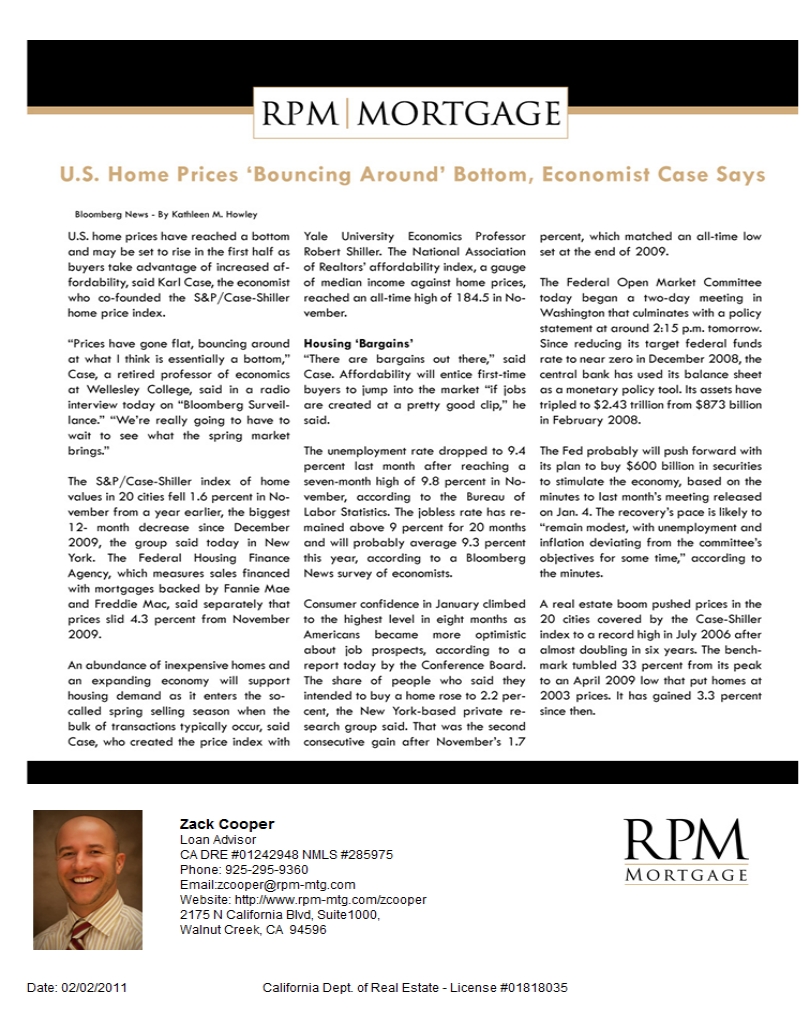
TEAM EMPOWERMENT MORTGAGE CHATTER: February 9; 1st Question To Ask Your Listing Agent; New-Home Recovery Post-Super Bowl; Obama and Freddie/Fannie; RPM HomePath Financing

“Every thought, action, decision, or feeling creates an eddy in the interlocking, interbalancing, ever-moving energy fields of life, leaving a permanent record for all of time. This realization can be intimidating when it first dawns on us, but it becomes a springboard for rapid evolution.” — Dr. David Hawkins: Physician, spiritual teacher, and lecturer


The First Question You Should Ask Your Listing Agent

What is the most important thing a seller should look for when hiring a real estate agent to sell their house? We are often asked this question. Is it the size of the company they are licensed with? Is it their marketing program? Their years experience in the business? Should you choose the agent who suggests the highest listing price?

There are many things that should be taken into consideration when hiring someone and giving them the responsibility for selling your home. In our opinion, the most important question you can ask a potential listing agent is a simple one:

Do you truly believe that now is a good time to buy a home?

Why should this matter when hiring someone to SELL your home? Buyers are nervous about purchasing right now. They want to know they are making an intelligent choice. We believe, especially in today’s market, you need to hire someone who realizes that this is one of the best times in American real estate history to buy. If an agent doesn’t believe that, how will they be able to convince a potential buyer to buy your home?

When interviewing a real estate professional, ask them to explain why purchasing a home makes sense today. They should be able to explain it simply and effectively. See how many of the following facts (which should be shared with every potential purchaser) the agent knows:

The Wall Street Journal last week stated:

“With home sales starting to improve, and with prices now possibly forming a bottom, real estate could well be the asset class that represents the best low-risk buying opportunity out there today.”

Donald Trump was just quoted saying:

“I’m pretty sure this is a great time to go out and buy a house. And if you do, in 10 years you’re going to look back and say, ‘You know, I’m glad I listened to Donald Trump’.”

John Paulson, a multibillionaire hedge fund operator and the investment genius who made a killing betting against housing a few years ago, is now bullish on residential real estate market. He recently said:

“If you don’t own a home, buy one. If you own one home, buy another one. If you own two homes, buy a third. And, lend your relatives the money to buy a home.”

A recent Gallup Poll showed that 67% of American’s think that now is a ‘good time’ to buy a home. The Gallup Organization went on to say:

“Overall, there is good reason for most Americans to think now is a good time to buy a house. Interest rates remain near historic lows. Home prices are down sharply, providing many incredible buys.”

The iconic financial paper in this country, the country’s most famous real estate investor, the most successful prognosticator of the housing market and 2/3 of all Americans say now is the time to buy a home. Shouldn’t your agent agree?

Bottom Line

Selling is nothing more than the transference of conviction. How can agents transfer that conviction if they themselves are not convinced? Find a listing agent who truly believes that someone should buy your home – TODAY! This is the single most important thing you should look for in a potential listing agent.

——————————————————————————–

New-Home Recovery Seen as Post-Super Bowl Selling Season Starts

Homebuilder executives and economists predict a post Super Bowl bounce in demand for residential construction as Americans turn their attention from football to another national pastime: house hunting.

The chief executive officers of six of the 10 largest U.S. homebuilders cited the potential of a sales comeback in the spring, traditionally their strongest season, during conference calls in the last four weeks. Housing forecasts from Fannie Mae and the Mortgage Bankers Association show the new-home market will begin a rebound that will last through at least 2012.

A revival in demand for new houses after record-low sales in 2010 may bolster a U.S. economy  that’s 19 months into a recovery. Residential construction is a key factor in gross domestic product because it requires the manufacturing of home components such as stoves, cement, tile and furnaces. Richard DeKaser, an economist at Boston-based Parthenon Group, said he expects the homebuilding industry will this year make its first positive contribution to GDP since 2005.

“The spring market is going to be the first test of the proposition that there’s an underlying improvement in new-home fundamentals,” DeKaser said in an interview. “If we don’t see the needle move, it will be very discouraging.”

CLICK HERE TO SEE THE ENTIRE ARTICLE

——————————————————————————–

Obama Due to Phase-Out Freddie Mac and Fannie Mae

The Obama administration will issue a proposal later this week recommending the gradual elimination of government-sponsored mortgage backers Fannie Mae and Freddie Mac, a White House official said Wednesday.

The highly-anticipated “white paper,” which is expected to be released Friday, will include three different options for reducing the role government plays in the mortgage market, the official said.

While the paper would mark an important development in the debate over what to do with Fannie and Freddie, a final decision by Congress is not expected any time soon.

After being rescued by the government in 2008, Fannie and Freddie have presented a major conundrum for policymakers in Washington.

The problem is that phasing out the two publicly traded companies could raise borrowing costs for homeowners and jeopardize the fragile housing market.

At the same time, Fannie and Freddie represent a major liability for taxpayers, who are on the hook for about $150 billion in federal aid the two institutions have received.

The issue has become politically charged, with some Republicans blaming Fannie and Freddie for contributing to the recent housing bubble. Democrats argue that the institutions help promote home ownership, especially among low- and middle-income Americans.

Given the political challenges involved and the threat to the housing market, any winding-down of Fannie and Freddie is likely to take place over a period of years.

A representative for Fannie Mae declined comment. Freddie Mac representatives did not immediately respond to a request for comment.

The three options in the administration’s white paper were outlined in published reports Wednesday.

The most conservative of the three options would involve no government role in the mortgage market beyond existing federal agencies, such as the Federal Housing Administration, according to the Wall Street Journal.

The two other options relate to the government’s place in the secondary mortgage market, previously filled by Fannie and Freddie. Under one option, the government would backstop mortgages during times of “market stress,” while the other recommends that the government be involved at all times.

In addition, officials could also reduce the maximum loan limit for mortgages that Fannie and Freddie are allowed to buy, and encourage them to raise the fees they charge banks to guarantee mortgages.

Other options that could be discussed in the white paper are gradual increases in the minimum down payments on government-backed loans, and an accelerated reduction in Fannie and Freddie’s loan portfolios.

CLICK HERE TO SEE THE ARTICLE – BROUGHT TO YOU BY YAHOO FINANCE

——————————————————————————–

Don’t forget, RPM Mortgage is your Fannie Mae HomePath Financing Lender

Make sure you’re aware of the First Look period with Fannie Mae HomePath homes. This is a perfect advantage for your owner occupied buyers against investors. I’ve provided a flyer below for more information. Now you have a HomePath Lender you can call!

TEAM EMPOWERMENT MORTGAGE CHATTER: February 7; Fannie & Freddie update; Reducing Size of mortgages for government backing; Confusing Employment Report; RPM Co-Branding


“If we all worked on the assumption that what is accepted as true is really true, there would be little hope for advance.” – by Orville Wright

 The government has flown past its January 31 deadline for a proposal on the future of Freddie and Fannie, and things may drone on for a while. (For the folks at the agencies, it is probably like knowing your boss and your boss’s boss are talk about you in the office down the hall.) Rep. Scott Garrett, chairman of the House Financial Services Committee’s Subcommittee on Capital Markets, announced that he would hold a hearing Wednesday on Feb. 9 on reforming Fannie Mae and Freddie Mac. “This hearing will be the first in a series of hearings to examine the steps Congress can take right now to protect taxpayers from the ongoing bailout of Fannie Mae and Freddie Mac.” The hearing is titled “GSE Reform: Immediate Steps to Protect Taxpayers and End the Bailout,” and will focus on immediate steps that Congress can take to begin F&F’s transition out of Federal conservatorship and examine ways to end the $150 billion bailout.

Speaking of proposals, it is heavily rumored that the Obama administration will recommend reducing the size of mortgages eligible for government backing. If that happens, it will, of course, make obtaining a home loan in high-priced areas more expensive. The $729,750 figure, of course, is only temporary and only available in certain areas. (In the old days, conventional loan limits were set around Thanksgiving, with secondary marketing managers being hounded by producers leading up to the announcement.) “The administration is now likely to suggest that Congress allow the policy to lapse as scheduled in September, lowering the loan limit to $625,500.” Limits

So investors were watching closely Friday when the prepayment speeds were announced. The aggregate prepayment speeds for Fannie Mae 30-year securities dropped 24%, for example, and speeds dropped much more for recent vintages. For seasoned pools, prepayment speeds came in faster than many had projected. Prepayments are based on many things: age of the loan, maturity, original note rate, potential of using HARP for streamline refinances, etc. Barclays, for example, suggests that over the next few months 30-yr prepayments should continue to slow significantly, and that the “2010 “vintage” will likely prepay significantly slower than its 2009 counterpart, for multiple reasons. One factor that may not have been priced in by the market is that the 2010 vintage has a large concentration of HARP-refinanced loans, which should prepay much slower than average. The biggest risk to prepayments right now is a possible expansion of the HARP program to all GSE loans. That would lead to a sharp rebound in the speeds of 2009 and later production.”

Friday topped off a bad week for rates with a very confusing Employment report followed by confusing price action. The headline drop in the Unemployment rate from 9.5% to 9% generated some large block selling, but a good percentage of analysts believe deep down this report looks pretty weak with only 36k jobs created and the rate plunge largely based on the unemployed giving up on their job searches. The BLS reported that bad weather kept over 700,000 Americans from work during the survey week, which certainly introduced a negative bias into things. The weather does not have as much of an impact on the Household Survey and the big story is the fact that the unemployment rate plunged 40 basis points to 9.4%.

Is the January Jobs Report Stronger Than It Appears? The confusing employment report on Friday reflected a dramatic drop in the unemployment rate without a strong uptick in job creation. Is the unusually large amounts of snowfall to blame for the negligible progress in job growth in January? The household survey reports a 117,000 rise in employment for January, much more than the 36,000 gain in payrolls reported via the establishment survey. The establishment survey has a smaller margin of error compared to the household survey because of its much larger sample size.

Bernanke Bets Commodities Won’t Fan Inflation Concern. Surging food and energy prices won’t accelerate U.S. inflation, allowing Fed to maintain easy money.

Fed Spends 40% on Benchmark Treasuries as Newest Prove Cheapest. The Federal Reserve’s Treasury purchases already have succeeded in driving investors to junk bonds and stocks. Now the are focus is on benchmark government securities, helping contain rising yields that set rates on everything from corporate debt to mortgages.

TEAM EMPOWERMENT MORTGAGE CHATTER: February 4: HUD Webinar; Buying a home cheaper than renting?; A Few Headline News Items; Zillow Feeding Listings to Yahoo; Today’s Rates; What a Realtor Should Ask An Appraiser


Happy Friday!  This is a pretty exciting weekend for you sports fans. Super Bowl XLV Sunday is almost here (Halftime Gig Announced – Black Eyed Peas, Fergie says “No Wardrobe Malfunctions”, I wonder what she’s referring to?? Ahh Yes, Janet Jackson!)!  Whatever your plans may be, be safe!  For all of us keeping it local, those that will actually be at the game will be bundling up big time with the weather in Dallas!  Can you say “Hello Snow!!!”.  Hosting this Sunday? Here are a few Super Bowl Snack ideas! I’m here in the office today, going into the weekend let me know if you need anything.  I’ve provided Today’s Rates should you need a pre-approval before the weekend. I’ve also shared a few questions a Realtor should be asking an appraiser. Just a reminder, RPM Mortgage has it’s own in-house, local appraisers!  Have a wonderful weekend!

“What could you not accept, if you but knew that everything that
happens, all events, past, present, and to come, are gently
planned by One Whose only purpose is your good?”
— Quote from A Course in Miracles

If you are wondering what to do on February 16th, why not listen in on HUD’s webinar “HUD-approved Housing Counseling Operation and Funding Overview.” This webinar will provide information on operational requirements, record keeping & reporting, use of HUD electronic systems, overview of the new HUD Counseling Handbook, etc. It’s free, although registration is required as are computer & internet access. For more information visit: HudWebinar


Recently Trulia compared the median list price with the median rent on two-bedroom apartments, condominiums, townhouses, lofts and co-ops listed on its website, and compared that to ownership costs including mortgage payments, property taxes and insurance. It determined that buying a home is cheaper than renting in 72% of the largest U.S. cities, led by Miami and Las Vegas. People have to live somewhere, right? And if your credit is shot… Trulia’s CEO stated, “Following the principles of supply and demand, renting has become relatively more expensive than buying in most markets.” RealtyTrac has reported that 2.87 million homes received notices of default, auction or repossession in 2010, while apartment vacancies are at a 2-year low. It is no surprise that the top 10 cities where buying is cheaper are all in Florida, Nevada, Texas, Arizona and California, as, except for Texas, those states were among the five with the highest foreclosure rates in 2010. 

Yesterday, after the daily commentary went out, we learned that Factory Orders rose 0.2% in December, and that the ISM Nonmanufacturing Index rose 2.3 points to 59.4 in January, hitting a new recent high. Federal Reserve Board Chairman Bernanke himself said yesterday that the low inflation rate combined with high unemployment would normally push the Federal Open Market Committee to cut rates, if they weren’t already near zero. “Although economic growth will probably increase this year, we expect the unemployment rate to remain stubbornly above, and inflation to remain persistently below, the levels that Federal Reserve policymakers have judged to be consistent
over the longer term with our mandate…” 

HEADLINE NEWS


Unemployment Rate Falls 0.4% to 9% in January; Payrolls Rise 36,000; both surprising in different directions as the Unemployment rate was projected to rise to 9.5%, and Non-Farm Payrolls 140k. Average hourly earnings increased by 8 cents to $22.86 and the average workweek for all private-sector employees edged lower to 34.2 hours in January. Payrolls in construction (-32,000) and transportation (-38,000), industries most affected by bad weather, dropped in January, while factory employment rose 49k, the most since August 1998. Private-sector jobs increased by 50,000 (private account for about 70% of the work force). The benchmark revisions show 2010 ended with 483,000 fewer jobs than prior to the revision.


Freddie Mac Survey: Mortgage Rates Show Mixed Results This Week     . The 30yr Fixed Rate mortgage averaged 4.81%  up from 4.80%, the 15yr rate averaged 4.08% down from 4.09% the prior week.

Obama officials likely to propose lowering loan limit for pricey mortgages      , and may recommend reducing the size of mortgages eligible for government backing.


ZILLOW FEEDING LISTINGS TO YAHOO REAL ESTATE

Zillow.com is now powering for-sale listings on Yahoo Real Estate and selling ads that feature real estate agents and brokers on both sites, the companies said as they flipped the switch on a partnership announced in July.

Zillow said it’s providing 4 million for-sale listings to Yahoo Real Estate, which continues to maintain its own separate databases of foreclosure properties, newly constructed homes and rentals.

The partnership allows real estate agents to place local ads on Yahoo Real Estate — a capability previously offered by Zillow, but not Yahoo Real Estate — and increases the number of listings and photographs buyers see on Yahoo Real Estate, the companies said.


The partnership effectively doubles the exposure agents and brokers who purchase advertising from Zillow.com receive, CEO Spencer Rascoff said when the companies joined forces to create what they touted today as “the largest real estate network on the Web.”


TEAM EMPOWERMENT MORTGAGE CHATTER: February 3rd; Top 10 free real estate apps for Android; HUD report; FHA Anti-Flipping Rule; Real Estate Connect SF 2011; RPM Co-Branding & HomePath Financing

 “If we all worked on the assumption that what is accepted is true is really true, there would be little hope for advance” – Orville Wright

As was mentioned yesterday, ARM business is on the rise. Buried in the MBA’s weekly survey yesterday was a note: applications for adjustable rate mortgages posted a weekly jump of +17.8%.

Yesterday was not the best day for the fixed-income markets. They started off pretty well, in spite of the strong ADP number, and the yield on the 10-yr was sitting around 3.40% – comfortably inside the range it has been in for a few months. But by the end of the day the 10-yr had touched 3.50%, and MBS prices were worse by .125-.250, blamed on another better-than-expected economic report (ADP) and worries about inflation related to higher commodity prices. (Since last Friday’s close, 10-year Treasuries have dropped 1.25 in price with the yield increasing about .16 %.)

Today and tomorrow are busy days for economic news, which so far are showing strength. We’ve had Jobless Claims, Productivity, and Unit Labor Costs. Productivity was +2.6% (better than expected) and Unit Labor Costs were down .6%. Jobless Claims went from 457k down to 415k, down 42k. The 4-week moving average is +1k. Ahead of us, at 8AM MST, are Factory Orders and ISM Non-Manufacturing Index. And tomorrow we will have the Nonfarm Payroll number, expected to be +140k. But after this early news, the 10-yr is still sitting around 3.50% and MBS prices are a shade worse.

Top 10 free real estate apps for Android

Search giant Google unveiled a new Web-based mobile applications store for smart phones powered under its Android operating system Wednesday.

The Android Market, which had only been available on Android smart phones until now, is now accessible through any Web browser. The portal allows users to easily search for and install apps that can be set up to automatically download to a user’s Android device.

The following rankings come from the new store, which allows users to filter apps by popularity and price. There is no formal “real estate” category in the Android Market; these apps appear in a search of the phrase “real estate” on the site. All are free.

HUD reports rise in ‘worst-case’ housing needs

Unemployment, the housing crisis and high rents have contributed to a rising number of households with “worst-case” housing needs, as defined by the U.S. Department of Housing and Urban Development in a report to Congress.

Residents in an estimated 7.1 million households in 2009 were very-low-income renters who did not receive any housing assistance and paid more than half of their income toward rent and/or lived in severely inadequate conditions — up 20 percent from 2007 and up 42 percent from 2001, according to the HUD report, released this week.

“High rents in proportion to renter incomes are an increasingly dominant cause of worst-case needs,” the report concluded.

FHA Extends ‘anti-flipping’ waiver

Homebuyers relying on FHA-insured financing will still be able to buy homes that have changed hands in the last 90 days, thanks to a decision by the Federal Housing Administration to extend a temporary waiver of its “anti-flipping” rule through the end of the year.

The anti-flipping rule — a 90-day waiting period implemented in 2003 to protect the FHA’s mortgage insurance program from losses — already included an exemption for homes repossessed by Fannie Mae, Freddie Mac, and state- and federally chartered financial institutions.

But last year, FHA took the additional step of waiving the waiting period for all resale’s — including homes purchased and rehabbed by private investors.

Since the broad waiver went into effect on Feb. 1, 2010, FHA said it has insured 21,000 90-day property flip loans worth more than $3.6 billion that would otherwise not have qualified for financing.


REAL ESTATE CONNECT – SF

JULY 27-29, 2011

For those of you interested in the Real Estate & Technology Connect this year click on the link above to register today!

Real Estate Connect® brings together the brightest minds in the real estate and technology industries for three incredible days every year in San Francisco and in New York. Each year, thousands of influential thought leaders gather at Real Estate Connect to discover emerging trends in technology, to network with top real estate leaders, to meet the up-and coming start-up companies, and to learn how to leverage the change that surrounds the real estate industry.

Founder Brad Inman says, “It was clear to me that the old industry was in fear and was doing everything it could to squelch innovation. I started Connect to give the new breed a platform to connect with enlightened members of the legacy industry. We created a safe place for the young entrepreneur to shout from the roof top to introduce their products.”


TEAM EMPOWERMENT MORTGAGE CHATTER: Feburary 2; Freddic Mac; MBA; Shadow Inventory; RPM Article: Bloomberg News (US Home Prices); RPM CO-Branding

 “Having a why – a powerful, compelling
reason – is the one thing no one can give you.” –    Stephen Pierce:  Internet marketer and author
 
 In the last quarter of 2010 Freddie Mac reported that 46% of homeowners who refinanced lowered their principal by putting in more money at closing, the highest cash-in percentage on record. Meanwhile, Freddie’s cash-out borrowers fell to 16% of all loans, the lowest percentage on record. Combine that with the MBA is projecting residential origination will drop below $1 trillion (2002-levels, and a 35% decrease from last year), expecting new home purchases to rise 30% & refinancing activity expected to fall 66%, and we have a different market. Keep on top of those business plans!
MBA Weekly Mortgage Applications Survey Market Composite Index increased 11.3%, Refinance Index increased 11.7 %, and the Purchase Index increased 9.5%. “Applications increased this week relative to the holiday week,” said Michael Fratantoni, MBA’s Vice President of Research and Economics. “Looking over the past two weeks, purchase applications are flat, and refinance applications are down about five percent.” The refinance share activity decreased to 69.3% and the ARM share increased to 5.5%. The average 30-year rate increased to 4.81% from 4.80% and 5-year rate increased to 4.13% from 4.12%.


The Federal Reserve Board on Tuesday announced that it does not expect to finalize three pending rulemakings under Reg. Z, which implements the Truth in Lending Act, prior to the transfer of authority for such rulemakings to the CFPB. RegZ
 

As the “flight to quality” concerning Egypt continued to ebb out of the market, yesterday fixed-income prices continued to worsen, pushing rates higher. 10-yr notes were worse by .5 (with the yield closing at 3.44%), and mortgage-backed security prices worsening by about .375. MBS sales also picked up a little, not a particularly good sign during a sell-off. Mortgage prices often trade as a spread to Treasury yields, and one trader reported that “spreads were about in the middle of their recent range, so not exactly enticing for money managers. Lower prices, however, helped and brought in some real money interest through the morning session; however, it was more than offset by modest supply and better selling.”
In terms of economic news, the ISM manufacturing number slowed in January, but still showed growth. The January reading was the strongest level since May 2004. On the flip side, Construction Spending fell 2.5% in December, and was 6.4% below its level in December 2009. This’s morning’s ADP number, with its dubious predictive power, was higher-than-expected. Currently the 10-yr yield is sitting around 3.40%, down from Tuesday’s close, and MBS prices are .125-.250 better.


 What Exactly Is Shadow Inventory?

 It is difficult to read an article about real estate today without the term “shadow inventory” being mentioned. But, what exactly is shadow inventory? It refers to the inventory of homes not yet for sale that will eventually come to market in the near future. Most definitions include properties already foreclosed on and owned by the banks (REOs), those houses in the foreclosure process and those homes where the homeowner is seriously delinquent on their mortgage payment (at least 90 days behind).
There are many questions about shadow inventory. Here are the most common misunderstandings addressed: 

I’ve heard about shadow inventory for years. Does it really exist?

Not only does it exist, it is being slowly released onto the market. The National Association of Realtors has reported that over 30% of all home sales over the last few months have been distressed properties.

Why include seriously delinquent homes in this number?


Seriously delinquent are counted because studies show that 98% of all those who fall 90 days behind never catch up and these properties eventually come to the market as distressed sales (short sales or foreclosures).
 

Do banks have a backlog of properties that they currently own?

Yes. In an article

in Housing Wire, RealtyTrac Senior Vice President Rick Sharga said:
“…major banks currently hold roughly 1 million REO, or homes repossessed through foreclosure, but only 30% have actually made it onto the market.”


Why are banks holding this inventory?

The article mentioned above answers this question this way:

Striking a proper balance on how to mange this shadow inventory of foreclosures is vital for the banks to show a healthy balance sheet while not dumping too many distressed properties onto the market, further dragging down home prices and values.


Isn’t most of this inventory sub-prime and exotic mortgages?

Not any longer. A study 


recently done by Morgan Stanley shows that:


26.3% of the loans are sub-prime
17.4% are Alt-A
56.2% are prime mortgages

Right now, prime mortgages make up the majority of loans in this shadow industry.

Isn’t most of this inventory confined to CA, AZ, NV and FL?

Not any more. The Morgan Stanley study showed:

…the shadow inventory is growing across all of the United States…” While hard-hit cities represent a more than fair share of shadow inventory, its distribution broadly encompasses all corners of the country,” said the analysts.


Bottom Line

Shadow inventory is real and will impact almost every part of the country. Make sure you ask a local real estate expert to find out how it may impact your market. 


 A FEW HEADLINES IN THE NEWS TODAY:

Can anything end this ‘Groundhog Day’ of a winter?   All this snow will affect commerce, the economy, and will most likely cause volatility in economic indicators.

that was less than the original report of 297,000. The median estimate called for a gain 140,000 gain in January. Friday’s BLS Non-Farm Payrolls report is forecast to show 140,000 jobs increase in January, with the jobless rate at 9.5%.
 

. The U.S. Treasury Department today said it would keep its long-term borrowing at steady levels and warned that the federal debt limit could be reached as soon as April 5. 

Treasuries Advance as Egyptian Concern Reemerges, Fueling Demand for Haven   , and are now down slightly. UST price support comes on concern political turmoil in Egypt may worsen, fueling demand for safe assets, as well as Fed buying of $1.5 billion to $2.5 billion of notes maturing between 2021 and 2027 today as part of QE2. The 10-year UST yield is at 3.45 this morning and has ranged between the 3.25% and 3.5% range this year. The US will sell $72 Billion UST’s at the quarterly refunding next week in the form of $32 billion in 3-year notes, $24 billion in 10-year notes and $16 billion in 30-year bonds.


TEAM EMPOWERMENT MORTGAGE CHATTER: January 31: HUD & FHA updates; GSE reform call; Does It Make Sense to Buy A Home?; Todays Rates; RPM Jumbo Program; Highlights of Whats In The News

“If passion drives you, let reason hold the reins.” – by Benjamin Franklin

Anyone interested in GSE reform and servicing compensation may want to listen in to a Banc of America Securities/Merrill Lynch call today at 7AM PST. Participant Passcode: 1239593, dial-in number US/CAN Toll Free: 1-888-797-2983. (It will also be available for the next 7 days, in replay form, at 1-888-203-1112, Passcode: 1239593.)

HUD issued a mortgagee letter focused on a change in the remittance process for over claimed amounts of FHA single family claims. This modification of the existing process is being made in response to the Department of the Treasury’s mandate for all agencies to switch from their current lockbox services to Treasury’s Pay.gov collection service. HUD

The FHA flipping waiver was extended. FHA’s “temporary” waiver of the agency’s ‘anti-flipping rule’ was extended through 2011. With certain exceptions, FHA regulations prohibit insuring a mortgage on a home owned by the seller for less than 90 days, but this is now waived. “Since the original waiver went into effect on last February, FHA has insured more than 21,000 mortgages worth over $3.6 billion on properties resold within 90 days of acquisition.”

And finishing up with HUD, recently HUD provided additional guidance on claim filing requirements for FHA’s refinance program for underwater borrowers. The program, begun last August, taps funds from the Emergency Economic Stabilization Act (EESA), administered by the Department of the Treasury, for partial payment of a mortgagee’s unpaid principal balance. HUDUnderwater.

The news out of Egypt on Thursday/Friday pushed bond prices higher & rates lower, and the stock market lower. MBS volume, depending on who you ask was either next-to-nothing or above the recent average. 10-yr notes rallied almost .5 down to a yield of 3.33%, and rate-sheet MBS prices were better by .250-.375, depending on coupon.

As long as Egypt hangs in there, and Europe doesn’t crumble, and China continues to buy our debt, the biggest economic event this week will be the employment report on Friday. Today we’ve already had Personal Income and Consumption (Spending), along with the PCE Prices number. PI was +.4%, as expected, and PC was +.7%, stronger. Later, at 7:45AM MST we have the Chicago Purchasing Manager’s numbers. After these numbers the 10-yr is at 3.36% and MBS prices are about .125 worse.

——————————————————————————–

Does It Make Sense To Buy a Home?
The financial turmoil we have experienced over the last five years has definitely taken it’s toll. It has especially been a difficult time for real estate. Nationally, values have fallen over 25% and there may be more softening in prices to come. We realize that this has caused difficulty, and in some cases, heartbreak for many families. People unable to make their mortgage payments have been forced to sell or, even worse, have faced foreclosure.

However, the thing that has continued to amaze us is the country’s steadfast belief in the benefits of homeownership even in these most difficult of times. The vast majority of Americans still realize that the value of a family owning a home goes far beyond just the financial considerations.

There have been three major surveys done in the last 75 days delving into Americans’ current belief in the value of owning a home:

The National Housing Survey by Fannie Mae this past November.
The Housing Survey by the Gallup Organization completed last month.
The American’s Attitudes About Homeownership (AAAH) study completed by Harris Interactive for the National Association of Realtors.

Each showed the country still believes that buying a home makes all the sense in the world. Let’s consider some of the findings:

Is owning a home good for a family?

In the AAAH study, 87% of homeowners and 64% of renters believed that “owning a home provides a healthy and stable environment for raising a family”.

The Fannie Mae study showed that the main reason people gave for buying a home is that “it is a good place to raise children and provide a good education”.

Has owning a home been a positive experience?
 

AAAH: The study shows that an astonishing 88% say it has been “a positive or very positive experience”. An overwhelming majority of home owners are happy with their decision to own a home. A full 93% of owners surveyed would buy again.

Fannie Mae: The study shows that 95% see homeownership as a “positive experience” for them and their families.

Do renters aspire to own a home?

AAAH: Most renters aspire to home ownership. The majority of renters (63%) say they are at least somewhat likely to purchase a home at some point in the future. Among them, young adults (18- to 24-years-old) have the strongest aspirations for home ownership.

Fannie Mae: 67% of renters plan to purchase a home in the future.

Is now a good time to buy a home?

AAAH: 78% of homeowners and 58% of renters believe now is a good time to buy.

Fannie Mae: 64% of those surveyed said it is a good time to buy a home.

Gallup Poll: 67% of Americans think now is a good time to purchase a home.

Bottom Line

Survey after survey report Americans believe two things: that there is a value in owning a home and that now is the time to buy!! What are you waiting for?

——————————————————————————–

WHAT’S IN THE NEWS?

Personal Income Increased 0.4% in December and Consumer spending increased 0.7%, higher than expected and increasing trend for sixth month in a row.  Spending for all of 2010 rose 3.5%, the fastest pace in three years, and the best performance since a 5.2% rise in 2007.

Influential Proposal to Outline Fannie, Freddie Fixes: All MBS would carry explicit government guarantees; Fees charged on mortgage bonds would finance a catastrophic risk insurance fund; If a mortgage firm became insolvent, the government would guarantee payments to investors on their securities, but the firm itself wouldn’t be rescued; Multiple firms would issue the same mortgage security, allowing for liquidity if one issuer failed. It is estimated that the proposal would increase mortgage rates by .5 of a percentage point on 30-year fixed, compared to the increase of 2 to 3 percentage points increase without such a guarantee as estimated by mortgage investors.

TEAM EMPOWERMENT MORTGAGE CHATTER: January 27: 5 Tips for 2011; Freddie & Fannie chatter; MBA priorities for 2011; RPM Jumbo Program; RPM Co-Branding

 “Never let what you cannot do stop
you from doing what you CAN do!” 
Stephen Pierce:  Internet marketer and author 
 

5 Tips for 2011

1. Build Your Listing Inventory

This will be the year that people again realize that there are more than just financial benefits to homeownership. They’ll remember that homeownership is still the American Dream. We believe that there will be a growing number of people ready, willing and able to purchase homes in 2011. For that reason, you must build a salable inventory of listings.

Make believe you own a shoe store and you know there will be a surge of buyers coming in over the next week. You should want to have every shoe, in every size and every color so that you can please every buyer. Now apply that to your real estate business.


2. Be Strong on Price

Many listings will sell in 2011; but not all of them. The inventory is still way too high in most communities and there will be more distressed properties (short sales and foreclosures) entering the market in the 2nd and 3rd quarters of this year. That will continue to put downward pressure on home prices.
Make sure that you counsel your sellers accordingly. They depend on you to help them price their house properly so it will sell and they, and their families, can move on with their lives. Don’t let them down!

3. Develop a Great Buyer Presentation Manual

The buyers will be out in large numbers this year. However, they will still have concerns as to whether or not this is a good time to buy real estate. Over the last few years that concern has turned into fear which resulted in many buyers staying on the sidelines. They were afraid to purchase, and therefore didn’t.

All fear comes from a lack of understanding. We must be prepared to educate purchasers as to why now is the PERFECT time to buy. Not just because we said so and they should listen to us. Instead, we should explain today’s market and shed light on the opportunities that exist.


We have to be prepared for every appointment. We should also be prepared for every, what we call, ‘pre-appointment’ interview. These are the times when you bump into someone in the store or at your child’s basketball game and they ask you “How’s the real estate market?” These informal conversations are crucial today. If we handle them professionally we will have an impact on that person’s perception of the market.
We have pictures of our children and/or pets on our mobile devices (phones and iPads). We must also have great visuals to help people understand what is happening in the market. If we handle the pre-appointment interview well, we will get more listing and buyer appointments. The result will be more transactions.

5. Realize This Will Be YOUR Year!

The last few years were rather difficult for real estate professionals. The nation’s financial meltdown and all the stimulus packages that followed put the market in the hands of outside influencers. We were forced to be reactive instead of proactive. That has all changed. For the first time in almost 5 years, we are back in control.
TAKE CONTROL! Your success is firmly in the hands of the person who should be molding it – YOU! Think Big and Dream Big. This is the year that agents will make small fortunes.


According to a story in the Financial Times, Freddie and Fannie have been quietly lobbying the US Treasury to cut the dividend they pay on preferred stock issued as part of their government bail-out. “A lower dividend would allow the two to begin repaying $150bn in taxpayer aid, these people said. It would also pave the way for a restructuring of the companies by cutting the amount of outstanding preferred stock held by the Treasury. Were it not for the dividend, both Fannie and Freddie would be close to breaking even. “Borrowing from the Treasury to repay the Treasury doesn’t make a whole lot of sense,” said Bose George of Keefe, Bruyette & Woods
 Moving on, the MBA released its 2011 legislative and regulatory priorities. The MBA has come under some criticism lately for focusing on the needs of its larger members, sometimes at the perceived expense of the mid-sized and smaller mortgage bankers. Regardless, here is what’s going on for 2011: http://www.mbaa.org/files/IssueBriefs/2011LegislativeandRegulatoryPriorities.pdf  


The National Association of Mortgage Brokers (NAMB) sent a letter to the Fed, among others, asking for the delay in enforcement of the changes to Regulation Z for 12 months and “for further clarification pertaining to loan originator (LO) compensation which is set to be enforced as of April 1.” http://www.namb.org/images/2011-01-18_Letter-to-Federal-Reserve_LO-Compensation.pdf 
 

The Federal Reserve just released its Reg. Z and TILA compliance informationhttp://www.federalreserve.gov/bankinforeg/regzcg.htm  


Yesterday’s New Home Sales turned some heads. Released by the Census Bureau and HUD, it showed a 17.5% increase in single-family home sales rather than the 3.1% that was expected. “Out West” sales were up over 70%. But for the year, NH Sales were down 14% from 2009’s levels, which weren’t anything to write home about either.
 

MBS prices finished the day worse by .375-.50, and US 10-year notes were down (worse) by .875 to yield 3.43%. Today we have some news, but it is not at the importance level of yesterday’s news. We will have the usual Jobless Claims, along with Durable Goods, Pending Home Sales, and the Treasury’s auction of $29 billion 7-yr UST notes. Ahead of those, the yield on the 10-yr is about 3.47%, and MBS prices are worse about .125.


4. Get Mobile With All Your Information  

1. Build Your Listing Inventory

This will be the year that people again realize that there are more than just financial benefits to homeownership. They’ll remember that homeownership is still the American Dream. We believe that there will be a growing number of people ready, willing and able to purchase homes in 2011. For that reason, you must build a salable inventory of listings.

TEAM EMPOWERMENT MORTGAGE CHATTER: January 25: Freddie & Fannie’s future delayed; NMLS public comment; The “Real” American Idol; RPM Jumbo Loan Program Press Release; Co-Branding


“There’s lots of people in this world who spend
so much time watching their health that
they haven’t the time to enjoy it.” Josh Billings: 19th century humorist

 Plans for Freddie and Fannie  – which are “required” by the end of January per Dodd-Frank, have now been pushed back until mid-February. “Officials say the delay is needed to accommodate other major policy initiatives, including next month’s release of the annual budget and the president’s State of the Union address today.”

While we’re on the topic, wanna buy a house? Call the agencies – Fannie & Freddie’s combined inventory of foreclosed residential property has quadrupled in just three years and now stands at $24 billion, and the number of properties on their books (over 241,000) has increased fivefold. That’s roughly a third of the total U.S. portfolio of repossessed homes. And the numbers show no signs of declining, since it seems that nationwide foreclosures are going up faster than buyers can be found.

The Nationwide Mortgage Licensing System and Registry (NMLS) is conducting the third annual NMLS User Conference & Training February 7-10, 2011 in Orlando, Florida. “The NMLS User Conference & Training brings together state and federal mortgage regulators, industry professionals, compliance companies, top law firms, and education providers to learn about the latest developments in mortgage supervision and to discuss pressing issues confronting the industry.” Website: NMLS

There is word out there that the FHA will suspend its anti-flipping rule for a second year in 2011. HUD’s existing rule, that prohibits the FHA from insuring a mortgage on a home that was owned by the seller for less than 90 days, was temporarily put on hold last February to help liquidity. There are certain restrictions, well known in the industry, but a HUD spokesman reported told HousingWire that the rule is currently “in the clearance process.”

Yesterday MBS prices worsened by .125, which was not enough for many investors to change their pricing and instead they let it eat into their profit margins. MBS volume was light, probably reflecting the state of new rate locks coming in the door. 10-year notes closed around 3.41%. Today for economic news we have nothing too dramatic: the Case-Shiller 20-city Index, along with Consumer Confidence, the FHFA Housing Price Index, the 2-yr auction, and tonight’s State of the Union Address. One issue contributing to this morning’s markets here in the US was a much-lower-than-expected GDP (Gross Domestic Product) number out of the UK. We find the 10-yr yield down to 3.35% and MBS prices better by roughly .250.

The Real American Idol – HOMEOWNERSHIP!
 
Simon Cowell would have to be considered congenial compared to the critics of real estate in the last few years. But like the popular TV show, where the ultimate winner is not chosen by a select few but instead by the vote of the nation, homeownership again has proven to be the choice of the people. There have been numerous survey’s and polls done in the past 90 days that confirm this.

  
American Attitudes About Homeownership is a new survey conducted by Harris Interactive for the National Association of Realtors. The findings of this survey combined with the findings of Fannie Mae’s November National Housing Survey and last week’s Gallup Pollpaint a clear picture that the majority of Americans still value homeownership and believe in its benefits. In the latest survey, America’s belief in owning a home came through loud and clear.
Here are a few of the findings:

 
Homeowners and renters agree that owning a home is a positive choice. A majority of homeowners and a sizable percentage of renters agree or strongly agree that owning a home provides a healthy and stable environment for raising a family (87 percent among homeowners and 64 percent among renters), that it helps them meet long-term financial goals (77 percent among homeowners and 55 percent among renters) and it helps them realize the American Dream (70 percent among homeowners and 48 percent among renters).

Most homeowners (95 percent) and renters (72 percent) believe that over a period of several years, it makes more sense to own a home than to rent

More than 8 in 10 homeowners (82 percent) and half of renters (50 percent) would prefer to buy a home if they had to move in the next six months. Furthermore, 78 percent of homeowners consider now a good time to buy as do 58 percent of renters.

Homeownership is viewed as a positive experience while less so for renting. Eighty-eight percent of current homeowners report that owning a home has been a positive or very positive experience. About half of renters (51 percent) consider their experience as positive or very positive.

Many renters aspire to homeownership. More than 6 in 10 renters are at least somewhat likely to purchase a home in the future and 24 percent indicate that they are extremely likely. Among young adult renters, 74 percent say they are likely to buy at some point in the future. About one-third (35 percent) of renters plan to purchase a home in the next 3 to 5 years (43 percent among young adult renters).    

We have argued for some time that the benefits of homeownership are more than just financial. This survey addressed this point and reported:  

 Bottom Line

A larger share of homeowners than renters describe their communities as safe and stable. Homeowners also report that they are more satisfied with their community and family life. While many factors contribute to a positive community environment, a large percentage of homeowners and renters believe a high rate of homeownership is one factor. Homeowners generally feel more connected to their communities, participate in community and civic activities more frequently and are more likely to know their neighbors well.

Owning a home has both financial and social benefits for your family. Today, you can buy a home at a discounted price and at an historically low interest rate. Why wait?  

 PRESS RELEASE – RPM STRIKES A “JUMBO DEAL”


 RPM is pleased to announce that it has entered into an agreement with a major Wall Street firm that will allow RPM to offer Jumbo loans up to $2 million. With this new product available to its clients, RPM anticipates originations over $1 billion within the first six months of this year.

Rob Hirt, CEO of RPM, is ecstatic about the new Jumbo loan capabilities which he feels will be a real “game changer” for the company.

“After an almost three year hiatus, it looks like Jumbo liquidity is making a comeback!” said Hirt. “This is excellent news for borrowers who need loans above $729,000 which is the maximum loan offered by Fannie Mae, Freddie Mac and FHA.”

The program will allow RPM to lend a 30 year mortgage up to $2 million on a home with the buyer making a 30 percent down payment, and up to $1 million with a 20 percent down payment.

Pricing for this program easily competes with the banks who are “too big to fail” and have made it so difficult for borrowers to obtain loans. Moreover, RPM has the ability to internally underwrite these loans and can use RPM Appraisal Services’ local appraisers to value the property versus the national appraisal companies sending in an appraiser from out of the area.

Hirt sees a lot of potential with this new product and believes that it will allow RPM to tap into untouched markets and really capitalize on Jumbo loans, which is a huge advantage the company now has over competitors.

“Believe it or not, interest rates are still at 40 year lows,” said Hirt. “Part of the problem now is that anyone that had a conforming loan has most likely refinanced. But the Jumbo market has been dead in the water! But not for long!”

RPM is in the midst of building partnerships with other large Wall Street firms that will hopefully be able to deliver more Jumbo products to RPM. With these products now available, RPM has a bright future for purchase money originations.

RPM Mortgage, Inc. is based in Walnut Creek and is a private family-owned mortgage bank and broker whose roots in the Bay Area stem back to 1986. RPM has 42 branches in California, Nevada, Texas, Idaho, Colorado and Connecticut and over 700 loan agents and employees. RPM’s loan agents are specially trained to offer FHA, VA and CalSTRS loan programs to their customers. They work with borrowers, realtors, CPAs, financial planners, attorneys and financial consultants to provide home buyers with the best financial solutions in the market today.

Visit The RPM Website: Jumbo Loan Program – RPM Mortgage Press Release


TEAM EMPOWERMENT MORTGAGE CHATTER: January 24; Distressed Inventory; RPM Jumbo Program; RPM Co-Branding


“The indispensable first step to getting the things you want out of life is this: decide what you want.”   – Ben Stein


To all of you sport enthusiasts keeping track of who will be meeting each other at the next Super bowl, looks like we’ll be watching the Steelers and Green Bay on Sunday, February 6th. To start off a new week, the news is light, but we do have some RPM News! If you haven’t talked to me about it yet, we’ve got a new 30 Year Fixed Jumbo Loan program rolling out, call me for more details. As mentioned last week, this feature is one of many from RPM, aside from our loan programs offered we also have our own manually underwritten loans which are done in-house as well as our appraisals, also done by in-house by appraisers who are local and know our market and areas. Don’t forget about co-branding, this is a great opportunity for you to continue your marketing even after a home is sold and you’ll also be able to utilize our co-branding library for open house flyers and more! Have yourself a great Monday and a wonderful week! I’m in the office today so please do not hesitate to contact me to discuss any of the above mentioned information or if you’ve got a loan scenario or need a pre-approval!

Rates continue to chop along. MBS prices were better by .250-.375 on Friday, and the 10-yr sitting at 3.42% keeps us right in the middle of our recent range. Traders reported “Seeing good buying of the basis by hedge funds and decent real $ buying 4.5s and 5s is helping MBS firm up into the afternoon. With the expectation of supply being light into the afternoon and continued rally, MBS could go out pretty well to end the week.” The same might be said for this week.

The biggest economic event this week will be Wednesday’s FOMC meeting, with an update on the economy and the Fed’s plans for monetary policy (but don’t look for any change in overnight rates). For economic news, there is nothing slated for today. Tomorrow we have the Case-Shiller 20-city Index, along with Consumer Confidence, the FHFA Housing Price Index (I lose track of the dozens of house price indices that come out every month), and, of course, the State of the Union Address. Wednesday we have the MBA applications index and New Home Sales, along with FOMC rate decision. Thursday has the usual Jobless Claims, but also Durable Goods & Pending Home Sales. Friday is the Employment Cost Index and GDP number for the fourth quarter along with the University of Michigan Consumer Sentiment survey. And don’t forget that $99 billion 2-yr, 5-yr, and 7-yr supply. Currently the 10-yr is about unchanged at 3.42%, and MBS prices are also about the same as Friday’s close.

DISTRESSED INVENTORY TO STEP OUT OF THE SHADOWS

We are beginning 2011 with much more positive news about real estate than we have had in several years. The pending sales numbers (houses going into contract) have been climbing for several months. Last month’s Existing Homes Sales Report from the National Association of Realtors showed an increase of over 12%. Demand definitely seems to be increasing. Does that mean prices will begin to appreciate? Probably not. Though buyers have finally come out of hiding and started to purchase homes again, an increased inventory of distressed properties is also emerging from the shadows. These houses will impact prices.

Prices are determined not by demand alone but instead by the relationship of demand to the supply of inventory available. We are talking about the ‘shadow inventory’ of homes that will come to market at discounted prices when they are sold as short sales or foreclosures. This inventory has swelled to several million units.

WHEN WILL THIS BEGIN AND WHAT IMPACT WILL IT HAVE ON PRICES?

Over the last year, banks have been slowly releasing this inventory to the market being careful not to release too great a number in fear of driving down house values even further. Over 25% of all sales in 2010 involved a distressed property. The numbers increased as the year went on with 33% of all sales in November being in this category. In December, that number jumped to 36%! It now seems that banks are preparing to increase the flow of such properties to the market.

Last month, CNBC reported on economist Nouriel Roubini’s predictions on this issue:

“There has been an effective moratorium on foreclosure,” said Roubini.

And the beginning of the end of that moratorium means more housing supply is about to become available on the market.

“The shadow inventory of not-yet-foreclosed homes – due to the moratorium – will surge in the next year,” Roubini says.


And Housing Wire reported last week that Fannie Mae “directed its mortgage servicers to delay scheduled foreclosure sales 45 days” for borrowers trying to get assistance through certain government programs

What impact will this have on prices? Wells Fargo projected that house prices will drop 8% by mid-year. Fannie Mae and Bank of America have also predicted price depreciation for the first half of 2011.

SHOULD I WAIT TO PURCHASE?

Not necessarily. Remember, sellers should sell now before prices do begin to fall. However, as a purchaser, you should look at cost. With interest rates on the rise, waiting may result in a higher monthly mortgage payment even with a lower sales price.

As a good example, Mr. Roubini, who was mentioned above, just sold his home and upgraded to a more expensive residence. Get counsel from a mortgage professional before you consider delaying a purchase.

Bottom Line

If you are looking to sell, you probably want to do it before this ‘surge’ of discounted competition comes to market.

CO-BRANDING FROM RPM

BECOME A FAN IF HAVEN’T ALREADY-

TEAM EMPOWERMENT MORTGAGE CHATTER: January 21: Is the Housing Market Coming Back?; Buy or Rent?; RPMs new 30 Year Fixed Jumbo Loan Program; Today’s Rates

“You may believe that you are responsible for what you do,but not for what you think. The truth is that you are responsible for what you think, because it is only at this level that you can exercise choice. What you do comes from what you think.” — Quote from A Course in Miracles

CALL ME TODAY FOR MORE DETAILS about the new 30 year Fixed Jumbo Loan Program that RPM will be rolling out soon!

It seems that the housing market is finally showing signs of a recovery. We are not suggesting that it will come roaring back and we will see 2006 numbers again. However, the National Association of Realtors released their December Existing Home Sales Report  yesterday. The report showed a 12.3% increase in closed transactions over the month before. Earlier in the week the Census Bureau reported  that:

Privately-owned housing units authorized by building permits in December were at a seasonally adjusted annual rate of 635,000. This is 16.7 percent above the revised November rate of 544,000.

Should we believe that real estate is starting to make a comeback? To some degree, we think yes. Both of the above reports are promising.

However, not all the news in the reports was positive. Existing home sales were slightly down from the same month last year. Housing completions were down 22.2% from last year’s numbers. Yet, we must also factor in that the numbers from the end of last year were artificially inflated by the Homebuyer Tax Credit. Any correlation between these numbers is not an apple-to-apple comparison.

These reports, coupled with anecdotal information we are receiving from the agents we coach all across the country, seem to suggest that we may have bottomed out in regard to the number of transactions being completed. That can only be a positive for the industry.

Bottom Line

Even though there is a huge amount of visible and shadow inventory which will continue to put downward pressure on prices, it seems that buyers are beginning to realize that there are tremendous opportunities in the market.

BUY OR RENT? PLAY CHESS, NOT CHECKERS

A number of pundits are saying that now is NOT the time to buy a home. They look at how prices have fallen over the last four years and claim that investing in real estate is too risky. However, we must also look at the gamble one takes in not buying to determine which is the riskier of the propositions. The cost of renting today verses the cost of purchasing a home today must be compared. We must also consider probable future costs in order to fully calculate the risk. We must think a few moves ahead.

We must play chess, not checkers.

There is much to consider in the rent/buy decision. If you own a home, your mobility is curtailed to some degree. If you rent, there is less stability in the household as the landlord, not the tenant, determines if or when the house must be vacated. For the sake of today’s debate, we will only look at the financial aspects of this decision.

Renting

In a growing number of regions, homeownership is already less expensive than renting. And, it looks like rents are headed even higher. The WSJ, in an article on their online resource Market Watch,titled Double Digit Rent Hikes Are on the Way  reported:

Apartment dwellers could be facing double-digit rent increases in the coming years as a shortage of new multifamily units coupled with a rise in prime renter-age households gives landlords clout they haven’t see since the mid-1990s.

“Demand pressures are building. It’s not bad today because rents have been down the last two years,” said William McLaughlin, an executive vice president with Avalon Bay Communities.

“But it feels a lot like 1992, when we were coming out of a deep recession…and we ended up seeing double-digit rent increases after that,” he said.

…Already there are signs the apartment market is tightening and in some cities rents are already going up 7% or 8% per year

Buying

Although prices are falling, interest rates are on the rise  and that can have a huge impact on your cost . The monthly mortgage payment (COST) you can negotiate today may be the lowest it will ever be in your lifetime.

John Paulson , one of the smartest housing analysts in the country, recently made it a point to say that if you don’t own a home – BUY ONE! Stan Humphries, chief economist of Zillow, explains  that Paulson is talking about COST NOT PRICE.

Paulson is not just betting on house prices, but also on the ability to lock in low financing now with the expectation that it will be easier to pay it back in the future because of inflation.

Bottom Line

Don’t play checkers! If you want to make the best financial decision regarding your housing, think ahead a few moves. Play chess by considering future costs