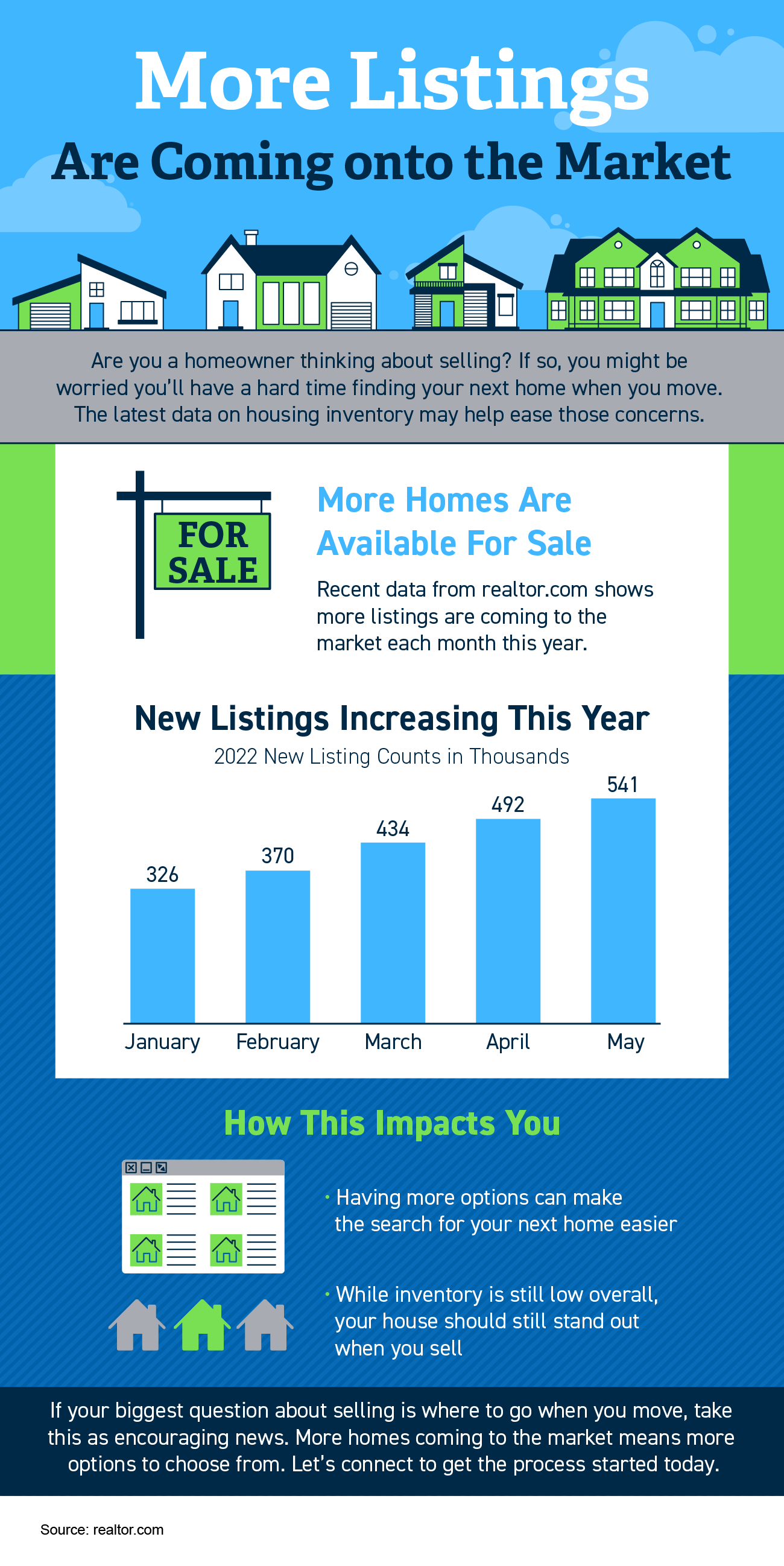
Worried you won’t be able to find your next home after you sell? You should know data from realtor.com shows more listings are coming onto the market each month this year.
Having additional options can make the search for your next home easier. But inventory is still low overall, which means your house should still stand out when you sell.
If your biggest question is where you’ll go if you sell, take this as encouraging news. Let’s connect to start the process today.
Looking up into the bright blue sky, a father and son gazed at the beautiful kite they had created together. The boy became very happy seeing his kite high in the air. The kite soared higher and higher, and the boy said, “Dad, it seems that the string is holding the kite back from flying higher. If we cut the string, the kite will be free and go even higher.””Dad, can we cut the string?”The father cut the string and the kite started to go a little higher. The boy beamed with happiness. But then, slowly, the kite started to drift downward and soon fell back to the ground. The boy was surprised and said, “I thought that cutting the string would cause the kite to fly higher, why did it fall down?”The father explained, “The string was not holding the kite from going higher. It was helping the kite to maintain its position in the sky. The string pulling on the kite keeps its nose pointing upward. When we cut the string and the wind slowed, we couldn’t pull the string to keep the kite pointed in the right direction. So, it could only return to the ground.”Summertime is a good time to remember that the things we think are holding us back are really giving us direction to continue toward our goals and what matters most.Enjoy the rest of your summer and keep your eyes pointed up!
Even if you haven’t been following real estate news, you’ve likely heard about the current sellers’ market. That’s because there’s a lot of talk about how strong market conditions are for people who want to sell their houses. But if you’re thinking about listing your house, you probably want to know: what does being in a sellers’ market really mean?
What Is a Sellers’ Market?
The latest Existing Home Sales Report from the National Association of Realtors (NAR) shows housing supply is still very low. There’s a 2-month supply of homes at the current sales pace.
Historically, a 6-month supply is necessary for a normal or neutral market where there are enough homes available for active buyers. That puts today deep in sellers’ market territory (see graph below):
What Does This Mean for You When You Sell?
When the supply of houses for sale is as low as it is right now, it’s much harder for buyers to find homes to purchase. That creates increased competition among purchasers which can lead to more bidding wars. And if buyers know they may be entering a bidding war, they’re going to do their best to submit a very attractive offer upfront. This could drive the final price of your house up.
And because mortgage rates and home prices are climbing, serious buyers are motivated to make their purchase soon, before those two things rise further. That means, if you put your house on the market while supply is still low, it will likely get a lot of attention from competitive buyers.
Bottom Line
The current real estate market has incredible opportunities for homeowners looking to make a move. Listing your house this season means you’ll be in front of serious buyers who are ready to buy. Let’s connect so you can jumpstart the selling process.
If you’re planning to sell your home this season, rising prices are great news for you. But it’s important to understand why prices are rising to begin with. One major factor is supply and demand.
In any industry, when there are more buyers for an item than there are of that item available, prices naturally rise. In those situations, buyers are willing to pay more to get the product or service they’re looking for when options are scarce. And that’s exactly what’s happening in the current real estate market.
Selma Hepp, Executive, Research & Insights and Deputy Chief Economist at CoreLogic, puts it like this:
“With so few homes, buyers are once again left with fierce competition that’s driving the share of homes that sold over the listing price up to 66% . . . With the continued imbalance between supply and demand, home prices are likely to have another year of strong gains and are expected to average about 10% growth for the year.”
Because it will take some time for housing supply to increase, experts believe prices will continue rising. The latest Home Price Expectations Survey forecasts what will happen with home prices over the next 5 years. As the graph below shows, while the rate of appreciation will moderate over the next few years, prices will continue rising through 2026:
What This Means When You Sell Your House
If you’re a homeowner, the projection for continued price appreciation this year opens up an opportunity to move. That’s because it may give your equity a major boost. Equity is the difference between what you owe on your house and its market value. The amount of equity you have increases as you make your monthly payments and as rising home prices drive up the market value for your home.
Growing equity is a powerful tool for homeowners. When you sell your house, the equity you’ve built comes back to you in the sale. That money could be enough to cover some (if not all) of your down payment on your next home.
Of course, if you want to know how much equity you have in your current house, it’s crucial to work with a real estate professional. They follow current market trends and can help you understand your home’s value when you’re ready to sell.
What This Means for Your Next Purchase
But today’s rising home values aren’t just good news if you’re ready to sell. Because price appreciation is forecast to continue in the years ahead, you can rest assured your next home will be an investment that should grow in value with time. That’s one of several reasons why real estate has been rated the best investment in a recent Gallup poll.
Bottom Line
If you’re weighing whether or not you should sell your house this season, know rising home values may be opening up an opportunity to use equity to fuel your move. Let’s connect so you can find out how much your home is worth and to learn more about all the benefits you have in today’s market.
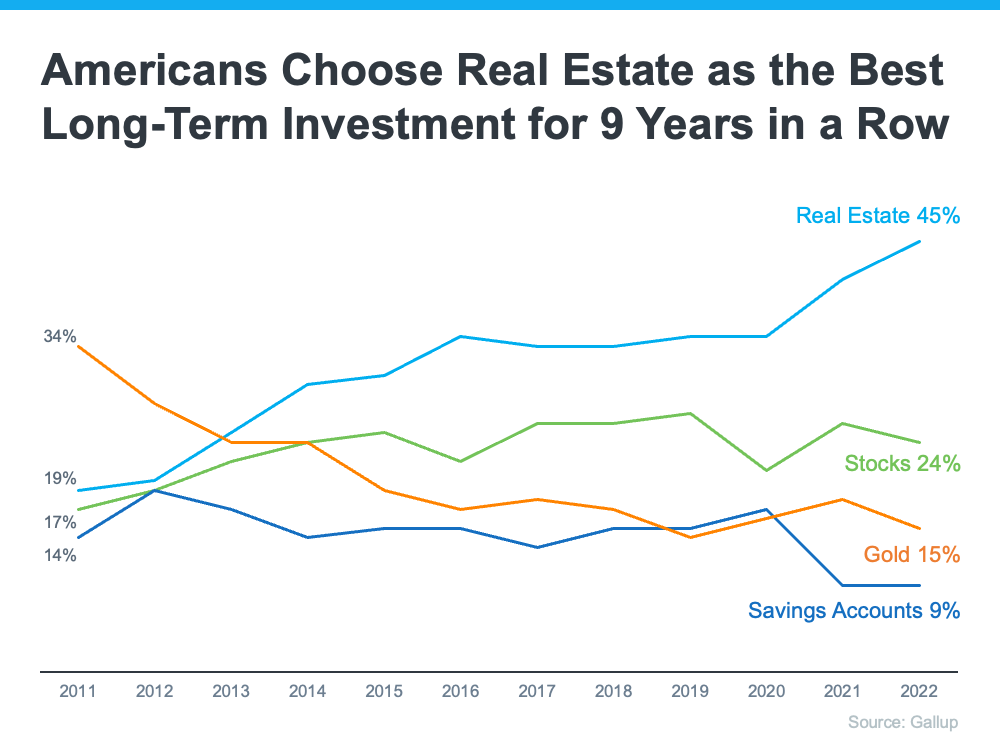
Americans’ opinion on the value of real estate as an investment is climbing. That’s according to an annual survey from Gallup. Not only is real estate viewed as the best investment for the ninth year in a row, but more Americans selected it than ever before.
The graph below shows the results of the survey since Gallup began asking the question in 2011. As the trend lines indicate, real estate has been gaining ground as the clear favorite for almost a decade now:
If you’re thinking about purchasing a home, let this poll reassure you. Even when inflation is high like today, Americans recognize owning a home is a powerful financial decision.
How an Investment in Real Estate Can Benefit You During High Inflation
Because inflation reached its highest level in 40 years recently, it’s more important than ever to understand the financial benefits of homeownership. Rising inflation means prices are increasing across the board, and that includes goods, services, housing costs, and more. When you purchase your home, you lock in your monthly housing payments, effectively shielding yourself from increases on one of your biggest budgetary items each month.
If you’re a renter, you don’t have that same benefit, and you aren’t protected from these increases, especially as rents rise. As Danielle Hale, Chief Economist at realtor.com, notes:
“Rising rents, which continue to climb at double-digit pace . . . and the prospect of locking in a monthly housing cost in a market with widespread inflation are motivating today’s first-time homebuyers.”
When Inflation Has Risen in the Past, Home Prices Have Too
Your house is also an asset that typically increases in value over time, even during inflation. That‘s because as prices rise, the value of your home does too. Mark Cussen, Financial Writer for Investopedia, puts it like this:
“There are many advantages to investing in real estate. . . . It often acts as a good inflation hedge since there will always be a demand for homes, regardless of the economic climate, and because as inflation rises, so do property values. . . .”
And since rising home values help increase your equity, and by extension your net worth, homeownership is historically a good hedge against inflation.
Bottom Line
Buying a home is a powerful decision. It’s no wonder why so many people view it as the best long-term investment, even when inflation is high. When you buy, you help shield yourself from increases in your housing costs and you own an asset that typically gains value with time. If you want to better understand how buying a home could be a great investment for you, let’s connect today.
A recession does not equal a housing crisis. That’s the one thing that every homeowner today needs to know. Everywhere you look, experts are warning we could be heading toward a recession, and if true, an economic slowdown doesn’t mean homes will lose value.
The National Bureau of Economic Research (NBER) defines a recession this way:
“A recession is a significant decline in economic activity spread across the economy, normally visible in production, employment, and other indicators. A recession begins when the economy reaches a peak of economic activity and ends when the economy reaches its trough. Between trough and peak, the economy is in an expansion.”
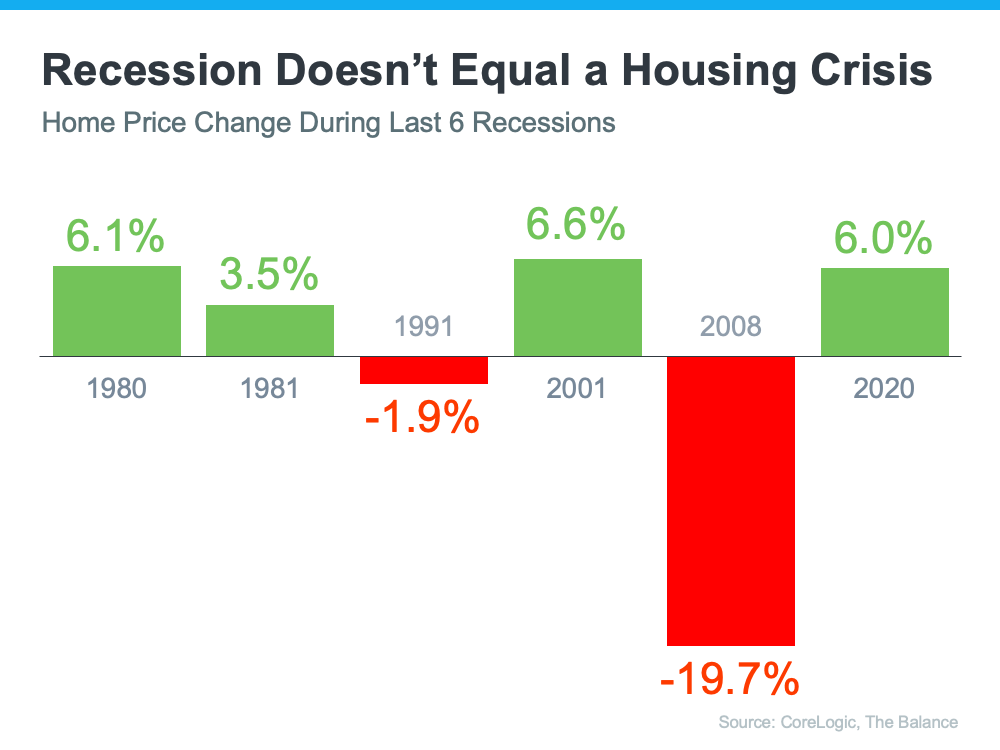
To help show that home prices don’t fall every time there’s a recession, take a look at the historical data. There have been six recessions in this country over the past four decades. As the graph below shows, looking at the recessions going all the way back to the 1980s, home prices appreciated four times and depreciated only two times. So, historically, there’s proof that when the economy slows down, it doesn’t mean home values will fall or depreciate.
The first occasion on the graph when home values depreciated was in the early 1990s when home prices dropped by less than 2%. It happened again during the housing crisis in 2008 when home values declined by almost 20%. Most people vividly remember the housing crisis in 2008 and think if we were to fall into a recession that we’d repeat what happened then. But this housing market isn’t a bubble that’s about to burst. The fundamentals are very different today than they were in 2008. So, we shouldn’t assume we’re heading down the same path.
Bottom Line
We’re not in a recession in this country, but if one is coming, it doesn’t mean homes will lose value. History proves a recession doesn’t equal a housing crisis.
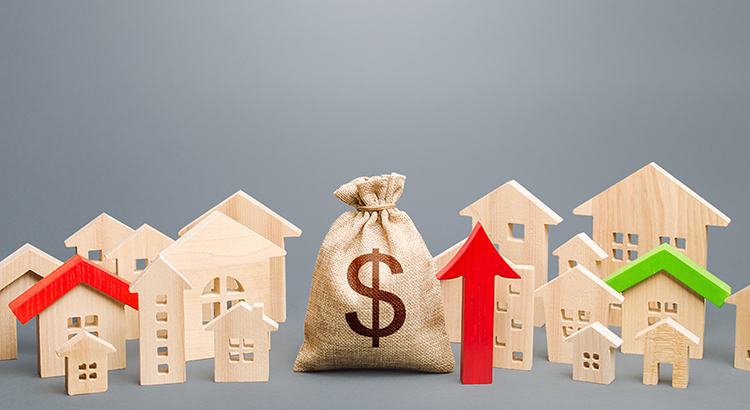
Dollar money bag and a city of house figures and red up arrow. Recovery and growth in property prices, high demand. Increase in rent. Increase in revenues to municipal budget. Investments.
As mortgage rates started to rise this year, many homeowners began to wonder if the value of their homes would fall. Here’s the good news. Historically, when mortgage rates rise by a percentage point or more, home values continue to appreciate. The latest data on home prices seems to confirm that trend.
According to data from CoreLogic, home price appreciation has been re-accelerating since November. The graph below shows this increase in home price appreciation in green:
This is largely due to an ongoing imbalance in supply and demand. Specifically, housing supply is still low, and demand is high. As mortgage rates started to rise this year, many homebuyers rushed to make their purchases before those rates could climb higher. The increased competition drove home prices up even more. Selma Hepp, Deputy Chief Economist at CoreLogic, explains:
“Home price growth continued to gain speed in early spring, as eager buyers tried to get in front of the mortgage rate surge.”
And experts say prices are forecast to continue appreciating, just at a more moderate pace moving forward. A recent article from Fortunesays:
“. . . the swift move up in mortgage rates . . . doesn’t mean home prices are about to crash. In fact, every major real estate firm with a publicly released forecast model . . . still predicts home prices will climb further this year.”
What This Means for You
If you’re thinking about selling your house, you should know you have a great opportunity to list your home and capitalize on today’s home price appreciation. As prices rise, so does the value of your home, which gives your equity a big boost.
When you sell, you can use that equity toward the purchase of your next home. And at today’s record-level of appreciation, that equity may be enough to cover some (if not all) of your down payment.
Bottom Line
History shows rising mortgage rates have not had a negative impact on home prices. Now is still a great time to sell your house thanks to ongoing price appreciation. When you’re ready to find out how much equity you have in your current home and what’s happening with home prices in your local area, let’s connect.
As people realize their needs are changing, some are turning to luxury housing to find their dream home. Investopedia helps define what pushes a home into this category. In a recent article, they point out that a luxury home isn’t only defined by its price. Location is also an important factor. It could be a condo at a desirable city address, a spacious home on the water, or one with access to luxury activities like arts and entertainment, high-end shopping and dining, and more. The home itself will also boast some of the finest features available.
According to the Luxury Market Report from the Institute for Luxury Home Marketing, there’s been a substantial increase in how many buyers are purchasing luxury homes over the past two years. It says:
“. . . North America recorded the fastest growth of demand during the first year of the pandemic. Also, demand has . . . consistently increased, andeven in April 2022, we saw a higher volume of sales compared to 2021.”
If you own a luxury home, it could be a great time to list your house today while demand is so high. But first, let’s understand where the demand is coming from.
What’s Driving the Heightened Buyer Demand for High-End Homes?
The same report says more people have reached a certain net-worth threshold, and that’s contributing to the increased interest in luxury housing:
“In 2020, we saw a 2.2% growth in the number of individuals with wealth of over $5 million in net value, but in 2021 that number grew by an outstanding 19.8%.
This total increase has resulted in the introduction of over 660,000 new individuals into the high net-worth bracket, which, combined with the existing affluent looking to both diversify and add new properties to their portfolio, provides a true insight into why the demand for luxury properties skyrocketed during 2021 and into 2022.”
So, if you’re looking to make changes to your real estate portfolio or are looking to sell your current house, it may be a great time to list and benefit from the high demand for luxury homes today.
Bottom Line
If you own a luxury home and want to know how strong demand is in your area, let’s connect so you can capitalize on current market conditions while buyer demand for upscale homes is so high.
A little girl was overheard talking to herself as she marched through the backyard, wearing her baseball cap and toting a ball and bat. “I’m the greatest hitter in the world,” she announced. Then she tossed the ball into the air, swung at it, and missed. “Strike one!” she yelled. Undaunted, she picked up the ball and said again, “I’m the greatest hitter in the world!” She tossed the ball into the air. When it came down she swung again and missed. “Strike two!” she cried. The girl then paused a moment to examine her bat and ball carefully, and then rubbed her hands together. She straightened her cap and said once more, “I’m the greatest hitter in the world!” Again she tossed the ball up in the air and swung at it. She missed. “Strike three!” “Wow!” She exclaimed. “I’m the greatest pitcher in the world! ”Either way – she’s right. Isn’t perspective a wonderful thing?
Did you know— the ancient Vikings measured age in how many winters someone lived through? I just love that idea, like we aren’t merely surviving the winter months with extra-thick socks while clutching a warm mug, but we are living through them and truly taking in all they have to offer and thriving in response.
I think we can all agree that 2021 was challenging and we are all likely to anticipate 2022 with a sense that there is a fresh start on the horizon. However, if we channel our inner Viking (skipping the horned hats), we are obligated to bring vivid life into this typically bleak month, rather than seeing it as something to survive until warmer times. There is living to be done in January, my friend!
Those ancient Vikings were masters of the sea and had an innate understanding of navigation by natural elements. Like many ancient cultures, they noted landmarks for reference points and used the stars to navigate their way while out at sea, however they also kept track of their route through storytelling. Reciting the route they took in a poetic tale was not only entertaining, but it was also a way to hand down trade routes through generations.
I’m sharing this with you because I think there is value in giving voice to the course you plan to take as you begin the journey through 2022, whether you plan to redo your kitchen or embark on an adventure later this year.








 Coops Coffee