Uncategorized

TEAM EMPOWERMENT MORTGAGE CHATTER: February 22nd; Headliners & Other News; Home Price in Big Cities; Jumbo Loan Program; Open House Flyer Example

“Maybe you are here on earth to learn that life is what you make of it, and it’s to be enjoyed.”  — Dick Sutphen: Psychic researcher, hypnotist, author

Headliners & Other News

Case Shiller: National Home Prices Are Close to the 2009Q1 Trough. S&P/Case-Shiller index of home values in 20 cities fell 2.4 percent, the biggest year-over-year decrease since December 2009. The National Home Price Index declined by 3.9% during the fourth quarter of 2010. The National Index is down 4.1% versus the 4Q 2009. Eighteen of the 20 cities in the index showed a year-over- year decline, led by a 9.1 percent drop in Detroit. “We ended 2010 with a weak report. The National Index is down 4.1% from the fourth quarter of 2009 and 18 of 20 cities are down over the last 12 months. Both monthly Composites and the National Index are moving closer to their 2009 troughs. The National Index is within a percentage point of the low it set in the first quarter of 2009. Despite improvements in the overall economy, housing continues to drift lower and weaker.” says David M. Blitzer, Chairman of the Index Committee at Standard & Poor’s. “Unlike the 2006 to 2009 period when all cities saw prices move together, we see some differing stories around the country. California is doing better with gains from their low points in Los Angeles, San Diego and San Francisco. At the other end is the Sun Belt – Las Vegas, Miami, Phoenix and Tampa. All four made new lows in December. Also seeing renewed weakness are some cities that were among the last to reach their peaks including Atlanta, Charlotte, Portland OR and Seattle, where news lows were also seen. Dallas, which peaked late, has so far stayed above its low marked in February 2009.”

Housing Needs a Good Spring in Its Step  The brighter economic outlook is not helping as it is lifting interest rates with the 30-year fixed rate mortgages jumped to above 5% after a low of 4.17% in November.

Conference Board Consumer Sentiment increased to 70.4 in February, the highest since February 2008, from 64.8 the prior month. The share who said they expect their incomes to increase in the next six months rose to 17.3 in February from 15.3 a month earlier, and those who said jobs were currently plentiful rose to 4.9 this month from 4.6, the fourth straight gain. The present conditions index climbed to 33.4 in February from 31.1, the fifth consecutive increase. Says Lynn Franco, Director of The Conference Board Consumer Research Center: “The Consumer Confidence Index is now at a three-year high (Feb. 2008, 76.4), due to growing optimism about the short-term future. Consumers’ assessment of current business and labor market conditions has improved moderately, but still remains rather weak. Looking ahead, consumers are more positive about the economy and their income prospects, but feel somewhat mixed about employment conditions.”

 Treasuries Rise as Protests, Violence in Libya Spur Demand for Safe Assets Treasuries prices have rose, with the 10yr UST yield dropping to 3.48%, the lowest in more than two weeks, as violence in Libya bolstered demand for the relative safety of government debt. Also supporting the bond market is the Federal Reserve plan to buy $6 billion to $8 billion of Treasuries maturing from 2016 to 2018 today as part of QE2. The US will sell $99 billion in UST this week, beginning with $35 billion two-year notes Tuesday afternoon. MBS prices are up 12/32 on 4.5% coupons as of 11:30am.

Bond Market Swaps Back Bernanke’s Benign Inflation View Bond Market Swaps Back Bernanke’s Benign Inflation View. Prices of some “highly visible” items such as gasoline have “significantly” increased, “overall inflation remains quite low” and wage growth has slowed, according to Fed Chairman Ben S. Bernanke. The five-year, five-year forward breakeven rate the Fed uses to chart investor expectations for future inflation has fallen to 2.77 percent from a 10-month high of 3.28 percent reached in December. “Ten-year yields have gotten to an appropriate level given the pace of the economic expansion and inflation expectations. Housing and stresses in state and local government finances will be a drag on growth. If yields moved over 4 percent it would attract demand from investors, including foreign central banks,” said Gregory Whiteley.

BOE Officials May Give Signals on Momentum Toward Interest-Rate Increase.Bank of England policy makers may this week signal how quickly the momentum toward higher interest rates is building as inflation accelerates to more than twice the central bank’s target.

——————————————————————————–

Home prices hit post-bust lows in most big cities

Home prices in a majority of major U.S. cities tracked by a private trade group have fallen to their lowest levels since the housing bubble burst, and analysts expect further declines this year.

The Standard & Poor’s/Case-Shiller 20-city home price index fell 1 percent in December from November. Prices fell in all but one of the metropolitan markets tracked.

The only city to see a gain was Washington, where hiring by the federal government has helped boost the region’s job market.

Eleven of the markets hit their lowest point since the housing bust, in 2006 and 2007: Atlanta, Charlotte, N.C., Chicago, Detroit, Las Vegas, Miami, New York, Phoenix, Portland, Ore., Seattle and Tampa, Fla.

The housing sector is struggling even while the rest of the economy is showing signs of a slow but steady recovery. The latest evidence of this divide came Tuesday when the Conference Board said its Consumer Confidence Index rose in February to its highest point in three years. The index surveys how people feel about hiring and income, and how they see that changing over the next six months.

Some of the worst declines are in cities hit hardest by foreclosures and high unemployment, including Detroit, Phoenix and Tampa. A home that sold for $250,000 in the Motor City in 2000 now sells for roughly $163,150, according to the housing report. Homes in Las Vegas and Cleveland now sell, on average, for less than they of what they did a decade ago. Many people are holding off buying or selling homes because they fear the market hasn’t hit bottom yet.

The housing recovery is uneven across the United States. Coastal cities in California and the Northeast are faring much better than the Midwest and Southeast. That’s mainly because they benefit from expensive and somewhat recession-proof housing markets buoyed by low unemployment and limited new construction.

The Case-Shiller report measures home price increases and decreases relative to prices in January 2000 and gives an updated three-month average for the metropolitan areas it looks at.


TEAM EMPOWERMENT MORTGAGE CHATTER: February 17; Foreclosure Dips; Headlines and Other News; Government & Housing Market; Real Estate Consulting; RPM Jumbo Loan Program Flyer

Good Thursday Morning To You Team!

Aside from the gloomy grey clouds in our weather forecast today, I would like to lift up your spirits and have you know that there is some sunshine out there! Yesterday our team received our 6th contract just within the last 2 weeks!! As mentioned previously we have recently seen an increase in loan applications as well! I also told you about RPM closing a Jumbo Refinance for $1.2 Million within LESS THAN 25 DAYS (In-House Underwriting and Appraisers!!). We’re readily prepared to continue taking on new contracts, loan applications, and any new business – period! If you need to discuss any difficult scenarios, or inquire on our loan programs to include the Jumbo Loan, FHA, Fannie Mae HomePath, or Conventional you know you can always give me a call! I’ll be in the office today, and I look forward to hearing from you!  Have a great day!!

“When we direct our thoughts properly, we can control our emotions…” – by W. Clement Stone


FORECLOSURE DIPS, BUT REMAINS ELEVATED

According to the Associated Press fewer Americans fell behind on their mortgage payments in the final three months of last year, but foreclosures are still rising.

The Mortgage Bankers Association said Thursday 8.2 percent of homeowners missed at least one mortgage payment in the October-December quarter. The figure, which is adjusted for seasonal factors, improved from 9.1 percent in the previous quarter and from a high of more than 10 percent in the January-March quarter.

The percentage of homes in the foreclosure process rose to 4.6 percent from 4.4 percent, tying an all-time high for the survey. Foreclosures are expected to peak this year as 5 million troubled loans move through the process.

Typically, the percentage of seriously delinquent borrowers — those more than 90 days behind on their mortgages or in foreclosure — is just above 1 percent. In the fourth quarter, that figure was 8.57 percent.

An improving job market is behind the decline in the delinquency rate, said MBA Chief Economist Jay Brinkmann. He noted that the private sector added 1.2 million jobs last year and the number of people applying for unemployment benefits started to fall in the fourth quarter.

“It’s a sign we’ve turned a corner, that’s the good news,” Brinkmann said. “The bad news is loans in foreclosure are still very high.”

Foreclosures dipped in the July-September quarter as lenders addressed allegations of improper paperwork during the foreclosure process. But by the final three months of last year, many had resumed taking back homes.

Banks are on track to repossess more than 1 million homes this year, the most since the housing meltdown began, according to foreclosure tracker RealtyTrac Inc. That will drive home prices down because foreclosures are sold at deep discounts.

The foreclosure crisis started years ago when borrowers took out risky loans with adjustable interest rates that they couldn’t afford. Many also qualified for loans without providing proof of income. The crisis spread to homeowners with good credit who took out safe, fixed-rate mortgages, but are struggling in a weak economy.

——————————————————————————–

HEADLINERS & OTHER NEWS

Initial claims increased by 25,000 to 410,000 for the week ending February 12; and the prior week was revised from 383,000 to 385,000. Continuing claims increased by 1,000 to 3.911 million for the week ending February 5, and there are millions more on extended and emergency benefits not counted in this figure. That claims did not jump even higher is encouraging and indicates that the labor market recovery remains on track.

Conference Board’s Leading Indicators increased 0.1% in January after rising 0.8% in December Six of the 10 indicators in the leading index contributed to the increase, led by the interest-rate spread and the stock market. The interest-rate spread between the overnight federal funds rate and the yield on the 10-year Treasury note widened, boosting the index by 0.34 point. “With January’s slight increase, following two large gains, the U.S. LEI is still pointing to economic expansion in the coming months. Falling housing permits and weakening labor market indicators were barely offset by the continued positive contributions of the financial components. The LEI remains on a rising trend, with its growth rate picking up in recent months. However, current economic conditions, as measured by the coincident economic index, while improving slowly, remain weak.” Says Ataman Ozyildirim, economist at The Conference Board.

Treasuries Rise Amid Tension in Mideast, Increase in U.S. Jobless Claims,

with the UST rally pushing the 10-year note yield down to 3.56%, the lowest level since Feb. 4. This could possibly set the stage for a continued rally to test 3.50% resistance. The market has basically erased the selloff since the January nonfarm payrolls report and the 10-year yield has fallen from a nine-month peak of 3.77% on Feb. 9. Two Iranian warships will pass through the Suez Canal and the Iranian government is in contact with Egyptian officials to arrange passage, and pro-democracy protesters in Bahrain are demanding the government resign, boosting demand for safer U.S. assets. The Fed will be buying Treasuries maturing between 2018 and 2021 today, and the U.S. will also be auctioning $9 billion of 30-year Treasury Inflation Protected Securities today.


FOMC Minutes: Fed Forecasts Faster Growth as Economy Improves, expecting GDP to grow by 3.4 to 3.9 percent this year, up from the previous forecast, released in November, of 3 to 3.6 percent. The Fed’s outlook for the job market was largely unchanged: 8.8 to 9 percent unemployment this year. “On the one hand, the additional spending could reflect pent-up demand following the downturn, or greater confidence on the part of households about the future, in which case it might be expected to continue,” the minutes noted. “On the other hand, the additional spending could prove short-lived, given that a good portion of it appeared to have occurred in relatively volatile categories such as autos.”


——————————————————————————–

GOVERNMENT & HOUSING MARKET – REFORMING AMERICA’S HOUSING MARKET

Late last Friday – when the world was focused on the resignation of Egypt’s President Hosni Mubarak — the Obama administration sent Congress a white paper entitled ” Reforming America’s Housing Finance Market ” laying out its recommendations on how to “wind down” the role of Fannie and Freddie and “dramatically transform the role of government” in the U.S. housing market.

According to the Wall Street Journal, the government suggested these three options which could be slowly implemented over the next five to seven years:

Option #1: The first option puts the vast majority of the mortgage market in the hands of the private sector, where lenders would originate mortgages and securitize them without any government backing.

Option #2: The second option is the same as the first, but would also create a limited government backstop that would primarily become active buying or guaranteeing loans in periods when private lenders retreated during financial shocks.

Option #3: The third option would create new privately owned companies to buy mortgages from banks and sell them as securities. Those securities would be explicitly guaranteed by the government as long as they meet certain criteria.

These government-sponsored enterprises were initially created to offer homebuyers easy and better access to more affordable capital when purchasing a home. And for decades, Fannie and Freddie did help many Americans realize the American Dream of home ownership.

But times have changed since the financial crisis of 2008, which was spurred by the mortgage industry – Fannie and Freddie included – granting subprime loans with adjustable rates to borrowers who really could not afford to be purchasing a home.

In the last three years, Fannie Mae and Freddie Mac have received roughly $150 billion of your tax dollars to prevent their failure and an even worse collapse in the housing market.

So now, it looks likely that Fannie and Freddie will be dismantled for the same reasons they were created. In a press release, Treasury Secretary Tim Geithner said, “This is a plan for fundamental reform – to wind down the GSEs, strengthen consumer protection, and preserve access to affordable housing for people who need it.”

——————————————————————————–

REAL ESTATE CONSULTING

Recommended Reads: Julie Garton-Good (“Real Estate a la Carte: Selecting the Services You Need and Paying What They’re Worth”) and Mollie Wasserman (“The End of Six Percent: How to Get the Expertise You Want without Paying A Commission Unless You Want To”) – On Real Estate Consulting

First, it’s extremely important to note that like regular commissions, there is no fixed rate on consulting. Commissions and consulting fees are negotiable. Each agent has to determine the best fit for his or her business.

To understand how real estate consulting works, it’s important to differentiate between consulting and the normal commission sales model.

According to Garton-Good, a salesperson “tells and sells” as opposed to a consultant who “guides but not decides.” Her premise is that consumers want someone who is on their side and who is hired to represent their interests. She also believes that too many agents are working for free. She was one of the first experts to argue for the unbundling of real estate services.

Today, Gen X and Gen Y prefer to research information online or through their friends. As a result, a better approach is to be the “trusted resource” that supplies clients with the informational resources they need to make the best possible decision.

According to Garton-Good, most agents spend way too much time providing service and not being paid for it. “Free” doesn’t exist. In fact, her experience is that the typical real estate agent is worth between $75 and $150 per hour. Consequently, if your hourly rate is $100 per hour and you spent three hours doing an open house or any other activity that doesn’t generate any leads, you just cost your business $300.

Garton-Good says that agents who shift to the real estate consulting approach have a strong understanding of how much their time is worth. Tracking your return on various activities is critical. You must also determine which activities pay you your hourly rate or more. For the activities that are not generating a return, you have two choices: dump them or delegate them.

Wasserman draws the distinction between two types of real estate activity. “Functionary” activities include those activities that technology can handle, such as providing information about local areas, schools, and crime statistics. It also includes activities, such as holding open house events, that do not require a high level of expertise.

Wasserman also argues that the real estate consulting model is your best defense against commission-cutting. To illustrate, for-sale-by-owner sellers normally do not want to pay a listing commission. They may, however, be willing to pay an agent to provide them with comparable sales and to help them with staging their home.

Given that only 5 percent of all sellers successfully sell their own property to a buyer they do not know, there’s a high probability that the FSBO will ultimately list with an agent. As Wasserman points out in her training: “Consulting is the antidote to commissionectomies!” Once they have already paid you a consulting fee, they’re highly unlikely to list with another agent.

TEAM EMPOWERMENT MORTGAGE CHATTER: February 16; RPM Jumbo Refinance; FHA Annual Mtg Insurance Premium & FHA Refinance Changes; News & Headlines; Avoiding Real Estate Failure; RPM Flyers – Jumbo Program and Example of Open House

Good Morning Team!

It’s Wednesday, can’t believe how fast the week is going by. We’ve got some exciting news from RPM, as mentioned we have our new Jumbo Program and I’m happy to share that we’ve just closed a jumbo refinance for $1.2 million, closed in less than 25 days. Don’t forget, we have in-house underwriters and appraisers to help with this turn around! This service is not only for the Jumbo Program however our underwriting and appraisal service is for all loans through RPM. If you need to discuss a loan scenario or need a pre-approval, do not hesitate to contact me. And don’t forget about our open house flyers, especially for those of you that may have open houses during this 3 day weekend for most (Monday is Presidents Day)!! Have a great day!

“That which you resist stays.” — Dr. David Hawkins: Physician, spiritual teacher, and lecturer


FHA ANNOUNCES ANNUAL PREMIUM MORTGAGE INSURANCE INCREASE

With Mortgagee Letter 11-10, FHA announces an increase to the Annual Mortgage Insurance Premium on standard FHA loan programs and a change that affects case numbers.

Here are the 7 things you need to know about these changes:

1. These changes are effective April 18th, 2011.

2. The Annual Insurance Premium will increase .25% for standard forward mortgages. The Upfront Mortgage Insurance remains at 1.00%.

3. The Annual Premium is now 1.15% for LTVs GREATER than 95% on 30 year loans

4. The Annual Premium is now 1.10% for LTVs EQUAL to or LESS than 95% on 30 year loans

5. The Annual Premium is now .50% for LTVs GREATER than 90% on 15 year loans

6. The Annual Premium is now .25% for LTVs EQUAL to or LESS than 90% on 15 year loans

7. Case numbers with no activity for 6 months will automatically be canceled (includes case numbers pulled prior to April 18th, 2011.

To Read The Update in Full:  DEPARTMENT OF HOUSING AND URBAN DEVELOPMENT

FHA ANNOUNCES REFINANCE CHANGES

With Mortgagee Letter 11-11, FHA announces changes to refinance transactions. This ML provides guidance on the changes as well as clarification on existing refinance guides and it will be worthwhile to read this ML in its entirety as a refresher.

Here are the 8 things you need to know about these clarifications and changes:

Borrower must be current on their mortgage for the month of closing AND the month prior to closing (The payment due the month of closing CAN be included in the payoff).

Second liens must be subordinated to the new FHA first in their entirety.

For all case numbers on investment property refinances assigned on or after April 15th, 2011, the borrower must have occupied the subject property for the last 12 months to qualify for maximum streamline financing; if less than 12 months, a full credit-qualifying qualifying regular refinance is required with a maximum LTV of 85%.

Effective no later than April 15th, 2011, the following net tangible benefit scenarios must exist on all streamline refinances: A. The total of the new P&I and MI portion of the payment must decrease by at least 5% OR B. Refinancing from an ARM to a fixed product (See chart in ML).

Effective no later than April 15th, 2011, lenders may now use the short Uniform Residential Loan Application (URLA) for non-credit qualifying streamline refinances ONLY.

Effective no later than April 15th, 2011, lenders no longer have to certify employment and income on streamline refinances.

TOTAL Scorecard must not be used for streamline refinances.

Lenders CANNOT add closing costs, discount points, prepaids or other costs to the loan balance on non-credit-qualifying streamline refinances. Lenders CAN add closing costs and prepaids (not discount points) ONLY through a full-credit-qualifying streamline WITH an appraisal.

To Read The Update in Full: DEPARTMENT OF HOUSING AND URBAN DEVELOPMENT

——————————————————————————–

News & Headlines:

Let’s hope that they have some loans to fill those securities! Last week mortgage applications dropped 9.5% to a level last seen in November 2008. Refinancing activity was down 11.4%, and now accounts for 64% of new apps, and purchases were down about 6%. Braver Stern Securities wrote that, “with conforming mortgage rates at (these levels), almost 60% of the FH/FN mortgage universe does not have an economic incentive to refinance at the current time. For FHA borrowers this number is just over 85%.”

The cost of rescuing mortgage giants Fannie Mae and Freddie Mac is likely to sink to nearly half of the current cost over the next decade, for example. The budget estimates keeping Fannie and Freddie afloat will cost $73 billion by 2021, reflecting dividends paid back to the Treasury Department and is 45% lower than the $131 billion cost to date and much lower than outside estimates. Fannie and Freddie must pay 10% dividends on the quarterly cash infusions they receive from the Treasury, which some argue should just be forgiven, thus saving them a tremendous amount of ducats. In fact, the White House estimates that the companies will be paying back more in dividends by 2013 than they receive in cash infusions and from 2014 on, the companies are expected to need no more funding. Turning to HUD, the budget proposal outlines a $48 billion spending program for fiscal year 2012, an increase of more than $900 million from 2010.

For economic news today we’ve had Housing Starts were up 14.6%. But Building Permits were down 10.4%. The Producer Price for January was +.8%, as expected, although ex-food & energy it was +.5% – the biggest jump since 2008. The Consumer Price Index comes out tomorrow, and we’ll be able to see if these price pressures have come down the consumer level. We find the 10-yr at 3.63%, and MBS prices very similar to where they closed Tuesday.

——————————————————————————–

How To Avoid Real Estate Failure

Enough fatigue and the result is failure, be it a slab of concrete, a bungee cord — or a real estate agent.

Most of you have spent the better part of the past five years feeling like underpaid test subjects in an engineering science lab. In fact, in the best of markets our work is defined by compression and tension. Find a client, serve the client, then go out and find another. Lather, rinse and repeat.

One minute, you’re are on top of the world, flush with listings or buyer clients, reveling in the ecstasy that is positive cash flow. The next, you’re wondering how we will eat in 45 days. If you have been licensed for more than two closing cycles, you know this feeling too well. If you have lived through a couple hundred or more transactions, you know it can wear you thin.

Ten years ago, it was easier to bounce back. You were tested in a fairly controlled environment. You had our highs and lows, your successes and failures, but the laws of real estate assured you that hard work would pay off, commitment would triumph, and your down time and down moments would inevitably be followed by another opportunity.

Rather, you’re just as busy as you were five years ago, the difference being you used to get paid for our efforts.

Fatigue happens. How to overcome it and avoid all-out failure is the question for all the marbles. It’s our marbles at stake, and I don’t profess to have the answers, but I do know that stagnation is not one of them.

You can’t win if your head’s not in the game. Catch up on your industry reading, tinker with your website, retool your listing presentation, or rewrite your business plan. Preview homes, research and study market trends, write a blog post or comment on a post. Engage in a little group therapy at the office — or here.

Rethink how the challenges you face now might be — if not altogether avoided — at least mitigated in the future. Dare to lose a listing opportunity by being brutally honest, knowing that the people who respect your honesty enough to hire you will be most likely to respect you throughout the transaction and find success.

This market is going to be with us for a while, and what that means is that the opportunities will be fewer and more difficult. But it doesn’t mean that we can’t each survive and thrive — both professionally and personally.

We need to remember that our business has cycles, as do markets. We need to be ever aware of the warning signs of too much tension and compression, and we need to be prepared to deal with the occasional fatigue lest we are threatened with catastrophic failure.

——————————————————————————–

TEAM EMPOWERMENT MORTGAGE CHATTER: February 15; 2 Tools for Online Real Estate Success; Selling Your House? 5 Reasons to do it NOW; FHA Premium Structure; Investors and Ginnie Mae; Rising Interest Rates; Homebuilders on Housing Market; Open House Flyer

“Most people diffuse their psychic energy (attention) in hundreds of random ways. Those who flow focus their psychic energy intentionally upon the task at hand. It really boils down to knowing your goal, concentrating upon it, remaining determined, and having the self-discipline to complete what you are doing.” — Dick Sutphen: Psychic researcher, hypnotist, author

TWO ESSENTIAL TOOLS FOR ONLINE REAL ESTATE SUCCESS:

1. Most important tool for success online: your mind

It’s the most essential thing you need for online success. Here are some specific ways to use your mind as you approach the mess of software and vendors and consultants and platforms and so on:

1. Think about what you’re really doing online in the first place. What do you want other people to do online that helps your business?

2. Think about what other people are really doing online in the first place. What can your business do to help other people?

3. Map out the whole process, a sort of customer workflow, starting with a potential customer who has a problem and ending with you solving their problem. Bonus points if you use crayons to make your map.

4. Make a circle around the parts of this workflow that take place on platforms you don’t fully control (Facebook, Twitter, Google and so on).

5. Make a circle in a different color around all the parts of this workflow that occur on platforms that you fully control (your company website, your self-hosted blog on your own domain and so on).

Without using your mind, you’re more likely to fall victim to “shiny object syndrome” and vanity metrics. If you know about your customers, and you know about you, then you can evaluate and deploy technology.

2. Second most important tool for online success: the humble spreadsheet

If you’re going to do things online, you’ll want to observe what people are doing online. Then make some improvements to what you’re doing online. Then repeat. Unless you’re perfect.

If you’re perfect, then everything always works out the way you think it should and you’re free to avoid doing anything different. I’m not perfect, though, so I like observing.

One of the hard parts of using observations to make decisions is that there are so many platforms and ways to make observations. By this, I mean there’s no one analytics package to rule them all. And even if there were, it probably wouldn’t have the metrics that matter most to your business.

If you’ve taken advantage of the first tool for online success — your mind — then you should be able to develop a handful of metrics that really matter for your business. This is easier to do in a room that has no computers or screens in it. It’s probably even easier to do in a location that isn’t your office.

Your own spreadsheet is where you store and analyze that data. Your own spreadsheet lets you focus on your business instead of Facebook’s business or Google’s business. And hopefully, your own spreadsheet will tell you how you’re doing in terms of helping customers.

——————————————————————————–

Selling Your House? 5 Reasons To Do It NOW!

The conventional wisdom when selling a home has always been to wait until the ‘Spring Buying Season’. Over the years, that has seemed to make sense and is now accepted as a good strategy for those who want to sell their house and receive the best possible price. This real estate market has shattered many previously held beliefs. The wisdom of waiting for a spring market is another belief that is about to fall. Here are five reasons why?

1.) Interest Rates Are On the Rise

Interest rates have spiked up rather dramatically over the last ninety days and are now over 5%. Initially, an increase in rates has a positive effect on the market as it forces buyers off the fence. However, it also eats into a buyer’s purchasing power. As rates increase, the mortgage amount a buyer qualifies for decreases. This will eventually have a negative impact on prices.

2.) Your Dream Home Will Never Be Cheaper

If your family goal is to sell your current house and take advantage of the fabulous selection of properties currently available to buy the home of your dreams, DO IT NOW! Prices will continue to soften in most markets. However, if you are buying, COST should be more important than PRICE. Cost can be dramatically impacted by rising mortgage interest rates. Do the math and decide if now is the time.

3.) Buyers Are Out Early

There is mounting evidence that buyers are coming out earlier this year. A belief that now is a good time to buy coupled with the increase in interest rates has started the buying season early.

Pete Flint, CEO of Trulia:

“We’re seeing a national resurgence of buyer and seller activity on Trulia.com. In January alone, we experienced an unprecedented level of site traffic including 11 million unique visitors – which is more than 70 percent year-over-year growth. We’ve are now experiencing 100,000 property views per minute.”

The National Association of Realtors just reported that the number of house sales increased 12.9% over last month.

4.) Inventory Increases Every Spring

Every year there is an increase of inventory which comes to market as we approach the spring. Here is the number of listings available for sale in 2010.

February – 3,531,000

March – 3,626,000

April – 4,029,000

We believe there will be an increase in these numbers in 2011 as there is a pent-up selling demand created by the weak market of the last few years. You won’t have to worry about this increasing competition if you sell now.

5.) We Are in the Eye of the Foreclosure Storm

While banks are trying to rectify their foreclosure procedures, there is a large supply of discounted properties which has been delayed coming to market. This inventory will be released sometime in the next few months. Foreclosures sell on average at a 41% discount. When released they will be competing with your house for the buyers in the marketplace. If you are looking to sell in 2011, you want to sell before this inventory becomes your competition.

CNN Money quoted the leadership Of RealtyTrac on this issue:

“We’ve now seen three straight months with fewer than 300,000 properties receiving foreclosure filings, following 20 straight months where the total exceeded 300,000,” said James Saccacio, CEO of RealtyTrac.

“Unfortunately,” he added, “This is less a sign of a robust housing recovery and more a sign that lenders have become bogged down in reviewing procedures, resubmitting paperwork and formulating legal arguments related to accusations of improper foreclosure processing.”

“We expect a spike in the first quarter,” said Rick Sharga, a RealtyTrac spokesman.

Bottom Line

These are five strong reasons to sell now instead of waiting until later in the year. Sit down with a local real estate professional today and decide the best options for you and your family.

——————————————————————————–

A Few Headliners & Other News

FHA’s New Premium Structure: “As part of ongoing efforts to strengthen the FHA capital reserves,” and to help push private money back into mortgages, the FHA came out with a new premium structure for FHA-insured mortgage loans increasing its annual mortgage insurance premium (MIP) by a quarter of a percentage point (.25) on all 30- and 15-year loans starting in mid-April. (The upfront MIP will remain unchanged at 1.0 percent.) The increase adds $30 to the average borrower’s payment and in total is estimated to add $3 billion annually to the FHA’s Mutual Mortgage Insurance Fund. It is the second increase since October.

Investors and Ginnie Mae: From an investor’s viewpoint, any investor holding Ginnie Mae securities just became much more comfortable with their holdings and with the odds of FHA-to-FHA refinancing going down. Those familiar with FHA loans realize that before October a 95% LTV 30-yr loan paid a 225 basis points up-front MIP with a 50 bps annual MIP. Now, that loan pays 100 bps up-front — but 110 bps annually. Investors believe that this change, given current rates, effectively removes any 5% and 5.5% FHA loans from being refinanced into new FHA loans.

Rising Interest Rates: The recent move up in interest rates wasn’t unexpected, as the rate markets have been technically bearish since Halloween. But what was not expected was the magnitude of the run-up. So, interestingly, many analysts believe that we have already seen the big move for rates (unless the world stops buying our debt, of course), so although rates are gradually expected to increase for much of 2011, don’t look for any big moves higher. Yesterday, on no real news, 10-year note prices drifted higher on the day and closed up 9/32s to yield 3.61%. It was a quiet session in mortgages as well, with supply around half the recent normal and MBS prices finishing the day about .125-.250 better. But, after a data-less session yesterday and a light week just past, we have had several reports today. Import Prices were +1.5% month-over-month, Export Prices +1.2%, Retail Sales were +.3%, ex-auto & gas it was +.2%, light but positive, and the Empire State Index came in at “15.43” – jump from the previous month’s. We have some minor news still to go, but after this early news we find the 10-yr at 3.63% and MBS prices worse by about .125.

Homebuilders View Of Housing Market Grim: Homebuilders are not seeing a turnaround in the housing market after the worst year for new-home sales in a half-century. The National Association of Home Builders says its index of builder sentiment for February remained unchanged for the fourth straight month at 16. Any reading below 50 indicates negative sentiment about the market. The index hasn’t been above that level since April 2006. Homebuilders are struggling to compete with millions of foreclosures that are forcing home prices down. Last year was also the worst in more than a decade for sales of existing homes.Weak sales mean fewer jobs. Each new home built creates, on average, the equivalent of three jobs for a year and generates about $90,000 in taxes, according to the trade group.

OPEN HOUSE FLYER EXAMPLE (Call Me to get your Open House Flyer created today!)

TEAM EMPOWERMENT MORTGAGE CHATTER: February 11; Fannie/Freddie Phase-out Proposed; Foreclosure filings on decline; Egypt and Wall Street; CalHAFA – Keep Your Home California Initiative; Altisource and HAFA; The Cost of Waiting For Prices to Fall; Rates

Happy Friday! 

Good Morning Team! As mentioned in yesterdays chatter, we’ve received a lot of new pre-approval requests, opened new escrows and I continue to work with my referral partners to keep it going at this pace. If you haven’t called to chat on our strategy don’t hesitate to call me. My team and I are committed to growing with you in 2011. I’m in the office today contact me with any pre-approval requests, discuss a loan scenario or maybe even provide you with a flyer for your open house you’re holding open this weekend. Friendly reminder, Monday is Valentines Day! Call me direct if you need anything 925-295-9360. Have a great weekend!!

“As soon as you start to feel differently about what you already have, you will start to attract more of the good things, more of the things you can be grateful for.” — Joe Vitale: Hypnotic marketer and author

A FEW HEADLINES:

Fannie, Freddie Phase-out Proposed. The “white paper” presented to congress today by Treasury Secretary Tim Geithner proposes three options for what could take their place and will begin the long process of debate over the nation’s $10.6 trillion mortgage market, calling for changes to be phased in “responsibly and carefully” to avoid economic disruptions. The steps likely mean higher borrowing costs, and less access to home loans for consumers. Administration officials said the transition to a new system could take five years or longer. The paper also recommends gradually raising fees that Fannie and Freddie charge to lenders in order to make mortgages that aren’t government-backed more competitive, and calls for gradually reducing the maximum loan limits. Banks would be required to hold more capital to withstand future housing downturns, and the paper calls for “more conservative underwriting standards that require homeowners to hold more equity in their homes.” The paper also calls for reducing the role of Federal Housing Administration.

RealtyTrac: Foreclosure filings fell 17% in January from a year earlier, the fourth straight month of declines, and rose 1% from December.

Wall Street slips on unrest in Egypt U.S. stocks fell on Friday as market uncertainty over Egypt grew amid risks of spreading unrest in the Middle East.


CalHAFA – Keep Your Home California Initiative  The California Housing Finance Agency fully implemented the programs under its “Keep Your Home California” initiative, a nearly $2 billion endeavor funded by the U.S. Treasury’s Hardest Hit Fund.


New Altisource Short Sale Service capitalizes on HAFA & provides opportunities for agents Altisource, based in Luxembourg, with US headquarters in suburban Georgia, said the addition of short sales and deed-in-lieu services comes in response to the Home Affordable Foreclosures Alternative (HAFA) program, a Treasury Department initiative that offers cash incentives to loan holders, borrowers and servicers that complete short sale and deed-in-lieu transactions instead of foreclosures

 ________________________________________

The Cost of Waiting for Prices to Fall

Many purchasers have been sitting on the sidelines waiting for home prices to hit bottom. They want to guarantee that they are purchasing at the best possible price. Like them, we also believe that prices still have some room to fall in most markets. However, we disagree that waiting is a good financial decision. The buyer should not be concerned about housing prices. They should be concerned about cost.

The cost of a house is made up of the price AND THE INTEREST RATE they will be paying. Two different pieces of news released yesterday highlight this point.

PRICES

The National Association of Realtors (NAR) released their 4th quarter housing research report. In the release, they reported that home sales rose 15.4% in the 4th quarter over the 3rd quarter. They also showed that prices remained stable during the year:

The national median existing single-family price was $170,600 in the fourth quarter, up 0.2 percent from $170,300 in the fourth quarter of 2009.

A buyer who delayed a purchase might find solace in the fact that prices have not increased. However, the other news released yesterday paints a different picture.

INTEREST RATES

The Primary Mortgage Market Survey was released by Freddie Mac which showed that the 30 year fixed rate mortgage was at 5.05%. Frank Nothaft, vice president and chief economist of Freddie Mac said:

“Long-term bond yields jumped on positive economic data reports, which placed upward pressure on mortgage rates this week…As a result, interest rates on a 30-year fixed-rate mortgage rose to the highest level since the last week in April 2010.”

So prices have remained stable but interest rates have risen dramatically in the last 90 days. What does that mean to a buyer looking to purchase a home this year?

The price is the same. It just costs more.

By sitting on the sidelines for the last 90 days a purchaser lost:

$89.44 a month

$1,073.28 a year

$32,198.40 over the thirty year life of the mortgage

If you buy a $340,000 home, double all these numbers.

Bottom Line

Even if prices fall another 10% this year, the cost of a home will increase if interest rates go up more than 1%. Buyers should not worry where prices are going. They should be concerned where costs will be later in the year.

Todays Rates – RPM Mortgage

TEAM EMPOWERMENT MORTGAGE CHATTER: February 9; 1st Question To Ask Your Listing Agent; New-Home Recovery Post-Super Bowl; Obama and Freddie/Fannie; RPM HomePath Financing

“Every thought, action, decision, or feeling creates an eddy in the interlocking, interbalancing, ever-moving energy fields of life, leaving a permanent record for all of time. This realization can be intimidating when it first dawns on us, but it becomes a springboard for rapid evolution.” — Dr. David Hawkins: Physician, spiritual teacher, and lecturer


The First Question You Should Ask Your Listing Agent

What is the most important thing a seller should look for when hiring a real estate agent to sell their house? We are often asked this question. Is it the size of the company they are licensed with? Is it their marketing program? Their years experience in the business? Should you choose the agent who suggests the highest listing price?

There are many things that should be taken into consideration when hiring someone and giving them the responsibility for selling your home. In our opinion, the most important question you can ask a potential listing agent is a simple one:

Do you truly believe that now is a good time to buy a home?

Why should this matter when hiring someone to SELL your home? Buyers are nervous about purchasing right now. They want to know they are making an intelligent choice. We believe, especially in today’s market, you need to hire someone who realizes that this is one of the best times in American real estate history to buy. If an agent doesn’t believe that, how will they be able to convince a potential buyer to buy your home?

When interviewing a real estate professional, ask them to explain why purchasing a home makes sense today. They should be able to explain it simply and effectively. See how many of the following facts (which should be shared with every potential purchaser) the agent knows:

The Wall Street Journal last week stated:

“With home sales starting to improve, and with prices now possibly forming a bottom, real estate could well be the asset class that represents the best low-risk buying opportunity out there today.”

Donald Trump was just quoted saying:

“I’m pretty sure this is a great time to go out and buy a house. And if you do, in 10 years you’re going to look back and say, ‘You know, I’m glad I listened to Donald Trump’.”

John Paulson, a multibillionaire hedge fund operator and the investment genius who made a killing betting against housing a few years ago, is now bullish on residential real estate market. He recently said:

“If you don’t own a home, buy one. If you own one home, buy another one. If you own two homes, buy a third. And, lend your relatives the money to buy a home.”

A recent Gallup Poll showed that 67% of American’s think that now is a ‘good time’ to buy a home. The Gallup Organization went on to say:

“Overall, there is good reason for most Americans to think now is a good time to buy a house. Interest rates remain near historic lows. Home prices are down sharply, providing many incredible buys.”

The iconic financial paper in this country, the country’s most famous real estate investor, the most successful prognosticator of the housing market and 2/3 of all Americans say now is the time to buy a home. Shouldn’t your agent agree?

Bottom Line

Selling is nothing more than the transference of conviction. How can agents transfer that conviction if they themselves are not convinced? Find a listing agent who truly believes that someone should buy your home – TODAY! This is the single most important thing you should look for in a potential listing agent.

——————————————————————————–

New-Home Recovery Seen as Post-Super Bowl Selling Season Starts

Homebuilder executives and economists predict a post Super Bowl bounce in demand for residential construction as Americans turn their attention from football to another national pastime: house hunting.

The chief executive officers of six of the 10 largest U.S. homebuilders cited the potential of a sales comeback in the spring, traditionally their strongest season, during conference calls in the last four weeks. Housing forecasts from Fannie Mae and the Mortgage Bankers Association show the new-home market will begin a rebound that will last through at least 2012.

A revival in demand for new houses after record-low sales in 2010 may bolster a U.S. economy  that’s 19 months into a recovery. Residential construction is a key factor in gross domestic product because it requires the manufacturing of home components such as stoves, cement, tile and furnaces. Richard DeKaser, an economist at Boston-based Parthenon Group, said he expects the homebuilding industry will this year make its first positive contribution to GDP since 2005.

“The spring market is going to be the first test of the proposition that there’s an underlying improvement in new-home fundamentals,” DeKaser said in an interview. “If we don’t see the needle move, it will be very discouraging.”

CLICK HERE TO SEE THE ENTIRE ARTICLE

——————————————————————————–

Obama Due to Phase-Out Freddie Mac and Fannie Mae

The Obama administration will issue a proposal later this week recommending the gradual elimination of government-sponsored mortgage backers Fannie Mae and Freddie Mac, a White House official said Wednesday.

The highly-anticipated “white paper,” which is expected to be released Friday, will include three different options for reducing the role government plays in the mortgage market, the official said.

While the paper would mark an important development in the debate over what to do with Fannie and Freddie, a final decision by Congress is not expected any time soon.

After being rescued by the government in 2008, Fannie and Freddie have presented a major conundrum for policymakers in Washington.

The problem is that phasing out the two publicly traded companies could raise borrowing costs for homeowners and jeopardize the fragile housing market.

At the same time, Fannie and Freddie represent a major liability for taxpayers, who are on the hook for about $150 billion in federal aid the two institutions have received.

The issue has become politically charged, with some Republicans blaming Fannie and Freddie for contributing to the recent housing bubble. Democrats argue that the institutions help promote home ownership, especially among low- and middle-income Americans.

Given the political challenges involved and the threat to the housing market, any winding-down of Fannie and Freddie is likely to take place over a period of years.

A representative for Fannie Mae declined comment. Freddie Mac representatives did not immediately respond to a request for comment.

The three options in the administration’s white paper were outlined in published reports Wednesday.

The most conservative of the three options would involve no government role in the mortgage market beyond existing federal agencies, such as the Federal Housing Administration, according to the Wall Street Journal.

The two other options relate to the government’s place in the secondary mortgage market, previously filled by Fannie and Freddie. Under one option, the government would backstop mortgages during times of “market stress,” while the other recommends that the government be involved at all times.

In addition, officials could also reduce the maximum loan limit for mortgages that Fannie and Freddie are allowed to buy, and encourage them to raise the fees they charge banks to guarantee mortgages.

Other options that could be discussed in the white paper are gradual increases in the minimum down payments on government-backed loans, and an accelerated reduction in Fannie and Freddie’s loan portfolios.

CLICK HERE TO SEE THE ARTICLE – BROUGHT TO YOU BY YAHOO FINANCE

——————————————————————————–

Don’t forget, RPM Mortgage is your Fannie Mae HomePath Financing Lender

Make sure you’re aware of the First Look period with Fannie Mae HomePath homes. This is a perfect advantage for your owner occupied buyers against investors. I’ve provided a flyer below for more information. Now you have a HomePath Lender you can call!

TEAM EMPOWERMENT MORTGAGE CHATTER: February 7; Fannie & Freddie update; Reducing Size of mortgages for government backing; Confusing Employment Report; RPM Co-Branding


“If we all worked on the assumption that what is accepted as true is really true, there would be little hope for advance.” – by Orville Wright

 The government has flown past its January 31 deadline for a proposal on the future of Freddie and Fannie, and things may drone on for a while. (For the folks at the agencies, it is probably like knowing your boss and your boss’s boss are talk about you in the office down the hall.) Rep. Scott Garrett, chairman of the House Financial Services Committee’s Subcommittee on Capital Markets, announced that he would hold a hearing Wednesday on Feb. 9 on reforming Fannie Mae and Freddie Mac. “This hearing will be the first in a series of hearings to examine the steps Congress can take right now to protect taxpayers from the ongoing bailout of Fannie Mae and Freddie Mac.” The hearing is titled “GSE Reform: Immediate Steps to Protect Taxpayers and End the Bailout,” and will focus on immediate steps that Congress can take to begin F&F’s transition out of Federal conservatorship and examine ways to end the $150 billion bailout.

Speaking of proposals, it is heavily rumored that the Obama administration will recommend reducing the size of mortgages eligible for government backing. If that happens, it will, of course, make obtaining a home loan in high-priced areas more expensive. The $729,750 figure, of course, is only temporary and only available in certain areas. (In the old days, conventional loan limits were set around Thanksgiving, with secondary marketing managers being hounded by producers leading up to the announcement.) “The administration is now likely to suggest that Congress allow the policy to lapse as scheduled in September, lowering the loan limit to $625,500.” Limits

So investors were watching closely Friday when the prepayment speeds were announced. The aggregate prepayment speeds for Fannie Mae 30-year securities dropped 24%, for example, and speeds dropped much more for recent vintages. For seasoned pools, prepayment speeds came in faster than many had projected. Prepayments are based on many things: age of the loan, maturity, original note rate, potential of using HARP for streamline refinances, etc. Barclays, for example, suggests that over the next few months 30-yr prepayments should continue to slow significantly, and that the “2010 “vintage” will likely prepay significantly slower than its 2009 counterpart, for multiple reasons. One factor that may not have been priced in by the market is that the 2010 vintage has a large concentration of HARP-refinanced loans, which should prepay much slower than average. The biggest risk to prepayments right now is a possible expansion of the HARP program to all GSE loans. That would lead to a sharp rebound in the speeds of 2009 and later production.”

Friday topped off a bad week for rates with a very confusing Employment report followed by confusing price action. The headline drop in the Unemployment rate from 9.5% to 9% generated some large block selling, but a good percentage of analysts believe deep down this report looks pretty weak with only 36k jobs created and the rate plunge largely based on the unemployed giving up on their job searches. The BLS reported that bad weather kept over 700,000 Americans from work during the survey week, which certainly introduced a negative bias into things. The weather does not have as much of an impact on the Household Survey and the big story is the fact that the unemployment rate plunged 40 basis points to 9.4%.

Is the January Jobs Report Stronger Than It Appears? The confusing employment report on Friday reflected a dramatic drop in the unemployment rate without a strong uptick in job creation. Is the unusually large amounts of snowfall to blame for the negligible progress in job growth in January? The household survey reports a 117,000 rise in employment for January, much more than the 36,000 gain in payrolls reported via the establishment survey. The establishment survey has a smaller margin of error compared to the household survey because of its much larger sample size.

Bernanke Bets Commodities Won’t Fan Inflation Concern. Surging food and energy prices won’t accelerate U.S. inflation, allowing Fed to maintain easy money.

Fed Spends 40% on Benchmark Treasuries as Newest Prove Cheapest. The Federal Reserve’s Treasury purchases already have succeeded in driving investors to junk bonds and stocks. Now the are focus is on benchmark government securities, helping contain rising yields that set rates on everything from corporate debt to mortgages.

TEAM EMPOWERMENT MORTGAGE CHATTER: February 4: HUD Webinar; Buying a home cheaper than renting?; A Few Headline News Items; Zillow Feeding Listings to Yahoo; Today’s Rates; What a Realtor Should Ask An Appraiser


Happy Friday!  This is a pretty exciting weekend for you sports fans. Super Bowl XLV Sunday is almost here (Halftime Gig Announced – Black Eyed Peas, Fergie says “No Wardrobe Malfunctions”, I wonder what she’s referring to?? Ahh Yes, Janet Jackson!)!  Whatever your plans may be, be safe!  For all of us keeping it local, those that will actually be at the game will be bundling up big time with the weather in Dallas!  Can you say “Hello Snow!!!”.  Hosting this Sunday? Here are a few Super Bowl Snack ideas! I’m here in the office today, going into the weekend let me know if you need anything.  I’ve provided Today’s Rates should you need a pre-approval before the weekend. I’ve also shared a few questions a Realtor should be asking an appraiser. Just a reminder, RPM Mortgage has it’s own in-house, local appraisers!  Have a wonderful weekend!

“What could you not accept, if you but knew that everything that
happens, all events, past, present, and to come, are gently
planned by One Whose only purpose is your good?”
— Quote from A Course in Miracles

If you are wondering what to do on February 16th, why not listen in on HUD’s webinar “HUD-approved Housing Counseling Operation and Funding Overview.” This webinar will provide information on operational requirements, record keeping & reporting, use of HUD electronic systems, overview of the new HUD Counseling Handbook, etc. It’s free, although registration is required as are computer & internet access. For more information visit: HudWebinar


Recently Trulia compared the median list price with the median rent on two-bedroom apartments, condominiums, townhouses, lofts and co-ops listed on its website, and compared that to ownership costs including mortgage payments, property taxes and insurance. It determined that buying a home is cheaper than renting in 72% of the largest U.S. cities, led by Miami and Las Vegas. People have to live somewhere, right? And if your credit is shot… Trulia’s CEO stated, “Following the principles of supply and demand, renting has become relatively more expensive than buying in most markets.” RealtyTrac has reported that 2.87 million homes received notices of default, auction or repossession in 2010, while apartment vacancies are at a 2-year low. It is no surprise that the top 10 cities where buying is cheaper are all in Florida, Nevada, Texas, Arizona and California, as, except for Texas, those states were among the five with the highest foreclosure rates in 2010. 

Yesterday, after the daily commentary went out, we learned that Factory Orders rose 0.2% in December, and that the ISM Nonmanufacturing Index rose 2.3 points to 59.4 in January, hitting a new recent high. Federal Reserve Board Chairman Bernanke himself said yesterday that the low inflation rate combined with high unemployment would normally push the Federal Open Market Committee to cut rates, if they weren’t already near zero. “Although economic growth will probably increase this year, we expect the unemployment rate to remain stubbornly above, and inflation to remain persistently below, the levels that Federal Reserve policymakers have judged to be consistent
over the longer term with our mandate…” 

HEADLINE NEWS


Unemployment Rate Falls 0.4% to 9% in January; Payrolls Rise 36,000; both surprising in different directions as the Unemployment rate was projected to rise to 9.5%, and Non-Farm Payrolls 140k. Average hourly earnings increased by 8 cents to $22.86 and the average workweek for all private-sector employees edged lower to 34.2 hours in January. Payrolls in construction (-32,000) and transportation (-38,000), industries most affected by bad weather, dropped in January, while factory employment rose 49k, the most since August 1998. Private-sector jobs increased by 50,000 (private account for about 70% of the work force). The benchmark revisions show 2010 ended with 483,000 fewer jobs than prior to the revision.


Freddie Mac Survey: Mortgage Rates Show Mixed Results This Week     . The 30yr Fixed Rate mortgage averaged 4.81%  up from 4.80%, the 15yr rate averaged 4.08% down from 4.09% the prior week.

Obama officials likely to propose lowering loan limit for pricey mortgages      , and may recommend reducing the size of mortgages eligible for government backing.


ZILLOW FEEDING LISTINGS TO YAHOO REAL ESTATE

Zillow.com is now powering for-sale listings on Yahoo Real Estate and selling ads that feature real estate agents and brokers on both sites, the companies said as they flipped the switch on a partnership announced in July.

Zillow said it’s providing 4 million for-sale listings to Yahoo Real Estate, which continues to maintain its own separate databases of foreclosure properties, newly constructed homes and rentals.

The partnership allows real estate agents to place local ads on Yahoo Real Estate — a capability previously offered by Zillow, but not Yahoo Real Estate — and increases the number of listings and photographs buyers see on Yahoo Real Estate, the companies said.


The partnership effectively doubles the exposure agents and brokers who purchase advertising from Zillow.com receive, CEO Spencer Rascoff said when the companies joined forces to create what they touted today as “the largest real estate network on the Web.”


TEAM EMPOWERMENT MORTGAGE CHATTER: February 3rd; Top 10 free real estate apps for Android; HUD report; FHA Anti-Flipping Rule; Real Estate Connect SF 2011; RPM Co-Branding & HomePath Financing

 “If we all worked on the assumption that what is accepted is true is really true, there would be little hope for advance” – Orville Wright

As was mentioned yesterday, ARM business is on the rise. Buried in the MBA’s weekly survey yesterday was a note: applications for adjustable rate mortgages posted a weekly jump of +17.8%.

Yesterday was not the best day for the fixed-income markets. They started off pretty well, in spite of the strong ADP number, and the yield on the 10-yr was sitting around 3.40% – comfortably inside the range it has been in for a few months. But by the end of the day the 10-yr had touched 3.50%, and MBS prices were worse by .125-.250, blamed on another better-than-expected economic report (ADP) and worries about inflation related to higher commodity prices. (Since last Friday’s close, 10-year Treasuries have dropped 1.25 in price with the yield increasing about .16 %.)

Today and tomorrow are busy days for economic news, which so far are showing strength. We’ve had Jobless Claims, Productivity, and Unit Labor Costs. Productivity was +2.6% (better than expected) and Unit Labor Costs were down .6%. Jobless Claims went from 457k down to 415k, down 42k. The 4-week moving average is +1k. Ahead of us, at 8AM MST, are Factory Orders and ISM Non-Manufacturing Index. And tomorrow we will have the Nonfarm Payroll number, expected to be +140k. But after this early news, the 10-yr is still sitting around 3.50% and MBS prices are a shade worse.

Top 10 free real estate apps for Android

Search giant Google unveiled a new Web-based mobile applications store for smart phones powered under its Android operating system Wednesday.

The Android Market, which had only been available on Android smart phones until now, is now accessible through any Web browser. The portal allows users to easily search for and install apps that can be set up to automatically download to a user’s Android device.

The following rankings come from the new store, which allows users to filter apps by popularity and price. There is no formal “real estate” category in the Android Market; these apps appear in a search of the phrase “real estate” on the site. All are free.

HUD reports rise in ‘worst-case’ housing needs

Unemployment, the housing crisis and high rents have contributed to a rising number of households with “worst-case” housing needs, as defined by the U.S. Department of Housing and Urban Development in a report to Congress.

Residents in an estimated 7.1 million households in 2009 were very-low-income renters who did not receive any housing assistance and paid more than half of their income toward rent and/or lived in severely inadequate conditions — up 20 percent from 2007 and up 42 percent from 2001, according to the HUD report, released this week.

“High rents in proportion to renter incomes are an increasingly dominant cause of worst-case needs,” the report concluded.

FHA Extends ‘anti-flipping’ waiver

Homebuyers relying on FHA-insured financing will still be able to buy homes that have changed hands in the last 90 days, thanks to a decision by the Federal Housing Administration to extend a temporary waiver of its “anti-flipping” rule through the end of the year.

The anti-flipping rule — a 90-day waiting period implemented in 2003 to protect the FHA’s mortgage insurance program from losses — already included an exemption for homes repossessed by Fannie Mae, Freddie Mac, and state- and federally chartered financial institutions.

But last year, FHA took the additional step of waiving the waiting period for all resale’s — including homes purchased and rehabbed by private investors.

Since the broad waiver went into effect on Feb. 1, 2010, FHA said it has insured 21,000 90-day property flip loans worth more than $3.6 billion that would otherwise not have qualified for financing.


REAL ESTATE CONNECT – SF

JULY 27-29, 2011

For those of you interested in the Real Estate & Technology Connect this year click on the link above to register today!

Real Estate Connect® brings together the brightest minds in the real estate and technology industries for three incredible days every year in San Francisco and in New York. Each year, thousands of influential thought leaders gather at Real Estate Connect to discover emerging trends in technology, to network with top real estate leaders, to meet the up-and coming start-up companies, and to learn how to leverage the change that surrounds the real estate industry.

Founder Brad Inman says, “It was clear to me that the old industry was in fear and was doing everything it could to squelch innovation. I started Connect to give the new breed a platform to connect with enlightened members of the legacy industry. We created a safe place for the young entrepreneur to shout from the roof top to introduce their products.”


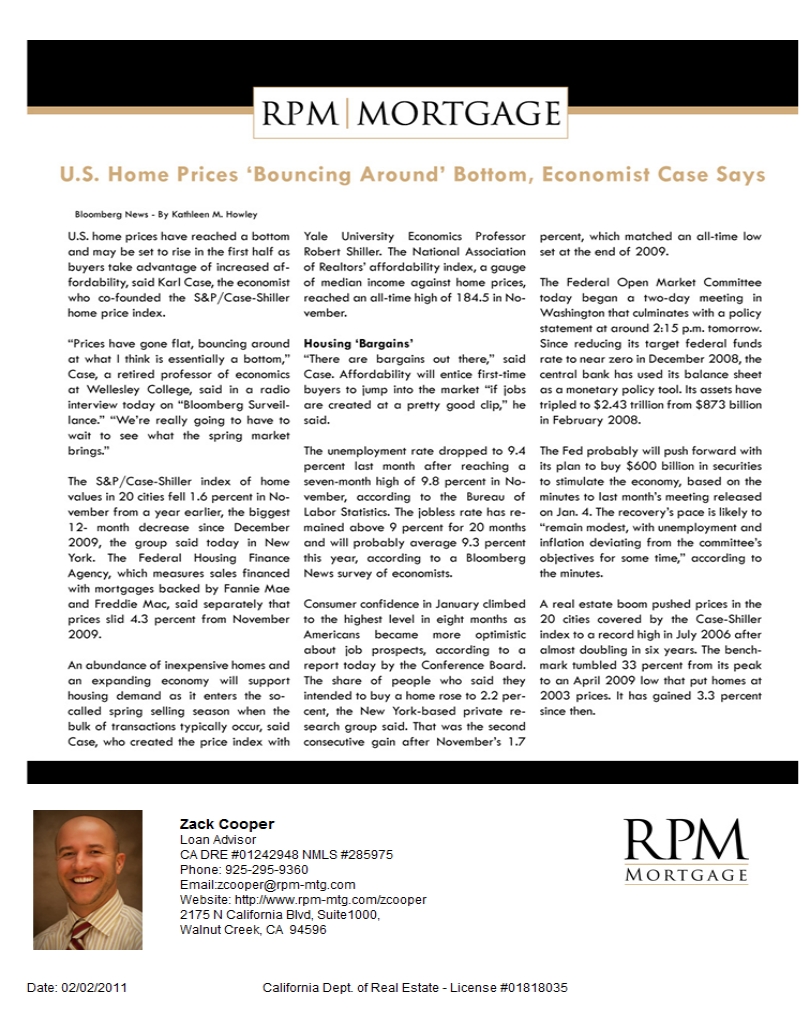
TEAM EMPOWERMENT MORTGAGE CHATTER: Feburary 2; Freddic Mac; MBA; Shadow Inventory; RPM Article: Bloomberg News (US Home Prices); RPM CO-Branding

 “Having a why – a powerful, compelling
reason – is the one thing no one can give you.” –    Stephen Pierce:  Internet marketer and author
 
 In the last quarter of 2010 Freddie Mac reported that 46% of homeowners who refinanced lowered their principal by putting in more money at closing, the highest cash-in percentage on record. Meanwhile, Freddie’s cash-out borrowers fell to 16% of all loans, the lowest percentage on record. Combine that with the MBA is projecting residential origination will drop below $1 trillion (2002-levels, and a 35% decrease from last year), expecting new home purchases to rise 30% & refinancing activity expected to fall 66%, and we have a different market. Keep on top of those business plans!
MBA Weekly Mortgage Applications Survey Market Composite Index increased 11.3%, Refinance Index increased 11.7 %, and the Purchase Index increased 9.5%. “Applications increased this week relative to the holiday week,” said Michael Fratantoni, MBA’s Vice President of Research and Economics. “Looking over the past two weeks, purchase applications are flat, and refinance applications are down about five percent.” The refinance share activity decreased to 69.3% and the ARM share increased to 5.5%. The average 30-year rate increased to 4.81% from 4.80% and 5-year rate increased to 4.13% from 4.12%.


The Federal Reserve Board on Tuesday announced that it does not expect to finalize three pending rulemakings under Reg. Z, which implements the Truth in Lending Act, prior to the transfer of authority for such rulemakings to the CFPB. RegZ
 

As the “flight to quality” concerning Egypt continued to ebb out of the market, yesterday fixed-income prices continued to worsen, pushing rates higher. 10-yr notes were worse by .5 (with the yield closing at 3.44%), and mortgage-backed security prices worsening by about .375. MBS sales also picked up a little, not a particularly good sign during a sell-off. Mortgage prices often trade as a spread to Treasury yields, and one trader reported that “spreads were about in the middle of their recent range, so not exactly enticing for money managers. Lower prices, however, helped and brought in some real money interest through the morning session; however, it was more than offset by modest supply and better selling.”
In terms of economic news, the ISM manufacturing number slowed in January, but still showed growth. The January reading was the strongest level since May 2004. On the flip side, Construction Spending fell 2.5% in December, and was 6.4% below its level in December 2009. This’s morning’s ADP number, with its dubious predictive power, was higher-than-expected. Currently the 10-yr yield is sitting around 3.40%, down from Tuesday’s close, and MBS prices are .125-.250 better.


 What Exactly Is Shadow Inventory?

 It is difficult to read an article about real estate today without the term “shadow inventory” being mentioned. But, what exactly is shadow inventory? It refers to the inventory of homes not yet for sale that will eventually come to market in the near future. Most definitions include properties already foreclosed on and owned by the banks (REOs), those houses in the foreclosure process and those homes where the homeowner is seriously delinquent on their mortgage payment (at least 90 days behind).
There are many questions about shadow inventory. Here are the most common misunderstandings addressed: 

I’ve heard about shadow inventory for years. Does it really exist?

Not only does it exist, it is being slowly released onto the market. The National Association of Realtors has reported that over 30% of all home sales over the last few months have been distressed properties.

Why include seriously delinquent homes in this number?


Seriously delinquent are counted because studies show that 98% of all those who fall 90 days behind never catch up and these properties eventually come to the market as distressed sales (short sales or foreclosures).
 

Do banks have a backlog of properties that they currently own?

Yes. In an article

in Housing Wire, RealtyTrac Senior Vice President Rick Sharga said:
“…major banks currently hold roughly 1 million REO, or homes repossessed through foreclosure, but only 30% have actually made it onto the market.”


Why are banks holding this inventory?

The article mentioned above answers this question this way:

Striking a proper balance on how to mange this shadow inventory of foreclosures is vital for the banks to show a healthy balance sheet while not dumping too many distressed properties onto the market, further dragging down home prices and values.


Isn’t most of this inventory sub-prime and exotic mortgages?

Not any longer. A study 


recently done by Morgan Stanley shows that:


26.3% of the loans are sub-prime
17.4% are Alt-A
56.2% are prime mortgages

Right now, prime mortgages make up the majority of loans in this shadow industry.

Isn’t most of this inventory confined to CA, AZ, NV and FL?

Not any more. The Morgan Stanley study showed:

…the shadow inventory is growing across all of the United States…” While hard-hit cities represent a more than fair share of shadow inventory, its distribution broadly encompasses all corners of the country,” said the analysts.


Bottom Line

Shadow inventory is real and will impact almost every part of the country. Make sure you ask a local real estate expert to find out how it may impact your market. 


 A FEW HEADLINES IN THE NEWS TODAY:

Can anything end this ‘Groundhog Day’ of a winter?   All this snow will affect commerce, the economy, and will most likely cause volatility in economic indicators.

that was less than the original report of 297,000. The median estimate called for a gain 140,000 gain in January. Friday’s BLS Non-Farm Payrolls report is forecast to show 140,000 jobs increase in January, with the jobless rate at 9.5%.
 

. The U.S. Treasury Department today said it would keep its long-term borrowing at steady levels and warned that the federal debt limit could be reached as soon as April 5. 

Treasuries Advance as Egyptian Concern Reemerges, Fueling Demand for Haven   , and are now down slightly. UST price support comes on concern political turmoil in Egypt may worsen, fueling demand for safe assets, as well as Fed buying of $1.5 billion to $2.5 billion of notes maturing between 2021 and 2027 today as part of QE2. The 10-year UST yield is at 3.45 this morning and has ranged between the 3.25% and 3.5% range this year. The US will sell $72 Billion UST’s at the quarterly refunding next week in the form of $32 billion in 3-year notes, $24 billion in 10-year notes and $16 billion in 30-year bonds.