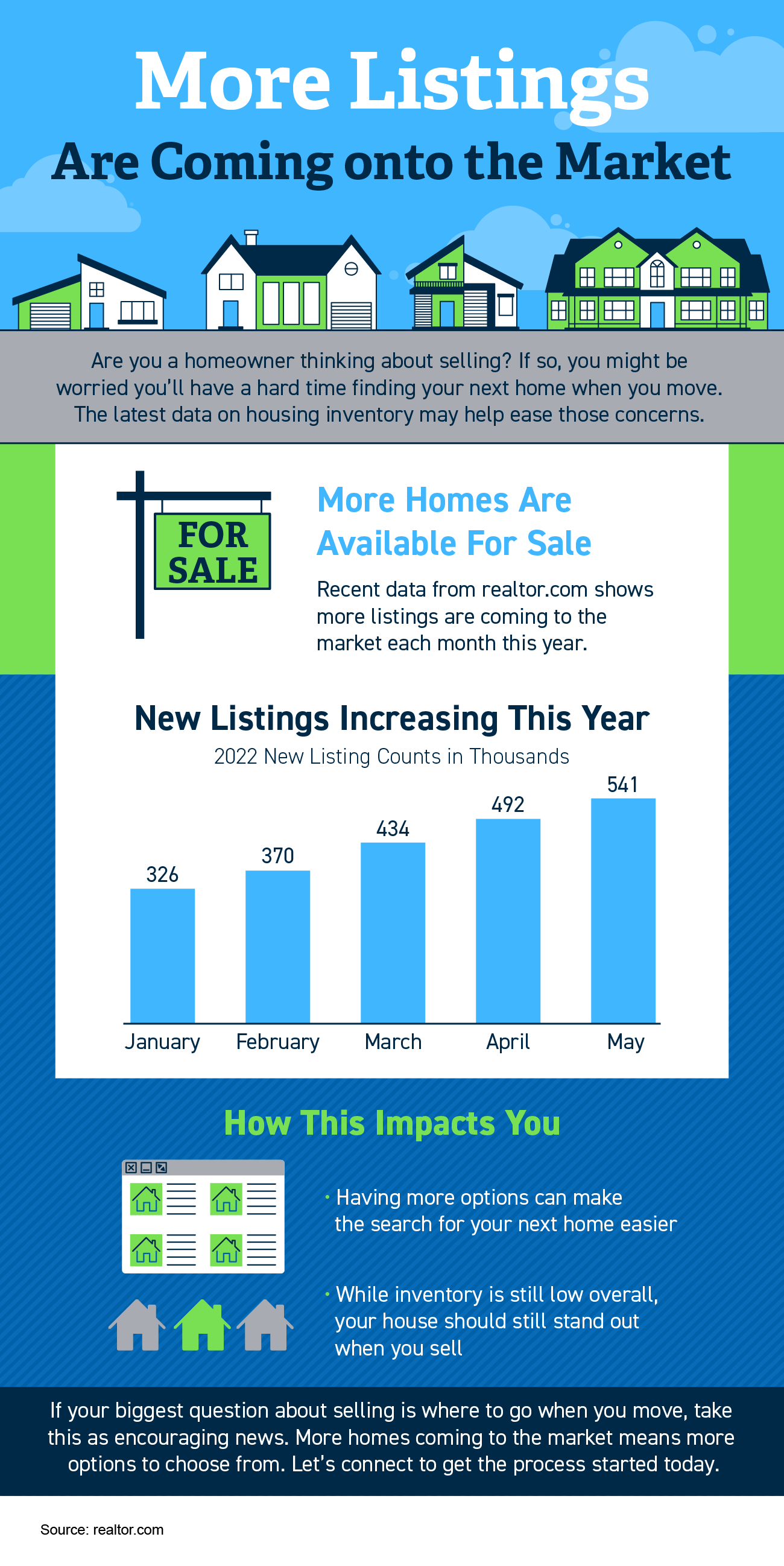
Worried you won’t be able to find your next home after you sell? You should know data from realtor.com shows more listings are coming onto the market each month this year.
Having additional options can make the search for your next home easier. But inventory is still low overall, which means your house should still stand out when you sell.
If your biggest question is where you’ll go if you sell, take this as encouraging news. Let’s connect to start the process today.
Looking up into the bright blue sky, a father and son gazed at the beautiful kite they had created together. The boy became very happy seeing his kite high in the air. The kite soared higher and higher, and the boy said, “Dad, it seems that the string is holding the kite back from flying higher. If we cut the string, the kite will be free and go even higher.””Dad, can we cut the string?”The father cut the string and the kite started to go a little higher. The boy beamed with happiness. But then, slowly, the kite started to drift downward and soon fell back to the ground. The boy was surprised and said, “I thought that cutting the string would cause the kite to fly higher, why did it fall down?”The father explained, “The string was not holding the kite from going higher. It was helping the kite to maintain its position in the sky. The string pulling on the kite keeps its nose pointing upward. When we cut the string and the wind slowed, we couldn’t pull the string to keep the kite pointed in the right direction. So, it could only return to the ground.”Summertime is a good time to remember that the things we think are holding us back are really giving us direction to continue toward our goals and what matters most.Enjoy the rest of your summer and keep your eyes pointed up!
If you’re a homeowner thinking about selling your house, you’re probably looking for the best time to make your move. That means you’re likely balancing a number of factors, like your changing needs, where you’ll go when you sell, and today’s mortgage rates in order to time it just right.
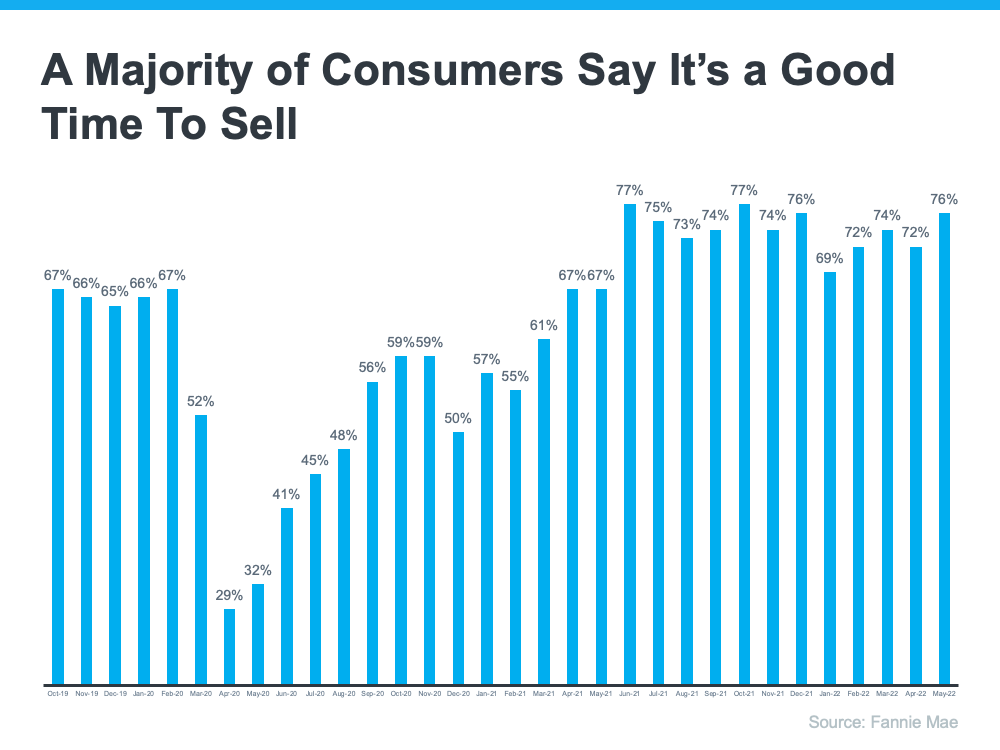
According to recent data, that sweet spot could already be here. The latest Home Purchase Sentiment Index (HPSI) by Fannie Mae finds that 76% of consumers believe now is a good time to sell.
The graph below shows the percentage of survey respondents who say it’s a good time to sell a house. The big dip in March and April of 2020 reflects how consumer sentiment dropped at the beginning of the pandemic as uncertainty about the health crisis grew. Since then, the percentage has grown consistently as more people feel confident it’s a good time to sell.
In fact, survey respondents think it’s an even better time to sell a house today than they did in 2019, which was a strong year for the housing market. The latest survey results indicate one of the strongest peaks in seller sentiment in nearly three years (see graph below):
What Makes Today a Good Time To Sell?
One reason so many people think it’s a good time to sell is because there are still more buyers in today’s market than there are homes for sale. That’s driving home prices up, making it a good time to sell your house.
And if you’re on the fence about whether or not to sell because you don’t know where you’ll go once you do, know that you might have more options today than in previous months. That’s because the number of homes coming onto the market has grown each month since the start of the year. When more homes come onto the market, it gives you more opportunities to find one that meets your changing needs.
Bottom Line
While the number of homes available for sale is growing and giving you more options for your move, inventory is still low overall. That could mean it’s a great time for you to sell. If you’re ready to address your changing needs and take advantage of today’s favorable conditions, let’s connect.
Even if you haven’t been following real estate news, you’ve likely heard about the current sellers’ market. That’s because there’s a lot of talk about how strong market conditions are for people who want to sell their houses. But if you’re thinking about listing your house, you probably want to know: what does being in a sellers’ market really mean?
What Is a Sellers’ Market?
The latest Existing Home Sales Report from the National Association of Realtors (NAR) shows housing supply is still very low. There’s a 2-month supply of homes at the current sales pace.
Historically, a 6-month supply is necessary for a normal or neutral market where there are enough homes available for active buyers. That puts today deep in sellers’ market territory (see graph below):
What Does This Mean for You When You Sell?
When the supply of houses for sale is as low as it is right now, it’s much harder for buyers to find homes to purchase. That creates increased competition among purchasers which can lead to more bidding wars. And if buyers know they may be entering a bidding war, they’re going to do their best to submit a very attractive offer upfront. This could drive the final price of your house up.
And because mortgage rates and home prices are climbing, serious buyers are motivated to make their purchase soon, before those two things rise further. That means, if you put your house on the market while supply is still low, it will likely get a lot of attention from competitive buyers.
Bottom Line
The current real estate market has incredible opportunities for homeowners looking to make a move. Listing your house this season means you’ll be in front of serious buyers who are ready to buy. Let’s connect so you can jumpstart the selling process.
Cropped shot of a young confident woman stretching legs after running at the park, against sunlight at sunset.
With a limited number of homes for sale today and so many buyers looking to make a purchase before mortgage rates rise further, bidding wars are common. According to the latest report from the National Association of Realtors (NAR), nationwide, homes are getting an average of 4.8 offers per sale. Here’s a look at how that breaks down state-by-state (see map below):
The same report from NAR shows the average buyer made two offers before getting their third offer accepted. In this type of competitive housing market, it’s important to know what levers you can pull to help you beat the competition. While a real estate professional is your ultimate guide to presenting a strong offer, here are a few things you could consider.
Offering over Asking Price
When you think of sweetening the deal for sellers, the first thought you likely have is around the price of the home. In today’s housing market, it’s true more homes are selling for over asking price because there are more buyers than there are homes for sale. You just want to make sure your offer is still within your budget and realistic for the market value in your area – that’s where a local real estate professional can help you through the process. Bankratesays:
“Simply put, being willing to pay more money than other buyers is one of the best ways to get your offer accepted. You may not have to increase it by a lot — it’ll depend on the area and other factors — so look to your real estate agent for guidance.”
Putting Down a Bigger Earnest Money Deposit
You could also consider putting down a larger deposit up front. An earnest money deposit is a check you write to go along with your offer. If your offer is accepted, this deposit is credited toward your home purchase. NerdWalletexplains how it works:
“A typical earnest money deposit is 1% to 2% of the home’s purchase price, but the amount varies by location. A higher earnest money deposit may catch a seller’s attention in a hot housing market.”
That’s because it shows the seller you’re seriously interested in their house and have already set aside money that you’re ready to put toward the purchase. Talk to a professional to see if this is something you can do in your area.
Making a Higher Down Payment
Another option is increasing how much of a down payment you’re going to make. The benefit of a higher down payment is you won’t have to finance as much. This helps the seller feel like there’s less risk of the deal or the financing falling through. And if other buyers put less down, it could be what helps your offer stand out from the crowd.
Non-Financial Options To Make a Strong Offer
Realtor.compoints out that while increasing these financial portions of the deal can help, they’re not your only options:
“. . . Price is not the only factor sellers weigh when they look at offers. The buyer’s terms and contingencies are also taken into account, as well as pre-approval letters, appraisal requirements, and the closing time the buyer is asking for.”
When it’s time to make an offer, partner with a trusted professional. They have insight into what sellers are looking for in your local market and can give you expert advice on what levers you may or may not want to pull when it’s time to write an offer.
From a non-financial perspective, this can include things like flexible move-in dates or minimal contingencies (conditions you set that the seller must meet for the purchase to be finalized). For example, you could make an offer that’s not contingent on the sale of your current home. Just remember, there are certain contingencies you don’t want to forego, like your home inspection. Ultimately, the options you have can vary state-to-state, so it’s best to lean on an expert real estate professional for guidance.
Bottom Line
In today’s hot housing market, you need a partner who can serve as your guide, especially when it comes to making a strong offer. Let’s connect so you have a trusted resource and coach on how to make the strongest offer possible for your specific situation.
If you’re planning to sell your home this season, rising prices are great news for you. But it’s important to understand why prices are rising to begin with. One major factor is supply and demand.
In any industry, when there are more buyers for an item than there are of that item available, prices naturally rise. In those situations, buyers are willing to pay more to get the product or service they’re looking for when options are scarce. And that’s exactly what’s happening in the current real estate market.
Selma Hepp, Executive, Research & Insights and Deputy Chief Economist at CoreLogic, puts it like this:
“With so few homes, buyers are once again left with fierce competition that’s driving the share of homes that sold over the listing price up to 66% . . . With the continued imbalance between supply and demand, home prices are likely to have another year of strong gains and are expected to average about 10% growth for the year.”
Because it will take some time for housing supply to increase, experts believe prices will continue rising. The latest Home Price Expectations Survey forecasts what will happen with home prices over the next 5 years. As the graph below shows, while the rate of appreciation will moderate over the next few years, prices will continue rising through 2026:
What This Means When You Sell Your House
If you’re a homeowner, the projection for continued price appreciation this year opens up an opportunity to move. That’s because it may give your equity a major boost. Equity is the difference between what you owe on your house and its market value. The amount of equity you have increases as you make your monthly payments and as rising home prices drive up the market value for your home.
Growing equity is a powerful tool for homeowners. When you sell your house, the equity you’ve built comes back to you in the sale. That money could be enough to cover some (if not all) of your down payment on your next home.
Of course, if you want to know how much equity you have in your current house, it’s crucial to work with a real estate professional. They follow current market trends and can help you understand your home’s value when you’re ready to sell.
What This Means for Your Next Purchase
But today’s rising home values aren’t just good news if you’re ready to sell. Because price appreciation is forecast to continue in the years ahead, you can rest assured your next home will be an investment that should grow in value with time. That’s one of several reasons why real estate has been rated the best investment in a recent Gallup poll.
Bottom Line
If you’re weighing whether or not you should sell your house this season, know rising home values may be opening up an opportunity to use equity to fuel your move. Let’s connect so you can find out how much your home is worth and to learn more about all the benefits you have in today’s market.
American traditional center hall colonial revival brick home with dormers.
One of the biggest concerns for a homeowner looking to sell is the time they’ll have to put in before listing their house. If that’s the case for you, you should know – your home might be closer to list-ready than you think in today’s housing market. A survey of recent sellers from realtor.com finds that many were able to get their house ready in less than a month. It says:
“With many homeowners expecting a quick sale, and in many cases a lack of contingencies, the preparation process took less than a month for over 50% of home sellers this past year, with 20% completing it in less than two weeks.”
Those sellers expecting to sell quickly are following recent buyer trends. With mortgage rates and home prices rising, buyers in today’s market are serious about finding a home quickly. But with the limited number of homes for sale, there are very few options for those buyers to choose from. That means many may be willing to take on projects after they purchase.
Because of this, you may be able to focus on less time-consuming tasks before putting your house on the market. According to the survey mentioned above, some of the top things recent sellers completed before listing over the past year include landscaping, making minor cosmetic updates, and touching-up paint (see image below):
A Real Estate Advisor Will Help Streamline the Process and Keep You Focused
Of course, each situation is different, and knowing what repairs or updates your house needs to stand out in your local area is critical. That’s where a trusted real estate professional comes in. In a recent article, NextAdvisor explains:
“. . . Real estate can be hyper-local, and demand can vary from one neighborhood to the next. It’s a good idea to work with a local real estate professional to determine an ideal listing price and if any improvements or repairs need to be completed before putting your home on the market.”
Your trusted real estate advisor knows the ins and outs of the market in your specific area. They’ll help you identify the places where you should and shouldn’t spend your time and money – and that can enable you to list quickly.
Bottom Line
If you’re ready to take advantage of the incredible conditions for sellers in today’s real estate market but are worried about the time it’ll take to get your home ready, you might be closer than you think. Let’s connect so you can see what you need to do before listing your house today.
Wood House Model with Question marks, House concept
If you’re following the news, all of the headlines about conditions in the current housing market may leave you with more questions than answers. Is the boom over? Is the market crashing or correcting? Here’s what you need to know.
The housing market is moderating compared to the last two years, but what everyone needs to remember is that the past two years were record-breaking in nearly every way. Record-low mortgage rates and millennials reaching peak homebuying years led to an influx of buyer demand. At the same time, there weren’t enough homes available to purchase thanks to many years of underbuilding and sellers who held off on listing their homes due to the health crisis.
This combination led to record-high demand and record-low supply, and that wasn’t going to be sustainable for the long term. The latest data shows early signs of a shift back to the market pace seen in the years leading up to the pandemic – not a crash nor a correction. As realtor.comsays:
“The housing market is at a turning point. . . . We’re starting to see signs of a new direction, . . .”
Home Showings Then and Now
The ShowingTime Showing Index tracks the traffic of home showings according to agents and brokers. It’s a good indication of buyer demand. Here’s a look at that data going back to 2019 (see graph below):
The 2019 numbers give a good baseline of pre-pandemic demand (shown in gray). As the graph indicates, home showings skyrocketed during the pandemic (shown in blue). And while current buyer demand has begun to moderate slightly based on the latest data (shown in green), showings are still above 2019 levels.
And since 2019 was such a strong year for the housing market, this helps show that the marketisn’t crashing – it’s just at a turning point that’s moving back toward more pre-pandemic levels.
Existing Home Sales Then and Now
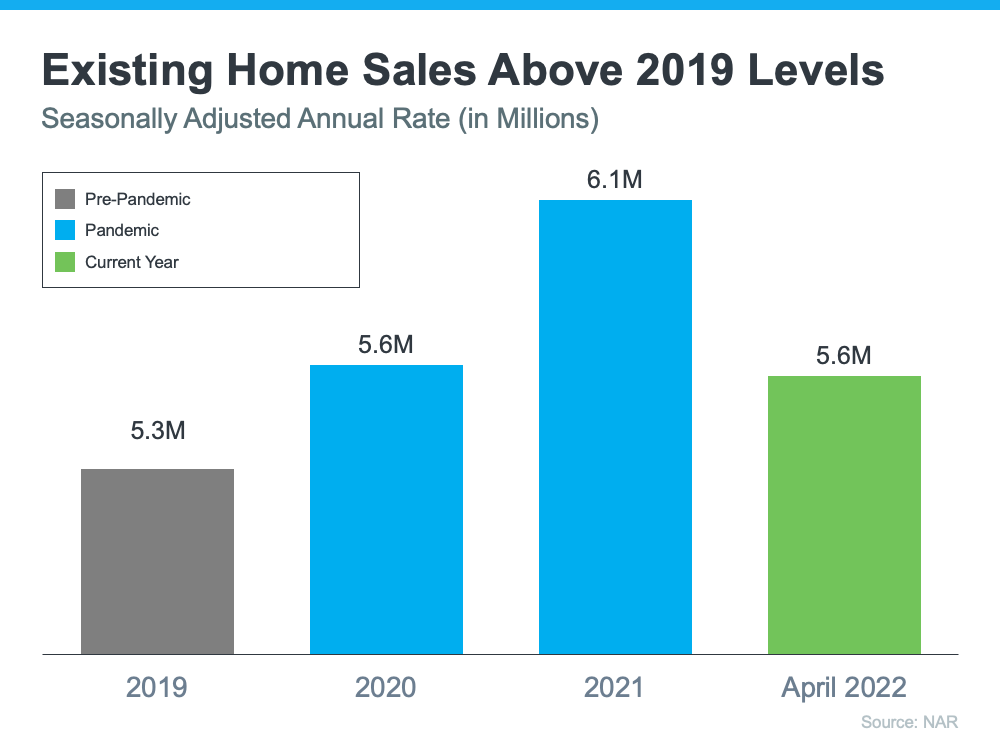
Headlines are also talking about how existing home sales are declining, but perspective matters. Here’s a look at existing home sales going all the way back to 2019 using data from the National Association of Realtors (NAR) (see graph below):
Again, a similar story emerges. The pandemic numbers (shown in blue) beat the more typical year of 2019 home sales (shown in gray). And according to the latest projections for 2022 (shown in green), the market is on pace to close this year with more home sales than 2019 as well.
It’s important to compare today not to the abnormal pandemic years, but to the most recent normal year to show the current housing market is still strong. First Americansums it up like this:
“. . . today’s housing market looks a lot like the 2019 housing market, which was the strongest housing market in a decade at the time.”
Bottom Line
If recent headlines are generating any concerns, look at a more typical year for perspective. The current market is not a crash or correction. It’s just a turning point toward more typical, pre-pandemic levels. Let’s connect if you have any questions about our local market and what it means for you when you buy or sell this year.
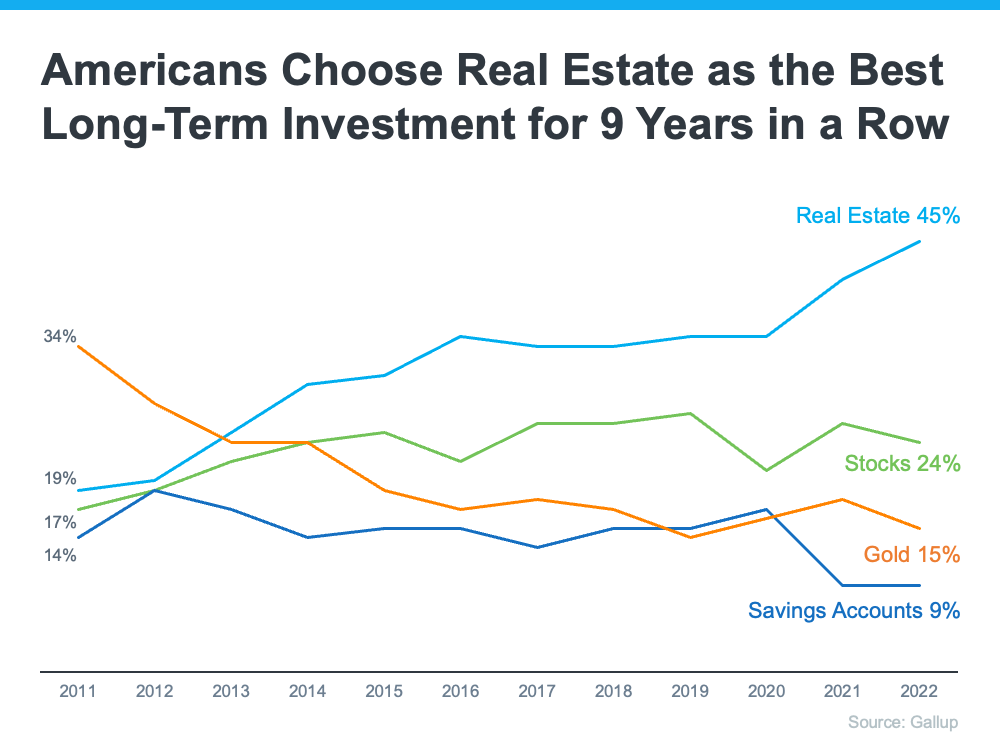
Americans’ opinion on the value of real estate as an investment is climbing. That’s according to an annual survey from Gallup. Not only is real estate viewed as the best investment for the ninth year in a row, but more Americans selected it than ever before.
The graph below shows the results of the survey since Gallup began asking the question in 2011. As the trend lines indicate, real estate has been gaining ground as the clear favorite for almost a decade now:
If you’re thinking about purchasing a home, let this poll reassure you. Even when inflation is high like today, Americans recognize owning a home is a powerful financial decision.
How an Investment in Real Estate Can Benefit You During High Inflation
Because inflation reached its highest level in 40 years recently, it’s more important than ever to understand the financial benefits of homeownership. Rising inflation means prices are increasing across the board, and that includes goods, services, housing costs, and more. When you purchase your home, you lock in your monthly housing payments, effectively shielding yourself from increases on one of your biggest budgetary items each month.
If you’re a renter, you don’t have that same benefit, and you aren’t protected from these increases, especially as rents rise. As Danielle Hale, Chief Economist at realtor.com, notes:
“Rising rents, which continue to climb at double-digit pace . . . and the prospect of locking in a monthly housing cost in a market with widespread inflation are motivating today’s first-time homebuyers.”
When Inflation Has Risen in the Past, Home Prices Have Too
Your house is also an asset that typically increases in value over time, even during inflation. That‘s because as prices rise, the value of your home does too. Mark Cussen, Financial Writer for Investopedia, puts it like this:
“There are many advantages to investing in real estate. . . . It often acts as a good inflation hedge since there will always be a demand for homes, regardless of the economic climate, and because as inflation rises, so do property values. . . .”
And since rising home values help increase your equity, and by extension your net worth, homeownership is historically a good hedge against inflation.
Bottom Line
Buying a home is a powerful decision. It’s no wonder why so many people view it as the best long-term investment, even when inflation is high. When you buy, you help shield yourself from increases in your housing costs and you own an asset that typically gains value with time. If you want to better understand how buying a home could be a great investment for you, let’s connect today.
Many people are wondering: will home prices fall this year? Whether you’re a potential homebuyer, seller, or both, the answer to this question matters for you. Let’s break down what’s happening with home prices, where experts say they’re headed, and how this impacts your homeownership goals.
“Price appreciation averaged 15% for the full year of 2021, up from the 2020 full year average of 6%.”
So why are prices climbing so much? It’s because there are more buyers than there are homes for sale. This imbalance is expected to maintain that upward pressure on home prices because homes for sale are a hot commodity in today’s low-inventory housing market.
Where Do Experts Say Prices Will Go from Here?
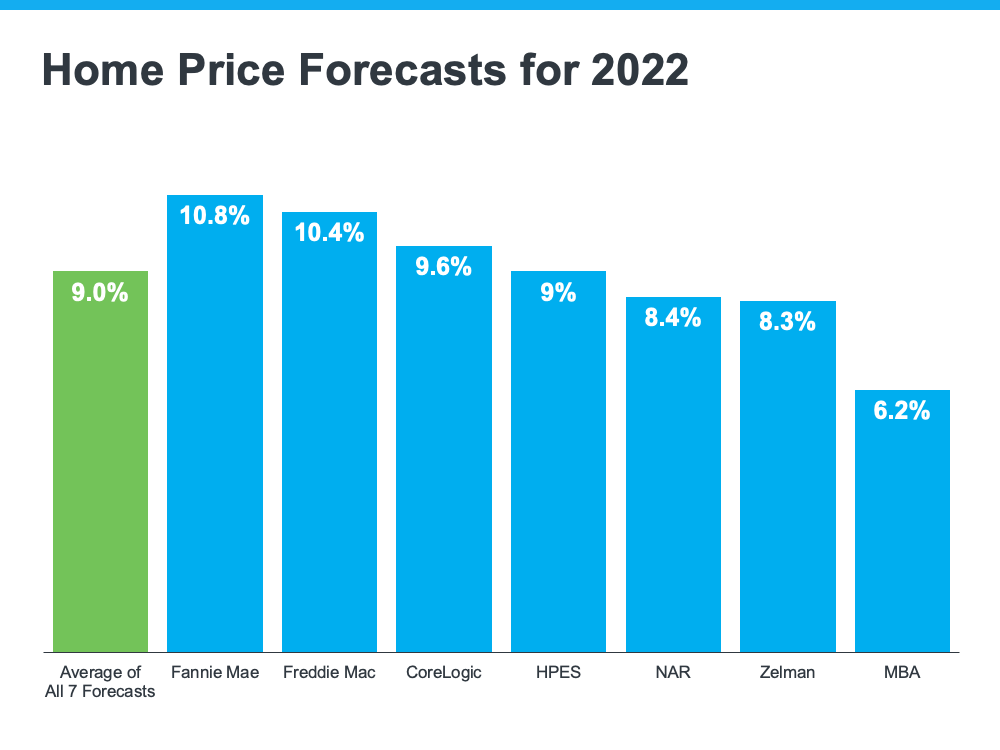
Experts say the housing market isn’t set up for a price decline due to that ongoing imbalance between supply and demand. In the latest home price forecasts for 2022, they’re calling for ongoing appreciation throughout the year (see graph below):
While the experts are forecasting more moderate price appreciation, the 2022 projections show price gains will remain strong throughout this year. First Americanexplains it like this:
“While house price growth is expected to moderate from the rapid pace of 2021, strong home buyer demand against a backdrop of historically tight inventory of homes for sale will likely keep appreciation positive in the coming year.”
What Does That Mean for You?
The biggest takeaway is that none of the experts are projecting depreciation. If you’re a homeowner thinking about selling, the higher price appreciation over the last two years has been great for your home’s value, but it’s also something you should factor in when planning your next steps. If you’ll also be buying a home after selling your current house, you shouldn’t wait for prices to fall. Waiting will only cost you more in the long run because climbing mortgage rates and rising home prices will have an impact on your next home purchase. Freddie Macsays:
“If you’re thinking about waiting until next year and that maybe rates are higher, but you’ll get a deal on prices – well that’s risky. It may be more advantageous to purchase this year relative to waiting until 2023 at this time.”
Bottom Line
If you’re thinking of selling to move up, you shouldn’t wait for prices to fall. Experts say prices will continue to appreciate this year. That means, if you’re ready, buying your next home before prices climb further may make the most financial sense. Let’s connect to begin the process of selling your current home and looking for your next one before prices rise higher.












 Coops Coffee